

The 23-Minute Penalty: How Multitasking Quietly Destroys Focus and Productivity!
Think multitasking makes you more productive? Cognitive science suggests the opposite. Every notification, message, or quick distraction leaves behind attention residue that can take up to 23 minutes to overcome. Discover how constant task switching damages focus, learning, memory, and deep work, and learn practical strategies to reclaim your attention in a distraction-driven world.
ACCESSIBLE LEARNING
Shiv Singh Rajput
6/7/20267 min read
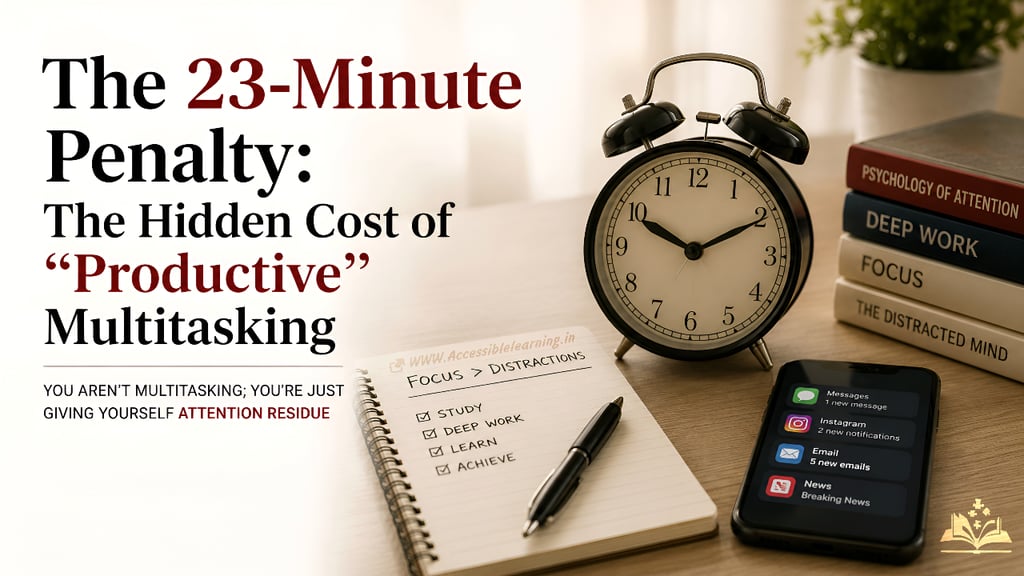
You Aren't Multitasking. You're Leaving Behind Attention Residue.
A student sits down to study for an important exam. Ten minutes later, a notification appears.
A quick glance at a message becomes a short reply. Then comes a social media check. Maybe an email. Perhaps a quick search for something unrelated.
Within moments, the study session is interrupted. Most people assume they can simply return to work and continue where they left off. The reality is far different.
Cognitive science suggests that every interruption leaves behind what researchers call attention residue, a lingering mental attachment to the previous task. Even after returning to work, part of the brain remains occupied by what was just abandoned.
The result is a hidden productivity tax that few people recognize.
Research has repeatedly shown that after an interruption, it can take an average of approximately 23 minutes to fully regain focus. In a world built around notifications, alerts, messages, and constant connectivity, this "23-minute penalty" may be one of the biggest obstacles to learning, productivity, and deep thinking.
The modern productivity culture celebrates multitasking. Science tells a different story.
What Is Attention Residue?
Attention residue occurs when a person switches from one task to another before completing the first task. Part of the mind remains focused on the previous activity, even while attempting to engage in the new one.
Imagine reading a complex chapter for an exam. Suddenly, a message notification appears. You respond and then return to studying. Although your eyes are back on the textbook, part of your brain is still processing the conversation.
Questions linger:
Did they reply?
Should I send another message?
What did they mean?
Did I forget something important?
This leftover cognitive activity creates mental clutter. The brain is no longer giving 100% attention to the current task.
Researchers from the University of Minnesota, including organizational psychologist Sophie Leroy, introduced the concept of attention residue to explain why task switching reduces performance. Their findings demonstrated that people perform worse on a new task when their attention remains partially attached to the previous one.
The issue isn't simply distraction. The issue is that the brain never fully leaves the previous task behind.
The Myth of Multitasking
For decades, multitasking has been viewed as a valuable skill. Job descriptions praise it. Students brag about it.
Professionals wear it like a badge of honor. Yet neuroscience reveals a surprising truth:
The human brain does not truly multitask.
Instead, it rapidly switches between tasks. This distinction matters.
Every switch forces the brain to:
Pause one activity.
Store relevant information.
Load information for a different task.
Reorient attention.
Resume work.
This process happens so quickly that it feels simultaneous. In reality, it is constant task switching. Each switch consumes mental energy and introduces errors. The more frequently a person switches, the greater the cognitive cost becomes.
Understanding the 23-Minute Penalty
One of the most cited findings in productivity research comes from studies examining workplace interruptions.
Researchers observed that after an interruption, workers often required approximately 23 minutes and 15 seconds to return fully to their original task. This does not mean every interruption causes exactly 23 minutes of lost work. Instead, it highlights how interruptions create a recovery period.
The brain must:
Remember where it left off.
Reconstruct context.
Rebuild concentration.
Suppress unrelated thoughts.
Even short interruptions can create surprisingly long recovery times. Consider a student studying for three hours.
If they check their phone six times and each interruption creates a lengthy refocusing process, a significant portion of that study session may be spent recovering focus rather than learning.
The lost time often goes unnoticed because the individual believes they are continuously working.

Why Notifications Are So Powerful
Notifications are engineered to capture attention. Every alert triggers a psychological response.
Humans evolved to notice novelty and potential threats. A vibration, sound, badge icon, or pop-up instantly signals that something new demands attention.
The brain responds automatically. This reaction is amplified by:
Social Curiosity
People naturally want to know who contacted them and why.
Fear of Missing Out (FOMO)
Many worry that they may miss important information, opportunities, or conversations.
Variable Rewards
Similar to slot machines, notifications deliver unpredictable outcomes.
Sometimes the notification is important.
Sometimes it isn't.
This uncertainty makes checking behavior highly addictive. As a result, even a silent phone sitting nearby can reduce concentration. The possibility of interruption is often enough to fragment attention.
The Learning Crisis Hidden in Plain Sight
Students today have access to more information than any previous generation.
Yet many struggle with sustained focus.
The problem is not necessarily intelligence.
The problem is attention fragmentation.
Learning requires:
Working memory
Deep processing
Repetition
Reflection
Concentration
Frequent interruptions disrupt all five. When students repeatedly switch between studying and digital distractions, they prevent information from moving efficiently into long-term memory.
Reading becomes shallower. Understanding becomes weaker. Retention declines. Many students respond by studying longer hours.
Unfortunately, more time does not always compensate for reduced focus quality. A focused hour often produces more learning than three distracted hours.
How Multitasking Damages Deep Work
Deep work refers to periods of intense concentration devoted to cognitively demanding activities.
Examples include:
Studying complex subjects
Writing
Programming
Research
Problem-solving
Strategic planning
These activities require uninterrupted mental effort. Deep work creates breakthroughs because the brain has enough time to build connections, recognize patterns, and generate insights.
Multitasking destroys this process. Every interruption resets momentum. Instead of progressing deeper into a problem, the brain repeatedly returns to the surface.
This explains why many people feel busy all day yet accomplish surprisingly little meaningful work. Activity is mistaken for productivity.
The Hidden Emotional Cost
The consequences extend beyond productivity. Constant task switching increases mental fatigue.
People often experience:
Increased stress
Frustration
Anxiety
Decision fatigue
Reduced satisfaction
When attention is fragmented, the brain remains in a state of partial engagement with multiple concerns. This creates a persistent feeling of mental overload. Many people interpret this sensation as being overwhelmed by work. In reality, they may be overwhelmed by interruptions.
Signs You Are Suffering From Attention Residue
You may be experiencing attention residue if you frequently:
Re-read the same paragraph multiple times
Forget what you were doing after interruptions
Check your phone without a clear reason
Feel busy but make little progress
Struggle to enter a flow state
Lose concentration after notifications
Need long periods to "get back into" work
These symptoms are increasingly common in digital environments.

How to Protect Your Focus
The good news is that attention residue can be reduced.
Turn Off Non-Essential Notifications
Most notifications are not urgent.
Removing unnecessary alerts immediately reduces interruptions.
Use Focus Blocks
Schedule uninterrupted work periods of 45 to 90 minutes.
Treat these sessions as appointments with your future self.
Keep the Phone Out of Reach
Physical distance reduces temptation.
Research consistently shows that simply having a smartphone nearby can consume mental resources.
Batch Communication
Instead of checking messages constantly, designate specific times to respond.
Finish Before Switching
Whenever possible, complete a task before beginning another.
This reduces attention residue and preserves mental clarity.
Create a Deep Work Environment
Choose a workspace that minimizes visual and digital distractions.
The fewer interruptions available, the easier it becomes to maintain concentration.
Why Focus Is Becoming a Competitive Advantage
In an age of endless notifications, attention is becoming one of the world's most valuable resources.
Information is abundant. Focus is scarce.
The ability to sustain concentration for extended periods now provides a significant advantage in education, careers, business, and creative work.
While others continuously divide their attention, focused individuals produce higher-quality results, learn faster, and make better decisions.
The gap between distracted and focused people is widening. Those who master attention gain an edge that technology cannot easily replace.
The Real Cost of "Productive" Multitasking
The biggest danger of multitasking is that it feels productive.
Messages are answered. Tabs are opened. Tasks appear to move forward.
Yet beneath the surface, cognitive performance steadily declines.
Every interruption leaves behind attention residue.
Every task switch carries a mental cost. Every notification risks triggering the 23-minute penalty.
The modern world encourages constant connectivity, but the brain was not designed for perpetual interruption.
Productivity is not about doing more things at once. It is about giving full attention to the right thing at the right time.
The next time a notification appears during a study session or deep work period, remember this:
The interruption itself may last only a few seconds.
The hidden cost could last nearly half an hour.


FAQ's
Q: What is the 23-minute penalty in productivity?
The 23-minute penalty refers to research showing that after an interruption, it can take an average of about 23 minutes and 15 seconds for a person to fully regain focus and return to their original level of concentration. The interruption itself may be brief, but the recovery process is often much longer.
Q: What is attention residue?
Attention residue is the mental carryover that occurs when you switch from one task to another. Even after moving to a new activity, part of your attention remains stuck on the previous task, making it harder to concentrate and perform effectively.
Q: Is multitasking actually a myth?
Yes, for most complex tasks. Cognitive science suggests that the brain does not truly multitask. Instead, it rapidly switches between tasks. This constant task switching reduces efficiency, increases errors, and consumes mental energy.
Q: Why do notifications hurt productivity?
Notifications interrupt focus and trigger attention shifts. Even a quick glance at a message can create attention residue, forcing the brain to spend time rebuilding concentration before returning to productive work.
Q: How does multitasking affect students and learning?
Multitasking during study sessions can reduce comprehension, weaken memory retention, and increase study time. Frequent interruptions prevent information from being processed deeply, making learning less effective and more exhausting.
Q: What happens in the brain during task switching?
When switching tasks, the brain must pause one activity, store relevant information, activate a different mental framework, and then rebuild focus. This process creates cognitive friction and can significantly reduce performance over time.
Q: Can listening to music while studying be considered multitasking?
It depends on the type of music and the task. Instrumental background music may have minimal impact for some people, but lyrics, frequent song changes, or active engagement with music can divide attention and reduce concentration on demanding cognitive work.
Q: How can I reduce attention residue while working or studying?
You can reduce attention residue by:
Turning off non-essential notifications
Using focus sessions of 45–90 minutes
Keeping your phone out of reach
Completing tasks before switching
Scheduling specific times for emails and messages
Creating a distraction-free workspace
Q: What is deep work, and why is it important?
Deep work is a state of uninterrupted concentration on cognitively demanding tasks. It helps people learn faster, solve complex problems, produce higher-quality work, and achieve greater productivity compared to fragmented work sessions.
Q: How many times can interruptions affect productivity in a day?
Even a handful of interruptions can have a significant impact. If each interruption triggers a lengthy refocusing period, multiple distractions throughout the day can consume hours of productive time without the person realizing it.
Q: Are smartphones the biggest cause of attention residue?
Smartphones are one of the most common sources of attention residue because they combine messaging, social media, email, news, and entertainment into a single device that constantly competes for attention through notifications and alerts.
Q: Why is focus becoming a valuable skill in the digital age?
As technology creates more distractions, the ability to maintain sustained attention has become increasingly rare. People who can focus deeply are often able to learn faster, make better decisions, and produce more meaningful work than those who constantly switch between tasks.
Subscribe to Frontier Intelligence
All © Copyright reserved by Accessible-Learning Hub
| Terms & Conditions
Accessible Learning Hub — Actionable clarity for high-agency minds.
Weekly breakdowns on AI breakthroughs, capital flow, and human performance systems. Zero fluff.