

The 2026 Lunar Gold Rush: How Private Tech Empires Are Claiming Extraterrestrial Resources
Explore the 2026 lunar gold rush as private tech companies compete for Moon resources, space infrastructure, and extraterrestrial wealth amid evolving space law and geopolitics.
HISTORY & CIVILIZATIONS
Sachin K Chaurasiya | Kim Shin
7/25/20268 min read
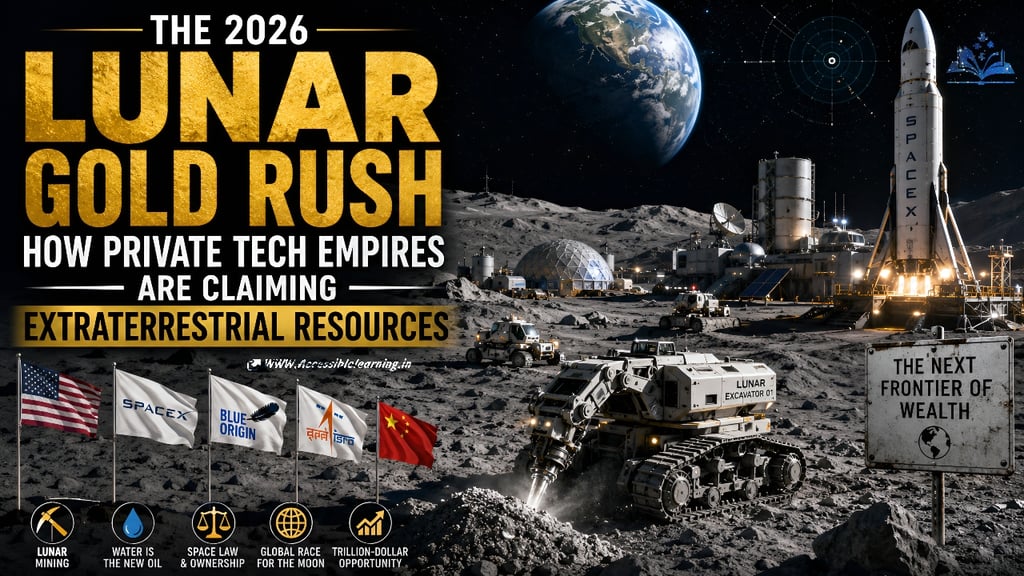
No country or company legally owns the Moon. However, several countries now recognize private ownership of resources extracted from space, creating a new economic race unlike anything in history.
The real competition in 2026 is not about planting flags. It is about controlling supply chains before large-scale extraction even begins.
Governments are funding exploration.
Private companies are building transportation.
Investors are buying infrastructure.
Lawyers are rewriting ownership models.
The first trillion-dollar space industry will likely be created before the first trillion dollars of resources are ever mined.
Why the "Lunar Gold Rush" Isn't Actually About Gold
Popular headlines imply companies are flying to the Moon to mine precious metals. That is largely incorrect.
The most valuable lunar resources are:
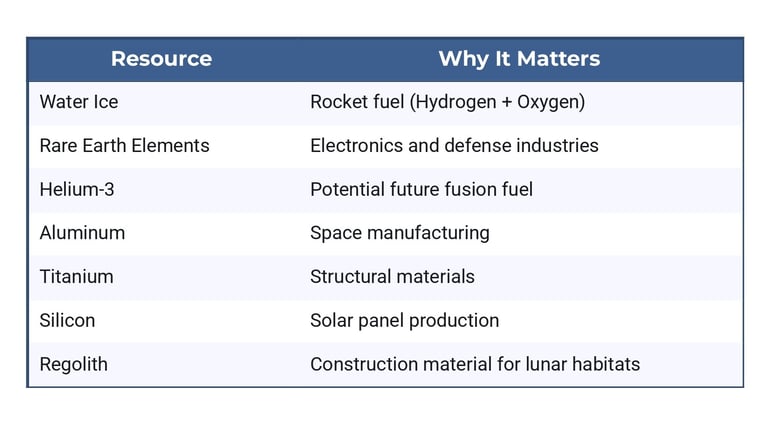
Ironically, transporting gold back to Earth would currently cost far more than its market value. Water is potentially the Moon's most valuable export because it enables spacecraft to refuel without returning to Earth.
That changes the economics of every future Mars mission.
Why 2026 Marks a Turning Point
Several independent developments have converged. Instead of a single "Moon race," the world is witnessing overlapping commercial races.
These include:
Heavy-lift reusable rockets
Lunar cargo systems
Autonomous mining robots
AI-assisted prospecting
Space-based manufacturing
Commercial lunar communications
Private investment exceeding government growth rates
The result resembles the early railroad era more than the Apollo program. Infrastructure comes first. Extraction follows.
The Infrastructure Race Is More Valuable Than the Mining Race
History offers an important lesson. During the California Gold Rush, many of the wealthiest fortunes were built by companies selling the following:
Picks
Shovels
Railroads
Banking
Transportation
Insurance
Exactly the same pattern is emerging in space.
Today's largest opportunities include the following:
Launch services
Orbital logistics
Navigation networks
Lunar communications
Autonomous robotics
Power generation
Landing systems
Orbital fuel storage
Companies controlling these layers may profit regardless of which miner eventually succeeds.

The Real Prize Is Water
When economists model lunar resources, water consistently ranks first. Why? Because every kilogram launched from Earth costs enormous amounts of energy and money.
Water can be separated into the following:
Hydrogen
Oxygen
Those become rocket fuel. Instead of launching fuel from Earth, spacecraft could refuel in orbit or on the Moon. That creates an entirely new logistics network. Some analysts describe lunar water as the "oil of the space economy." Unlike oil, however, its greatest value comes from reducing transportation costs rather than powering terrestrial industries.
AI Is Quietly Becoming the Most Valuable Mining Tool
Human miners are unlikely to dig the first lunar mines. Machines will. Modern lunar mining concepts rely heavily on the following:
Autonomous navigation
Computer vision
Geological AI
Digital twins
Predictive maintenance
Swarm robotics
Edge computing
Satellite mapping
A lunar mining operation may employ only a handful of humans supervising thousands of autonomous systems from Earth. The productivity model resembles automated ports more than traditional mining camps.
The Geopolitics of Lunar Resources
The competition is no longer limited to two superpowers. Multiple nations are investing in long-term lunar capability.
These include:
United States
China
India
Japan
European partners
United Arab Emirates
Each approaches the Moon differently.
Some focus on science.
Others prioritize strategic infrastructure.
Some seek commercial leadership.
Others view lunar capability as national security.
The Moon is becoming part of global industrial policy.
The Quiet Legal Revolution
The most misunderstood issue is ownership. The Outer Space Treaty prohibits countries from claiming sovereignty over the Moon. However, it does not explicitly prohibit ownership of extracted resources.
Several nations have enacted domestic laws allowing companies to own resources they extract from celestial bodies.
This distinction resembles international fishing.
Nobody owns the ocean.
Companies can own the fish they catch.
That interpretation remains debated internationally, creating ongoing legal uncertainty.

Can Companies Really Own Lunar Resources?
The answer depends on jurisdiction. Several countries recognize ownership of extracted materials. Others argue such laws stretch existing international agreements.
Future disputes may involve:
Mining zones
Resource rights
Operational safety areas
Orbital traffic
Environmental preservation
Scientific heritage sites
Many experts expect international legal frameworks to evolve as commercial activity expands.
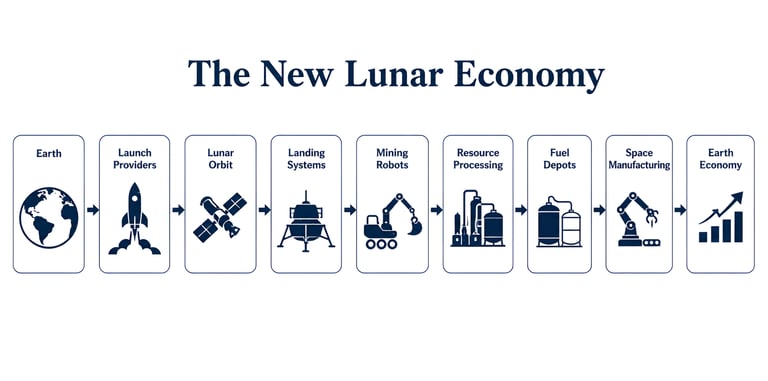
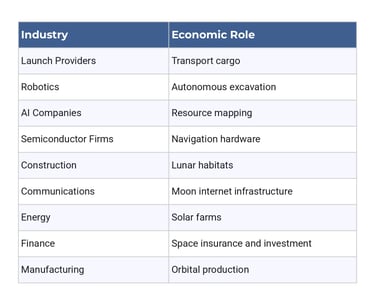
The Economic Chain Is Bigger Than Mining
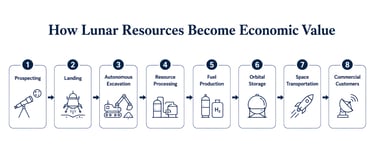
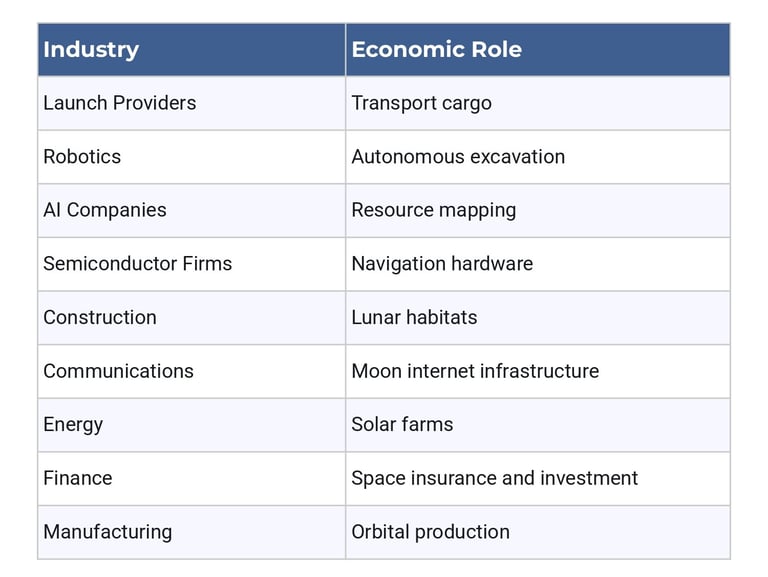
Mining represents only one layer. The broader lunar economy includes:
Why Asteroid Mining Still Matters
Asteroids contain extraordinary concentrations of metals. Some metallic asteroids possess nickel, iron, platinum-group metals, cobalt, and other industrial materials. However, extracting them presents immense engineering and economic challenges.
Near-term commercial activity is expected to prioritize the following:
Resource mapping
Scientific reconnaissance
Technology demonstrations
Water extraction
In-space manufacturing
Returning precious metals to Earth remains less attractive than using resources directly in space.
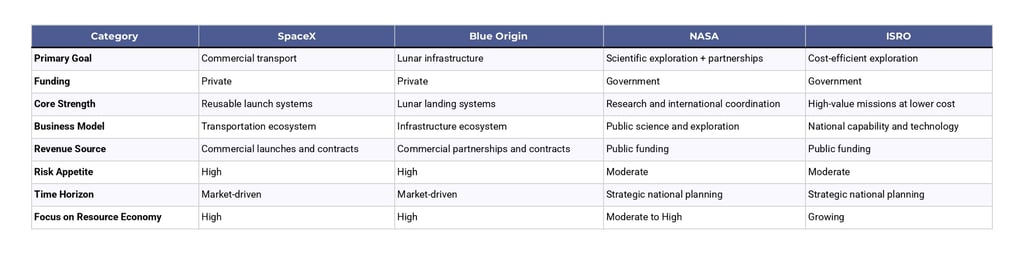
Ethics: Who Benefits?
The biggest unanswered question is not technological. It is economic.
If private firms establish dominant control over:
Fuel depots
Transportation
Lunar communications
Processing facilities
they could gain influence over future space commerce, similar to how ports and railroads shaped industrial economies on Earth.
Critics worry this could produce extraterrestrial monopolies.
Supporters argue private investment is the only practical way to finance rapid expansion.
Both arguments contain merit.
Environmental Questions Beyond Earth
Mining the Moon appears environmentally cleaner than mining rainforests. But new ethical questions emerge.
Should humanity preserve scientifically important lunar regions?
How much alteration is acceptable?
Should historic landing sites receive permanent protection?
Can future generations reverse industrial damage if mistakes occur?
These questions are increasingly entering international policy discussions.
The Hidden Financial Opportunity
Most investors focus on launch companies. Yet history suggests supporting industries often outperform pioneers.
Potential growth sectors include the following:
Space robotics
Satellite servicing
Lunar communications
Autonomous AI
Orbital manufacturing
Space cybersecurity
Space insurance
Precision navigation
Advanced materials
Space construction
As with previous industrial revolutions, enabling technologies may capture more value than raw resource extraction.
Why the Lunar Economy Could Reshape Earth
The long-term objective is not simply bringing materials home.
It is creating a self-sustaining industrial economy beyond Earth.
If resources can be mined, processed, and used in space, future infrastructure such as satellites, habitats, telescopes, and deep-space missions could rely far less on expensive launches from Earth.
That shift could permanently reduce the cost of expanding human activity throughout the solar system.
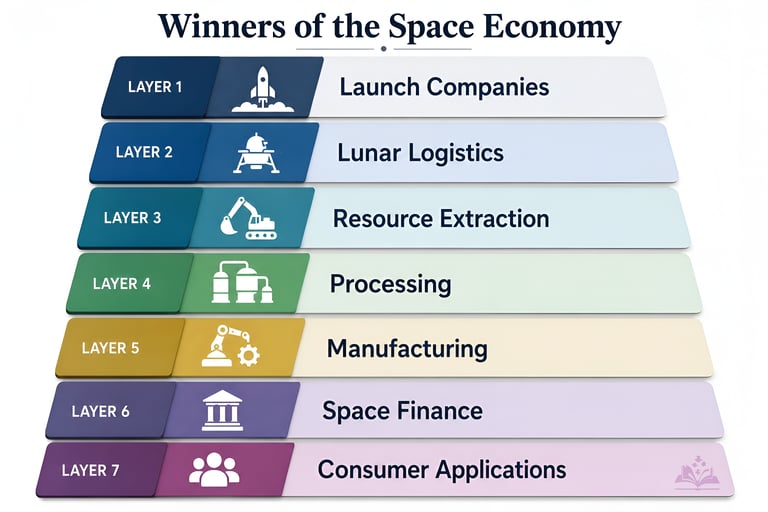

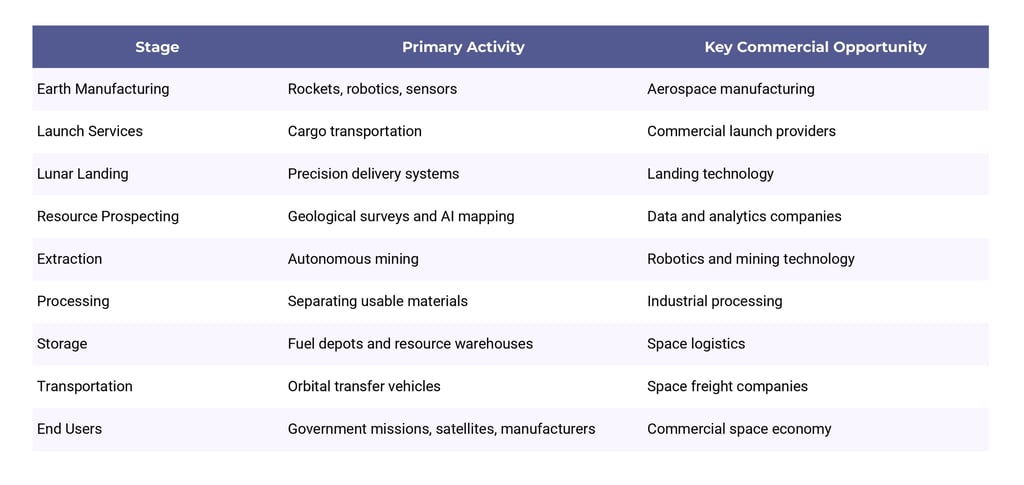
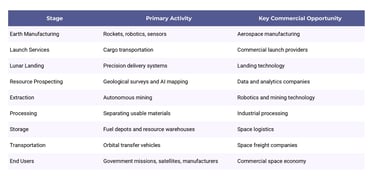
The Emerging Lunar Supply Chain: From Launch Pad to Marketplace
Many discussions about lunar mining focus exclusively on extracting resources. In reality, mining is only one link in a much larger industrial chain. Before a kilogram of lunar material generates economic value, it must move through multiple commercial layers.
The Financial Reality: Why Investors Are Funding Infrastructure Instead of Mining
Contrary to popular belief, venture capital is not pouring money into companies promising immediate lunar mining profits.
Instead, investment is flowing toward businesses solving practical bottlenecks, including:
Reusable launch technology
Autonomous robotics
Lunar communications networks
Space-grade semiconductor manufacturing
Orbital servicing
Space logistics software
AI-driven mission planning
Precision navigation systems
This mirrors earlier technological revolutions. During the internet boom, internet service providers, cloud infrastructure, and semiconductor manufacturers often generated more sustainable returns than many consumer-facing startups.
For investors, lunar infrastructure represents a lower-risk gateway into the expanding space economy.
What Could Slow the Lunar Economy?
Although enthusiasm surrounding lunar commercialization continues to grow, several obstacles remain before large-scale resource extraction becomes economically viable.
The most significant barriers include:
Extremely high transportation costs
Limited in-space power generation
Harsh lunar temperature cycles
Abrasive lunar dust damaging machinery
Delayed communications during critical operations
Absence of universally accepted mining regulations
Uncertain insurance and liability frameworks
Difficulty attracting long-term private investment before commercial revenue exists
These challenges explain why many analysts believe the first profitable businesses will provide services that support lunar operations rather than mining itself.
Looking Beyond the Moon: The Next Phase of the Space Economy
The Moon is widely viewed as a proving ground rather than the final destination. Technologies developed for lunar operations are expected to support future missions involving:
Asteroid resource extraction
Mars settlements
Orbital manufacturing facilities
Commercial space stations
Deep-space fuel depots
Interplanetary cargo transportation
In this sense, the Moon functions as humanity's first industrial laboratory beyond Earth. Success there will determine how efficiently future civilizations expand throughout the Solar System.

The phrase "lunar gold rush" may conjure images of prospectors chasing hidden treasure, but the reality unfolding in 2026 is far more complex. The true race is not for gold. It is for the infrastructure, legal influence, technological leadership, and economic positioning that will define humanity's expansion beyond Earth.
The next generation of wealth is unlikely to come from selling lunar rocks back to Earth. Instead, it will emerge from building the transportation networks, autonomous robotics, communication systems, energy infrastructure, and financial services that make a permanent off-world economy possible.
This is why the most important question is no longer "Who will reach the Moon first?" It is "Who will control the systems that everyone else depends on once they arrive?"
As governments and private companies continue investing billions into lunar exploration, the Moon is evolving from a scientific destination into an economic frontier. The decisions made today regarding ownership rights, environmental stewardship, international cooperation, and commercial regulation will shape not only the future of space exploration but also the balance of economic power on Earth.
History has repeatedly shown that every major frontier, whether maritime, industrial, or digital, has created new winners, new monopolies, and new geopolitical realities. The lunar economy appears poised to follow the same pattern, only this time the frontier lies 384,400 kilometers above us.
The companies and nations that succeed will not simply discover new resources. They will define the rules of the first extraterrestrial economy, laying the foundation for a future in which space is no longer a destination but an extension of the global marketplace.
Frequently Asked Questions
Q: Who legally owns resources mined from the Moon?
Under current international law, no country can claim sovereignty over the Moon. However, several nations allow companies to own resources they extract from celestial bodies under domestic legislation. This interpretation remains legally debated and will likely evolve through future international agreements.
Q: How much is asteroid mining worth?
Asteroid mining is often estimated as a multi-trillion-dollar long-term opportunity because many asteroids contain water, nickel, iron, cobalt, and platinum-group metals. Real economic value depends on transportation costs, processing technology, and whether those materials are used in space or returned to Earth.
Q: Why is lunar water considered more valuable than gold?
Water can be split into hydrogen and oxygen to produce rocket fuel. Establishing fuel production on the Moon would dramatically reduce the cost of deep-space missions, making water one of the most strategically valuable resources in the emerging space economy.
Q: Which industries are expected to benefit most from the lunar economy?
Beyond aerospace companies, sectors such as robotics, artificial intelligence, satellite communications, cybersecurity, advanced materials, insurance, semiconductor manufacturing, logistics, and precision navigation are expected to capture significant economic value as lunar infrastructure expands.
Q: What is the biggest obstacle to commercial lunar mining?
The greatest challenge is not finding resources but making extraction economically viable. High launch costs, limited infrastructure, harsh lunar conditions, energy requirements, and uncertain international regulations remain significant barriers to profitable commercial operations.
Q: Could private companies monopolize lunar resources?
Some experts believe companies that control launch systems, fuel depots, communication networks, or processing facilities could gain outsized influence over future space commerce. Whether this becomes a monopoly will depend largely on international regulations and market competition.
Q: Why are governments partnering with private space companies?
Governments benefit from private-sector innovation, lower launch costs, and faster technology development, while private companies gain funding, contracts, and scientific collaboration. This public-private partnership model is expected to dominate future lunar exploration and commercialization.
Subscribe to Frontier Intelligence
All © Copyright reserved by Accessible-Learning Hub
Accessible Learning Hub — Actionable clarity for high-agency minds.
Weekly breakdowns on AI breakthroughs, capital flow, and human performance systems. Zero fluff.