

The 2026 Global Conflict Map: Counting the Cost
A data-driven look at the global conflict landscape in 2026. With more than 55 countries experiencing armed conflict and nearly 239 million people needing humanitarian aid, this analysis explores where violence is rising, why wars are becoming more complex, and the growing human cost affecting millions of civilians and children worldwide.
NEWS/CURRENT AFFAIRSGLOBAL ISSUESHARSH REALITYNEPOTISM/SOCIAL ISSUES
Shiv Singh Rajput | Vishwajeet Chaurasiya
3/13/202610 min read
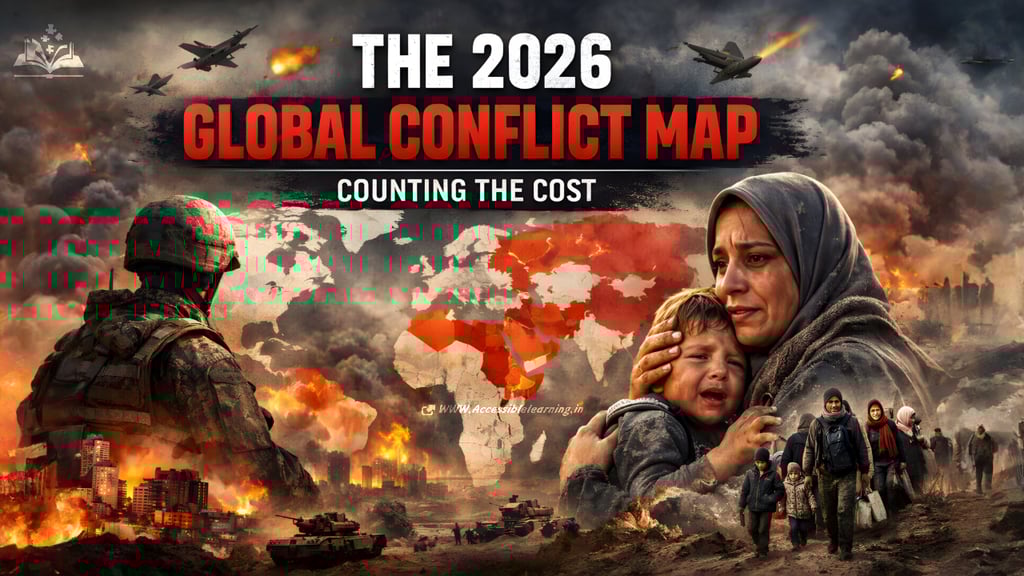
If you look at the global map in 2026, it reveals a difficult reality. Conflict is no longer isolated to a few well-known regions. Instead, violence is unfolding across multiple continents at the same time, affecting a growing number of countries and communities.
According to current global assessments, more than 55 countries are experiencing active armed conflict or high-level organized violence as of March 2026. These conflicts range from large interstate wars to civil wars, insurgencies, and persistent organized violence inside fragile states.
But the true impact of these conflicts cannot be understood through numbers alone. Behind every conflict zone are people whose lives have been uprooted, whose homes have been destroyed, and whose futures have become uncertain overnight.
The global conflict landscape in 2026 is not just about where wars are happening. It is about how deeply they are affecting the lives of millions of people.
A World Experiencing Multiple Wars Simultaneously
One of the most striking features of today’s global situation is how many major conflicts are unfolding at the same time.
In earlier decades, the international community often focused on a single major war dominating headlines. In 2026, however, the world is dealing with several major conflicts simultaneously, each demanding diplomatic attention, humanitarian aid, and global political engagement.
This overlapping pattern of crises stretches international resources. Peacekeeping missions, humanitarian organizations, and diplomatic channels are trying to respond to multiple emergencies at once.
It also creates a ripple effect. Instability in one region can influence migration flows, economic markets, energy supplies, and political alliances in another. The result is a global system where conflicts are increasingly interconnected.
The Middle East’s Renewed Cycle of Escalation
The Middle East has once again become one of the most volatile regions in the global conflict landscape.
Recent military actions, including Operation Roaring Lion and Operation Epic Fury, have triggered a new cycle of escalation across the region. What began as targeted military operations quickly evolved into broader confrontations involving airstrikes, missile attacks, and cross-border tensions.
Urban areas have been particularly affected. Hospitals are overwhelmed, infrastructure has been damaged, and thousands of civilians have been forced to leave their homes.
Beyond the immediate humanitarian impact, the escalation also raises concerns about wider regional instability. Several neighboring states remain on high alert, and global powers are watching closely due to the region’s strategic importance for energy routes and international trade.
For civilians living in these areas, the situation changes daily. What once felt like distant geopolitical tension has now become a direct threat to everyday life.
Ukraine’s War and the New Reality of Modern Warfare
The war in Ukraine has now entered its fifth year, making it one of the longest-running major conflicts in Europe in recent history.
Over time, the nature of the conflict has evolved. Early phases of rapid territorial advances have been replaced by prolonged frontline battles and defensive strategies. Many regions now experience a slow and exhausting war of attrition. Technology has also reshaped how the war is fought. Drone warfare, precision missiles, and digital intelligence systems have become central tools on the battlefield.
However, while military strategies continue to evolve, the civilian impact remains severe. Cities across the country face repeated infrastructure damage, particularly in energy systems and transportation networks.
Millions of people remain displaced. Some families have moved several times since the conflict began, while others continue to live close to active frontlines. The war has also reshaped global geopolitics, influencing defense policies, military spending, and international alliances across Europe and beyond.
Sudan’s Civil War and a Humanitarian Catastrophe
Among the most devastating conflicts unfolding today is the civil war in Sudan.
Fighting between rival military factions has transformed large parts of the country into conflict zones. Major cities have seen intense fighting, looting, and widespread destruction.
Essential services such as electricity, water systems, and hospitals have collapsed in many areas. Markets and supply chains have been disrupted, making food increasingly difficult to access.
Millions of people have fled their homes, seeking safety either within Sudan or across international borders. Refugee camps in neighboring countries are struggling to cope with the growing influx of displaced families.
Aid organizations warn that food insecurity in several regions has reached extremely dangerous levels. Without consistent humanitarian access, entire communities face the risk of famine conditions.
Despite international calls for ceasefires, the conflict remains fragmented, with different armed groups controlling different areas.

The Sahel and the Expanding Crisis Across Africa
Beyond Sudan, the African continent is facing a series of interconnected security challenges.
The Sahel region, stretching across countries such as Mali, Burkina Faso, and Niger, has become one of the most fragile security environments in the world. Armed militant groups operate across borders, often targeting rural communities and weak state institutions.
Political instability has added to the challenge. Several countries in the region have experienced military coups in recent years, creating uncertainty about governance and security strategies.
Climate pressures are also intensifying existing tensions. Desertification, drought, and shrinking farmland are pushing communities into competition over limited resources.
For civilians, the result is a complex crisis where conflict, economic hardship, and environmental stress all overlap. Many families are forced to leave rural areas and move toward cities or refugee camps, hoping to find greater safety and access to basic services.
Long-Running Conflicts in Asia
Several regions across Asia continue to deal with long-running internal conflicts and fragile political situations.
In some countries, governments are facing insurgent groups that have operated for decades. In others, ethnic tensions or regional autonomy movements continue to fuel periodic violence.
These conflicts often remain localized but deeply entrenched. Communities in affected areas experience recurring cycles of military operations, ceasefires, and renewed fighting.
Border disputes also contribute to regional tensions in some parts of Asia. Even when large-scale war does not break out, military standoffs and diplomatic disputes can create prolonged uncertainty for populations living near contested regions.
For people in these areas, peace often feels temporary rather than permanent.
The Economic Impact of Global Conflicts
The consequences of modern conflicts extend far beyond the battlefield.
Wars disrupt global supply chains, energy markets, and trade routes. Regions affected by conflict often experience severe economic contraction, with businesses shutting down and investment disappearing.
For countries hosting refugees, the sudden arrival of displaced populations can strain infrastructure, housing, and public services. At the same time, governments involved in conflict frequently increase military spending, diverting resources away from healthcare, education, and economic development.
These economic pressures can last for years, even after fighting ends.
The Humanitarian Crisis Reaches Historic Levels
As conflicts spread across more regions, humanitarian needs have reached unprecedented levels.
As of 2026, 239 million people worldwide require urgent humanitarian assistance. This is the highest level recorded since the end of World War II.
These individuals face daily challenges such as food shortages, lack of safe drinking water, limited medical care, and unstable living conditions.
Humanitarian organizations are working across dozens of crisis zones, but the scale of need continues to grow faster than available funding.
In many areas, aid workers also face security risks, making it difficult to reach the communities that need assistance the most.
The Children Growing Up in War Zones
Perhaps the most troubling consequence of today’s global conflicts is their impact on children.
Current estimates suggest that one out of every five children worldwide is living in or fleeing a conflict zone.
For many young people, war has become a defining part of childhood. Schools close due to violence, families move repeatedly to escape fighting, and access to healthcare becomes limited.
The psychological impact can be long-lasting. Children exposed to conflict often carry trauma well into adulthood, affecting education, employment opportunities, and overall well-being.
When large numbers of children grow up without stability or education, the consequences can shape entire societies for generations.
Why Conflicts Are Becoming More Complex
Modern conflicts are rarely simple battles between two sides. Many involve multiple armed groups, regional powers, and international interests.
Several factors are contributing to the growing complexity of global conflicts:
Geopolitical rivalries are increasing tensions between major powers.
Fragile governments struggle to maintain control in regions with weak institutions.
Economic inequality and inflation fuel social unrest.
Climate change intensifies competition over water, land, and food resources.
Digital technology has introduced new forms of warfare, including cyber attacks and information manipulation.
These overlapping pressures make conflicts harder to resolve and more likely to spread beyond their original borders.
The Rise of Proxy Wars
Another defining feature of modern conflicts is the increasing role of proxy warfare. Instead of confronting each other directly, powerful nations often support local factions, militias, or governments in regional conflicts.
This pattern allows major powers to influence outcomes without deploying large numbers of their own troops. However, it often prolongs conflicts and makes peace negotiations far more complicated.
Proxy wars also increase the number of actors involved in a conflict. What may begin as a local dispute can gradually evolve into a wider geopolitical struggle with international implications.
For civilians caught in the middle, this often means longer wars and slower paths toward peace.


The Global Displacement Crisis
Conflict today is the single largest driver of forced displacement across the world.
Millions of people are leaving their homes not because they want to migrate, but because staying has become impossible. Entire communities are forced to abandon towns that have become battlefields.
Many displaced families remain within their own countries, moving from one temporary shelter to another as fighting spreads. Others cross borders and become refugees, hoping to find safety in neighboring nations.
Displacement rarely ends quickly. Some families spend years or even decades living in camps or temporary settlements while waiting for conditions back home to stabilize.
Urban Warfare and the Destruction of Cities
Modern wars are increasingly fought in urban areas rather than remote battlefields.
Cities that once served as economic and cultural centers are turning into frontlines. Fighting in densely populated environments often leads to severe destruction of infrastructure, including roads, hospitals, schools, and power systems.
Urban warfare also places civilians directly in the path of conflict. Even when residents attempt to leave, damaged transportation routes and security risks can make evacuation extremely difficult.
Rebuilding a city after such destruction can take decades, long after the fighting has ended.
The Digital Battlefield
War today is not fought only with tanks and artillery. Digital technology has opened a new front in global conflicts.
Cyberattacks can disrupt power grids, financial systems, communication networks, and government infrastructure. In some cases, these attacks occur even before traditional military operations begin.
Information warfare has also become a powerful tool. Social media platforms are often used to spread propaganda, influence public opinion, and manipulate narratives around conflicts.
This digital dimension of warfare means that even people far from physical battlefields can feel the impact of global conflicts.
The Strain on Global Food Security
Armed conflicts have a direct effect on global food production and distribution.
When farming regions become battlefields, agricultural production drops dramatically. Crops go unharvested, supply chains break down, and transportation routes become unsafe.
Conflicts in key agricultural regions can also influence global food prices. Countries that depend heavily on imports may face sudden shortages or rising costs.
For vulnerable populations already dealing with poverty or climate challenges, these disruptions can push communities closer to hunger and malnutrition.
A Growing Challenge for International Diplomacy
The increasing number of simultaneous conflicts has made diplomatic resolution more difficult.
International organizations and mediators often have limited capacity to manage multiple crises at once. Negotiations require time, trust, and sustained political attention, all of which become harder to maintain when new conflicts emerge regularly.
In some situations, peace processes collapse because armed groups fragment or because external actors become involved. This complexity means that even when ceasefires are achieved, they may remain fragile unless deeper political and economic issues are addressed.
The global conflict map of 2026 shows a world under strain. More than 55 countries experiencing violence is a staggering figure, but the deeper story lies in how these conflicts affect ordinary lives.
Each statistic represents a person who has lost something important. A home destroyed by fighting. A child forced to leave school. A family separated while searching for safety.
The number of 239 million people needing humanitarian aid is not just a measurement of crisis. It is a reminder that behind every conflict headline are individuals trying to rebuild their lives in the middle of uncertainty.
Understanding the scale of global conflict is important. But remembering the human stories behind those numbers may be even more essential.

Countries Currently Experiencing War or Major Armed Conflict
Europe
Ukraine
Russia (related to the Ukraine war and border attacks)
Middle East
Israel
Palestine (Gaza and West Bank conflict)
Syria
Yemen
Iraq
Iran (regional proxy confrontations)
Lebanon
Africa
Sudan
South Sudan
Ethiopia
Somalia
Democratic Republic of Congo
Central African Republic
Libya
Mali
Burkina Faso
Niger
Nigeria
Cameroon
Chad
Mozambique
Eritrea
Algeria
Tunisia (militant insurgency risk areas)
Asia
Afghanistan
Myanmar
Pakistan
India (insurgency in Kashmir and internal conflicts)
Philippines
Thailand (southern insurgency)
Indonesia (Papua conflict)
Bangladesh (regional militant activity)
Sri Lanka (post-war instability zones)
Caucasus & Central Asia
Armenia
Azerbaijan
Kyrgyzstan
Tajikistan
Latin America & Caribbean
These conflicts are often categorized as organized armed violence or cartel warfare rather than traditional wars.
Mexico
Colombia
Haiti
Brazil (criminal armed conflict zones)
Ecuador
Venezuela
Peru
Fragile Conflict Zones
Turkey (Kurdish conflict)
Morocco / Western Sahara
Saudi Arabia (Yemen war involvement)
United Arab Emirates (Yemen war involvement)
Kenya (Somalia-linked insurgency)
Uganda (rebel groups in border regions)
Tanzania (spillover militancy threats)
Benin (Sahel militant expansion)
Togo (Sahel militant expansion)

FAQs
Q: How many countries are currently experiencing war or armed conflict in 2026?
As of early 2026, more than 55 countries are experiencing active armed conflict or high-level organized violence. These include full-scale wars, civil wars, insurgencies, and sustained militant violence affecting national stability.
Q: Which regions of the world are most affected by conflict today?
The regions with the highest concentration of conflicts include Africa, the Middle East, Eastern Europe, and parts of Asia. The Sahel region in Africa, the Middle East escalation, and the ongoing war in Ukraine are among the most significant sources of instability.
Q: What is the difference between a war and an armed conflict?
A war typically refers to large-scale fighting between states or major organized forces. An armed conflict is a broader term that also includes civil wars, insurgencies, militia violence, and organized clashes that may not involve formal declarations of war.
Q: How many people are affected by global conflicts today?
Around 239 million people worldwide currently require urgent humanitarian assistance due to conflict and related crises. These individuals face challenges such as displacement, food insecurity, limited healthcare access, and damaged infrastructure.
Q: How many children are living in conflict zones?
Current estimates suggest that one in five children globally is living in or fleeing a conflict zone, exposing millions to disrupted education, trauma, and long-term instability.
Q: Why are global conflicts increasing in recent years?
Several factors are contributing to the rise in conflicts, including geopolitical rivalry, fragile governments, economic instability, climate-related pressures, and the spread of proxy wars. These overlapping challenges make conflicts more complex and harder to resolve.
Q: Which conflicts are currently shaping global geopolitics the most?
Some of the most influential conflicts include the war in Ukraine, the Middle East escalation, Sudan’s civil war, and ongoing instability across the Sahel region in Africa. These crises have significant global impacts on security, migration, and economic stability.
Q: How do modern conflicts affect the global economy?
Wars can disrupt trade routes, energy supplies, food production, and international markets. They often lead to higher military spending and economic uncertainty, which can affect both regional economies and global financial stability.
Subscribe to Frontier Intelligence
All © Copyright reserved by Accessible-Learning Hub
| Terms & Conditions
Accessible Learning Hub — Actionable clarity for high-agency minds.
Weekly breakdowns on AI breakthroughs, capital flow, and human performance systems. Zero fluff.