

The 1.5°C Ghost: How Humanity Is Adapting to a Hotter, Unstable World
The world has quietly entered the 1.5°C overshoot era, where extreme heat, shifting habitability, and climate pressure are redefining how societies function. This article explores radical adaptation, the rise of “unlivable hours,” and the Great Simplification—a necessary transition away from excess toward resilient, survival-focused systems that can sustain humanity through the coming century.
HARSH REALITYENVIRONMENTGLOBAL ISSUESAWARE/VIGILANT
Jagdish Nishad
4/7/20267 min read
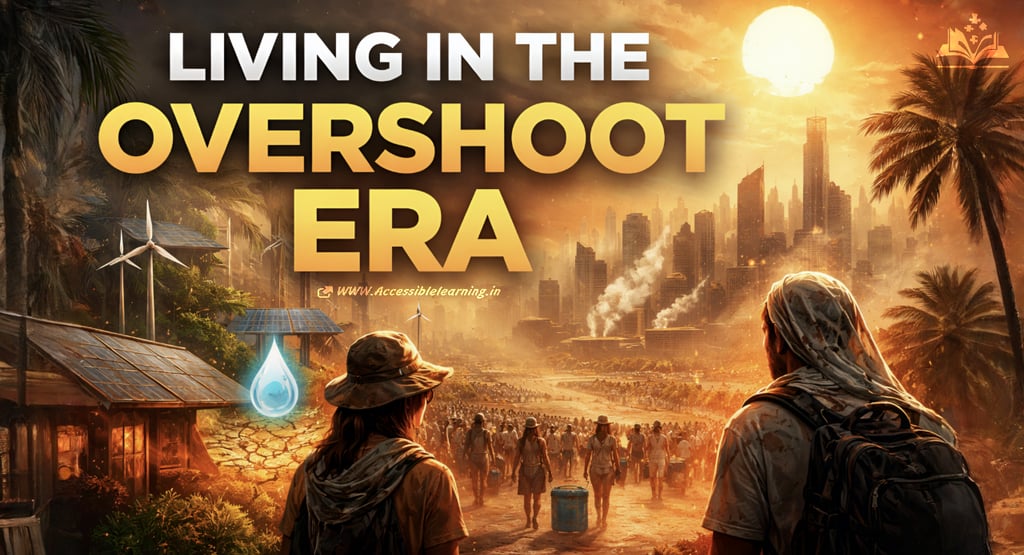
The Line We Crossed Quietly
There was no single day when the world officially crossed 1.5°C. No alarm, no ceremony. Instead, it happened the way most planetary changes do, gradually and unevenly.
Recent temperature records across 2023–2025 have already shown months where global warming temporarily exceeded 1.5°C above pre-industrial levels. Climate models now suggest that a sustained overshoot is likely within the next decade, even under moderate emission reduction scenarios.
So the conversation has shifted. We are no longer standing at the edge of prevention.
We are stepping into management, adaptation, and redesign.
The 1.5°C target has become a ghost. Still present, still meaningful, but no longer something we can fully hold onto in the near term.
Overshoot Is Not Collapse. It Is Compression.
The overshoot era does not arrive as a single catastrophic event. It shows up as pressure across every system at once.
Heatwaves are longer, earlier, and more intense
Rainfall becomes erratic, swinging between drought and flooding
Food systems face instability due to temperature and water stress
Energy demand spikes during heat extremes, pushing grids to failure
This is best understood as compression. The margins that once allowed error, inefficiency, and excess are shrinking. Civilization is being forced to operate with less room for mistakes.
The Expanding Geography of Heat
One of the most significant shifts in recent years is not just warming itself but how heat behaves.
In regions across South Asia, including parts of India, heatwaves are now arriving earlier in the year and lasting longer into the monsoon transition. Urban centers experience intensified conditions due to the urban heat island effect, where concrete and asphalt trap heat long after sunset.
Globally, scientists are tracking wet-bulb temperature thresholds. At around 35°C wet-bulb, the human body can no longer cool itself effectively, even in shade.
While such extremes are still rare, lower but dangerous thresholds (30–33°C wet-bulb) are becoming more common, especially in densely populated regions.
This creates a new category of risk:
Not places that are permanently uninhabitable,
but places that are temporarily incompatible with human biology.
Time Becomes the New Geography
The future of habitability is no longer just about where you live.
It is about when you can live there safely.
Across multiple regions:
Outdoor labor is shifting to early morning and late-night windows
Schools and public services are experimenting with heat-adjusted schedules
Informal economies are adapting faster than formal systems, often out of necessity
This leads to the rise of “split-day societies," where activity is fragmented around climate constraints.
Cities that once functioned on a continuous daily rhythm are beginning to pulse with temperature cycles.


Radical Adaptation in Practice
Adaptation is no longer theoretical. It is already happening, though unevenly and often without coordination.
Rebuilding for Heat, Not Just Growth
Urban design is slowly shifting toward heat resilience:
Reflective rooftops and pavements are being introduced in high-risk zones
Tree cover and shaded corridors are being prioritized in city planning
Traditional architectural principles, once abandoned, are returning
Buildings are being designed to function with minimal reliance on active cooling
In many cases, older knowledge systems are proving more relevant than modern design trends.
Energy: The New Lifeline
Cooling demand is now one of the fastest-growing forms of energy consumption. Air conditioning, once a symbol of comfort, is becoming a basic survival tool. But this creates a paradox:
More cooling increases energy demand
Higher demand increases emissions (in fossil-dependent systems)
Increased emissions worsen long-term warming
To break this loop, there is a growing push toward:
Decentralized solar energy systems
Localized microgrids
Energy storage solutions that can sustain cooling during peak demand
Energy is no longer just an economic issue. It is directly tied to human survival under extreme heat.
Water Becomes the Central Resource
If heat defines the problem, water defines the limits of adaptation. Recent years have shown simultaneous patterns of:
Severe droughts in some regions
Extreme flooding in others
Unpredictable monsoon behavior affecting agriculture
Adaptation strategies increasingly revolve around:
Rainwater harvesting at scale
Wastewater recycling
Precision irrigation
Urban water budgeting
In the overshoot era, water security becomes climate security.
Migration Without Crisis Thinking
Climate migration is often framed as a future emergency. In reality, it is already underway, though often internal and gradual.
The overshoot era normalizes mobility:
Movement from rural to urban areas due to agricultural stress
Relocation from high-heat zones to relatively cooler regions
Seasonal migration patterns intensifying
The challenge is not migration itself. It is whether systems are built to absorb and integrate movement smoothly. Societies that treat mobility as a planned adaptation strategy will remain stable. Those that resist it may face repeated disruption.
The Great Simplification: A Structural Reset
The overshoot era quietly removes the conditions that allowed excess to thrive.
High-consumption lifestyles depend on:
Stable supply chains
Predictable weather
Cheap energy
Abundant resources
All four are becoming less reliable. The result is not an immediate collapse but a gradual shedding of complexity that cannot be sustained.
What Simplification Looks Like in Reality
Products designed for longevity instead of replacement
Localized production reducing dependency on global logistics
Reduced material consumption without reducing quality of life
Cultural shifts away from accumulation toward functionality and resilience
This is not about forced austerity. It is about aligning human systems with physical limits.
Rethinking Progress in a Warmer World
The idea of progress is being rewritten in real time. Old definition:
Growth, speed, scale, expansion
Emerging definition:
Stability under stress
Systems that degrade gracefully, not collapse abruptly
Efficiency that reduces vulnerability
Societies that can adapt without losing cohesion
Progress becomes less visible but more meaningful.
The Psychological Shift: From Fear to Function
One of the most important transitions is mental. Climate narratives have long oscillated between urgency and despair. But neither supports long-term action.
The overshoot era requires a different mindset:
Acceptance without passivity
Urgency without panic
Adaptation without denial
This is where the concept of radical adaptation becomes powerful. It replaces the question:
“Can we stop this entirely?”
with:
“How do we live well within what is now unavoidable?”

A Century Defined by Choices, Not Just Temperature
The next hundred years will not be defined only by how much the planet warms but by how societies respond to that warming.
Two futures are possible within the same temperature range:
One marked by fragmentation, inequality, and reactive crisis management
Another shaped by cooperation, simplification, and proactive adaptation
The physical constraints are real. But within those constraints, there is still room for design.
The Future That Can Still Work
The 1.5°C world we aimed for may be slipping out of reach in the short term. But the overshoot era is not a dead end. It is a transition. A forced one, but still open to direction. The systems built during the age of abundance are being tested under conditions of stress. Some will fail. Others will evolve.
What remains will likely be:
More local
More efficient
Less wasteful
More aligned with the realities of a finite planet
The Great Simplification is not about losing the future. It is about removing what makes the future impossible.
And in that process, something quieter but more durable may emerge:
A civilization that finally learns how to live within limits,
without losing its capacity to adapt, create, and endure.
FAQ's
Q: What does “1.5°C overshoot” actually mean?
The 1.5°C overshoot refers to a scenario where global average temperatures temporarily or permanently rise above 1.5°C compared to pre-industrial levels. It does not mean instant collapse, but it signals increased climate risks like extreme heat, flooding, and ecosystem stress before any possible stabilization.
Q: Has the world already crossed 1.5°C warming?
Yes, in recent years (2023–2025), the world has experienced short-term breaches of the 1.5°C threshold during certain months. However, a long-term sustained overshoot is expected within the next decade if current trends continue.
Q: What are “unlivable heat conditions”?
Unlivable heat conditions occur when temperature and humidity combine to exceed the human body’s ability to cool itself. This is often measured using wet-bulb temperature. At extreme levels, even healthy people cannot survive prolonged exposure without cooling.
Q: Will parts of Earth become completely uninhabitable?
Not permanently in most cases, but many regions could become seasonally or temporarily uninhabitable due to extreme heat. This means people may still live there but will need to adapt their schedules, infrastructure, and lifestyles significantly.
Q: What is radical climate adaptation?
Radical adaptation is the process of redesigning human systems—cities, work, energy, and lifestyles—to function under extreme climate conditions. It goes beyond small adjustments and focuses on deep structural changes to ensure long-term survival and stability.
Q: What is the “Great Simplification” in a climate context?
The Great Simplification refers to a gradual shift away from high-consumption, resource-intensive lifestyles toward more efficient, localized, and sustainable systems. It emphasizes reducing excess while maintaining functionality and resilience.
Q: How will extreme heat affect daily life?
Daily life will change in several ways:
Work hours may shift to cooler times of day
Outdoor activities will become limited during peak heat
Energy demand for cooling will increase
Cities may adopt night-based or split-day activity patterns
Q: Will climate change increase migration?
Yes, climate migration is expected to rise due to heat, water scarcity, and agricultural challenges. However, it will often be gradual and internal, not always sudden or cross-border. Managed properly, migration can become a form of adaptation rather than a crisis.
Q: Can technology solve the overshoot problem?
Technology will help—through renewable energy, cooling systems, and water management—but it is not a complete solution. The overshoot challenge also requires behavioral, cultural, and economic changes.
Q: Is it too late to act on climate change?
No. While preventing all warming may no longer be possible, every fraction of a degree matters. Reducing emissions and improving adaptation can still significantly limit damage and improve long-term outcomes.
Q: What role does water play in the overshoot era?
Water becomes one of the most critical resources. Climate change disrupts rainfall patterns, leading to both droughts and floods. Effective water management, storage, and recycling will be essential for survival and stability.
Q: How will cities change in a hotter world?
Future cities will focus on:
Heat-resistant design and materials
Increased green cover and shade
Efficient public transport and reduced heat traps
Decentralized energy systems
Cities will shift from consumption hubs to resilience-focused environments.
Q: What industries will be most affected by extreme heat?
Industries relying on outdoor labor and stable weather conditions will be most impacted, including
Agriculture
Construction
Logistics and transportation
Energy production
These sectors will need to adapt through automation, scheduling changes, and new technologies.
Q: How can individuals adapt to extreme heat conditions?
Individuals can adapt by:
Adjusting daily routines to avoid peak heat
Improving home ventilation and insulation
Staying hydrated and using cooling methods
Reducing energy and water waste
Supporting local and sustainable systems
Q: What is the biggest challenge of the overshoot era?
The biggest challenge is not just environmental but social and structural. It lies in ensuring that adaptation is equitable, so vulnerable populations are not left behind while others secure resources for survival.
Q: What is the future of human civilization in the overshoot era?
Human civilization is unlikely to disappear, but it will transform significantly. The future will likely involve:
Simpler, more efficient systems
Greater reliance on local resources
Increased adaptability to environmental limits
A redefinition of progress focused on resilience rather than growth
Subscribe to Frontier Intelligence
All © Copyright reserved by Accessible-Learning Hub
| Terms & Conditions
Accessible Learning Hub — Actionable clarity for high-agency minds.
Weekly breakdowns on AI breakthroughs, capital flow, and human performance systems. Zero fluff.