

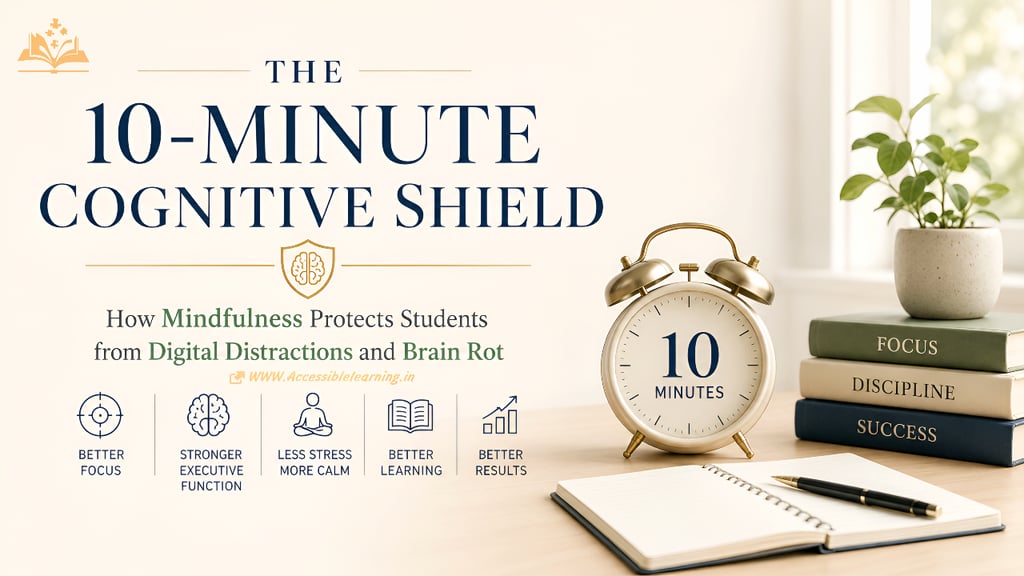
The 10-Minute Cognitive Shield: How Mindfulness Protects Students from Digital Distractions
In an age of endless notifications, social media feeds, and algorithm-driven distractions, maintaining focus has become one of the biggest challenges for students. Discover how a simple 10-minute mindfulness practice can strengthen attentional control, improve executive function, reduce digital overload, and act as a powerful cognitive shield against modern distractions.
ACCESSIBLE LEARNING
Shiv Singh Rajput
6/12/20266 min read

The Attention Crisis Nobody Prepared Us For
A student's greatest challenge today is no longer access to information. It is protecting attention.
Every day, students compete against endless notifications, short-form videos, recommendation algorithms, social media feeds, and digital distractions engineered to capture and hold their focus. While technology has made learning more accessible than ever, it has also created an environment where sustained concentration feels increasingly difficult.
Researchers have begun describing this phenomenon as an attention crisis. Many students report difficulty reading long texts, staying focused during lectures, completing assignments without interruptions, or retaining information after studying.
The result is what many people casually refer to as "brain rot," a state of mental fatigue characterized by fragmented attention, reduced focus, and constant cognitive overload.
Fortunately, science has identified a surprisingly simple countermeasure. It takes just ten minutes.
What Is the 10-Minute Cognitive Shield?
The 10-Minute Cognitive Shield is a daily mindfulness practice designed to strengthen the brain's ability to focus, filter distractions, and regulate attention.
Unlike traditional perceptions of meditation as a spiritual or wellness activity, modern neuroscience increasingly views mindfulness as a form of cognitive training.
Think of it as a mental firewall.
Just as antivirus software protects a computer from harmful intrusions, mindfulness helps protect the brain from the constant barrage of digital stimuli competing for attention.
A simple ten-minute session can help learners regain control over their focus before the day's distractions begin to take over.
Why Mindfulness Is No Longer Just for Yogis
For decades, mindfulness was often associated with yoga studios, spiritual retreats, or personal wellness communities. Today, that perception is rapidly changing.
Educational institutions, neuroscientists, psychologists, and performance experts are increasingly adopting mindfulness because of its measurable effects on cognitive performance.
The conversation has shifted from
"Does meditation help people relax?"
to:
"Can mindfulness improve attention, learning, and decision-making?"
The evidence suggests that it can. Rather than being a luxury habit, mindfulness is becoming a practical tool for academic survival.
How Digital Algorithms Hijack Attention
To understand why mindfulness matters, it helps to understand what students are up against. Most digital platforms are built around one objective: maximizing engagement.
Algorithms analyze user behavior and continuously deliver content designed to trigger curiosity, emotional reactions, or novelty-seeking behavior. Every swipe, click, and notification activates the brain's reward systems.
Over time, this can create several challenges:
Reduced attention span
Increased task switching
Difficulty sustaining concentration
Lower working memory performance
Greater susceptibility to distractions
Mental fatigue and information overload
The brain gradually becomes conditioned to seek constant stimulation. Studying, which requires sustained focus and delayed rewards, begins to feel more difficult by comparison. This is where mindfulness serves as a biological countermeasure.
The Science Behind the Cognitive Shield
Mindfulness meditation involves intentionally directing attention to a chosen focus point, such as breathing, body sensations, or sounds. Whenever the mind wanders, attention is gently redirected.
While this sounds simple, something remarkable happens beneath the surface. Each time attention returns to the present moment, neural networks responsible for focus and self-regulation become more active.
This process strengthens what psychologists call attentional control.
Attentional control is the ability to:
Stay focused on relevant information
Resist distractions
Shift attention intentionally
Sustain concentration for longer periods
These abilities are fundamental to learning, problem-solving, and academic performance.
Recent clinical studies have shown that even brief mindfulness sessions can improve executive functioning and cognitive flexibility. In other words, mindfulness does not merely help students feel calmer. It helps them think better.

Why Ten Minutes Can Be Enough
One of the biggest misconceptions about meditation is that it requires long sessions. Many students assume they need thirty minutes, an hour, or even a dedicated lifestyle change to experience benefits.
Research suggests otherwise. Even short mindfulness sessions can produce measurable improvements in attention and mental clarity. The reason is that mindfulness functions like exercise for the brain.
A brief daily workout performed consistently often produces greater benefits than occasional intensive sessions. Ten focused minutes each day can gradually strengthen neural circuits responsible for concentration and self-control. Consistency matters more than duration.
How the 10-Minute Cognitive Shield Works
A basic practice can be broken into four stages.
Minute 1–2: Settle In
Sit comfortably and eliminate distractions.
Focus attention on natural breathing without trying to control it.
Minute 3–5: Observe Attention
Notice thoughts, worries, plans, or distractions as they arise.
Do not engage with them.
Simply observe.
Minute 6–8: Return to the Breath
Whenever attention drifts, gently return focus to breathing.
This act of returning is the actual training.
Minute 9–10: Prepare for Focused Work
Before ending the session, choose one important task for the day.
Visualize giving it your full attention.
This creates a mental transition from awareness practice into productive action.
Benefits Students Can Notice
Students who consistently practice mindfulness often report the following:
Improved Concentration
Fewer interruptions from wandering thoughts.
Better Memory Retention
Enhanced ability to absorb and recall information.
Reduced Academic Stress
Greater emotional regulation during exams and deadlines.
Stronger Self-Discipline
Improved resistance to digital distractions.
Increased Learning Efficiency
More productive study sessions with less wasted time.
These benefits can compound over weeks and months, creating meaningful improvements in academic performance.
Mindfulness and the Future of Learning
The educational landscape has changed dramatically.
Students are no longer competing only against difficult subjects or demanding exams.
They are competing against entire ecosystems designed to capture attention.
Success increasingly depends on the ability to control focus rather than simply acquire information.
In this environment, mindfulness is evolving from a wellness habit into a cognitive necessity.
The students who learn to manage attention effectively may gain an advantage that extends far beyond the classroom.
The battle for attention is one of the defining challenges of modern education. Every notification, recommendation, and endless scroll competes for valuable cognitive resources. The good news is that the brain remains adaptable.
A simple ten-minute mindfulness practice can help strengthen attentional control, improve executive function, and create a protective barrier against digital overload. The 10-Minute Cognitive Shield is not about escaping technology. It is about using the brain more intentionally within a world designed to distract it.
For students navigating today's information-saturated environment, mindfulness may no longer be optional self-care. It may be one of the most effective cognitive survival tools available.

Frequently Asked Questions
Q: What is the 10-Minute Cognitive Shield?
The 10-Minute Cognitive Shield is a short daily mindfulness practice designed to strengthen attention, focus, and executive function. It acts as a mental defense system against distractions, digital overload, and information fatigue by training the brain to maintain concentration more effectively.
Q: Can 10 minutes of mindfulness really improve focus?
Yes. Research suggests that even brief mindfulness sessions can improve attentional control, working memory, and cognitive flexibility. Consistent practice helps train the brain to resist distractions and stay focused on important tasks.
Q: How does mindfulness help students study better?
Mindfulness helps students improve concentration, reduce stress, enhance memory retention, and strengthen self-discipline. These benefits can lead to more productive study sessions and better academic performance.
Q: What is executive function, and why is it important for students?
Executive function refers to mental skills that help people plan, organize, focus, remember instructions, and manage multiple tasks. Strong executive function is essential for studying, completing assignments, managing time, and achieving academic goals.
Q: Does mindfulness reduce the effects of social media and digital distractions?
Mindfulness cannot eliminate digital distractions, but it can improve a person's ability to recognize distractions and redirect attention. This helps students maintain focus despite constant notifications, social media feeds, and online interruptions.
Q: What happens in the brain during mindfulness meditation?
During mindfulness practice, brain regions associated with attention, emotional regulation, and self-control become more active. Over time, this can strengthen neural pathways that support concentration and decision-making.
Q: Is mindfulness meditation the same as relaxation?
Not exactly. While mindfulness often creates a sense of calm, its primary purpose is awareness and attention training. The goal is to strengthen focus rather than simply achieve relaxation.
Q: How long does it take to see benefits from mindfulness?
Some people notice improved mental clarity after a single session, but the most significant benefits typically develop after several weeks of consistent daily practice.
Q: Can mindfulness improve memory and learning?
Studies suggest mindfulness can support working memory and information retention by reducing mental clutter and improving the brain's ability to focus on relevant information during learning.
Q: Is mindfulness suitable for teenagers and college students?
Yes. Mindfulness is widely used in schools, colleges, and educational programs because it is safe, accessible, and effective for improving focus, emotional regulation, and academic performance.
Q: What is the best time of day to practice the 10-Minute Cognitive Shield?
Many students find it beneficial to practice in the morning before classes or study sessions. However, any consistent time of day can be effective if it fits into a daily routine.
Q: Can mindfulness help with exam stress and test anxiety?
Mindfulness can help reduce stress and anxiety by encouraging present-moment awareness and emotional regulation. Many students use mindfulness techniques before exams to stay calm and focused.
Q: Why is mindfulness becoming important in the digital age?
Modern technology constantly competes for attention. Mindfulness helps individuals regain control of their focus, making it a valuable skill for learning, productivity, and mental well-being in an increasingly distracted world.
Q: Is mindfulness backed by science?
Yes. Numerous studies in psychology, neuroscience, and education have examined mindfulness and found positive effects on attention, stress management, emotional regulation, and cognitive performance.
Q: How can beginners start practicing mindfulness?
Beginners can start by sitting quietly for 10 minutes, focusing on their breathing, and gently returning their attention whenever their mind wanders. Consistency is more important than perfection.
Subscribe to Frontier Intelligence
All © Copyright reserved by Accessible-Learning Hub
Accessible Learning Hub — Actionable clarity for high-agency minds.
Weekly breakdowns on AI breakthroughs, capital flow, and human performance systems. Zero fluff.