

Tenjin Matsuri, Osaka: The Festival That Turns a City Into a Controlled Storm
Tenjin Matsuri in Osaka is more than a fireworks festival. Discover the history, river processions, economic impact, cultural significance, hidden logistics, and why this 1,000-year-old tradition still dominates modern Japan.
CULTURE/TRADITIONTRAVEL LIFEJAPANCELEBRATION/FESTIVALS
Kim Shin
7/12/20264 min read
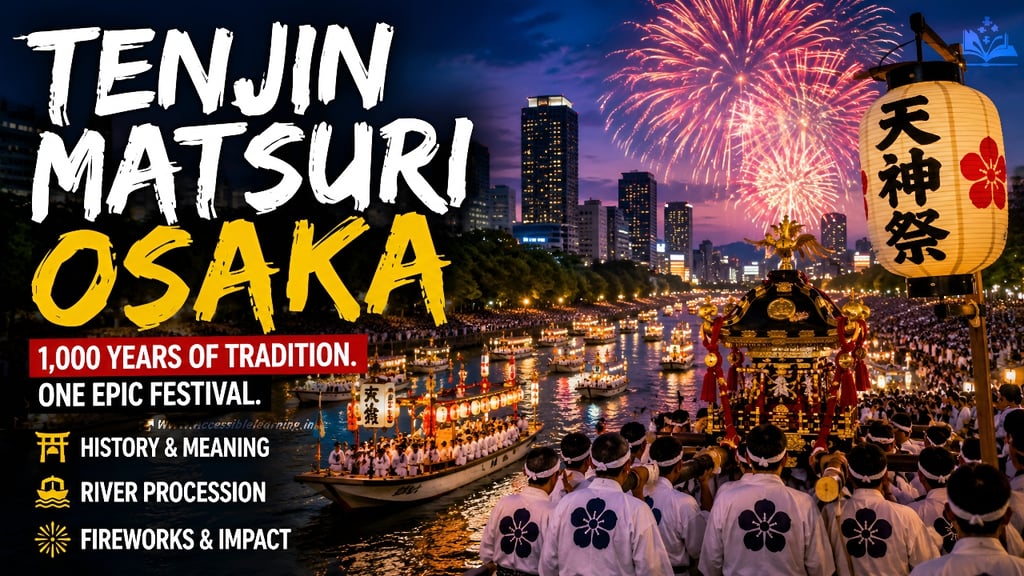
Tenjin Matsuri is not just another Japanese festival. It is one of Japan's three greatest festivals, drawing well over a million visitors into Osaka's streets, rivers, and public spaces every year. For two days, an entire modern city reorganizes itself around a tradition that dates back more than a thousand years.
TENJIN MATSURI IS A MASSIVE LOGISTICAL MACHINE, NOT JUST A RELIGIOUS EVENT
Most travel articles sell Tenjin Matsuri as a colorful celebration with boats and fireworks. That description barely scratches the surface.
The festival centers on the worship of Sugawara no Michizane, a scholar and politician later deified as Tenjin, the Shinto deity of learning. The event originates from Osaka's famous Tenmangu Shrine and has continued for centuries through wars, political upheaval, economic crashes, and modernization.
What visitors actually witness is a highly coordinated operation involving shrine officials, volunteers, city authorities, police, transportation networks, merchants, performers, and river traffic managers.
Without that coordination, the festival would collapse into chaos within hours.
THE PROCESSION SHOWS OSAKA'S IDENTITY BETTER THAN ANY MUSEUM
The heart of Tenjin Matsuri lies in its processions.
Participants dressed in historical costumes march through Osaka carrying sacred objects, banners, drums, and portable shrines. These processions do not exist merely for entertainment. They publicly display the city's connection to its past while forcing modern Osaka to temporarily slow down and acknowledge its roots.
This matters because Osaka often lives in Tokyo's shadow when outsiders discuss Japan.
Tokyo dominates politics.
Kyoto dominates historical tourism.
Osaka fights for cultural visibility.
Tenjin Matsuri serves as a reminder that Osaka possesses its own identity, traditions, and historical significance.
The festival acts as a yearly declaration that Osaka refuses to become just another giant commercial city.
THE RIVER PROCESSION IS THE REAL STAR
The most famous part of the festival occurs on the Okawa River.
Dozens of decorated boats move across the water carrying priests, musicians, performers, and sacred objects. Crowds line the riverbanks while the city skyline creates a dramatic backdrop.
This scene often appears in photographs because it perfectly captures the collision between old Japan and modern Japan.
Ancient religious rituals float past illuminated office towers. Traditional music echoes through a city packed with convenience stores, digital billboards, and corporate headquarters.
Few festivals display that contrast as clearly.
The river procession transforms Osaka itself into a stage.
THE FIREWORKS ARE SPECTACULAR, BUT THEY DISTRACT PEOPLE FROM THE REAL PURPOSE
Many visitors come for the fireworks.
That is understandable. The nighttime display creates one of Japan's most visually impressive festival scenes.
Yet the obsession with fireworks often hides the deeper purpose of Tenjin Matsuri.
The festival exists because of faith, community participation, and cultural continuity. Fireworks attract tourists and media coverage, but they are not the reason the event survived for over a millennium.
The uncomfortable truth is that modern tourism increasingly treats ancient festivals as content opportunities.
People record videos.
Influencers chase viral clips.
Brands seek marketing opportunities.
Meanwhile, the religious foundations that created these traditions receive far less attention.
Tenjin Matsuri constantly balances cultural preservation against commercial demand.

THE ECONOMIC IMPACT IS IMPOSSIBLE TO IGNORE
For local businesses, Tenjin Matsuri functions as an economic engine. Restaurants fill up. Hotels increase occupancy. Street vendors generate significant revenue.
Transportation networks experience major spikes in passenger traffic.
The festival pumps money into Osaka's economy while reinforcing the city's reputation as one of Japan's most energetic urban centers.
Yet economic success creates pressure.
Bigger crowds mean greater security concerns.
More tourism means higher operational costs.
Commercialization risks overwhelming authenticity.
Every year, organizers walk a narrow line between growth and preservation.
Many historic festivals around the world fail at this balancing act.
Tenjin Matsuri continues to survive because organizers understand that cultural value must remain stronger than commercial value.
CROWD CONTROL IS ONE OF THE FESTIVAL'S BIGGEST CHALLENGES
Millions admire the spectacle.
Few consider the infrastructure required to support it.
Road closures affect daily life.
Public transport operates under heavy demand.
Emergency services remain on alert.
Security personnel manage enormous crowds concentrated around the river and major viewing areas.
The festival's success depends less on fireworks and more on operational discipline.
Visitors rarely notice this because efficient management becomes invisible when it works.
The moment it fails, everyone notices.
WHY TENJIN MATSURI STILL MATTERS IN THE DIGITAL AGE
Many traditional festivals struggle to remain relevant.
Tenjin Matsuri does not.
The reason is simple.
It provides something modern digital culture cannot replicate.
People gather physically.
Communities participate directly.
Generations share the same experience in the same place.
No livestream can replace that.
No social media platform can reproduce the feeling of standing beside the river while centuries-old traditions move through a modern city.
The festival survives because it offers a rare form of collective memory in an era obsessed with individual attention.
THE REAL STORY OF TENJIN MATSURI
Tenjin Matsuri is not a fireworks show.
It is not a tourist attraction.
It is not an Instagram backdrop.
It is a living demonstration of how a city preserves its identity while embracing modernity.
For two days each year, Osaka shuts down the illusion that progress requires abandoning tradition.
The festival proves the opposite.
A city can build skyscrapers, expand infrastructure, embrace technology, and still carry a thousand years of history through its streets and waterways.
That is the real power of Tenjin Matsuri.
The fireworks fade.
The crowds leave.
The social media posts disappear.
The tradition remains.
Subscribe To Our Newsletter
All © Copyright reserved by Accessible-Learning Hub
| Terms & Conditions
Knowledge is power. Learn with Us. 📚

