

Tana Toraja Funeral Festival: Indonesia's Extraordinary Ancestral Funeral Rites
Discover the Tana Toraja Funeral Festival, where elaborate ancestral funeral rites, buffalo sacrifices, and ancient traditions reveal the true cost of honoring the dead.
CULTURE/TRADITIONINDONESIACELEBRATION/FESTIVALS
Dewi | Kim Shin
7/12/20264 min read
Death Doesn't End Life Here. It Starts the Biggest Family Event.
Most cultures rush to bury the dead. The people of Tana Toraja in South Sulawesi, Indonesia, often do the exact opposite.
Families may keep the body inside the family home for months or even years while they save enough money for a proper funeral. During this period, relatives commonly treat the deceased as someone who is merely ill or resting. They continue daily rituals, offer food, and maintain a relationship with the body until the community gathers for the official funeral.
That single fact destroys almost every Western assumption about death.
The funeral, not the moment of death, marks the true transition into the ancestral world.
This Is a Social Contract, Not a Tourist Performance
Calling it the "Tana Toraja Funeral Festival" oversimplifies what actually happens. These ceremonies, known locally as Rambu Solo', combine religious belief, ancestral tradition, family honor, and community politics into one massive event.
Every guest matters.
Every gift gets recorded.
Every buffalo counts.
Families invite relatives from across Indonesia and overseas. Villages transform into temporary gathering grounds where thousands of people eat, negotiate relationships, exchange gifts, and reinforce generations of family alliances.
Miss an important funeral, and people notice.
Attend one generously, and your family's reputation grows stronger.
Death becomes the strongest social glue in Torajan society.
Buffalo Are More Than Livestock
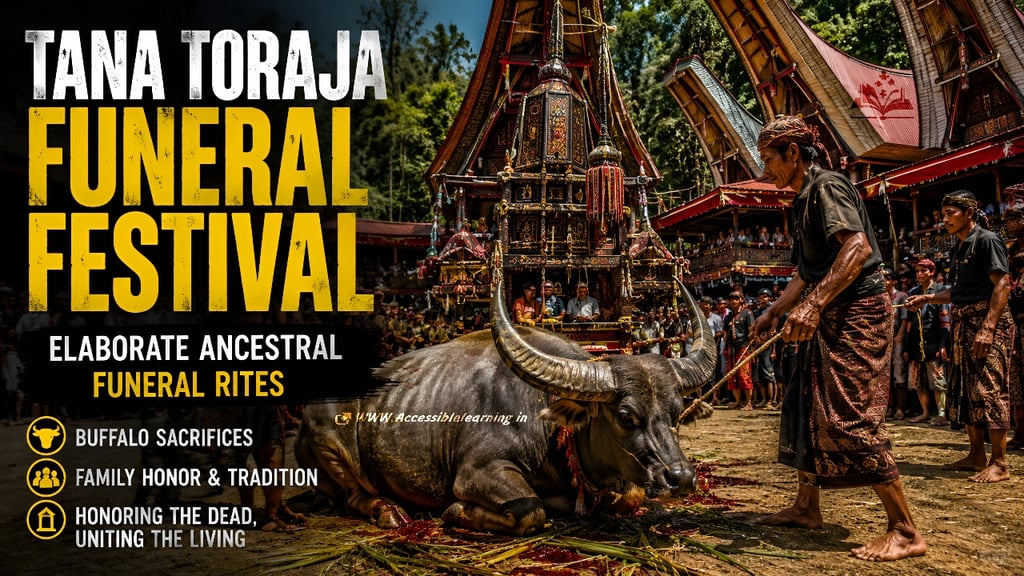
Nothing captures the ceremony's intensity better than the buffalo sacrifices.
The buffalo represents wealth, prestige, and spiritual transportation. According to Torajan belief, buffalo help carry the deceased toward Puya, the afterlife.
That belief creates enormous pressure.
Ordinary ceremonies may involve several buffalo.
Elite families sometimes sacrifice dozens or even more than one hundred.
Rare albino buffalo command astonishing prices because they symbolize exceptional status. A single prized animal can cost more than an average Indonesian family's annual income.
Critics see extravagance.
Local families see sacred responsibility.
Ignoring that distinction misses the entire point.
The Price of Respect Can Last for Years
The world's fascination usually stops at dramatic photographs.
The financial reality deserves far more attention.
Many families spend years, sometimes decades, preparing for one funeral. Relatives working in Jakarta, Singapore, Australia, or Europe send money home because the ceremony represents the entire family's reputation.
Some households borrow heavily.
Others sell livestock or land.
The funeral becomes both a spiritual necessity and an economic burden.
Outsiders often criticize the expense without recognizing the deeper reality.
For Torajans, failing to honor parents properly carries a social cost that money alone cannot measure.
Ancient Ritual Meets Modern Tourism
Tourism changed Tana Toraja forever. International photographers, travel influencers, and documentary crews now arrive hoping to witness ceremonies that few outsiders fully understand.
Some families welcome visitors because tourism creates additional income.
Others worry cameras reduce sacred traditions into viral entertainment.
Social media has intensified that conflict.
Videos showing buffalo sacrifices generate millions of views, but many viewers never learn why the ritual exists. Shock spreads faster than understanding.
The algorithm rewards blood.
Culture receives far less attention.
Christianity Never Erased Older Beliefs
Missionaries introduced Christianity across the region during the twentieth century. Today, many Torajans identify as Christian while still preserving funeral customs rooted in older ancestral traditions.
Rather than replacing local beliefs, many communities blended them.
Church services often stand beside traditional rituals.
Modern clothing appears alongside ceremonial attire.
Christian hymns share space with ancient customs.
This cultural adaptation explains why Torajan funerals remain remarkably resilient despite decades of religious and economic change.


The Ceremony Doesn't End at Burial
Burial itself varies dramatically. Some families place coffins inside limestone cliffs. Others use carved rock chambers. Children may rest inside living trees specially prepared for infant burials.
Wooden ancestor figures called Tau Tau overlook cliffs from balconies, symbolically watching descendants below. These burial sites transform the landscape into a living archive of family history rather than silent cemeteries. Death remains visible instead of hidden.
Ma'Nene Proves the Relationship Never Ends
One of Toraja's most discussed traditions happens long after the funeral.
During Ma'Nene, families carefully remove ancestors from their resting places, clean their bodies, replace clothing, repair coffins, and spend time together before returning them to their graves.
To many outsiders, the practice feels unsettling.
To Torajans, it demonstrates respect.
Remembering ancestors requires action, not sentiment.
The ceremony reinforces the belief that family obligations continue across generations.
Travel Guide: What Visitors Need to Know Before Attending
If you plan to witness a Toraja funeral, leave your expectations behind.
The ceremonies do not operate on fixed tourist schedules. Families determine the timing based on finances, community readiness, and traditional obligations.
Dress conservatively.
Always ask before photographing mourners or sacred rituals.
Never interrupt ceremonies for better camera angles.
Respect animal sacrifices, even if they challenge your personal beliefs.
Hire knowledgeable local guides who understand both the language and cultural expectations.
Most importantly, remember that you are entering someone's family event, not buying a ticket to a performance.
Respect always outweighs curiosity.
Why This Tradition Refuses to Disappear
Globalization usually weakens ancient customs. Tana Toraja continues resisting that trend.
Young Torajans leave for education and careers, yet many return home for family funerals because participation remains a cultural obligation that distance cannot erase.
The ceremonies continue evolving.
Technology changes communication.
Tourism changes economics.
Religion changes interpretation.
None of those forces have eliminated the central idea.
The dead still unite the living.
That may explain why Tana Toraja continues attracting worldwide attention. Visitors arrive expecting an unusual funeral. They leave confronting a deeper question.
What if modern society abandoned meaningful rituals long before this community ever did?
The Tana Toraja Funeral Festival stands among humanity's most remarkable cultural traditions because it refuses to separate death from community, memory, economics, and identity.
Yes, the buffalo sacrifices spark controversy.
Yes, the ceremonies demand extraordinary financial commitment.
Yes, tourism creates uncomfortable tensions.
But reducing these funerals to viral images or exotic headlines misses their real significance.
Tana Toraja reminds the world that honoring the dead requires more than flowers, speeches, or a single afternoon. It demands time, sacrifice, family unity, and a willingness to place collective memory above personal convenience.
Whether admired or questioned, few traditions expose the true cost of respect more honestly than Tana Toraja.
Subscribe To Our Newsletter
All © Copyright reserved by Accessible-Learning Hub
| Terms & Conditions
Knowledge is power. Learn with Us. 📚

