

Tabnine vs Supermaven Comparison: Features, Pricing, and Performance Explained
A detailed comparison of Tabnine vs Supermaven covering features, pricing, security, deployment options, performance, and real-world use cases. Discover which AI coding assistant is better for individuals, startups, and enterprise teams.
AI ASSISTANTEDITOR/TOOLSAI/FUTURE
Sachin K Chaurasiya
3/5/20265 min read
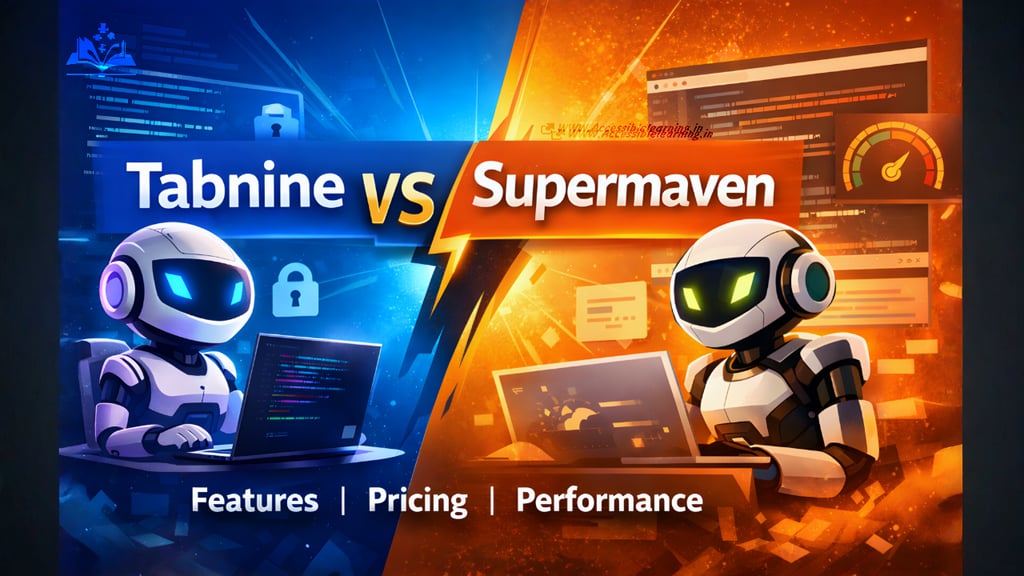
AI coding assistants are no longer optional for serious development workflows. They help reduce repetitive work, speed up implementation, and improve code quality. Two tools that often come up in comparison are Tabnine and Supermaven.
While both are AI-powered coding assistants, they differ significantly in architecture, philosophy, pricing, deployment flexibility, and ideal use cases. This in-depth comparison covers everything you need to make an informed decision.
Product Overview
Tabnine
Tabnine is an AI coding platform designed with enterprise environments in mind. It focuses on secure deployments, team governance, AI-driven workflows, and deep integration into professional development pipelines. It positions itself as more than just autocomplete. It aims to function as an AI teammate embedded in your engineering process.
Supermaven
Supermaven is a newer AI coding assistant built around speed and large context awareness. Its main differentiator is its ability to process very large portions of code at once while delivering low-latency completions. It is particularly appealing to solo developers and small teams due to its strong free tier and affordable pricing.
Context Window and Repository Awareness
One of the most important technical differences lies in how much of your codebase the model can understand at once.
Supermaven
Known for very large context windows.
Designed to handle massive repositories and monorepos.
Helps maintain architectural consistency across distant files.
Particularly strong when working on large-scale refactoring or feature extensions.
Tabnine
Focuses on structured context management.
Uses an enterprise context engine to align suggestions with project patterns.
Optimized for organizational knowledge rather than just token size.
Supports consistency across teams through managed AI guidance.
If your primary challenge is navigating a massive codebase alone, Supermaven’s wide context visibility may feel more powerful. If you manage a team and care about standardization, Tabnine’s structured approach may be more beneficial.
Deployment Flexibility and Infrastructure Control
This is a major decision point for many teams.
Tabnine
Offers cloud deployment.
Supports on-premises installation.
Can run in air-gapped environments.
Suitable for regulated industries such as finance, healthcare, or government.
Supermaven
Primarily cloud-based.
Easy to set up with minimal configuration.
Ideal for developers who prioritize convenience over infrastructure control.
If compliance, data sovereignty, or internal hosting is mandatory, Tabnine clearly stands out.

Security, Privacy, and Data Policies
Security is not just about deployment. It also involves data retention and training policies.
Tabnine
Designed to operate without using your private code for training.
Emphasizes enterprise-grade privacy controls.
Allows stricter control over how data is handled.
Aligns well with organizations that have strict internal security audits.
Supermaven
Cloud-focused with defined retention policies.
Suitable for developers comfortable with cloud-based AI workflows.
More practical for independent developers and startups.
Enterprises should always review contractual data policies before adoption. For individuals, both platforms are generally acceptable, but Tabnine provides more formal control mechanisms.
Performance and Latency
Speed directly affects developer flow.
Supermaven
Built for low-latency completions.
Suggestions appear quickly, reducing interruption.
Strong emphasis on maintaining flow state.
Often praised for responsiveness in large projects.
Tabnine
Prioritizes stable and context-aware suggestions.
May feel slightly more structured than speed-focused.
Designed for reliability within team ecosystems.
If your workflow depends on uninterrupted coding sessions, Supermaven may feel smoother. If structured accuracy and team alignment matter more, Tabnine may fit better.
Feature Depth Beyond Autocomplete
AI assistants are evolving beyond simple code suggestions.
Tabnine
AI chat assistance.
Refactoring support.
Documentation generation.
Enterprise workflow automation.
Integration potential with internal tooling and CI/CD systems.
Governance tools to guide AI behavior according to coding standards.
Supermaven
Inline completions.
Project-wide awareness.
Chat-based assistance.
Optimized for writing and navigating code efficiently.
Focused more on productivity than enterprise orchestration.
Tabnine leans toward system-level automation. Supermaven leans toward developer-level acceleration.
IDE and Language Support
Both tools support major development environments such as:
Visual Studio Code
JetBrains IDEs
Popular programming languages including Python, JavaScript, TypeScript, Java, and more
The difference is not in compatibility but in experience. Supermaven emphasizes speed within the editor. Tabnine emphasizes integration within broader development ecosystems.
Team Collaboration and Governance
This is where the gap widens.
Tabnine
Built-in governance capabilities.
Supports organization-wide coding standards.
Designed for larger engineering teams.
Enables centralized AI configuration.
Supermaven
More developer-centric.
Lightweight setup.
Fewer enterprise governance layers.
Ideal for fast-moving teams without heavy compliance requirements.
If you lead a structured engineering organization, Tabnine’s governance features may justify its higher cost.

Pricing Comparison
Supermaven
Offers a strong free tier.
Affordable Pro plan.
Excellent value for freelancers and startups.
Low barrier to entry.
Tabnine
Free version with limited capabilities.
Paid tiers for advanced features.
Enterprise pricing for private deployment and advanced controls.
Higher overall cost but includes enterprise-grade features.
Budget-conscious developers will likely lean toward Supermaven. Larger organizations may see Tabnine as an investment in infrastructure stability.
Scalability
Supermaven
Scales well for individual developers and small teams.
Handles large repositories efficiently.
Tabnine
Scales across departments and large engineering teams.
Designed for long-term enterprise adoption.
Integrates into structured DevOps pipelines.
Learning Curve and Setup
Supermaven
Quick installation.
Minimal configuration.
Beginner-friendly.
Tabnine
Simple for basic use.
Advanced features may require configuration and policy setup.
More complexity at enterprise scale.
Pros and Cons Summary
Supermaven
Pros
Massive context window
Fast completions
Affordable pricing
Strong free plan
Great for large repositories
Cons
Cloud-first architecture
Limited enterprise deployment flexibility
Fewer governance controls
Tabnine
Pros
On-prem and air-gapped deployment
Enterprise-grade privacy controls
Governance and workflow automation
Strong compliance positioning
Team-level AI configuration
Cons
Higher pricing
More complex for small teams
May be excessive for solo developers
Tabnine and Supermaven serve different audiences.
If you are a solo developer, startup founder, or small team that wants speed, affordability, and wide repository awareness, Supermaven is often the practical choice. If you operate in a compliance-heavy industry, manage a structured engineering organization, or need private AI deployment and governance controls, Tabnine is likely the better long-term solution.
Both tools can improve productivity significantly. The right choice depends less on features and more on your environment, compliance requirements, and development scale. In the end, the most reliable way to decide is simple: test them in your actual workflow and measure what truly improves your output.


FAQ's
Q: Is Tabnine better than Supermaven?
It depends on your needs.
If you are an individual developer or small team focused on speed and large codebase awareness, Supermaven may feel more efficient.
If you are part of a larger organization that requires private deployment, compliance controls, and governance features, Tabnine is typically the stronger choice.
Q: Which tool is better for large codebases or monorepos?
Supermaven is known for handling very large context windows, which can make it highly effective for monorepos and complex architectures.
Tabnine can also manage large projects, but its strength lies more in structured enterprise context management rather than sheer context size.
Q: Can Tabnine or Supermaven run without sending code to the cloud?
Tabnine supports on-premises and air-gapped deployments, making it suitable for teams that cannot send code to external servers.
Supermaven is primarily cloud-based, so organizations with strict data policies should review its infrastructure model before adopting it.
Q: Do these tools train on my private code?
Both tools emphasize privacy policies that protect user code. However, the specifics vary by plan and deployment type.
For enterprises, it is always recommended to review contractual agreements and data usage terms before integration.
Q: Which is more affordable for individual developers?
Supermaven generally offers a stronger free tier and a lower-cost Pro plan, making it more accessible for solo developers and freelancers.
Tabnine’s advanced features are primarily geared toward paid and enterprise plans, which may be more suitable for larger teams.
Q: Do Tabnine and Supermaven support major IDEs?
Yes. Both tools integrate with popular editors such as Visual Studio Code and JetBrains IDEs. They also support widely used programming languages, including Python, JavaScript, TypeScript, Java, and more.
Q: Will these tools replace developers?
No. These tools are productivity assistants. They help generate boilerplate code, suggest improvements, and reduce repetitive tasks. Developers are still responsible for architecture, logic, validation, and final decisions.
Q: Which tool is easier to set up?
Supermaven is typically faster to install and start using, especially for individual developers.
Tabnine is also simple to install, but enterprise-level deployment and governance features may require additional configuration.
Subscribe to Frontier Intelligence
All © Copyright reserved by Accessible-Learning Hub
| Terms & Conditions
Accessible Learning Hub — Actionable clarity for high-agency minds.
Weekly breakdowns on AI breakthroughs, capital flow, and human performance systems. Zero fluff.