

Synthetic Meat vs. Regenerative Farming: The War for Your Plate
As the global food system faces climate pressure and rising demand, two powerful solutions are emerging: synthetic meat and regenerative farming. This in-depth guide explores how lab-grown meat and soil-restoring agriculture compete to shape the future of food and sustainability and what ultimately ends up on your plate.
AI/FUTUREA LEARNINGENVIRONMENT
Kim Shin | Jagdish Nishad
3/25/20268 min read
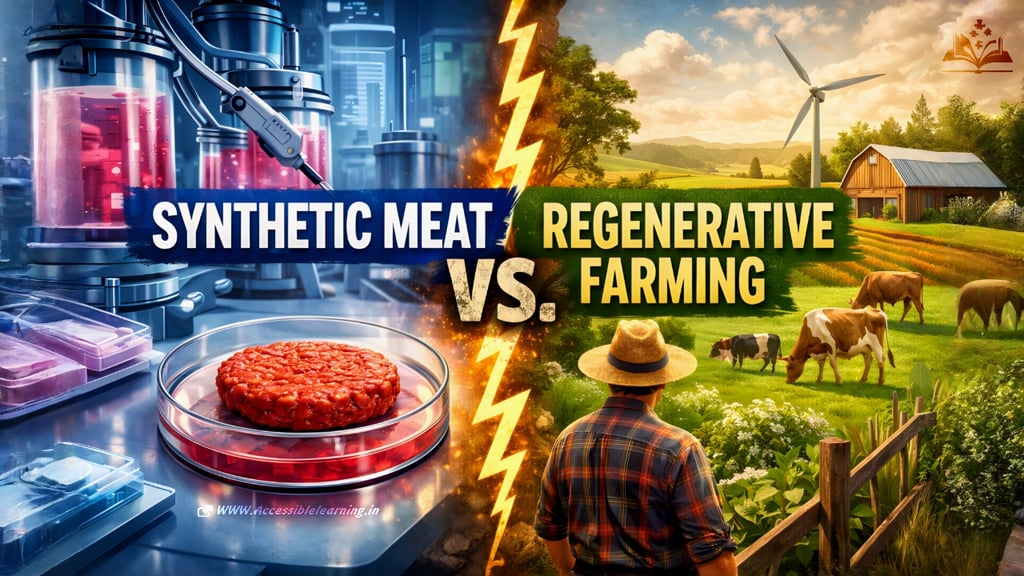
The future of food is becoming one of the most important global debates of the 21st century. As the world’s population approaches 10 billion people, the pressure on agriculture, land, water, and climate systems continues to grow. Traditional industrial farming has long been criticized for its environmental impact, while new technologies promise alternatives that could reshape how food is produced.
Two powerful movements now sit at the center of this debate: synthetic meat (also known as lab-grown or cultivated meat) and regenerative farming. Both claim to offer a path toward sustainable food systems, but they approach the problem in completely different ways.
Synthetic meat focuses on technology and biotechnology, creating meat without raising animals. Regenerative farming focuses on restoring natural ecosystems, improving soil health and biodiversity through better farming practices.
These two visions represent more than just different farming methods. They reflect two fundamentally different ideas about the future of food.
Understanding Synthetic Meat
Synthetic meat, often called cultivated meat or lab-grown meat, is produced by growing animal cells in a controlled environment rather than raising and slaughtering animals.
Scientists take a small sample of animal cells and place them in a nutrient-rich environment where the cells multiply and form muscle tissue. Over time, these cells grow into meat that is biologically identical to conventional meat.
How Synthetic Meat Is Produced
The production process generally follows several steps:
Cell Extraction: A small biopsy is taken from an animal to obtain muscle cells.
Cell Cultivation: The cells are placed in a nutrient medium containing amino acids, sugars, vitamins, and growth factors.
Bioreactor Growth: Cells multiply inside bioreactors, similar to fermentation tanks used in brewing.
Tissue Structuring: The growing cells form muscle fibers that resemble traditional meat.
Harvesting and Processing: The cultivated tissue is harvested and shaped into products like burgers, nuggets, or steaks.
Why Synthetic Meat Is Gaining Attention
Advocates believe synthetic meat could dramatically reduce the environmental impact of meat production. Potential benefits include:
Reduced land use
Lower methane emissions
Less water consumption
Elimination of animal slaughter
Reduced risk of zoonotic diseases
Livestock farming currently contributes around 14–15% of global greenhouse gas emissions, largely from cattle methane emissions and land clearing for grazing. Synthetic meat aims to bypass these environmental costs.
Current Challenges
Despite the excitement, cultivated meat still faces major hurdles:
High production costs: Although costs have dropped significantly since the first lab-grown burger in 2013, scaling production remains expensive.
Energy demand: Large bioreactors require significant energy input, raising questions about whether cultivated meat truly reduces emissions.
Consumer acceptance: Many people remain skeptical about eating meat grown in laboratories.
Regulatory barriers: Food safety authorities are still developing frameworks for approval.
Some companies have already received regulatory approval in limited markets, but global adoption is still in its early stages.


What Is Regenerative Farming?
Regenerative farming takes a completely different approach. Instead of replacing animals with technology, it focuses on working with natural systems to restore soil, ecosystems, and biodiversity.
The idea is simple: healthy soil can store carbon, support stronger crops, and reduce the environmental damage caused by conventional agriculture. Regenerative agriculture emphasizes practices that rebuild soil health rather than degrade it.
Core Principles of Regenerative Farming
Common regenerative techniques include:
Rotational grazing: Animals move between pastures, preventing overgrazing and allowing vegetation to recover.
Cover crops: Farmers plant crops specifically to protect and enrich soil during off-seasons.
Reduced tillage: Minimizing soil disturbance preserves soil structure and microbial life.
Agroforestry: Trees are integrated into farmland to increase biodiversity and carbon storage.
Composting and natural fertilization: Organic matter replaces synthetic fertilizers.
Why Soil Health Matters
Soil is one of the planet’s largest carbon sinks. Healthy soil can store enormous amounts of carbon that would otherwise enter the atmosphere as CO₂. Some regenerative agriculture advocates believe improved farming methods could help reverse soil degradation and reduce climate impacts.
Benefits often cited include:
Increased soil carbon storage
Improved water retention
Greater biodiversity
Reduced chemical inputs
More resilient ecosystems
Rather than replacing livestock, regenerative systems often integrate animals as part of ecological cycles.
The Environmental Debate
The environmental debate between synthetic meat and regenerative farming is complex. Both sides claim to reduce agriculture’s impact on climate and ecosystems.
Synthetic Meat Argument
Supporters argue that cultivated meat could dramatically reduce the need for:
Large grazing lands
Industrial livestock farms
Deforestation for feed crops
Methane emissions from cattle
In theory, meat could be produced in urban production facilities, freeing land for forests or biodiversity restoration.
Regenerative Farming Argument
Regenerative agriculture advocates counter that well-managed livestock can actually improve ecosystems.
They argue that grazing animals:
Stimulate plant growth
Help cycle nutrients into soil
Increase soil carbon storage
Restore degraded land
Critics of lab-grown meat also warn that highly industrialized food production could shift control of food systems toward large biotech companies.
The debate therefore extends beyond sustainability and into questions about food sovereignty, rural economies, and corporate control.
Economic and Industry Implications
The future of food is also a major economic battlefield.
The Rise of Food Technology
Venture capital investment in alternative proteins has surged over the past decade. Major food companies and technology investors are funding cultivated meat startups in hopes of building a new global protein industry.
The cultivated meat sector is developing:
Advanced bioreactor systems
Animal-free growth media
3D tissue structuring technologies
If scalable, these technologies could create entirely new manufacturing-based food supply chains.
The Resurgence of Sustainable Farming
At the same time, regenerative agriculture is gaining momentum among farmers, environmental groups, and food companies seeking more sustainable supply chains. Large brands are investing in regenerative practices to:
Improve sustainability reporting
Reduce environmental footprints
Respond to consumer demand for ethical food production
This movement could reshape agriculture by encouraging smaller-scale, ecosystem-focused farming systems.
Consumer Perception and Trust
Public opinion will ultimately shape which food systems succeed. Many consumers are excited about innovative food technologies, but others feel uncomfortable with highly engineered foods.
Common consumer concerns about synthetic meat include:
Perceived artificiality
Food safety worries
Nutritional differences
Corporate ownership of food technology
Regenerative agriculture, on the other hand, often appeals to consumers seeking natural, locally produced food. However, regenerative systems can be harder to scale globally, and verifying regenerative claims can be challenging without standardized certification.

Nutritional Questions Still Matter
One of the biggest questions in this debate is nutrition. Synthetic meat is designed to mimic conventional meat, but many people still wonder whether it can truly match the full nutritional profile of naturally raised animal products. Protein may be easy to replicate, but factors like fat composition, micronutrients, and long-term health effects are still part of the discussion.
Regenerative farming supporters often argue that food quality starts with soil quality. Their view is that healthier soil can produce more nutrient-dense crops and support healthier animals. That does not automatically mean every regenerative product is better, but it does show that this debate is not only about emissions or technology. It is also about what kind of food people want to trust and eat over time.
The Corporate Control Question
Another important layer is ownership. Synthetic meat is being developed mostly by startups, biotech firms, and heavily funded food-tech companies. That creates concern about patents, production control, and whether the future food system could become more centralized in the hands of a few major players.
Regenerative farming usually points in the opposite direction. It is often connected with local farms, regional supply chains, and farmer-led systems. Supporters say this keeps food production closer to communities. Critics, however, argue that regenerative farming can still be used as a marketing label by large corporations if standards remain unclear.
Can Either Option Truly Scale?
Scalability is where the debate gets more serious. Synthetic meat sounds promising in theory, but producing large volumes at affordable prices remains a major challenge. The science is moving fast, but replacing a meaningful share of global meat demand is not simple.
Regenerative farming also faces scaling issues. It may work well in certain regions, but not every landscape, climate, or farming economy can shift easily. It often requires education, patience, and long-term land management, which makes rapid adoption difficult. So the real issue is not just which model sounds better. It is the model that can work in the real world at a global level.
A Bigger Cultural Shift Around Food
This conflict also reflects a cultural divide. Synthetic meat represents a future where food becomes more engineered, controlled, and technologically produced. Regenerative farming represents a return to ecological thinking, land stewardship, and slower agricultural systems.
That is why this conversation feels bigger than meat alone. It touches values like tradition, innovation, trust, convenience, and the human relationship with nature. In many ways, the war for your plate is also a war over what kind of future people are willing to accept.
The Future: Competition or Coexistence?
The debate between synthetic meat and regenerative farming is often framed as a direct conflict, but the reality may be more nuanced. Some experts believe the future food system could include both approaches.
Synthetic meat might reduce pressure on industrial livestock production, particularly in dense urban regions. Regenerative farming could help restore soil health and biodiversity while continuing to produce animal products through ecological farming systems.
The ultimate outcome will likely depend on:
Technological breakthroughs
Climate policy
consumer behavior
agricultural economics
global food demand


Why This Debate Matters
The choices societies make about food production will influence:
climate stability
biodiversity loss
rural livelihoods
public health
global food security
Agriculture already occupies nearly half of the planet’s habitable land, making it one of humanity’s largest environmental footprints.
Whether the future of meat comes from bioreactors or revitalized soil ecosystems, the decisions made today will shape how billions of people eat in the decades ahead. The war for your plate is not just about what food looks like. It is about how humanity chooses to produce food in a world facing environmental limits.
Both synthetic meat and regenerative farming offer visions of a different agricultural future. The real challenge will be deciding which path, or combination of paths, can truly feed the planet while protecting it.
FAQ's
Q: What is synthetic meat?
Synthetic meat, also called cultivated or lab-grown meat, is produced by growing animal cells in controlled laboratory environments. Instead of raising and slaughtering animals, scientists cultivate muscle cells in nutrient-rich bioreactors until they form real meat tissue. The goal is to produce meat with fewer environmental impacts than traditional livestock farming.
Q: What is regenerative farming?
Regenerative farming is an agricultural approach that focuses on restoring soil health, improving biodiversity, and strengthening ecosystems. Farmers use practices like rotational grazing, cover crops, composting, and reduced tillage to rebuild soil and make farming more sustainable over time.
Q: Is synthetic meat safe to eat?
Yes, cultivated meat is designed to meet strict food safety standards before reaching consumers. Governments and food regulators evaluate production processes, ingredients, and safety data before approving products. However, regulations are still evolving in many countries as the technology develops.
Q: Which option is better for the environment?
Both approaches aim to reduce the environmental impact of food production, but they do so differently. Synthetic meat may reduce land use, water use, and methane emissions from livestock. Regenerative farming focuses on improving soil health, increasing carbon storage, and restoring ecosystems. The overall impact depends on how each system is implemented at scale.
Q: Does synthetic meat taste the same as regular meat?
Because cultivated meat is grown from real animal cells, it is biologically similar to traditional meat. Many companies are working to replicate the texture, flavor, and structure of conventional meat products. Early products often appear first in processed forms like nuggets or burgers, while whole cuts are still being developed.
Q: Can regenerative farming feed the global population?
This remains a major topic of debate. Supporters argue that healthier soils and improved farming methods can increase long-term productivity and resilience. Critics question whether regenerative systems alone can meet global demand for meat and crops without significant land expansion.
Q: Why are tech companies investing in synthetic meat?
The global demand for protein is expected to grow significantly as populations rise. Many investors believe cultivated meat could become a large future food industry, reducing pressure on land and livestock while creating new biotech-driven supply chains.
Q: Why is regenerative agriculture gaining popularity?
Consumers and food companies are becoming more concerned about soil degradation, climate change, and biodiversity loss. Regenerative agriculture offers a way to produce food while repairing ecosystems rather than depleting them, which is why it is gaining attention in sustainability discussions.
Q: Is synthetic meat vegan?
Not exactly. Although no animals are slaughtered during production, cultivated meat is still derived from animal cells. Because of this, many vegans do not consider it fully vegan, though some view it as an ethical improvement over traditional meat.
Q: What does the future of meat production look like?
The future food system may include multiple approaches. Synthetic meat could help reduce reliance on industrial livestock farming, while regenerative agriculture could restore ecosystems and improve soil health. Rather than one replacing the other, both models may coexist as the global food system evolves.
Subscribe to Frontier Intelligence
All © Copyright reserved by Accessible-Learning Hub
| Terms & Conditions
Accessible Learning Hub — Actionable clarity for high-agency minds.
Weekly breakdowns on AI breakthroughs, capital flow, and human performance systems. Zero fluff.