

Subtitles, Lore, and The New Digital Literacy
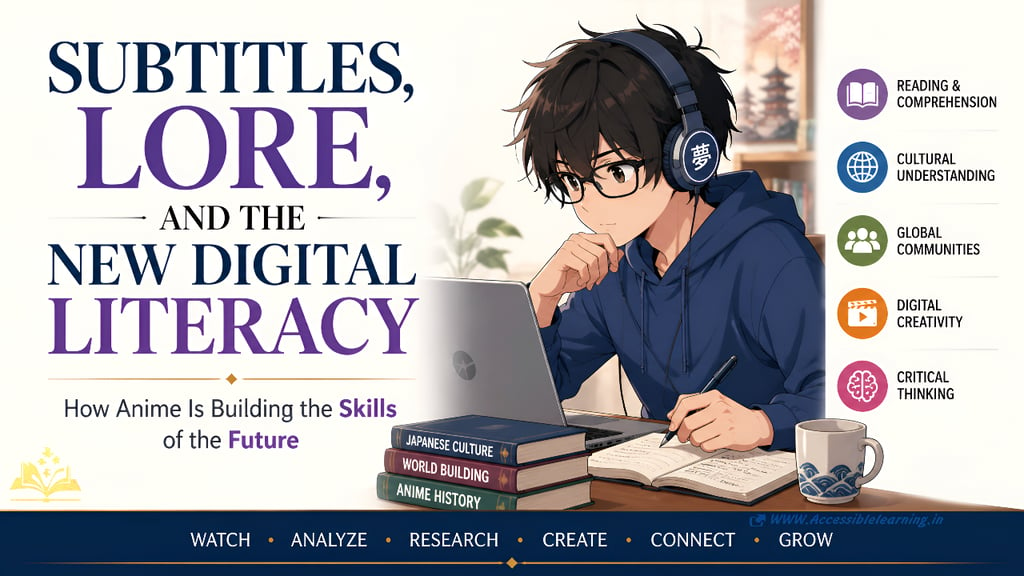
Anime is no longer just entertainment. Discover how subtitles, lore analysis, fan communities, and digital creativity are helping a new generation develop critical thinking, media literacy, research skills, and global communication abilities in the digital age.
ANIME INDUSTRYEDUCATION/KNOWLEDGECOMPANY/INDUSTRY
Hikari | Kim Shin
6/18/20267 min read
Stop Calling It Passive Screen Time
For years, screen time has been treated as a simple equation: more hours in front of a screen equals less learning, less engagement, and less productivity. Parents worry about it. Educators criticize it. Commentators often dismiss it as passive entertainment.
But that perspective is becoming increasingly outdated.
Today's anime fans are not merely sitting back and consuming content. They are decoding subtitles at high speed, tracking complex fictional histories, participating in global discussions, creating multimedia projects, researching cultural references, and engaging with communities that span continents.
In many ways, anime culture has become an unexpected training ground for modern digital literacy.
The skills required to fully participate in contemporary fandom often mirror the very competencies that schools, universities, and employers increasingly value: critical thinking, information synthesis, media analysis, cross-cultural communication, digital creativity, and online collaboration.
The question is no longer whether anime is "just entertainment."
The better question is:
What skills are people actually developing while engaging with it?
Understanding Digital Literacy in the Modern Era
Traditional literacy focused on reading and writing. Digital literacy is broader.
Today, it includes the ability to:
Interpret information from multiple media formats
Navigate online communities
Evaluate sources
Understand digital culture
Communicate across platforms
Create multimedia content
Participate responsibly in online ecosystems
Modern learners are expected to process text, images, audio, video, and social interaction simultaneously. Anime fandom often demands exactly these abilities.
What appears to outsiders as casual entertainment frequently involves sophisticated layers of engagement that require active participation rather than passive viewing.
The Hidden Skill of Reading Subtitles
One of the most overlooked aspects of anime consumption is subtitle reading.
Unlike dubbed content, subtitles require viewers to process written language while simultaneously interpreting visual storytelling, character expressions, environmental details, and plot developments.
This creates a form of multitasking that strengthens several cognitive skills.
Viewers must:
Read quickly
Maintain visual attention
Process dialogue context
Interpret emotional cues
Connect spoken and written information
Many anime series feature rapid dialogue, dense exposition, or culturally nuanced conversations that require sustained concentration. Fans often become highly efficient readers without realizing it.
Over time, subtitle-heavy viewing can improve reading speed, comprehension, and the ability to extract meaning from text under time constraints.
While subtitles are not a substitute for formal reading education, they represent a surprisingly active form of media engagement.
Lore Consumption Is Advanced Information Processing
Modern anime storytelling has evolved far beyond simple episodic narratives. Many series now feature:
Multi-generational histories
Political systems
Fictional religions
Power structures
Timelines
Geographic regions
Mythological references
Understanding these worlds often requires viewers to collect and organize large amounts of information. Consider how fans engage with complex franchises.
They create:
Timeline charts
Character relationship maps
Theory documents
Historical breakdowns
World-building analyses
Keeping track of these details resembles the kind of information management used in academic research. Fans frequently compare sources, identify inconsistencies, build interpretations, and discuss evidence with others. In practical terms, they are learning how to organize knowledge across multiple interconnected sources.

The Rise of Fandom Research Culture
A single episode can generate hundreds of questions.
Who is that character?
What historical event was referenced?
What does a particular symbol mean?
Is there a cultural tradition behind a scene?
Anime communities often encourage investigation rather than passive acceptance.
Fans routinely search for:
Historical inspirations
Folklore references
Language nuances
Production details
Creator interviews
Source material comparisons
This habit of digging deeper cultivates research behavior. People learn how to search effectively, compare information sources, verify claims, and build informed interpretations. These are increasingly valuable skills in a world flooded with information.
Global Communities Create Cross-Cultural Literacy
Anime is inherently international. A viewer in India might discuss a new episode with fans in Brazil, Germany, Indonesia, Canada, and Japan within minutes of release.
This global environment exposes participants to different perspectives, communication styles, and cultural contexts. Fans learn:
International communication etiquette
Online collaboration
Cultural sensitivity
Perspective-taking
Community moderation norms
Many discover aspects of Japanese culture, history, language, customs, and social values while simultaneously interacting with people from entirely different backgrounds. The result is a form of informal global education. These interactions help develop cultural awareness that traditional classrooms often struggle to provide.
Memes Are a Language of Their Own
Internet culture operates through memes, references, inside jokes, and evolving formats. Anime fandom is one of the most active participants in this ecosystem.
Creating or understanding memes requires the following:
Context awareness
Pattern recognition
Visual communication
Humor interpretation
Community knowledge
To outsiders, a meme may look simple. To insiders, it often contains layers of references that connect multiple stories, events, characters, and community discussions. Navigating this environment strengthens the ability to decode symbolic communication, a growing necessity in digital spaces.
AMVs and Edits: Digital Creativity in Action
Anime Music Videos (AMVs), short edits, and fan compilations have become major forms of creative expression. Producing these projects involves a surprising range of technical skills.
Creators often learn:
Video editing
Motion graphics
Audio synchronization
Storyboarding
Visual pacing
Graphic design principles
Many begin as hobbyists and gradually develop professional-level abilities. The skills gained through fandom projects frequently transfer into careers involving media production, marketing, design, content creation, and digital storytelling. What starts as a tribute to a favorite series can become a gateway into creative industries.

Learning Through Community Discussion
Online anime communities are often driven by analysis. Fans debate:
Character motivations
Symbolism
Themes
Plot predictions
Ethical dilemmas
Narrative structure
These discussions encourage participants to support arguments with evidence. People quote scenes, compare episodes, reference source materials, and challenge interpretations.
This resembles critical discussion practices used in literature courses and academic environments. The difference is that participants are often motivated by genuine enthusiasm rather than obligation. That enthusiasm can create deeper engagement and longer-lasting learning.
Why Lore Analysis Mirrors Critical Thinking
Critical thinking involves more than finding the correct answer. It requires evaluating evidence, identifying assumptions, and considering multiple interpretations. Anime fandom regularly exercises these abilities.
When viewers analyze:
Character decisions
Story themes
Hidden clues
Narrative foreshadowing
they are engaging in interpretation rather than simple consumption. Complex stories invite audiences to connect information across episodes, compare perspectives, and construct theories. These activities train analytical thinking in ways that are both enjoyable and intellectually demanding.
The Shift From Consumer to Participant
Perhaps the most significant change in modern media culture is the shift from passive audiences to active participants. Anime fans rarely stop at watching.
They often:
Discuss
Analyze
Create
Edit
Research
Share
Collaborate
Teach others
This participatory model transforms entertainment into an interactive learning environment. People are no longer simply receiving content. They are contributing to ecosystems built around that content. This distinction matters because participation develops skills that consumption alone cannot.
What Parents and Educators Often Miss
The concern about excessive screen time is understandable. Not all digital engagement is equally beneficial. However, focusing exclusively on time spent overlooks an important question:
What is happening during that time?
A teenager who spends two hours analyzing story themes, creating video edits, discussing cultural references, and collaborating with global communities is engaging differently from someone mindlessly scrolling through endless content.
The educational value lies not in the platform itself but in the depth of engagement. Understanding this distinction allows parents and educators to evaluate digital activities more accurately. The goal should not be eliminating screens. The goal should be encouraging meaningful interaction with them.
The Future of Literacy Looks Different
The modern world demands more than traditional reading and writing skills. People must navigate information-rich environments, understand digital culture, communicate globally, and create content across multiple formats.
Anime fandom unexpectedly intersects with many of these requirements. Through subtitles, lore exploration, community participation, content creation, and cultural exchange, fans often develop competencies that align closely with modern definitions of digital literacy.
This does not mean every anime viewer automatically gains these skills. But it does challenge the assumption that watching anime is inherently passive. In reality, many fans are practicing forms of reading, research, analysis, creativity, and communication that reflect the demands of a digital-first world.
The next time someone dismisses anime as "just screen time," it may be worth looking closer. Behind the subtitles and story arcs is an ecosystem that encourages curiosity, creativity, critical thinking, and global connection. And those are exactly the kinds of skills that define literacy in the twenty-first century.

FAQ's
Q: How does watching anime improve digital literacy?
Anime can improve digital literacy by encouraging viewers to read subtitles, analyze complex stories, research cultural references, participate in online discussions, and create digital content such as edits, reviews, and fan projects. These activities strengthen reading, communication, critical thinking, and media literacy skills.
Q: Is watching anime considered passive screen time?
Not always. While casual viewing can be passive, many anime fans actively engage with story analysis, lore research, community discussions, content creation, and cross-cultural learning. This makes anime consumption far more interactive than traditional passive entertainment.
Q: Do subtitles help improve reading skills?
Yes. Reading subtitles requires viewers to process text quickly while following visual storytelling and dialogue. This can support reading speed, comprehension, attention, and information processing skills, especially among regular subtitle users.
Q: What skills do anime fans develop through lore analysis?
Lore analysis can help develop critical thinking, pattern recognition, information organization, research abilities, memory retention, and analytical reasoning. Fans often connect clues, timelines, character histories, and world-building elements to understand complex narratives.
Q: How does anime encourage critical thinking?
Many anime series present layered themes, moral dilemmas, symbolism, and hidden story details. Viewers often evaluate character decisions, interpret messages, compare perspectives, and form theories, all of which promote critical thinking and deeper analysis.
Q: Can anime help with cross-cultural understanding?
Yes. Anime introduces audiences to aspects of Japanese culture, traditions, language, history, and social values. Global anime communities also allow fans to interact with people from different countries, fostering cultural awareness and international communication skills.
Q: Why are anime communities important for learning?
Anime communities encourage discussion, debate, collaboration, and knowledge sharing. Fans exchange ideas, explain complex concepts, discuss themes, and recommend resources, creating an environment that supports informal learning and intellectual engagement.
Q: How do anime edits and AMVs build digital skills?
Creating Anime Music Videos (AMVs) and edits often requires video editing, storytelling, audio synchronization, graphic design, motion effects, and content publishing skills. These abilities are relevant to careers in media, marketing, content creation, and digital production.
Q: Does anime help develop media literacy?
Yes. Anime viewers frequently evaluate narratives, identify themes, interpret symbolism, recognize storytelling techniques, and assess information shared within online communities. These practices contribute to stronger media literacy and digital awareness.
Q: Why should parents and educators view anime differently?
Parents and educators should evaluate the quality of engagement rather than focusing only on screen time duration. Many anime fans actively practice reading, research, creativity, communication, and problem-solving skills, making anime a potential tool for digital learning and cultural exploration rather than merely entertainment.
Subscribe To Our Newsletter
All © Copyright reserved by Accessible-Learning Hub
| Terms & Conditions
Knowledge is power. Learn with Us. 📚

