

Student Online Privacy in the AI Age: Risks, Rights, and Smart Safety Practices
In the AI era, student data is constantly collected, analyzed, and stored across learning platforms and digital tools. This guide explains what online privacy really means for students today, the hidden risks behind AI-powered education, and practical ways to stay safe while learning online.
A LEARNINGEDUCATION/KNOWLEDGEAI/FUTURE
Shiv Singh Rajput
2/13/20267 min read
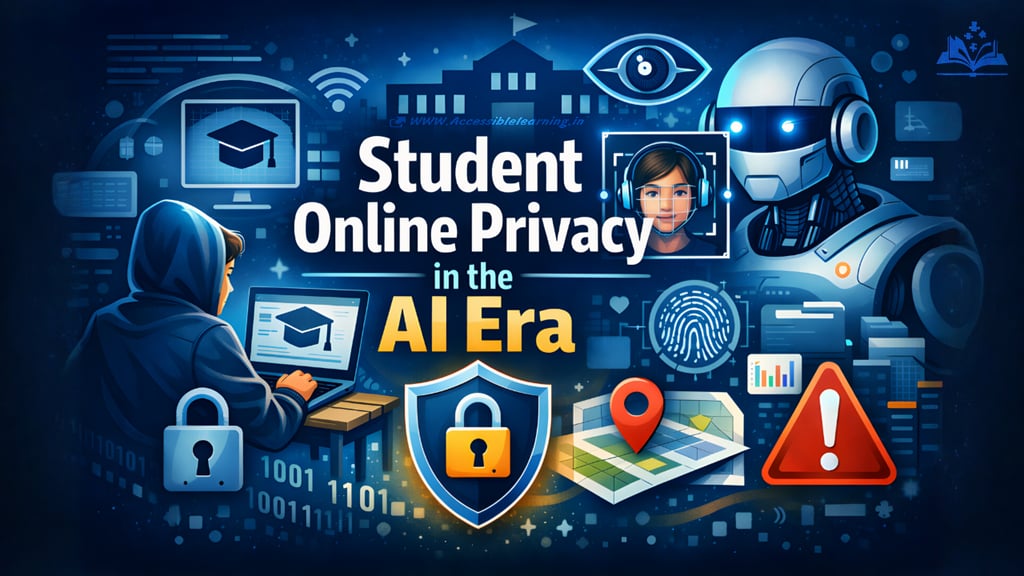
The internet has always collected data, but the rise of AI has changed the scale, speed, and purpose of that collection. For students, this shift matters more than ever. From online classes and learning apps to AI-powered tools that track behavior, recommend content, or grade assignments, student data is constantly being generated, analyzed, and stored.
Understanding online privacy is no longer optional. It is a basic digital survival skill. This article explains how student data is collected in the AI era, what risks exist, and how students can protect themselves without becoming paranoid or disconnected from technology.
Why Student Privacy Matters More in the AI Era
AI systems do not just store data. They learn from it. When students use educational platforms, AI tools, browsers, or social media, they create detailed digital profiles. These profiles can include:
Learning speed and weaknesses
Attention patterns and behavior
Search history and interests
Location and device usage
Voice, face, and biometric data
Unlike traditional data collection, AI connects small pieces of information to make predictions. This can influence academic opportunities, advertising exposure, future job screening, and even mental health assessments. For students, this data trail begins early and can follow them for years.
How Student Data Is Collected Today
Many students underestimate how much data they share daily. Common sources include:
Online Learning Platforms: LMS tools, virtual classrooms, and test platforms track logins, time spent, clicks, answers, and sometimes even webcam activity.
AI Study Tools: AI tutors, writing assistants, and note-taking apps often store prompts, assignments, and personal learning patterns.
Browsers and Search Engines: Search queries related to studies, exams, or careers are logged and linked to user profiles.
Mobile Apps and Devices: Educational apps may access contacts, storage, microphones, cameras, or location data beyond what is necessary.
Social Media and Communities: Study groups, academic posts, and casual interactions still feed advertising and profiling algorithms.
Key Privacy Risks Students Should Be Aware Of
Over-Collection of Data
Many platforms collect more data than they need. This increases exposure if data is shared, sold, or breached.
Lack of Transparency
Students are rarely told clearly how long data is stored, who can access it, or how it is used to train AI models.
Data Used Beyond Education
Student data may be repurposed for marketing, analytics, or third-party partnerships.
AI Bias and Profiling
AI systems may label students based on behavior or performance, which can reinforce bias or limit opportunities.
Surveillance Fatigue
Constant monitoring through webcams, screen tracking, or behavior analytics can harm mental well-being and trust.
Data Breaches
Educational institutions and edtech platforms are frequent targets for cyberattacks due to weak security practices.
AI Tools in Education: Helpful but Not Neutral
AI-powered tools can improve learning, but they are not neutral observers. When students use AI tools:
Their prompts may be logged
Their writing style can be analyzed
Their mistakes may be stored as training data
Their behavior may influence future recommendations
This does not mean students should avoid AI. It means they should use it consciously. A good rule is simple: do not share anything with an AI tool that you would not be comfortable seeing stored long-term.
Important Online Privacy Rights Students Should Know
Depending on the region, students may have legal protections such as
The right to know what data is collected
The right to access or correct personal data
The right to request data deletion
Limits on data collection for minors
Even if laws exist, enforcement is often weak. Awareness is the first line of defense.

Practical Online Privacy Tips for Students
Use Strong, Unique Passwords
Never reuse passwords across study platforms, email, and social media. Use a password manager if possible.
Review App Permissions
Check what apps can access your camera, microphone, location, and files. Remove unnecessary permissions.
Be Careful With AI Inputs
Avoid sharing personal identifiers, private documents, or sensitive thoughts with AI tools.
Use Privacy-Focused Browsers and Settings
Enable tracker blocking, limit cookies, and regularly clear browsing data.
Think Before Posting
Academic posts, opinions, or jokes can be archived and analyzed later. Context does not always survive algorithms.
Keep Devices Updated
Security updates often fix vulnerabilities that attackers exploit.
The Long-Term Digital Footprint Students Rarely Think About
Student data does not disappear after graduation. AI systems archive patterns, not just files. Study habits, learning difficulties, writing styles, and behavioral signals can remain stored for years.
This matters because future systems may reuse old data in new contexts. A learning profile created in school could later influence scholarship screening tools, job assessment algorithms, or recommendation engines. What feels like harmless data today can become a permanent digital identity tomorrow.
AI-Generated Content and Ownership Confusion
When students use AI to write, summarize, or brainstorm, a major question arises: who owns the output?
Many platforms reserve the right to reuse student-generated content to train their models. This means:
Personal ideas may be absorbed into future AI outputs
Original thinking can lose ownership clarity
Sensitive academic work might be stored indefinitely
Students should always review content ownership clauses, especially for creative or research-heavy work.
Facial Recognition and Biometric Risks in Online Education
Some institutions use facial recognition for attendance, exams, or identity verification. This introduces serious privacy concerns.
Biometric data is different from passwords. You cannot change your face or voice if that data is leaked. Once compromised, biometric information creates lifelong risk.
Students should question systems that require face scans or continuous camera access unless there is a strong, transparent justification.
Algorithmic Pressure and Mental Health Impact
AI systems often track productivity, attention, and engagement. While designed to improve performance, this can create invisible pressure. Students may feel:
Constantly judged by unseen systems
Anxious about being “flagged” as low-performing
Afraid to explore creatively due to monitoring
Privacy is not only about security. It is also about psychological safety and freedom to learn without fear.
Dark Patterns in Educational Platforms
Some edtech tools use design tricks to push students into sharing more data. These include:
Default opt-in settings for data sharing
Confusing consent language
Hard-to-find privacy controls
Pressure to connect social accounts
Learning platforms should support education, not manipulate behavior. Students should take time to explore privacy settings instead of clicking “agree” quickly.


The Risk of Data Profiling and Labeling
AI thrives on categorization. Once a student is labeled as a “slow learner,” “high risk,” or “low engagement,” that label can follow them silently across systems.
Even if labels are not visible, they can affect:
Content recommendations
Academic interventions
Teacher dashboards
Automated decision systems
Students deserve the right to grow without being trapped by past data.
Third-Party Tools Used Without Student Awareness
Schools often integrate multiple tools into one system. A single login may connect to several third-party services behind the scenes. Each service may collect its own data, increasing exposure. Students are rarely informed about how many external companies have access to their academic activity. Transparency here is essential but often missing.
AI Surveillance vs Trust-Based Learning
Education works best when built on trust. Over-surveillance can reduce curiosity and honesty. When students know they are constantly tracked, they may:
Avoid asking genuine questions
Focus on pleasing algorithms instead of learning
Lose confidence in their own thinking
Privacy-respecting systems encourage exploration. Surveillance-heavy systems create compliance, not understanding.
Preparing Students for a Privacy-Aware Future
Privacy education should be part of digital literacy, not an afterthought. Students should learn:
How AI systems work at a basic level
What data is valuable and why
How to read privacy policies critically
How to advocate for their digital rights
Understanding privacy is not about restriction. It is about control.
What Schools and Institutions Should Be Doing
While students must stay informed, institutions also carry responsibility. Ethical educational technology should include:
Clear privacy policies written in simple language
Minimal data collection by default
Strong encryption and security practices
No forced surveillance without necessity
Transparency about AI usage and data sharing
Students should feel empowered to question tools that feel invasive or unnecessary.
Balancing Learning, AI, and Privacy
The goal is not to fear technology. It is to use it wisely. AI can personalize education, reduce workload, and open new learning paths. But without privacy awareness, students risk losing control over their digital identity before they even understand its value. Online privacy in the AI era is about balance. Learn, explore, and innovate, but stay conscious of what you share, where you share it, and why. Your data is part of your future. Treat it with the same care you give to your education.

FAQ's
Q: What is student online privacy in the AI era?
Student online privacy refers to how personal, academic, and behavioral data is collected, stored, and used by digital learning platforms and AI-powered tools. In the AI era, this data is analyzed to predict behavior, personalize learning, and make automated decisions.
Q: What kind of data do AI tools collect from students?
AI tools may collect login activity, learning speed, assignment responses, search history, writing patterns, voice or facial data, device information, and interaction behavior within apps or platforms.
Q: Are AI learning tools safe for students to use?
AI tools can be safe if used responsibly. The risk comes from over-sharing personal information, unclear data policies, and weak security practices. Understanding what data a tool collects is key to using it safely.
Q: Can student data be used for purposes other than education?
Yes. In some cases, student data may be used for analytics, product improvement, AI training, or shared with third parties. This depends on the platform’s privacy policy and regional data protection laws.
Q: Do students own the content they create using AI tools?
Not always. Some platforms claim partial rights over AI-generated content or user inputs. Students should review terms related to content ownership before using AI tools for assignments or creative work.
Q: How does AI monitoring affect student mental health?
Continuous tracking and performance analysis can create stress, fear of judgment, and pressure to perform for algorithms rather than learning naturally. Privacy-friendly systems reduce this psychological burden.
Q: What are the biggest privacy risks for students today?
Major risks include data over-collection, lack of transparency, biometric data misuse, AI profiling, data breaches, and long-term digital footprints that follow students into adulthood.
Q: Can students request deletion of their data?
In many regions, students have the right to access, correct, or request deletion of their data. However, the process can be unclear, and not all platforms fully comply.
Q: How can students protect their privacy while studying online?
Students can use strong passwords, limit app permissions, avoid sharing sensitive data with AI tools, review privacy settings, and think carefully before posting or uploading content.
Q: Should schools be responsible for protecting student privacy?
Yes. Schools and institutions should choose ethical tools, minimize surveillance, clearly explain data usage, and prioritize student safety over convenience or analytics.
Q: Is avoiding AI tools the best way to stay private?
No. The goal is not to avoid AI but to use it wisely. Informed use, awareness, and smart digital habits offer better protection than complete avoidance.
Q: Why is student privacy a long-term issue, not a short-term one?
Because data collected during education can influence future opportunities, digital reputation, and algorithmic decisions long after a student leaves school. Privacy today shapes freedom tomorrow.
Subscribe to Frontier Intelligence
All © Copyright reserved by Accessible-Learning Hub
| Terms & Conditions
Accessible Learning Hub — Actionable clarity for high-agency minds.
Weekly breakdowns on AI breakthroughs, capital flow, and human performance systems. Zero fluff.