

St. Petersburg White Nights Festival: Russia’s Most Beautiful Cultural Marathon
Discover the truth behind the St. Petersburg White Nights Festival. Explore the midnight sun phenomenon, the Scarlet Sails spectacle, cultural significance, tourism impact, and how Russia transforms endless twilight into one of the world's most powerful cultural events.
EVENT/SPECIALRUSSIACELEBRATION/FESTIVALS
Kim Shin
7/1/20263 min read
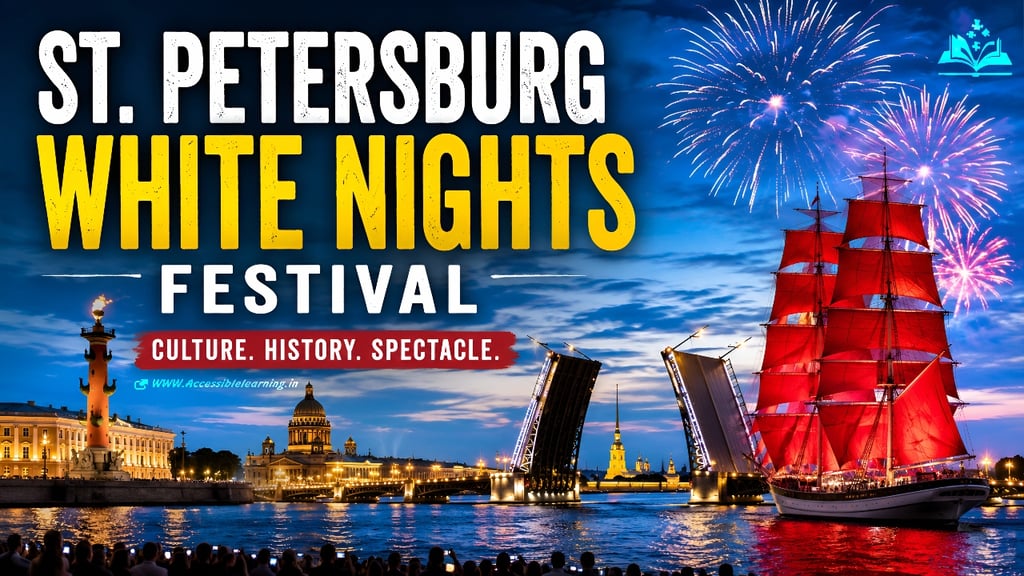
The most shocking fact about the St. Petersburg White Nights Festival is simple: for several weeks every summer, darkness practically disappears from the city. At nearly 60 degrees north latitude, the sun barely dips below the horizon, turning midnight into an eerie twilight and transforming the city into a nonstop cultural machine.
The Festival Isn't a Party. It's a City-Wide Performance Machine.
Many outsiders imagine the White Nights Festival as a single event. That assumption misses the point entirely.
The festival operates as a massive collection of concerts, ballet performances, opera productions, outdoor celebrations, exhibitions, and public spectacles spread across weeks. The city effectively becomes a stage.
Founded in the post-Soviet era and heavily expanded during the 1990s, the festival now attracts visitors from across Europe, Asia, and the former Soviet world. The centerpiece remains the Mariinsky Theatre, where world-class opera and ballet dominate the cultural calendar.
This is not casual entertainment. The organizers position St. Petersburg as Russia's cultural capital, and White Nights serves as the annual demonstration.
The Real Star Is Geography, Not Entertainment
No marketing campaign could invent what nature provides for free. During June and early July, the city experiences the famous "white nights" phenomenon. The sky never becomes fully dark. Instead, a silver-blue glow hangs over the city for hours after sunset.
That natural backdrop creates the festival's greatest advantage.
Tourists attend midnight concerts and walk along rivers at 1 a.m. without feeling like the day has ended. Photographers chase reflections across canals. Restaurants stay busy deep into the night.
The city exploits a geographic phenomenon and converts it into economic and cultural power.
Scarlet Sails Dominates the Global Headlines
If one event defines the festival internationally, it is the Scarlet Sails celebration.
Designed originally as a graduation event for school students, Scarlet Sails evolved into one of Europe's largest public spectacles. Massive crowds gather along the Neva River while fireworks, music performances, light shows, and a tall ship with scarlet sails create a theatrical finale.
The imagery looks almost fictional.
Yet behind the spectacle sits a huge logistical operation involving security planning, crowd control, river traffic management, stage construction, and transportation coordination.
Millions watch through television broadcasts and online streams, turning a local celebration into a national cultural event.
Behind the Romance Lies a Serious Economic Engine
Cities rarely spend money on festivals out of pure cultural generosity.
White Nights generates enormous tourism activity. Hotels fill, restaurants expand service hours, museums increase attendance, and transportation networks operate under intense demand.
Local businesses benefit directly from visitor spending.
The festival also strengthens St. Petersburg's international brand. Every ballet performance, orchestral concert, and Scarlet Sails broadcast functions as cultural advertising.
Officials understand this reality perfectly. Culture attracts visitors. Visitors spend money. Money reinforces the city's importance. The romantic narrative sells tickets. The economic strategy keeps the festival growing.

Russia Uses White Nights as Cultural Soft Power
Ignoring politics would produce an incomplete picture.
For decades, Russia has used major cultural institutions to project influence abroad. White Nights fits directly into that tradition.
The festival showcases Russian ballet, classical music, opera, architecture, and artistic heritage on a global stage. International performers often participate, but the event ultimately highlights Russian cultural achievement.
Supporters view this as legitimate cultural promotion. Critics argue that governments frequently use cultural events to improve national image during politically difficult periods.
Both interpretations contain truth. Either way, White Nights demonstrates how culture can operate as a strategic asset rather than simple entertainment.
The Festival Preserves Heritage While Feeding Modern Tourism
St. Petersburg faces the same challenge confronting many historic cities.
How do you preserve cultural authenticity while accommodating mass tourism?
White Nights walks that line every year.
The festival celebrates classical traditions rooted in imperial Russia while simultaneously attracting modern audiences seeking social media moments, concerts, and large-scale public experiences.
Some cultural purists complain about commercialization. Others argue that without tourism revenue, many cultural institutions would struggle to maintain global relevance.
The tension remains unresolved, and perhaps it always will.
Why White Nights Still Matters
Most festivals entertain people for a weekend and disappear. White Nights does something larger.
It merges geography, history, economics, politics, culture, and tourism into a single annual phenomenon. The nearly endless daylight creates the atmosphere, but the city supplies the ambition.
Visitors remember the glowing midnight skies. Officials measure economic impact. Artists pursue prestige. Businesses chase revenue.
The result is one of the world's most distinctive cultural festivals, not because it sells a fantasy, but because it transforms an unusual natural event into a powerful expression of urban identity.
That combination keeps White Nights relevant long after the fireworks fade and darkness finally returns to St. Petersburg.
Subscribe To Our Newsletter
All © Copyright reserved by Accessible-Learning Hub
| Terms & Conditions
Knowledge is power. Learn with Us. 📚

