

Spring Equinox Day Explained: Meaning, Science, Traditions, and Hidden Facts
Discover the meaning of Spring Equinox Day, its science, cultural traditions, spiritual symbolism, and rare facts. Learn why this powerful moment of balance has inspired festivals, astronomy, and creativity for thousands of years.
CULTURE/TRADITIONEVENT/SPECIALCELEBRATION/FESTIVALSEUROPEAN UNION
Jagdish Nishad
3/8/20266 min read
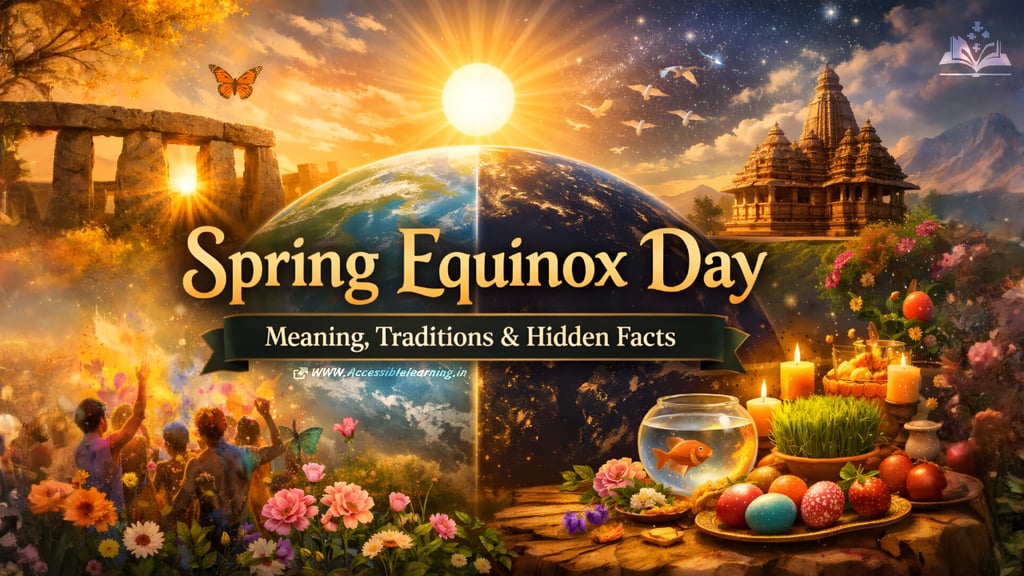
Spring Equinox Day is one of the most important astronomical moments of the year. It marks the official beginning of spring in the Northern Hemisphere and autumn in the Southern Hemisphere. But beyond the seasonal shift, the equinox carries deep cultural, spiritual, and scientific meaning that has fascinated humans for thousands of years.
This guide explains everything about Spring Equinox Day in a simple way while giving you detailed insights you may not have heard before.
What is Spring Equinox Day?
The spring equinox is the moment when day and night are almost equal in length across the Earth. The word "equinox" comes from Latin words meaning "equal night."
It happens when the Sun crosses the Earth's equator, moving from the Southern Hemisphere to the Northern Hemisphere. This usually occurs around March 20 or March 21 every year.
Key Facts
Marks the start of spring in the Northern Hemisphere
Marks the start of autumn in the Southern Hemisphere
Day and night are nearly equal everywhere
Happens twice a year: March Equinox and September Equinox
The Science Behind the Spring Equinox
The equinox happens because of Earth's tilt. Earth is tilted about 23.5 degrees on its axis. As Earth orbits the Sun, different parts receive different amounts of sunlight. On the equinox, the tilt is positioned so that sunlight falls equally on both hemispheres.
What Really Happens on Equinox Day
The Sun is directly above the equator
Shadows are shortest at noon
Everywhere on Earth gets about 12 hours of daylight
The Sun rises exactly in the east and sets exactly in the west
Interesting Science Fact
Even on equinox day, day and night are not perfectly equal. Because of atmospheric refraction and how sunrise is measured, daylight is actually a few minutes longer than night.
Why Spring Equinox Matters in Nature
The Spring Equinox signals change in ecosystems. Many natural cycles are linked to sunlight duration.
Changes in Plants
Trees begin new leaf growth
Flowers bloom
Seeds start germinating
Photosynthesis increases
Changes in Animals
Birds start migration
Many animals begin breeding season
Insects become active
Hibernating animals wake up
Spring is nature's reset button.
Spring Equinox in Different Cultures
Ancient civilizations carefully tracked the equinox because it helped them plan farming and religious events.
1. India – Holi Festival
Holi, the festival of colors, often falls near the spring equinox. It celebrates renewal, joy, and the victory of good over evil.
2. Persia – Nowruz
Nowruz, the Persian New Year, begins exactly on the spring equinox. Families clean homes, prepare special food, and welcome new beginnings.
3. Japan – Vernal Equinox Day
Japan celebrates Shunbun no Hi, a national holiday honoring nature and ancestors.
4. Europe – Pagan Traditions
Ancient Europeans celebrated Ostara, honoring fertility, light, and rebirth. Many Easter traditions, like eggs and rabbits, come from these old celebrations.
5. Maya Civilization
The pyramid at Chichen Itza shows a serpent-shaped shadow during the equinox sunset, symbolizing the god Kukulkan.

Spiritual Meaning of the Spring Equinox
Across cultures, the equinox represents balance. Light and darkness are equal. Many people use this day for reflection, gratitude, and setting intentions. Common spiritual themes include:
New beginnings
Personal growth
Balance in life
Letting go of the past
Planting new ideas
Unknown and Fascinating Facts About Spring Equinox
Here are some things most people do not know:
1. You Can Balance an Egg Anytime
There is a myth that eggs stand upright only on equinox day. In reality, you can balance an egg any day with patience.
2. Earth Tilts Sideways to the Sun
During equinox, Earth's tilt is sideways relative to the Sun, not toward or away from it.
3. Mars Also Has Equinoxes
Other planets like Mars experience equinoxes too. Seasons are universal in the solar system.
4. Ancient Temples Align with Equinox Sunlight
Structures like Stonehenge and Angkor Wat are aligned with equinox sunrise or sunset.
5. Day Length Changes Fastest Around Equinox
Sunrise and sunset times shift more quickly around the equinox than any other time of year.
Spring Equinox and Mental Health
Longer daylight affects mood. More sunlight helps the body produce serotonin and vitamin D, improving energy and mental clarity. People often feel more motivated, creative, and hopeful during spring. This is not imagination. It is biology.
How to Celebrate Spring Equinox Today
You do not need a big ritual. Simple actions can make the day meaningful.
Simple Ways to Celebrate
Clean your home and workspace
Start a new habit or project
Plant flowers or herbs
Watch sunrise or sunset
Write goals for the year
Donate old items
Spend time in nature
For creative people, like writers and designers, it is a perfect day to start a new idea or brand direction.
Spring Equinox Around the World in 2026
In 2026, the Spring Equinox in the Northern Hemisphere occurs on March 20. In India, the equinox happens around late afternoon or evening depending on the time zone. Observing the sunset that day is a beautiful reminder of Earth's motion.
Why Spring Equinox Still Matters in Modern Life
Today we live with electric lights and climate control, but the equinox still reminds us of something important: life moves in cycles. Understanding seasons connects us to nature, improves mental health, and gives rhythm to our goals. Farmers still depend on seasonal patterns. Solar energy production changes with seasons. Even global climate research uses equinox data.


Rare and Little-Known Facts About the Spring Equinox
Earth Spins Faster at the Equinox
Scientists have observed that Earth’s rotation speed changes slightly during equinox periods because of atmospheric pressure shifts and wind redistribution.
Equinox Creates the Fastest Sunrise Shift
Around the equinox, sunrise and sunset times change faster than any other period of the year. In some places, sunrise shifts by nearly 3 minutes per day.
You Can Track Equinox with a Simple Stone
Ancient people placed a stone upright and marked its noon shadow. The shortest shadow of the year is at summer solstice, but the straight east–west shadow alignment happens at equinox.
Some Flowers Bloom Only Around Equinox
Certain wildflowers and desert plants bloom specifically when daylight crosses a certain threshold near equinox periods. Their internal clocks depend on light duration.
Birds Navigate Using Equinox Light Angles
Many migratory birds adjust direction based on sunlight angle and magnetic field changes that become more noticeable around equinox periods.
Equinox Was Used to Measure Earth’s Size
Ancient Greek scientist Eratosthenes used solar shadow angles around equinox periods to estimate Earth’s circumference with surprising accuracy.
Equinox Light Looks Different to Photographers
Because of balanced sunlight angles, shadows look softer and colors appear warmer. Many photographers plan landscape shoots near equinox days to capture evenly lit skies and smooth horizon light.
Satellites Use Equinox to Calibrate Sensors
Earth-observation satellites rely on equinox lighting conditions to compare climate data accurately. With both hemispheres receiving similar sunlight, scientists can measure cloud cover, ice reflection, and temperature changes more precisely.
Ancient Calendars Began Near the Equinox
Many early civilizations started their new year around the spring equinox. It was the easiest natural signal that winter had ended and planting season had begun.
Equinox Happens at One Exact Moment Worldwide
The equinox is a single global event in time. Whether you are in Mumbai, London, or Tokyo, it happens simultaneously. Only your clock shows a different local time.
The Day-Night Line Becomes Nearly Straight
From space, the boundary between daylight and darkness, called the terminator line, becomes almost perfectly straight from pole to pole during equinox.
Some Crops Depend on Equinox Day Length
Rice, wheat, and soybeans respond strongly to daylight duration. Farmers study equinox light patterns to plan sowing and harvesting cycles.
Equinox Was Used for Navigation
Before GPS, sailors tracked sunrise direction around equinox to confirm east–west orientation during long sea journeys.
The North and South Poles Experience Sunrise and Sunset Only Once
At the poles, the sun rises near the spring equinox and sets near the autumn equinox. That means six months of daylight followed by six months of night.
Human Sleep Patterns Shift Around Equinox
Research shows people often sleep differently during equinox periods because changing daylight affects circadian rhythm and hormone levels.
FAQ's
Q: What is the real meaning of Spring Equinox?
It is the moment when Earth’s tilt places the Sun directly above the equator, creating nearly equal day and night and marking seasonal balance.
Q: Why is Spring Equinox important globally?
It influences farming cycles, animal migration, climate research, cultural festivals, and even satellite calibration used by scientists.
Q: Does Spring Equinox happen at the same time everywhere?
No. It occurs at one exact moment globally, but local dates and times differ due to time zones.
Q: Why are so many festivals near the equinox?
Ancient societies linked the equinox with planting seasons, renewal, and balance. Festivals like Holi and Nowruz celebrate this natural transition.
Q: Can you actually notice the equinox without tools?
Yes. The sun rises almost exactly in the east and sets in the west, and shadows align differently than usual.
Q: Are day and night perfectly equal on an equinox?
Not exactly. Because of atmospheric refraction, daylight is slightly longer than night.
Q: Why do people feel more positive around spring?
Longer daylight increases serotonin and vitamin D levels, improving mood and energy naturally.
Q: What makes the Spring Equinox special for creators and thinkers?
It symbolizes balance, renewal, and fresh beginnings, making it a powerful theme for storytelling, design, branding, and art concepts like your Krishna/Vishnu warm-tone visuals.
Q: How did ancient civilizations track the equinox?
They used shadow measurements, temple alignments, and stone markers to track sunrise positions and seasonal changes.
Q: Will climate change affect the equinox?
The equinox timing will stay the same, but seasonal weather patterns around it are already shifting.
Subscribe To Our Newsletter
All © Copyright reserved by Accessible-Learning Hub
| Terms & Conditions
Knowledge is power. Learn with Us. 📚

