

Space: The Ultimate Tax Haven and Resource Mine
Space is emerging as the next economic frontier. Explore how orbital industries, asteroid mining, and space law could reshape global wealth and resources.
SPACE/TECHSPACE MISSIONCOMPANY/INDUSTRY
Jagdish Nishad
2/20/20266 min read
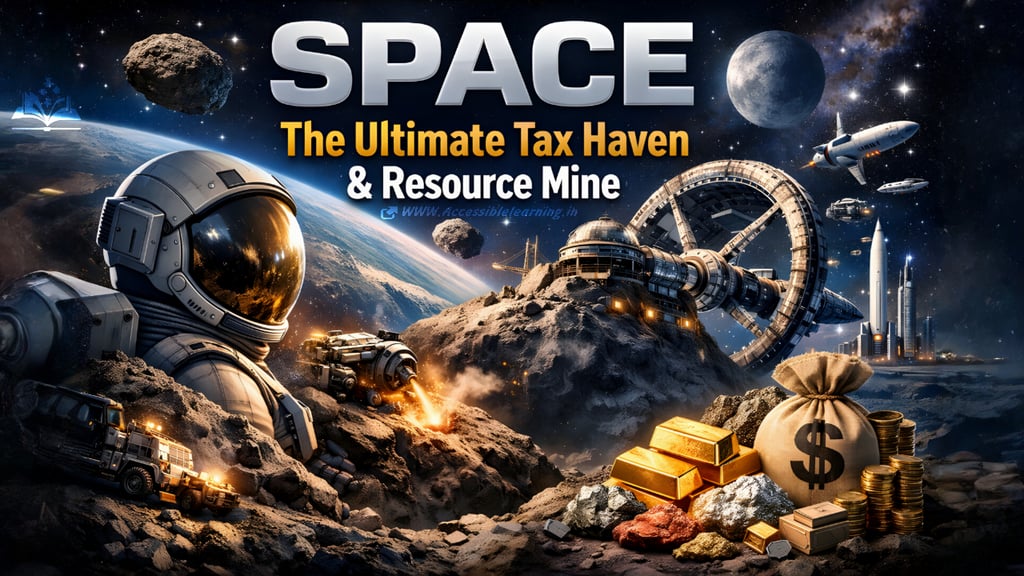
Space is no longer just the domain of astronauts and science fiction writers. Governments, private companies, and investors are beginning to see space as something more practical: a place for economic expansion, resource extraction, and even new financial structures. Two ideas are gaining attention in policy circles and tech communities. First, space could function as a kind of tax-neutral zone for certain activities. Second, it could become the largest resource reserve humanity has ever accessed.
This article explores both ideas in depth, looking at legal realities, economic incentives, technological limits, ethical concerns, and what the next few decades may actually look like.
Why Space Is Being Seen as an Economic Frontier
For centuries, economic expansion followed geography. Trade routes led to colonial ports, which led to industrial centers. Today, we are seeing the same pattern with orbital infrastructure.
Key reasons driving interest in space economics:
Launch costs have dropped dramatically thanks to reusable rockets.
Private space companies are competing, lowering prices further.
Satellite demand for internet, imaging, and navigation keeps growing.
Governments want strategic advantage in space technology.
Companies like SpaceX, Blue Origin, and Rocket Lab are making space access routine. When access becomes routine, business models follow.
The Idea of Space as a Tax Haven
What "Tax Haven" Means in This Context
A tax haven is normally a jurisdiction with low or zero taxes, strong privacy, and flexible corporate rules. The idea of space as a tax haven comes from a simple question:
If a company operates outside national territory, where do taxes apply?
The Legal Framework Today
Current space law is based mainly on the 1967 Outer Space Treaty. It states that:
No nation can claim sovereignty over celestial bodies.
Space is for peaceful use.
Nations are responsible for their registered space objects.
Because spacecraft must be registered with a country, that country still regulates them. So today, companies cannot just avoid taxes by moving operations into orbit.
However, legal gray areas are emerging:
Space stations owned by multinational corporations
Lunar or asteroid mining operations
Autonomous manufacturing in orbit
Digital services run from satellites
Countries like Luxembourg, the UAE, and the United States have already passed laws recognizing private space resource rights. This signals a future where tax competition could extend into space activity licensing.
Realistic Tax Scenarios in Space
Rather than true tax-free operations, more likely outcomes include:
Special Economic Zones in orbit Governments may offer tax incentives for companies building orbital factories or data centers.
Flag-of-registration competition Similar to ships using favorable maritime registries, spacecraft could register in countries with lower taxes.
Lunar or asteroid mining royalties Governments may tax resources brought back to Earth rather than extracted in space.
Digital services hosted in orbit Satellite-based cloud services, may create new tax jurisdiction debates.
In short, space may not be a literal tax haven, but it could reshape global tax competition.
Space as the Largest Resource Mine in History
Asteroid Mining Potential
Asteroids contain metals like iron, nickel, platinum, and rare earth elements. Some estimates suggest a single metal-rich asteroid could contain more platinum than has ever been mined on Earth.
Potential resources include:
Platinum-group metals for electronics and fuel cells
Water ice for rocket fuel and life support
Nickel and iron for construction in space
Rare earth elements for advanced technology
Companies such as Planetary Resources and Deep Space Industries explored these ideas, though both shifted direction due to funding challenges. Still, interest remains strong.
Lunar Resources
The Moon is rich in materials useful for building infrastructure. Important lunar resources:
Helium-3 for possible future fusion energy
Water ice at lunar poles
Regolith for construction
Oxygen extracted from lunar soil
NASA's Artemis program and similar missions from China and India aim to establish a sustained presence that could support resource extraction.
Why Mining in Space Makes Sense
Mining in space is expensive, but certain factors make it attractive:
No environmental regulations like on Earth
Zero-gravity manufacturing advantages
Materials used directly in space avoid launch costs
Long-term scarcity of rare metals on Earth
The biggest early market may not be bringing metals to Earth. It may be using resources to build satellites, space stations, and solar power arrays in orbit.
Space Manufacturing: The Hidden Opportunity
Factories in microgravity can create materials impossible to make on Earth. Examples include:
Perfect fiber optics
Ultra-pure pharmaceuticals
Advanced semiconductors
New alloys
Companies are already experimenting with 3D printing in orbit. If manufacturing becomes profitable, orbital factories may follow the same path as offshore factories once did.


Economic Impact on Earth
If space resources become accessible, several major changes could happen:
Commodity price shifts Rare metals may become cheaper, changing industries.
New trillion-dollar markets Orbital construction, solar power satellites, and deep-space transport could create massive industries.
Geopolitical competition Space access may define future superpowers.
New legal systems International law will need updates for property rights, labor laws, and environmental rules in space.
Ethical and Environmental Questions
Even in space, ethical issues matter. Key concerns include:
Who owns space resources?
Will space become dominated by a few mega-corporations?
Could mining debris create dangerous orbital junk?
How do we protect scientifically valuable celestial bodies?
There is growing discussion about creating space environmental law before large-scale mining begins.
Technical Barriers Still Ahead
Despite the excitement, several challenges remain:
High launch costs compared to Earth mining
Limited autonomous robotics capability
Long mission timelines
Space radiation effects on equipment
Lack of large-scale space infrastructure
Most experts believe meaningful asteroid mining is still 20–40 years away.
The Most Likely Future Timeline
2025–2035
Expansion of satellite mega-constellations
Early orbital manufacturing experiments
Lunar bases for research
Legal frameworks for resource rights
2035–2055
Mining of lunar water ice
Construction materials produced in orbit
Commercial space stations
Early asteroid prospecting missions
After 2055
Large-scale asteroid mining
Space-based solar power grids
Permanent off-world industrial zones
A real space economy connected to Earth
Will Space Really Become a Tax Haven?
Probably not in the traditional sense. But space will likely create new financial structures where companies choose favorable regulatory regimes for their spacecraft and space operations. This is similar to how ships and aircraft are registered today. The bigger story is not tax avoidance. It is economic expansion beyond Earth.
Space represents two powerful ideas at once. It is a place where old systems like taxation and regulation must be redefined. And it is a place with almost unlimited material resources.
The companies and nations that solve launch costs, robotics, and long-duration operations will shape the next economic era. Whether that future is fair, sustainable, and peaceful depends on the laws and ethics we build today.
Space will not replace Earth’s economy overnight. But it may become the largest new economic frontier since the industrial revolution.

Frequently Asked Questions
Q: Can space really become a tax haven?
Not in the traditional sense. Spacecraft and space stations are still regulated by the country where they are registered under the Outer Space Treaty framework. However, companies may choose favorable jurisdictions for licensing and regulation, similar to how ships use maritime registries today.
Q: What resources can be mined in space?
Asteroids and the Moon contain valuable materials like platinum-group metals, nickel, iron, rare earth elements, and water ice. Water is especially important because it can be converted into rocket fuel for deep-space missions.
Q: Why is asteroid mining important for the future?
Asteroid mining could supply rare metals without damaging Earth’s environment. It may also provide construction materials for satellites and space stations, reducing the need to launch heavy equipment from Earth.
Q: Who owns resources mined in space?
International law says no country owns celestial bodies, but some nations allow private companies to own extracted resources. Laws from the United States, Luxembourg, and the UAE are shaping how ownership might work in the future.
Q: How soon will space mining become real?
Small-scale experiments are already happening. Large-scale asteroid mining may take 20 to 40 years due to high costs, limited robotics, and infrastructure challenges.
Q: Will space resources make metals cheaper on Earth?
Possibly. If asteroid mining becomes efficient, rare metals could become more affordable, changing industries like electronics, renewable energy, and electric vehicles.
Q: What companies are working on space resource projects?
Several private companies and government programs are exploring this field, including SpaceX, Blue Origin, and NASA. Some startups focused on asteroid mining have paused operations, but their research continues to influence future missions.
Q: Could space manufacturing replace factories on Earth?
Not completely, but certain products made in microgravity like fiber optics, pharmaceuticals, and advanced materials, could be more efficient to produce in orbit.
Q: What are the biggest risks of mining in space?
Major risks include space debris, high mission costs, legal conflicts, and environmental damage to celestial bodies that hold scientific value.
Q: Why are governments interested in space resources?
Space resources can support national security, economic growth, and technological leadership. Countries investing early may gain major advantages in future industries.
Q: Could space-based data centers avoid taxes?
Satellite-based digital services could create new tax challenges, but companies would still be regulated by their registration country. Governments are already studying how to tax space-based services.
Q: Is space mining good for the environment?
It could reduce mining damage on Earth, but it also raises concerns about space debris and preserving important celestial sites. New environmental rules will likely be needed.
Subscribe to Frontier Intelligence
All © Copyright reserved by Accessible-Learning Hub
| Terms & Conditions
Accessible Learning Hub — Actionable clarity for high-agency minds.
Weekly breakdowns on AI breakthroughs, capital flow, and human performance systems. Zero fluff.