

Sora AI vs Viggle AI vs Haiper AI: Full Comparison Guide (2026)
A detailed comparison of Sora AI, Viggle AI, and Haiper AI. Explore features, differences, use cases, and which AI video tool is best for creators, marketers, and filmmakers in 2026.
ARTIFICIAL INTELLIGENCE & FUTURE TECH
Sachin K Chaurasiya
4/16/20264 min read
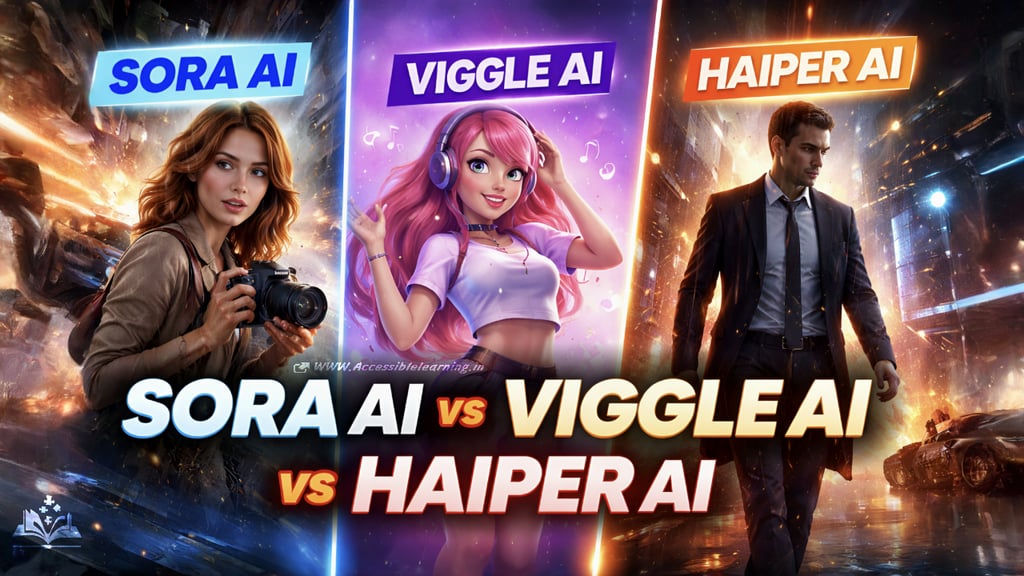
AI video generation is no longer experimental. It’s becoming a real creative tool. But not all platforms are built the same. Sora AI, Viggle AI, and Haiper AI each represent a different direction in this space: simulation, animation, and cinematic rendering. This guide goes deeper into how they actually work, what makes them different at a technical level, and where each one fits.
What Makes These Tools Fundamentally Different
Before comparing features, it helps to understand their core philosophy:
Sora AI → World Simulation Engine
Viggle AI → Motion & Character Engine
Haiper AI → Visual Rendering Engine
That difference affects everything from output quality to use cases.
Sora AI: Built to Simulate the Real World
What the Official Model Focuses On
Converts text or images into realistic video scenes
Designed to simulate real-world physics and motion
Can generate videos up to ~1 minute with consistent structure
Supports multiple camera angles automatically
Enables character reuse and scene stitching (Sora 2 updates)
Under-the-Hood (Important Insight)
Built using a diffusion + transformer architecture
Generates video in latent space using 3D patches
Trained on large-scale video datasets with recaptioning
This is why Sora feels less like a tool and more like a world simulator.
Advanced Capabilities
Maintains object consistency across frames
Understands cause and effect (basic physics)
Can extend or remix existing video clips
Supports text + image hybrid prompting
Real Limitations (From Official Insights)
Still struggles with complex physics accuracy
Can confuse left/right or spatial relationships
Heavy compute requirements limit accessibility
Viggle AI: Precision Motion & Character Control
What the Platform Focuses On
Turns static images into animated characters
Uses motion transfer from real video references
Supports lip-sync and facial expressions
Works with avatars, influencers, and digital humans
Core Strength (Why It Exists)
Viggle is not trying to generate worlds. It focuses on controllable animation.
That means:
You can define exact movement
You can reuse characters consistently
You get predictable outputs
Advanced Capabilities
Real-time pose tracking and mapping
Character consistency across multiple clips
Strong compatibility with short-form content formats
Limitations
No deep understanding of environments
Cannot generate complex cinematic scenes from scratch
Output realism depends heavily on input assets
Haiper AI: Cinematic Rendering & Visual Quality
What the Platform Focuses On
High-quality text-to-video and image-to-video generation
Emphasis on cinematic visuals and smooth motion
Produces high-resolution outputs (4K and above)
Designed for longer, polished video sequences
Core Strength
Haiper sits between Sora and traditional video tools. It focuses less on deep simulation and more on:
Visual clarity
Motion smoothness
Production-ready output
Advanced Capabilities
Better frame consistency and transitions
Cleaner lighting and texture rendering
Optimized for brand and commercial visuals
Limitations
Less advanced “world understanding” than Sora
Slower rendering for complex prompts
Still evolving in terms of control features
Use Case Breakdown
When Sora AI Makes the Most Sense
Storytelling, films, concept videos
Advertising and cinematic content
Complex scenes with multiple elements
When Viggle AI Is the Better Choice
Social media content (Reels, Shorts)
Meme creation and character animation
VTubers and digital influencers
When Haiper AI Fits Best
Brand videos and polished visuals
High-resolution marketing content
Smooth cinematic sequences
Key Differences That Actually Matter
Sora AI thinks like a simulation system
Viggle AI behaves like an animation tool
Haiper AI acts like a rendering engine
That’s the real distinction, not just features.
Pros & Cons Summary
Sora AI
✔ Deep scene understanding
✔ Real-world simulation approach
✔ Multi-scene storytelling
✘ High compute demand
✘ Imperfect physics in edge cases
Viggle AI
✔ Strong motion control
✔ Easy to use
✔ Ideal for creators
✘ Limited scope
✘ Not cinematic
Haiper AI
✔ High visual quality
✔ Smooth motion output
✔ Better for professional visuals
✘ Slower rendering
✘ Less advanced simulation
These tools are not direct replacements for each other
Sora AI is pushing toward AI-generated worlds
Viggle AI is optimizing character-driven content
Haiper AI is refining visual production quality
If you choose based on your workflow instead of hype, the decision becomes much easier.

Control vs Creativity Trade-Off
Sora AI leans toward creative freedom. You describe what you want, and it interprets it.
Viggle AI leans toward precise control, especially for movement and expressions.
Haiper AI balances both but prioritizes visual polish over flexibility.
👉 In simple terms:
Sora = imagination
Viggle = control
Haiper = refinement
Editing & Iteration Workflow
Sora AI supports iterative prompting, meaning you refine outputs by adjusting prompts rather than editing frames directly.
Viggle AI allows repeatable motion reuse, making it easier to maintain consistency across multiple clips.
Haiper AI is more aligned with render-based workflows, where you refine output quality rather than structure.
Learning Curve & Skill Requirement
Sora requires understanding of prompt engineering and scene structuring
Viggle requires basic knowledge of motion references and timing
Haiper benefits from understanding cinematic composition (lighting, angles, pacing)
👉 The skill you already have determines which tool feels easiest.
Content Ownership & Practical Usage
These platforms generally allow commercial usage, but:
Sora outputs may include watermarks or restrictions depending on access tier
Viggle content is often used for UGC (user-generated content) and social media
Haiper is better suited for brand-safe, production-ready visuals
Speed vs Output Quality
Viggle AI → Fastest generation (optimized for short clips)
Sora AI → Balanced but compute-heavy
Haiper AI → Slower but produces cleaner, high-resolution output
Integration & Ecosystem Direction
Sora is expected to integrate deeply with broader AI ecosystems (like creative workflows and automation tools)
Viggle is moving toward creator tools and community-driven templates
Haiper is aligning more with professional video production pipelines
FAQ's
Q: Which AI tool is best for consistent character generation across videos?
Viggle AI performs best because it allows controlled motion reuse and character persistence, making it ideal for recurring characters.
Q: Can these AI tools replace traditional video editing software?
Not completely. They can generate content, but tools like editing software are still needed for fine control, sequencing, and post-production.
Q: Which platform is more suitable for brand marketing content?
Haiper AI is typically the better choice due to its focus on high-quality visuals, smooth transitions, and polished output.
Q: Is prompt writing important for all three tools?
It matters most for Sora AI and Haiper AI, where output heavily depends on how well you describe the scene.
For Viggle, input assets matter more than prompts.
Q: Do these AI tools support real-time video generation?
Not fully. Viggle AI comes closest with fast animation workflows, but true real-time cinematic generation is still evolving.
Q: Which AI is better for storytelling vs short-form content?
Storytelling → Sora AI
Short-form content → Viggle AI
High-end visual storytelling → Haiper AI
Q: Are these tools suitable for beginners?
Yes, but
Viggle AI is the easiest to start with
Sora and Haiper require some learning to get high-quality results



Subscribe to Frontier Intelligence
All © Copyright reserved by Accessible-Learning Hub
Accessible Learning Hub — Actionable clarity for high-agency minds.
Weekly breakdowns on AI breakthroughs, capital flow, and human performance systems. Zero fluff.