

Skills That Will Matter More Than Degrees in the Next 10 Years
In a rapidly changing job market, degrees are no longer the strongest measure of talent. This article explores the skills that will matter more than formal education in the next ten years, explaining why employers are shifting toward skill-based hiring and which abilities will define future-proof careers.
A LEARNINGEDUCATION/KNOWLEDGENEW YOUTH ISSUES
Shiv Singh Rajput
1/31/20264 min read
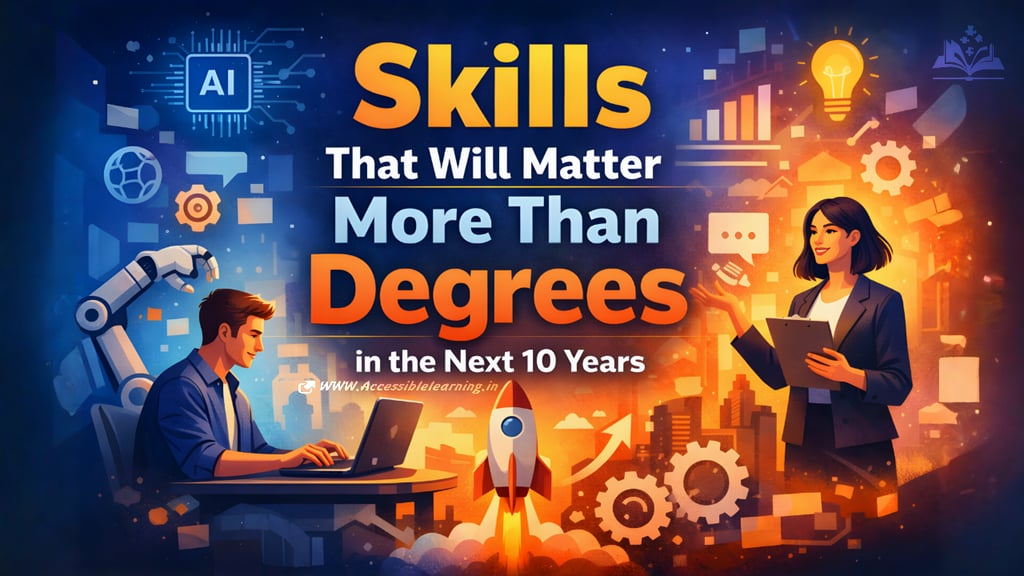
The global job market is going through a structural shift. Degrees are no longer the primary filter for talent, especially in fast-moving industries. Employers are realizing that a certificate does not guarantee capability, adaptability, or real-world performance. Over the next decade, skills that produce results will outweigh formal education in hiring, promotions, and income growth.
This change is not anti-education. It is pro-ability. Knowledge still matters, but applied knowledge matters more. The future belongs to people who can learn quickly, solve problems, and deliver outcomes in uncertain environments.
Why degrees are losing their dominance
Traditional education is slow by design. Curriculums are fixed, assessment is theoretical, and learning often happens far from real-world conditions. Meanwhile, industries evolve in real time.
Several forces are accelerating this shift:
Technology cycles are shorter than academic cycles
AI and automation are changing job roles faster than degrees can adapt
Companies want immediate contribution, not long onboarding periods
Freelance and contract work reward proof of skill, not formal titles
Global remote hiring increases competition and raises skill standards
As a result, degrees are becoming background signals, while skills are becoming decision drivers.
The skill economy and outcome-based value
We are entering a skill economy where value is measured by output, not credentials. Employers increasingly ask:
What have you built?
What problems have you solved?
What impact did your work create?
Can you adapt when tools or requirements change?
In this model, learning never stops. Careers become flexible, non-linear, and skill-stacked instead of ladder-based.
High-impact skills that will shape future careers
Applied AI and tool fluency
AI will not replace most people, but people who know how to use AI will replace those who do not. Applied AI means knowing how to prompt, validate outputs, automate workflows, and integrate AI into daily work. This skill will be relevant in writing, design, law, healthcare, marketing, finance, and operations.
Data understanding and analytical thinking
Data literacy is no longer optional. Even non-technical roles require understanding trends, metrics, and evidence-based decisions. The ability to ask the right questions of data is more valuable than complex calculations.
Problem-solving in real conditions
Future work is ambiguous. Clear instructions will be rare. Problem-solving means identifying root causes, testing assumptions, and iterating solutions. This skill separates doers from followers.
Communication across formats
Written clarity, verbal articulation, and visual explanation are essential. People who can communicate clearly reduce confusion, align teams, and influence decisions. As remote work grows, asynchronous communication becomes even more important.
Creativity and original judgment
AI can generate options, but humans choose direction. Creativity involves taste, context, and decision-making. This applies to content, design, strategy, branding, and innovation. Original thinkers will guide machines, not compete with them.
Digital execution and automation
Knowing how to build simple tools, automate tasks, and use no-code or low-code platforms saves time and increases leverage. Execution-focused digital skills turn ideas into working systems.
Learning agility and reskilling ability
Job roles will change repeatedly. The most valuable professionals will be those who can learn a new tool or domain within weeks, not years. Learning how to learn is the most durable skill.
Emotional intelligence and people skills
As work becomes more collaborative and cross-functional, interpersonal skills gain importance. Empathy, listening, feedback, and leadership without authority will define high-impact professionals.
Strategic thinking and prioritization
Understanding trade-offs, long-term impact, and resource allocation is critical. Strategy is not about titles. It is about thinking beyond tasks and understanding consequences.
Ethical reasoning and responsibility
AI, data, and automation raise serious ethical questions. Professionals who can balance innovation with responsibility, privacy, and fairness will be trusted with greater authority.
Focus, discipline, and self-management
The ability to concentrate deeply, manage time, and work without constant supervision will define productivity. In a distraction-heavy world, focus becomes a competitive advantage.

How employers will judge skills instead of degrees
Skill-based hiring is becoming practical and measurable. Companies increasingly rely on:
Portfolios and case studies
Trial tasks and paid test projects
Demonstrated results and metrics
Peer reviews and references
Real-world problem simulations
What you can show will matter more than what you claim.
Skills compound faster than credentials
Degrees are static. Skills compound. Each new skill increases the value of existing ones. For example, combining communication with AI tools creates more value than either skill alone. Skill stacking will define career growth.
This also means individuals can design their own career paths instead of following predefined routes.
Long-term career security in a changing world
The safest career strategy is not chasing titles or certificates. It is building skills that:
Transfer across industries
Adapt to new tools
Solve real problems
Create visible impact
People who invest in skill development gain independence, mobility, and long-term relevance.
Degrees will still exist, and in some professions they will remain necessary. But for most modern careers, skills will be the primary currency. The next ten years will reward those who take ownership of learning, focus on execution, and develop human-centered abilities that technology cannot replace.
In the future, your value will not be defined by where you studied but by what you can do, how fast you can adapt, and how effectively you create results.
Frequently Asked Questions
Q: Are degrees becoming completely irrelevant?
No. Degrees still matter in regulated and highly specialized fields such as medicine, law, engineering, and academic research. However, in many technology, creative, business, and digital roles, degrees are no longer the main hiring factor. Skills, portfolios, and proven results increasingly carry more weight.
Q: Which skills are most future-proof?
Skills that combine human judgment with technology are the most future-proof. These include problem-solving, communication, adaptability, critical thinking, emotional intelligence, and the ability to work with AI and data. These skills remain valuable even as tools and platforms change.
Q: How can someone prove skills without a degree?
Skills can be proven through real projects, portfolios, case studies, freelance work, internships, open-source contributions, and work trials. Employers care more about what you have built or improved than formal certificates.
Q: Is it too late to shift from a degree-based career to a skill-based one?
No. Many professionals successfully shift at any stage of their career. Skill-based careers are flexible and allow gradual transitions. Learning practical skills alongside existing work experience often strengthens, rather than replaces, a career.
Q: Do online courses and certifications matter?
They matter only if they lead to practical outcomes. Courses that focus on real-world projects, problem-solving, and measurable results are valued far more than those that only provide completion certificates.
Q: Will AI reduce the importance of human skills?
AI increases the importance of human skills. As machines handle routine tasks, human abilities like judgment, creativity, ethics, communication, and leadership become more valuable, not less.
Q: How should students prepare for the next 10 years?
Students should focus on building practical skills alongside formal education. Working on real projects, learning digital tools, improving communication, and developing the habit of continuous learning will prepare them better than relying on degrees alone.
Q: What is the biggest mistake people make when focusing on skills?
The biggest mistake is learning skills without applying them. Skills only gain value when they are used to solve real problems and produce visible results. Practice and execution matter more than theory.
Subscribe to Frontier Intelligence
All © Copyright reserved by Accessible-Learning Hub
| Terms & Conditions
Accessible Learning Hub — Actionable clarity for high-agency minds.
Weekly breakdowns on AI breakthroughs, capital flow, and human performance systems. Zero fluff.