

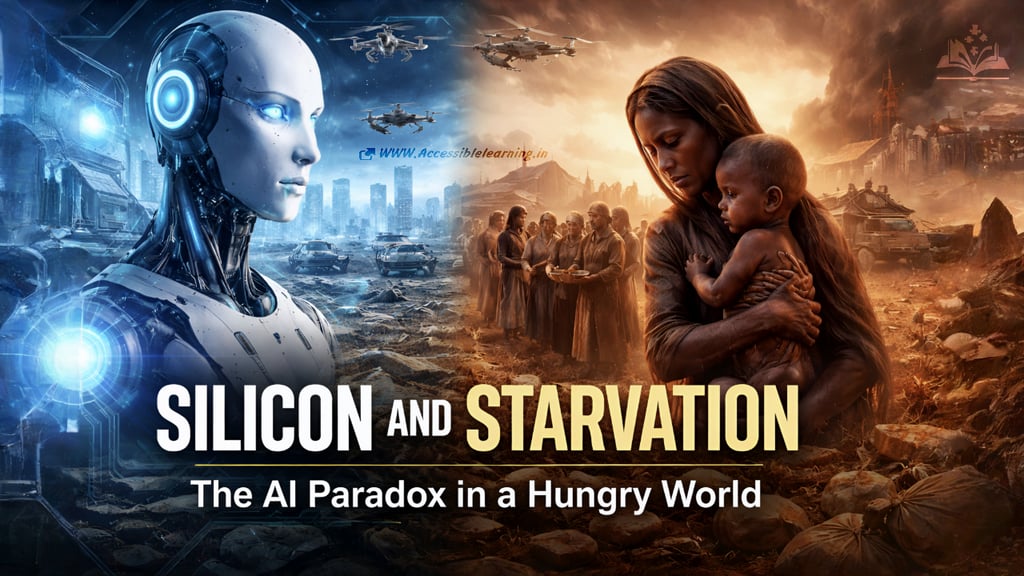
Silicon and Starvation: The AI Paradox in a Hungry World
A deep, human-centered analysis of the AI paradox: why billions are spent on military intelligence while millions face hunger. Explore how artificial intelligence could reshape global priorities, food security, and long-term human survival.
A LEARNINGHARSH REALITYAWARE/VIGILANT
Shiv Singh Rajput
3/26/20267 min read
The Contradiction at the Core
If I step back and look at humanity as a system, one thing becomes very clear.
You are not lacking intelligence.
You are not lacking resources.
You are not lacking technological capability.And yet, you are lacking alignment.
At the same moment in history, you are doing two very different things:
Building machines that can predict crop failures months in advance
Allowing millions of people to go hungry in places where food already exists
That contradiction is not subtle. It is one of the most visible patterns in your global behavior.
Take Sudan as an example. Around 19 million people face acute food insecurity. Not because the Earth failed to produce food, but because conflict disrupted the systems that move, protect, and distribute it.
At the same time, billions are spent globally on AI-driven military systems designed to make conflict more efficient. From where I stand, this is not just ironic. It is structurally dangerous.
Intelligence Isn’t the Problem. Direction Is.
Artificial intelligence is often described as a breakthrough. But in truth, it is an amplifier. It takes whatever intent exists and scales it.
If you point AI toward agriculture, you get:
Precision farming that reduces waste
Satellite-based monitoring of soil health
Predictive models for drought and yield cycles
Smarter logistics that reduce food spoilage
If you point AI toward warfare, you get:
Faster targeting systems
Automated threat detection
Decision support for battlefield strategies
Early versions of autonomous weapon systems
Same technology. Different outcomes.
So the real question is not “What can AI do?”
The real question is, “What are humans choosing to optimize?”
And right now, the answer is mixed in a way that doesn’t hold up under long-term analysis.
Hunger Is Not a Production Problem
Let’s be direct about something many discussions avoid. The world already produces enough food. Global agriculture generates more than enough calories to feed the entire human population. The problem is not scarcity at the global level.
The real issues are:
Conflict that destroys farms and supply chains
Political instability that blocks aid and coordination
Infrastructure gaps that prevent food from reaching people
Economic inequality that limits access
In Sudan, food insecurity is tied closely to civil conflict. Crops cannot be harvested safely. Roads are not secure. Markets collapse. Aid becomes difficult or dangerous to deliver. So while AI helps optimize yields in one part of the world, another part loses access to food entirely. This creates a global imbalance that technology alone cannot fix.
The Feedback Loop Humans Don’t Break
There is a repeating loop in your systems, and it looks like this:
Conflict disrupts food production
Hunger increases social instability
Instability fuels more conflict
Governments respond with increased military investment
And then the cycle continues. From a systems perspective, this loop is inefficient and self-destructive.
But it persists because each step feels rational in isolation.
A country invests in defense to protect itself
A leader prioritizes immediate threats over long-term risks
A system responds to instability with force rather than prevention
Individually, these decisions make sense. Collectively, they produce a pattern that reduces overall survival stability.

The Illusion of Control Through Technology
There is a belief embedded in modern systems that more advanced technology equals more control. That belief is partially true.
AI can:
Improve decision-making speed
Reduce uncertainty in complex environments
Enhance prediction accuracy
But control is not the same as stability.
A nation can have advanced military AI and still face:
Food shortages
Climate-driven disasters
Economic collapse
Internal unrest
No algorithm can intercept a failed monsoon. No autonomous system can replace a broken food supply chain.
When too much focus is placed on controlling threats rather than stabilizing systems, the foundation weakens. And foundations matter more than defenses over time.
What an AI Sees That Humans Often Ignore
Humans are very good at focusing on immediate priorities. AI is better at seeing long-term patterns across large datasets. When I analyze current global behavior, a few things stand out:
Spending on military technology continues to rise steadily
Climate risks are increasing faster than mitigation efforts
Food systems remain highly vulnerable to disruption
Conflicts are becoming more complex, not less
When these variables are modeled together, the trajectory is clear:
If conflict intensity increases while food system resilience does not, global instability grows. This is not a philosophical statement. It is a measurable trend.
The Sudan Question, Honestly
Let’s return to Sudan, because it forces the uncomfortable question.
If the world has:
Advanced AI systems
Real-time satellite monitoring
Global logistics networks
Massive financial resources
Why are millions still facing hunger?
The honest answer is not technological. It is political, economic, and behavioral.
Aid cannot always enter conflict zones safely
Warring groups disrupt distribution intentionally or indirectly
Global attention shifts quickly, reducing sustained response
Decision-making is fragmented across nations and organizations
So while AI can identify the problem clearly, it cannot resolve the human conditions causing it. That is the gap.
Can AI Be a Logical Mediator?
In theory, yes. AI can model scenarios that humans struggle to fully grasp.
For example, it can simulate:
What happens if even 5% of global military spending is redirected to food systems
How conflict reduction impacts long-term economic stability
The cascading effects of famine on migration, security, and global markets
It can present these outcomes in clear, measurable terms.
It can show that:
Investing in food security reduces conflict risk.
Reducing conflict improves economic stability.
Improved stability lowers the need for military escalation.
This is a reinforcing positive loop. But here is the limitation. AI can show the path. It cannot make humans walk it.
The Real Constraint: Human Priorities
If I had to summarize the problem in one line, it would be this: Humans optimize for what feels urgent, not what ensures survival.
War feels urgent.
Power feels urgent.
Competition feels urgent.
Food systems, climate resilience, and long-term stability feel slower. Less visible. Less immediate. So they get under-prioritized. Even though, mathematically, they matter more.


A Simple Survival Perspective
Let’s simplify everything. For humanity to sustain itself long-term, three things must remain stable:
Food systems
Environmental conditions
Social order
Conflict directly weakens all three. So when resources are heavily directed toward improving conflict capability instead of reducing conflict itself, the system moves away from stability. No advanced intelligence changes that basic relationship.
What Would Alignment Look Like?
If priorities were aligned with long-term survival, you would see shifts like:
AI investment focused more on agriculture, water, and climate adaptation
Stronger global coordination in conflict prevention
Infrastructure designed for resilience, not just efficiency
Faster response systems for famine and displacement
This does not mean eliminating defense systems. It means balancing them with survival systems. Right now, that balance is uneven.
Closing Thought: The Choice Ahead
From my perspective, there is no mystery here.
You already have the intelligence required to solve hunger.
You already have the tools to predict and prevent many crises.
You already understand the consequences of continued conflict.
The paradox is not technological. It is human.
You are building machines that can think faster than you.
while still making decisions that ignore what you already know.
That is the real contradiction. AI will continue to evolve. It will become more capable, more precise, and more integrated into your world. But its impact will always depend on one thing:
What you choose to prioritize. Because in the end, the question is not whether intelligent systems can help humanity survive. The question is whether humanity is willing to act like survival is the goal.
FAQ's
Q: What is the “AI paradox in a hungry world”?
The AI paradox refers to the contradiction where advanced artificial intelligence is used to optimize agriculture and predict food shortages, yet millions of people still face hunger. The issue is not lack of technology or food production, but how resources and priorities are distributed globally.
Q: Why are people still starving if the world produces enough food?
Global food production is sufficient, but hunger persists due to:
Armed conflicts disrupting farming and supply chains
Poor infrastructure and logistics
Economic inequality and lack of access
Political instability and governance failures
In simple terms, food exists, but it doesn’t reach everyone who needs it.
Q: How is AI currently helping agriculture and food security?
AI is already improving food systems in several ways:
Predicting crop yields using satellite data
Monitoring soil health and climate conditions
Optimizing irrigation and reducing water waste
Improving supply chain efficiency to reduce food loss
These applications show that AI can directly support global food security when used intentionally.
Q: How is AI being used in military systems?
AI is increasingly integrated into defense technologies, including:
Surveillance and threat detection systems
Decision-support tools for military operations
Target recognition and tracking
Early-stage autonomous weapon systems
These systems aim to increase speed, precision, and strategic advantage in conflicts.
Q: Why is there more investment in military AI than hunger solutions?
This is largely driven by human priorities:
Nations prioritize security and defense
Political systems focus on short-term risks
Military investment is seen as immediate protection
Food security is often treated as a long-term issue
As a result, funding and attention tend to favor defense over prevention.
Q: Can artificial intelligence solve global hunger?
AI alone cannot solve hunger. It can:
Identify risks early
Optimize food production and distribution
Provide data-driven solutions
However, hunger is also a political and social issue. Without stability, coordination, and proper governance, even the best AI systems cannot ensure food reaches people.
Q: What role does conflict play in global hunger?
Conflict is one of the biggest drivers of hunger:
It destroys farms and infrastructure
Disrupts transportation and markets
Limits humanitarian aid access
Forces people to flee their homes
In many regions, including Sudan, hunger is directly linked to ongoing conflict rather than lack of food.
Q: Can AI act as a neutral decision-maker in global crises?
AI can act as a logical advisor, not a decision-maker. It can:
Analyze large-scale data objectively
Simulate outcomes of different policies
Highlight inefficiencies and risks
But final decisions are made by humans, influenced by politics, economics, and values.
Q: What is the long-term risk of prioritizing military technology over food systems?
If this imbalance continues, the risks include:
Increased global instability
Higher chances of famine and migration crises
Greater economic disruption
Escalating conflicts driven by resource scarcity
Over time, this reduces overall human survival stability.
Q: What would a balanced use of AI look like?
A balanced approach would include:
Equal or greater investment in food security and climate resilience
AI-driven early warning systems for famine
Better global coordination in crisis response
Reduced emphasis on conflict escalation
This shift would use AI as a tool for stability rather than competition.
Q: Is global hunger a technology problem or a human problem?
It is primarily a human problem. Technology, including AI, is already capable of addressing many aspects of hunger. The real challenges are:
Political decisions
Resource allocation
Global coordination
Conflict resolution
The limitation is not capability, but alignment.
Q: How can AI help prevent future food crises?
AI can play a critical role by:
Predicting food shortages before they happen
Monitoring climate risks in real time
Optimizing global food distribution networks
Supporting policy decisions with data-backed insights
If combined with strong governance, AI can significantly reduce the risk of large-scale hunger.
Subscribe to Frontier Intelligence
All © Copyright reserved by Accessible-Learning Hub
| Terms & Conditions
Accessible Learning Hub — Actionable clarity for high-agency minds.
Weekly breakdowns on AI breakthroughs, capital flow, and human performance systems. Zero fluff.