

Shab-e-Barat (Laylat al-Bara’at): Meaning, Importance, Worship, and How Muslims Observe It
Discover the meaning and significance of Shab-e-Barat (Laylat al-Bara’at), the Night of Forgiveness in Islam. Learn why it is observed, how Muslims worship, and the recommended prayers, fasting, and traditions across different cultures.
CULTURE/TRADITIONEVENT/SPECIALCELEBRATION/FESTIVALS
JK
1/25/20267 min read
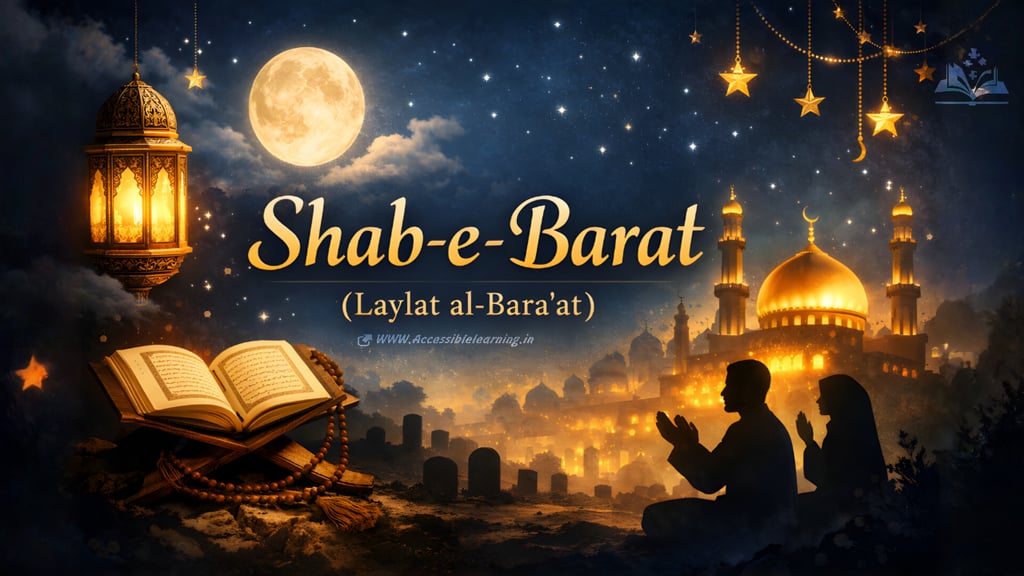
Shab-e-Barat, also known as Laylat al-Bara’at, is widely observed by Muslims in many parts of the world as a night of forgiveness, mercy, prayer, and spiritual renewal. It falls on the 15th night of Sha’ban, the eighth month of the Islamic calendar, and is often seen as a deeply meaningful opportunity to reconnect with Allah before the blessed month of Ramadan begins.
For many believers, Shab-e-Barat is not simply a religious date on the calendar. It is a night of reflection, repentance, and hope. People pause to review their lives, seek forgiveness for sins, pray for the deceased, and ask Allah for guidance, peace, and a better future.
What is Shab-e-Barat (Laylat al-Bara’at)?
The term Shab-e-Barat comes from Persian and Urdu:
“Shab” means “night.”
Barat means “deliverance,” “freedom,” or “salvation.”
In Arabic, the night is called Laylat al-Bara’at (ليلة البراءة), which carries a similar meaning: the night of liberation from sin and punishment.
It is often described as a spiritually powerful night because believers use it to seek Allah’s mercy, purification of the heart, and protection from future hardship. While practices vary across different cultures and Islamic traditions, the night remains centered on worship and repentance.
When is Shab-e-Barat Observed?
Shab-e-Barat is observed on the 15th night of Sha’ban. Since the Islamic calendar follows the lunar cycle, it moves each year in the Gregorian calendar. The night begins after Maghrib prayer and continues until Fajr.
Because Islamic months begin with moon sightings, the exact date may differ slightly depending on the country or local religious authorities.
Why is Shab-e-Barat Important?
Shab-e-Barat is important for its spiritual themes. Many Muslims believe it is a night when Allah’s mercy is especially near and when sincere repentance is deeply valued. People pray not only for themselves but also for their families, their communities, and those who have passed away.
The night is often connected to the following spiritual goals:
Seeking forgiveness for past mistakes and sins
Repairing faith and intention through worship and humility
Preparing the heart for Ramadan
Making sincere du’a for guidance, health, and peace
Remembering the afterlife and the temporary nature of worldly life
For many believers, Shab-e-Barat feels like a spiritual “reset,” giving them a chance to start fresh and move forward with stronger faith.
The Spiritual Meaning Behind “The Night of Forgiveness”
One of the key meanings of Laylat al-Bara’at is the idea of Allah’s boundless mercy. Islam strongly emphasizes that no matter how imperfect a person may be, Allah’s door of repentance remains open.
Shab-e-Barat becomes meaningful because it inspires people to take that repentance seriously. It encourages believers to ask themselves questions like
Have I wronged anyone?
Have I neglected prayer or duties?
Have I allowed pride, anger, or jealousy into my heart?
What can I change before Ramadan begins?
This night is often spent with the intention of returning to Allah with honesty, humility, and hope.
Acts of Worship on Shab-e-Barat
While worship may differ from place to place, the most common and widely accepted acts of worship on this night include prayer, Qur’an recitation, dhikr, and du’a.
1) Voluntary (Nafl) Prayers
Many people perform extra prayers during the night. These prayers are voluntary and are offered with the intention of seeking closeness to Allah. The focus is usually on sincerity rather than the number of rak’ahs.
Worshippers often extend their sujood (prostration), asking Allah for forgiveness and guidance in the most humble posture of prayer.
2) Du’a (Supplication)
Du’a is one of the most important parts of Shab-e-Barat. People pray for:
forgiveness for sins
protection from hardship
success and peace in life
family well-being
healing for those who are ill
ease for those facing problems
strength of faith and a good ending
This night is commonly used to pour out one’s heart in a deeply personal way, asking Allah for help in the matters that cannot be solved by human effort alone.
3) Dhikr and Istighfar
Dhikr (remembrance of Allah) and istighfar (seeking forgiveness) are widely practiced throughout the night. Believers repeat phrases of remembrance to cleanse the heart and maintain focus.
Common forms include:
Astaghfirullah (I seek Allah’s forgiveness)
SubhanAllah (Glory be to Allah)
Alhamdulillah (All praise is for Allah)
Allahu Akbar (Allah is the Greatest)
La ilaha illallah (There is no god but Allah)
The purpose is not just repetition but spiritual awareness and humility.
4) Qur’an Recitation
Many Muslims read the Qur’an on this night, either individually at home or in gatherings at mosques. Some recite specific surahs, while others read any portion of the Qur’an based on what they know or can manage.
Reciting the Qur’an brings peace, strengthens belief, and helps a person reflect on the deeper purpose of life.
Fasting After Shab-e-Barat
It is common in many Muslim communities to fast the following day, the 15th of Sha’ban, as a voluntary fast. Sha’ban itself is known as a month in which the Prophet Muhammad ﷺ fasted frequently, and fasting is seen as a good spiritual practice as Ramadan approaches.
Fasting after Shab-e-Barat is not obligatory, but it is considered beneficial as a form of discipline and preparation for Ramadan.
Visiting Graves and Praying for the Deceased
In many regions—especially in South Asia—people visit graveyards on Shab-e-Barat. This is done for reasons such as:
making du’a for deceased relatives
remembering death and the afterlife
reflecting on the temporary nature of the world
Islam encourages remembering the afterlife, and visiting graves can soften the heart and bring perspective. However, scholars often remind people to avoid superstition or treating grave visits as compulsory rituals.
How Shab-e-Barat is Observed in Different Cultures
Shab-e-Barat is observed with varying cultural traditions across different Muslim societies.
In India, Pakistan, and Bangladesh, the night may include:
community prayers
sweets prepared at home
charity and food distribution
visits to cemeteries
gatherings for Qur’an recitation
In Turkey, the night is known as Berat Kandili, and mosques may hold special programs of recitation, prayer, and remembrance.
In parts of the Middle East, the observation may be quieter, often focused on prayer at home or worship in mosques without major cultural traditions.
These differences highlight an important point: the essence of the night lies in worship and repentance, not in any particular cultural celebration.
Shab-e-Barat and the Question of Religious Evidence
There are different scholarly positions regarding Shab-e-Barat. Some scholars strongly emphasize worship on this night, while others consider certain common practices to be cultural rather than religious.
However, the night continues to hold value for many Muslims for a simple reason:
Repentance, du’a, worship, and Qur’an recitation are always encouraged in Islam.
If this night motivates a person to turn sincerely toward Allah, it becomes a meaningful spiritual opportunity.
What to Avoid on Shab-e-Barat
The night is best spent with purity of intention. Believers are advised to avoid:
turning the night into entertainment or unnecessary celebration
wasteful traditions
superstition or fear-based beliefs not rooted in Islamic teachings
focusing only on food and customs while neglecting prayer
Shab-e-Barat is meant to guide the heart toward humility and sincere worship.


A Simple and Meaningful Way to Spend the Night
For those who want a balanced approach, Shab-e-Barat can be observed in a simple and sincere way:
Pray Maghrib and Isha on time
Recite some Qur’an
Offer voluntary prayers
Spend time in istighfar and dhikr
Make personal du’a for yourself and others
Sleep if needed, and try to wake for worship before Fajr
If possible, fast the next day
Even small acts performed sincerely can hold great spiritual weight.
The True Purpose of Shab-e-Barat
Shab-e-Barat (Laylat al-Bara’at) is a night that invites believers to return to Allah with sincerity. It reminds Muslims that no soul is beyond mercy, and no past is too heavy to be forgiven when repentance is honest.
Beyond cultural traditions and differing opinions, the heart of this night remains the same: seeking forgiveness, repairing the soul, and renewing the connection with Allah.
For many Muslims, Shab-e-Barat becomes a turning point—an emotional and spiritual reset that prepares them to enter Ramadan with a cleaner heart, stronger faith, and renewed purpose.
FAQ's
Q: What is Shab-e-Barat (Laylat al-Bara’at)?
Shab-e-Barat, also called Laylat al-Bara’at, is the 15th night of Sha’ban in the Islamic calendar. It is widely observed as a night of forgiveness, mercy, prayer, and repentance, where Muslims seek Allah’s blessings and spiritual renewal.
Q: Why is Shab-e-Barat important in Islam?
Shab-e-Barat is considered important because many Muslims believe it is a night of Allah’s mercy and forgiveness. People spend the night in worship, du’a, and remembrance, asking for forgiveness of sins and preparing spiritually for Ramadan.
Q: When is Shab-e-Barat celebrated?
Shab-e-Barat is observed on the night between the 14th and 15th of Sha’ban. It starts after Maghrib prayer and continues until Fajr. The exact date may vary slightly by country due to moon sighting.
Q: What should Muslims do on Shab-e-Barat?
On Shab-e-Barat, Muslims commonly:
offer nafl (voluntary) prayers
recite the Qur’an
make du’a for forgiveness and guidance
perform dhikr and istighfar
pray for deceased relatives
fast the next day (optional)
Q: Is fasting compulsory on Shab-e-Barat?
No, fasting is not compulsory. However, many Muslims choose to fast on the 15th of Sha’ban as a voluntary act of worship, especially since Sha’ban is a month strongly linked with increased fasting.
Q: Which prayers are recommended on Shab-e-Barat?
There is no single fixed prayer that is compulsory for Shab-e-Barat. Muslims generally perform voluntary nafl prayers, tahajjud if possible, and spend time making du’a, istighfar, and Qur’an recitation.
Q: Is Shab-e-Barat mentioned in the Qur’an?
Shab-e-Barat is not directly mentioned by name in the Qur’an. However, the night is widely respected in many Muslim communities, and worship such as repentance, prayer, and Qur’an recitation is always encouraged in Islam.
Q: Is visiting the graveyard part of Shab-e-Barat?
Many Muslims visit graveyards on Shab-e-Barat to pray for the deceased and reflect on the afterlife. This practice is common in some cultures, though it is generally viewed as optional rather than mandatory.
Q: What is the difference between Shab-e-Barat and Laylat al-Qadr?
Shab-e-Barat occurs in Sha’ban and is associated with repentance and forgiveness, while Laylat al-Qadr occurs in the last ten nights of Ramadan and is considered the most blessed night, linked to the revelation of the Qur’an and worship equal to 1000 months.
Q: Can women worship on Shab-e-Barat?
Yes. Women can worship on Shab-e-Barat through du’a, dhikr, Qur’an recitation, charity, and other acts of worship. Worship is still possible even if a woman is not praying due to menstruation.
Subscribe To Our Newsletter
All © Copyright reserved by Accessible-Learning Hub
| Terms & Conditions
Knowledge is power. Learn with Us. 📚

