

Sawan (Shravan) Begins: The Holy Month of Shiv Ji Is a Test of Faith, Pain, and National Scale
Sawan (Shravan), the holy month of Shiv Ji, brings millions of devotees into fasting, temple worship, and the massive Kanwar Yatra. Explore its spiritual significance, extreme physical challenges, economic impact, and the logistical realities behind India's largest Shiva devotion movement.
CULTURE/TRADITIONINDIA/BHARATCELEBRATION/FESTIVALS
Jagdish Nishad
7/19/20265 min read
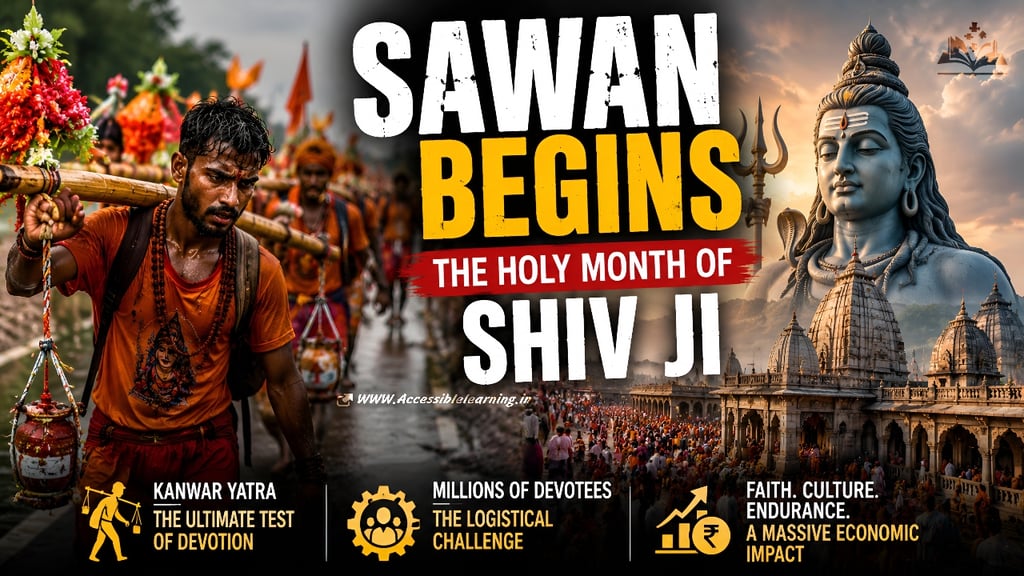
Every year, millions of devotees willingly walk hundreds of kilometers carrying sacred water on their shoulders. Many do it barefoot. Some sleep on roadsides. Others push their bodies to exhaustion under scorching heat and relentless rain. This is not a fitness challenge or a military exercise. This is Sawan, the holiest month dedicated to Shiv Ji.
For outsiders, it may look like a colorful religious season. For those living through it, Sawan is one of the largest annual displays of devotion, endurance, and mass public mobilization anywhere in the world.
SAWAN IS NOT A FESTIVAL. IT IS A MONTH-LONG SPIRITUAL MARATHON.
Sawan, also known as Shravan, holds special significance in Hindu tradition because devotees believe Shiv Ji becomes especially receptive to prayers during this period.
The month follows the Hindu lunar calendar and typically falls between July and August. Across India, temples witness a surge in visitors, fasting rituals intensify, and Mondays, known as Shravan Somwar, become major religious occasions.
But reducing Sawan to prayers and temple visits misses the bigger picture. This month transforms highways, cities, villages, local economies, transportation networks, and public administration on a massive scale.
THE KANWAR YATRA PUSHES HUMAN ENDURANCE TO THE LIMIT
Nothing represents Sawan's intensity better than the Kanwar Yatra.
Millions of Kanwariyas travel to sacred rivers such as the Ganga, collect holy water, and carry it back to Shiv Ji temples in their hometowns. Many cover distances ranging from 50 to over 500 kilometers.
They walk for days. Some run. Some refuse to place the Kanwar on the ground even once.
Many travel barefoot despite blistered feet, dehydration, muscle fatigue, and unpredictable weather.
This pilgrimage demands genuine physical sacrifice. It strips away comfort and replaces it with discipline, pain, and persistence.
Critics often focus on traffic disruptions or public inconvenience. Supporters point to something equally important: very few modern activities can motivate millions of people to voluntarily embrace such hardship for spiritual reasons alone.
MILLIONS OF PILGRIMS CREATE A LOGISTICAL NIGHTMARE
Romanticizing the pilgrimage ignores reality. Managing Sawan crowds is an administrative headache of extraordinary proportions.
State governments deploy thousands of police personnel. Medical camps operate around the clock. Traffic routes change. Emergency services remain on alert. Temporary shelters, sanitation facilities, water distribution points, and security checkpoints emerge almost overnight.
One serious failure can trigger stampedes, accidents, or public health emergencies.
Cities along major pilgrimage routes face enormous pressure. Roads become congested. Public transport systems strain under demand. Local authorities balance religious freedom with public safety every single day.
The scale resembles a large national event repeated continuously for weeks.
SHIVA TEMPLES BECOME ECONOMIC POWERHOUSES
Sawan does not only influence religion. It moves money. Temple towns experience a dramatic economic surge.
Flower vendors, sweet shops, transport operators, roadside eateries, religious goods sellers, hotels, and local artisans often earn a significant share of their annual income during this period.
Small businesses that struggle throughout the year can experience remarkable sales growth during Sawan.
The demand chain extends far beyond temples.
Milk suppliers, fruit traders, logistics providers, event organizers, tent operators, and countless informal workers benefit from the seasonal spike in activity.
Religious devotion fuels a substantial economic ecosystem that rarely receives enough attention from policymakers or analysts.

FASTING DURING SAWAN REQUIRES DISCIPLINE, NOT SOCIAL MEDIA CONTENT
Social media often turns Sawan fasting into aesthetic content. Reality looks different.
Many devotees follow strict dietary restrictions for weeks. Some consume only specific foods. Others observe complete fasts on Mondays. Families alter meal plans, daily schedules, and household routines.
The purpose is not dietary experimentation.
The traditional goal is self-control.
Fasting forces participants to confront desire, habit, and physical discomfort. Whether one agrees with the practice or not, it requires commitment that goes far beyond posting devotional content online.
SAWAN KEEPS ANCIENT TRADITIONS ALIVE IN A DIGITAL AGE
India changes rapidly. Smartphones dominate attention. Algorithms shape culture. Urban lifestyles continue to expand. Yet Sawan remains remarkably resilient.
Young devotees still participate in pilgrimages. Families continue ritual observances. Temples attract massive crowds despite endless digital distractions.
This persistence reveals something important.
Religious traditions survive not because they remain frozen in time, but because communities continuously adapt them to modern realities.
Sawan demonstrates that ancient belief systems still possess tremendous social influence in contemporary India.
THE CULTURAL IMPACT GOES FAR BEYOND RELIGION
Sawan influences music, literature, folk traditions, seasonal celebrations, and local identities.
Devotional songs fill public spaces. Communities organize gatherings. Rural and urban populations engage in shared rituals that strengthen social connections.
For many people, Sawan acts as a cultural anchor. It creates a collective experience that cuts across economic classes and geographic boundaries.
In a country often divided by language, region, and politics, few observances generate participation on such a vast scale.
THE REAL STORY OF SAWAN
The real story of Sawan is not just faith.
It is endurance.
It is infrastructure under pressure.
It is millions of people willingly embracing hardship in pursuit of spiritual meaning.
It is a seasonal economic engine powering thousands of local businesses.
It is one of the clearest examples of how ancient traditions continue to shape modern India.
Every year, roads fill with pilgrims, temples overflow with devotees, and entire communities reorganize themselves around a month dedicated to Lord Shiva.
Whether viewed through a religious, cultural, economic, or logistical lens, Sawan remains one of the most powerful annual phenomena in India. Ignore the scale, and you miss the point entirely.
FAQ's
Q: What is Sawan (Shravan), and why is it important?
Sawan, also known as Shravan, is the holiest month dedicated to Shiv Ji in the Hindu calendar. Devotees believe that prayers, fasting, and worship performed during this period bring spiritual growth, blessings, and fulfillment of wishes.
Q: Why is Shiv Ji especially worshipped during Sawan?
According to Hindu traditions, the month of Sawan is closely linked to Lord Shiva. Many scriptures describe it as a highly auspicious time when Shiva is believed to be particularly receptive to the prayers and devotion of his followers.
Q: What is the Kanwar Yatra?
The Kanwar Yatra is one of the world's largest annual pilgrimages. Devotees known as Kanwariyas collect holy water from sacred rivers, especially the Ganga, and carry it over long distances to offer it at Shiva temples.
Q: Why do devotees fast during Sawan?
Many devotees observe Sawan fasts to practice self-discipline, devotion, and spiritual purification. Common observances include fasting on Shravan Mondays (Somwar Vrat) and following specific dietary restrictions throughout the month.
Q: What are the main rituals performed during Sawan?
Popular rituals include offering water and milk to the Shiva Lingam, chanting "Om Namah Shivaya," observing Somwar fasts, visiting Shiva temples, performing Rudrabhishek, and participating in devotional gatherings.
Q: Which are the most famous Shiva temples to visit during Sawan?
Major pilgrimage sites include Kashi Vishwanath Temple, Kedarnath Temple, Baidyanath Jyotirlinga, and Mahakaleshwar Jyotirlinga.
Q: How does Sawan impact India's economy?
Sawan generates significant economic activity through religious tourism, temple offerings, transportation services, accommodation, food vendors, flower markets, and sales of devotional items, benefiting thousands of small businesses.
Q: When does Sawan start and end?
The dates of Sawan vary each year based on the Hindu lunar calendar and regional traditions. In different parts of India, the beginning and ending dates may differ slightly depending on whether the local calendar follows the Purnimanta or Amanta system.
Q: What is the significance of Shravan Somwar?
Shravan Somwar refers to the Mondays that fall during the month of Sawan. These days are considered especially sacred for Lord Shiva worship, and many devotees observe fasts and perform special prayers seeking health, prosperity, and spiritual blessings.
Subscribe To Our Newsletter
All © Copyright reserved by Accessible-Learning Hub
| Terms & Conditions
Knowledge is power. Learn with Us. 📚

