

Republic Day in India: The Constitution, the Citizen, and the Country We Are Still Building
Republic Day is not just a national holiday for India. It marks the moment citizens took ownership of their future through the Constitution. This article explores Republic Day beyond parades and speeches, examining India’s real achievements, overlooked losses, everyday realities, and the questions that will shape the republic’s future.
INDIAN HISTORYEVENT/SPECIALINDIA/BHARATCELEBRATION/FESTIVALS
Shiv Singh Rajput
1/13/20267 min read
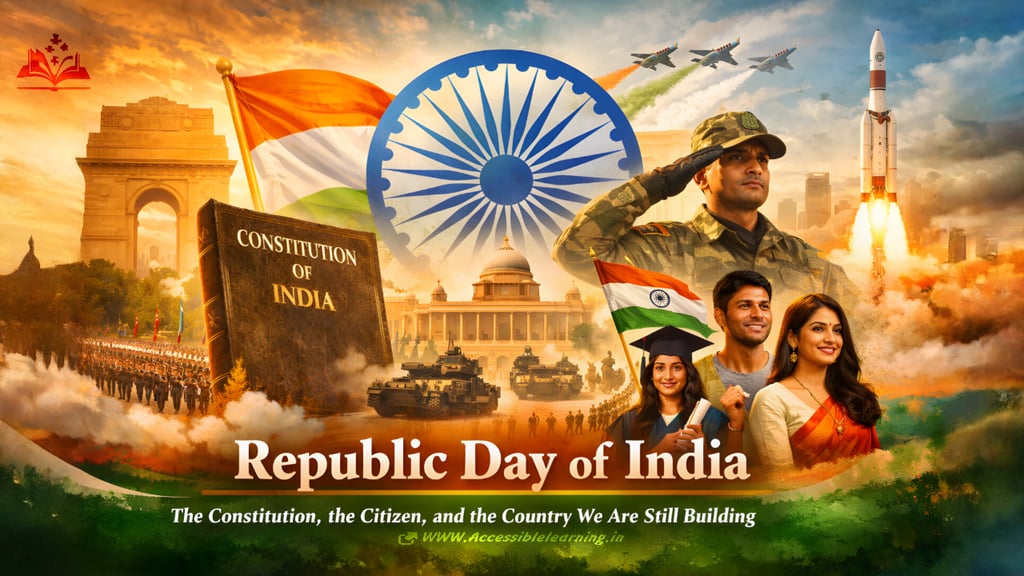
Every year on 26 January, India pauses. Streets are quieter, television screens glow with the Republic Day parade, and tricolors appear on balconies, school grounds, and office desks. But Republic Day is not just a ceremonial date on the calendar. It marks the moment India chose to govern itself not by inherited power, but by a shared constitutional promise.
This day is about what India decided to become, what it managed to achieve, what it struggled to protect, and what still lies unfinished.
Why Republic Day Matters Beyond History Books
India became independent on 15 August 1947, but freedom alone did not define the nation. On 26 January 1950, the Constitution of India came into force, replacing colonial laws with a framework written by Indians, for Indians.
The choice of 26 January was deliberate. It honored the 1930 “Purna Swaraj” declaration, when Indians formally demanded complete independence. Republic Day connects those two moments: the dream of freedom and the discipline of self-rule.
At its core, Republic Day celebrates the sovereignty of citizens, not rulers. Power flows upward from the people, not downward from authority.
The Constitution: India’s Quiet Revolution
The Indian Constitution is often called the longest written constitution in the world, but its real strength lies elsewhere. It attempted something rare in human history: uniting extreme diversity under a single legal and moral framework.
It gave:
Universal adult franchise at a time when many countries denied voting rights
Fundamental Rights to protect individuals from the state itself
A balance between unity and federalism
Space for reform through amendments rather than revolutions
This document turned millions of subjects into citizens overnight. That transformation is one of India’s greatest achievements.
What India Has Achieved Since Becoming a Republic
Democracy at Scale
India runs the largest democratic exercise in the world. Elections involving hundreds of millions of voters happen with remarkable consistency. Governments change, voices argue, and institutions bend but largely hold.
Despite pressures, India has maintained civilian control over the military and avoided authoritarian collapse, something many post-colonial nations struggled with.
Social Mobility and Representation
Republic Day reminds us that India institutionalized equality in principle, even when society resisted it in practice.
Reservation policies, constitutional protections for minorities, and expanded education have enabled millions from marginalized communities to enter administration, science, sports, and politics.
The Republic did not erase inequality, but it opened doors that were once sealed.
Economic Reinvention
From food shortages in the 1950s to becoming a major global economy, India’s journey is uneven but undeniable.
Green Revolution turned hunger into food security
Liberalization in the 1990s reshaped markets and opportunity
Digital public infrastructure like Aadhaar, UPI, and DigiLocker changed governance itself
Republic Day celebrates not just freedom, but the ability to course-correct.
Global Identity and Soft Power
India today is not just seen as a former colony. It is a space power, a technology hub, a cultural exporter, and a geopolitical voice that matters.
Yoga, cinema, startups, science missions, and diplomacy have all become extensions of the Republic’s confidence.
What India Has Lost Along the Way
Republic Day is also a moment for honest reflection.
The Spirit of Dialogue
The Constitution encourages debate and disagreement. Yet public discourse has increasingly turned combative. Listening is often replaced by labeling, and complexity by slogans.
A Republic weakens when disagreement becomes disloyalty.
Institutional Trust
Institutions are the backbone of any republic. When trust in media, courts, universities, or governance systems erodes, democracy becomes fragile even if elections continue.
Republic Day reminds us that institutions need constant care, not blind loyalty or casual dismissal.
Civic Responsibility
Rights are celebrated loudly; duties are often quietly ignored.
Cleanliness, public behavior, respect for law, and civic discipline are not optional extras. A republic survives not only on laws but also on everyday conduct.
Republic Day in the Present: What It Reflects Today
The modern Republic Day parade is more than a military display. It is a narrative.
Indigenous defense technology reflects strategic self-reliance
Cultural tableaux show regional identity within national unity
Youth participation signals the future ownership of the Republic
Women-led contingents redefine traditional power images
This evolving symbolism shows how India sees itself now, not just how it remembers the past.

The Republic in Daily Life: Where the Constitution Touches You (and Where It Doesn’t)
Most Indians do not feel the Constitution through grand ideals. They feel it when a train reservation works, when a court date is postponed, when a government portal crashes, or when a welfare benefit finally arrives after months.
Republic Day quietly reminds us of a hard truth:
A republic is judged not by its intentions, but by its execution.
India’s success story is uneven because implementation, not imagination, has always been the real battlefield.
The Middle-Class Republic: India’s Silent Backbone
One of India’s biggest post-Republic transformations is the rise of the middle class. This group did not exist at scale in 1950.
Salaried jobs, public sector hiring, and later private enterprise created economic stability
Education became the single most powerful ladder out of poverty
The middle class became both the taxpayer and the primary system user
Yet this group also carries the heaviest burden. They fund the system, rely on it daily, and feel its failures most sharply. Republic Day rarely talks about this tension, but it defines modern India.
The Republic and the Poor: Inclusion Without Dignity Is Incomplete
India has lifted millions out of extreme poverty, but dignity has lagged behind access.
Welfare delivery improved through digitization
Direct benefit transfers reduced leakage
Basic services reached deeper rural areas
At the same time, dependency replaced empowerment in many cases. A republic should eventually make itself unnecessary in people’s lives, not be permanently required for survival.
This remains one of India’s unfinished tasks.
Youth, Jobs, and the Anxiety of the Future
India is one of the youngest republics demographically, but opportunity has not grown at the same speed.
Degrees increased faster than meaningful employment
Skill gaps remain despite training programs
Competitive exams became pressure cookers rather than gateways
Republic Day celebrations often highlight youth power, but the reality is a generation negotiating uncertainty, hustle, and survival at the same time.
A republic cannot thrive on aspiration alone. It must convert ambition into pathways.
Women and the Republic: Progress With Resistance
Legal equality exists. Social equality is still negotiated daily.
Women vote, lead, and work across sectors
Laws protect, but enforcement varies widely
Safety and economic independence remain uneven
What has changed is visibility. What remains is acceptance. Republic Day should not just celebrate women’s presence but question why normalcy still feels exceptional.
The Digital Republic: Speed Without Patience
India’s digital governance model is admired globally. But speed has come with trade-offs.
Systems scaled faster than user understanding
Connectivity arrived before digital literacy
Automation reduced corruption but increased exclusion in edge cases
The digital republic works best for the informed and connected. The challenge ahead is making it humane, not just efficient.
Cultural Confidence and the Risk of Amnesia
India today is more culturally confident than at any time since independence. That confidence is valuable. But confidence can turn fragile if history is simplified. A republic grows stronger when it remembers complexity, not when it edits it. Losing nuance means losing wisdom, and republics cannot afford intellectual shortcuts.
What Republic Day Rarely Asks, But Should
Are citizens participants or spectators?
Are institutions serving the Constitution or personalities?
Are laws adapting faster than society or falling behind it?
Are we preparing for the next 25 years or celebrating the last 75?
These questions are uncomfortable. That is exactly why they matter.
The Most Honest Meaning of Republic Day
Republic Day is not about perfection.
It is about permission.
Permission to question.
Permission to improve.
Permission to disagree without breaking apart.
India’s republic is noisy, flawed, ambitious, and resilient. Its real achievement is not that it never failed, but that it never stopped trying to correct itself.
That is the Republic worth protecting.

The Republic India Is Still Becoming
Republic Day is unfinished business. The Constitution was never meant to be frozen. It was designed to adapt without losing its soul. The real question is not whether India is perfect, but whether it remains self-correcting.
The future Republic depends on:
Education that teaches thinking, not memorization
Economic growth that includes dignity, not just data
Technology that empowers citizens, not replaces accountability
National pride that coexists with constitutional humility
India’s greatest strength is not uniformity. It is the ability to argue, adapt, and still stay together.
Republic Day Is Not Just a Celebration; It Is a Test
Every 26 January asks Indians a quiet question:
Are we still committed to the values we inherited, or are we only proud of the symbols?
The flag, the anthem, and the parade matter. But the Republic truly lives in classrooms, courtrooms, polling booths, workplaces, and daily choices.
Republic Day is not about looking back with nostalgia. It is about looking forward with responsibility.
Because a republic does not survive on memory alone.
It survives on participation.
FAQ's
Q: Why is Republic Day celebrated on 26 January and not on Independence Day?
Independence Day marks freedom from British rule, but Republic Day marks self-governance. On 26 January 1950, India adopted its own Constitution, replacing colonial laws and making citizens the true source of power.
Q: What actually changed for Indians after becoming a republic?
Indians moved from being ruled subjects to constitutional citizens. Voting rights, legal equality, fundamental freedoms, and access to public institutions became guaranteed, not granted by authority.
Q: Is Republic Day only about the Constitution?
No. It is about accountability. The Constitution is the framework, but Republic Day reminds citizens and governments alike that power must operate within limits and public responsibility.
Q: Why does the Republic Day parade focus so much on the military?
The parade symbolizes civilian control over the armed forces. In a republic, the military serves the Constitution, not political power or individuals, reinforcing democratic balance.
Q: Has India lived up to the promises of its Constitution?
Partially. India has upheld democracy, unity, and electoral freedom, but struggles remain in equality, justice delivery, and social dignity. Republic Day is as much about reflection as celebration.
Q: What role do citizens play in keeping the republic strong?
Participation. Voting, questioning authority, following laws, respecting institutions, and civic responsibility are essential. A republic weakens when citizens become passive observers.
Q: How is Republic Day relevant to young Indians today?
It defines their rights, opportunities, and protections. It also places responsibility on them to improve institutions, not abandon them, as India’s future leaders and workforce.
Q: What is the biggest challenge facing the Indian republic today?
Balancing rapid economic and digital growth with social trust, institutional independence, and inclusive development without weakening constitutional values.
Q: Is Republic Day still meaningful in modern India?
Yes, but its meaning has evolved. It is no longer just historical pride but a reminder that democracy requires continuous effort, discipline, and honesty.
Q: What is the true message of Republic Day for Indians?
The republic is not owned by governments or leaders. It belongs to its citizens, and its strength depends on how responsibly that ownership is exercised.
Subscribe To Our Newsletter
All © Copyright reserved by Accessible-Learning Hub
| Terms & Conditions
Knowledge is power. Learn with Us. 📚

