

Regional Holidays: Meaning, Importance, and Cultural Depth
Discover the meaning, importance, and cultural diversity of regional holidays. Learn how local festivals preserve traditions, boost economies, and reflect unique identities across different regions.
CULTURE/TRADITIONEVENT/SPECIALINDIA/BHARATCELEBRATION/FESTIVALS
Jagdish Nishad
4/15/20264 min read
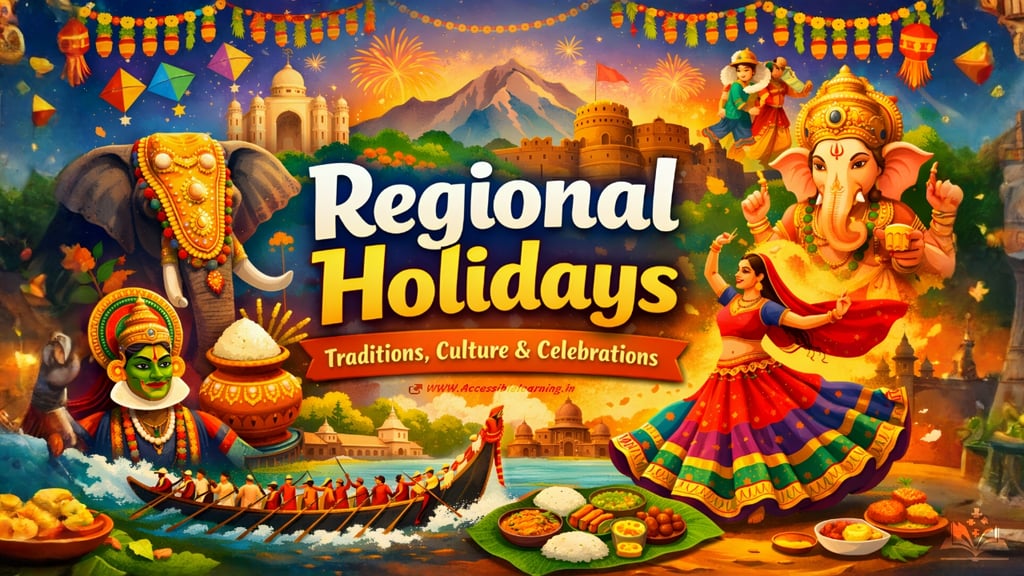
Regional holidays are not just local celebrations. They are living expressions of identity, memory, and tradition. While national holidays unite a country, regional holidays reveal its true diversity. They tell stories that are often overlooked at the national level but deeply felt within communities. Let’s go deeper into the aspects that make regional holidays truly fascinating.
Hidden Layers of Regional Holidays
1. Language and Identity Preservation
Many regional holidays are closely tied to local languages. Folk songs, chants, and storytelling traditions are performed in native dialects that may not be widely spoken outside the region.
These celebrations:
Help preserve endangered languages
Keep oral traditions alive
Strengthen regional pride
2. Food as Cultural Memory
Every regional holiday has its own signature dishes. These are not random recipes. They are deeply symbolic.
For example:
Ingredients often reflect seasonal availability
Recipes are passed down through generations
Cooking methods are tied to rituals
Food becomes a way of remembering history and belonging.
3. Unique Local Rituals You Won’t Find Elsewhere
Some regional traditions are so specific that they exist only in one place.
Examples include:
Boat races during Kerala festivals
Mask dances in Himalayan regions
Fire-walking rituals in parts of South India
Animal fairs and symbolic ceremonies in rural areas
These rituals may seem unusual to outsiders but carry deep spiritual or historical meaning.
4. Regional Holidays as Storytelling Platforms
Every holiday has a story behind it:
A mythological event
A historical victory
A seasonal transition
These stories are retold through:
Performances
Decorations
Processions
This keeps history alive in a more engaging way than textbooks.

The Role of Art, Music, and Performance
Regional holidays are a stage for artistic expression. They promote:
Folk dances (like Garba and Bihu)
Classical performances (like Kathakali)
Handmade decorations and crafts
In many cases, entire communities participate in creating art, making the celebration collaborative.
Regional Holidays and Tourism Power
Regional festivals are becoming major tourism drivers.
Why tourists love them:
Authentic cultural experiences
Unique visuals and photography opportunities
Local cuisine and traditions
Examples:
Durga Puja attracting global visitors
Goa’s regional feasts blending Indian and Portuguese culture
Rajasthan’s desert festivals
This creates a strong connection between culture and economy.
Digital Age and Regional Festivals
Today, regional holidays are no longer limited by geography.
How technology is changing things:
Live streaming of festivals
Viral reels showcasing traditions
Online communities celebrating together
Even people living far from their hometown can stay connected.
Environmental and Sustainable Aspects
An interesting shift is happening in how regional holidays are celebrated.
Traditional practices were often eco-friendly:
Natural decorations (flowers, मिट्टी idols, leaves)
Minimal waste
Community sharing
Modern efforts include:
Eco-friendly idols during Ganesh Chaturthi
Plastic-free celebrations
Awareness campaigns
This blend of tradition and sustainability is shaping the future.
Psychological and Social Impact
Regional holidays are not just cultural. They affect mental and emotional well-being. They provide:
A break from routine
A sense of belonging
Opportunities for social bonding
For many people, these festivals are the most emotionally meaningful times of the year.


Lesser-Known Facts About Regional Holidays
Some regional holidays follow lunar or solar calendars, so dates change every year
The same festival can look completely different in different regions
Many holidays started as small village traditions and grew into large-scale events
Some are officially recognized, while others are informal but widely celebrated
Regional Holidays in a Globalized World
As the world becomes more connected:
Regional festivals are gaining global audiences
Diaspora communities celebrate them abroad
Cultural exchange is increasing
At the same time, there is a growing effort to:
Protect authenticity
Avoid over-commercialization
Maintain traditional values
Regional holidays are where culture feels most real. They are not standardized or uniform, and that is exactly what makes them powerful. They carry emotion, history, and identity in ways that national celebrations often cannot.
Understanding regional holidays gives you a deeper, more human view of the world. It shows how people live, celebrate, and connect with their roots in unique and meaningful ways.
FAQ's
Q: What are regional holidays?
Regional holidays are official or widely observed days celebrated within specific states, provinces, or communities. They reflect local culture, traditions, history, or religious practices rather than nationwide significance.
Q: How are regional holidays different from national holidays?
Regional holidays are limited to particular areas and celebrate local identity, while national holidays are observed across an entire country and usually mark major historical or political events.
Q: Why are regional holidays important?
Regional holidays help preserve cultural heritage, promote community bonding, and support local economies through tourism, food, crafts, and events.
Q: Can regional holidays vary within the same country?
Yes, regional holidays can differ widely within the same country. For example, in India, each state celebrates unique festivals based on its culture, language, and traditions.
Q: Are regional holidays public holidays?
Some regional holidays are officially recognized as public holidays in specific regions, meaning schools, offices, and government institutions may remain closed locally.
Q: How do regional holidays impact travel plans?
Regional holidays can affect travel by increasing demand for transportation and accommodation. Popular festivals often attract tourists, leading to higher prices and crowded destinations.
Q: Do regional holidays have fixed dates every year?
Not always. Many regional holidays follow lunar or traditional calendars, so their dates may change each year.
Q: How do regional holidays benefit local businesses?
They boost local economies by increasing sales in sectors like hospitality, retail, handicrafts, and food. Festivals often create seasonal business opportunities.
Q: Are regional holidays celebrated internationally?
Yes, many regional holidays are celebrated by diaspora communities around the world, helping preserve cultural identity even outside their native region.
Q: How are regional holidays evolving in modern times?
With digital media and globalization, regional holidays are gaining global visibility. At the same time, there is a growing focus on sustainability and preserving authentic traditions.
Q: What are some examples of regional holidays?
Examples include Onam (Kerala), Bihu (Assam), Pongal (Tamil Nadu), and Durga Puja (West Bengal). Each reflects the unique culture of its region.
Q: Why do regional holidays matter in a globalized world?
They highlight cultural diversity, promote mutual understanding, and help people stay connected to their roots in an increasingly connected and fast-changing world.
Subscribe To Our Newsletter
All © Copyright reserved by Accessible-Learning Hub
| Terms & Conditions
Knowledge is power. Learn with Us. 📚

