

Region of Interest (ROI) Video Encoding: The Secret to High-Speed Streaming
Discover how Region of Interest (ROI) Video Encoding uses AI to prioritize visual focus, reduce bandwidth consumption, improve streaming quality, and deliver faster, more efficient video experiences across streaming, gaming, and video conferencing platforms.
DIGITAL MARKETINGEDITOR/TOOLSAI/FUTURECOMPANY/INDUSTRY
Sachin K Chaurasiya | Kim Shin
7/1/20267 min read
Why Modern Video Players Only Waste Data on the Parts of the Screen You Are Actually Looking At
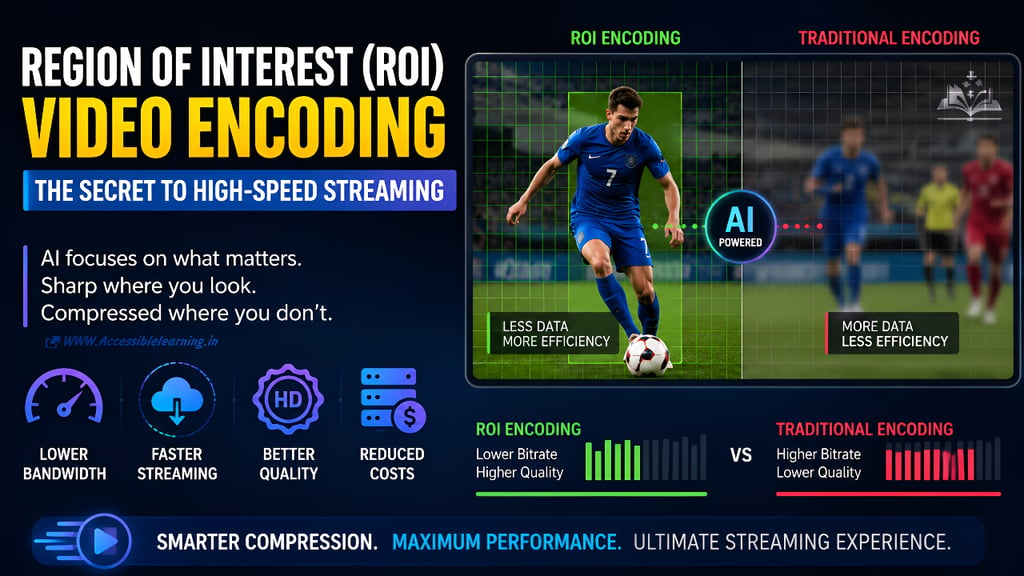
Imagine watching a football match in 4K. The player's face is crystal clear. The ball is sharp. The scoreboard is perfectly readable. Yet the crowd in the background, distant stadium seats, and other less important areas are being compressed far more aggressively.
You don't notice the difference.
Your eyes never focus there.
This is the hidden trick powering modern video streaming efficiency: Region of Interest (ROI) Video Encoding.
Instead of treating every pixel equally, ROI encoding prioritizes the parts of a video that matter most while reducing bitrate consumption in less important regions. The result is higher visual quality, lower bandwidth costs, faster streaming, and improved user experience.
As video traffic continues to dominate global internet usage, ROI encoding has become one of the most important technologies behind modern streaming platforms, cloud gaming services, surveillance systems, video conferencing applications, and AI-powered media delivery.
What Is Region of Interest (ROI) Video Encoding?
Definition
Region of Interest (ROI) Video Encoding is a video compression technique that allocates more bits and encoding resources to important areas of a video frame while applying stronger compression to less important regions.
In simple terms:
Important objects receive higher quality
Background elements receive lower quality
Overall bitrate remains lower
Visual perception remains high
The encoder identifies areas that deserve greater detail and preserves them during compression.
These regions may include:
Human faces
Moving objects
Text overlays
User interface elements
Sports players
Vehicles
Product displays
Presentation slides
Gaming characters
Everything else can be compressed more aggressively.
Why Traditional Video Encoding Wastes Bandwidth
Conventional video encoders generally process frames with relatively uniform quality targets. This creates a major inefficiency. Human vision does not evaluate every pixel equally.
People naturally focus on the following:
Faces
Motion
Bright objects
Text
Objects near the center of attention
Meanwhile, large portions of every frame receive little or no visual attention.
Examples include:
Empty sky
Static walls
Distant scenery
Background crowds
Out-of-focus objects
Traditional encoding still spends valuable bits preserving details viewers rarely notice. ROI encoding eliminates this waste.
The Science Behind Visual Attention
Human vision operates through selective attention.
The brain constantly filters information and prioritizes certain visual signals.
Researchers have found that viewers are more likely to focus on:
Motion
Moving objects attract immediate attention.
Faces
Humans are naturally drawn to facial features.
Contrast
Bright or highly contrasted objects stand out.
Text
The brain instinctively attempts to read visible text.
Central Vision
Most detail perception occurs in the fovea, a small area in the center of the retina.
This means only a fraction of the screen receives detailed visual analysis at any given moment.
ROI encoding leverages this biological reality.

How ROI Video Encoding Works
The process combines video compression algorithms with intelligent scene analysis.
Step 1: Frame Analysis
Each frame is analyzed in real time. The system identifies important content.
Examples:
Faces
Vehicles
People
UI elements
Motion regions
Step 2: ROI Map Creation
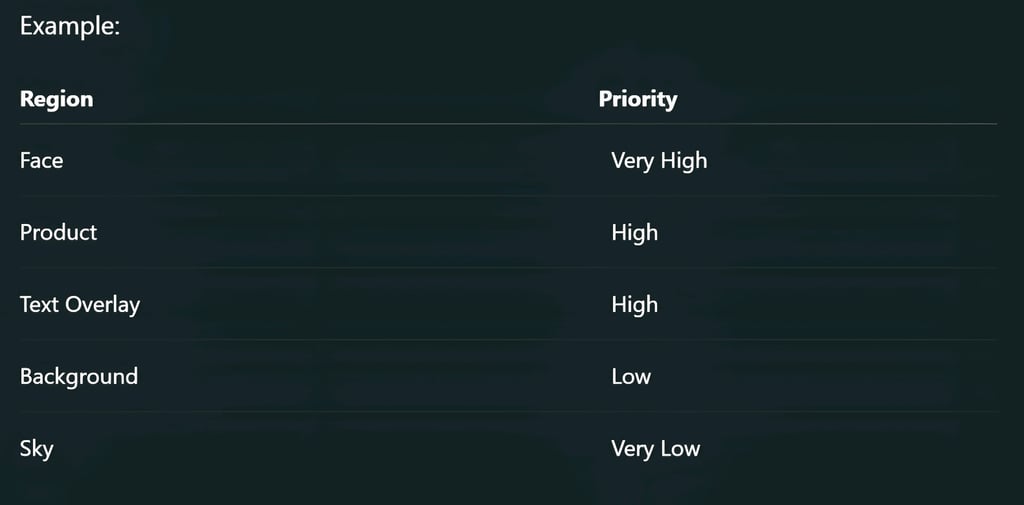
The encoder generates a priority map. Different regions receive different importance levels.

Step 3: Bit Allocation
The encoder distributes bitrate according to importance. High-priority regions receive:
Lower quantization
Higher detail preservation
Better texture retention
Low-priority regions receive:
Higher quantization
More aggressive compression
Reduced bitrate
Step 4: Video Delivery
The viewer receives a video that appears visually sharp while consuming significantly less bandwidth.
The Role of AI in ROI Encoding
Modern ROI systems increasingly rely on artificial intelligence.
Traditional ROI methods used predefined rules.
AI-powered solutions can dynamically identify important content far more accurately.
Object Detection
Neural networks identify:
People
Animals
Vehicles
Products
Logos
Face Recognition
Faces are automatically assigned high priority.
Eye-Gaze Prediction
AI predicts where viewers are most likely to look.
Saliency Detection
Models estimate visual importance across an entire frame.
Motion Analysis
Fast-moving objects receive increased encoding attention.
The result is a compression strategy that closely mirrors human perception.
Eye Tracking and Visual Focus Prediction
One of the most advanced forms of ROI encoding uses gaze prediction. Some systems directly track eye movement. Others estimate visual attention through AI models.
The encoder predicts:
What viewers are looking at
What they are likely to look at next
Which areas can tolerate quality reduction
This enables real-time bitrate optimization.
The concept is especially powerful in the following:
Virtual reality
Augmented reality
Cloud gaming
Interactive video systems
ROI Encoding in Video Streaming Platforms
Streaming services constantly balance quality and bandwidth. ROI encoding provides a major advantage. Benefits include:
Reduced CDN Costs
Lower bitrates mean less data transfer.
Faster Start Times
Smaller streams load more quickly.
Reduced Buffering
Bandwidth requirements decrease.
Better Mobile Performance
Users on slower networks receive smoother playback.
Higher Perceived Quality
Important content remains sharp despite reduced file sizes.
This creates a better experience without requiring additional bandwidth.
ROI Encoding for Cloud Gaming
Cloud gaming presents a unique challenge. Every frame must be transmitted with extremely low latency. ROI encoding helps by prioritizing:
Player character
Crosshair
HUD elements
Active gameplay areas
Background environments can receive stronger compression.
Benefits include:
Reduced latency
Lower bandwidth usage
Improved responsiveness
Better image quality where it matters
This approach has become increasingly important as cloud gaming adoption grows.

ROI Encoding in Video Conferencing
Video conferencing platforms use ROI encoding extensively.
In a typical meeting:
The speaker's face matters most.
The office wall behind them does not.
ROI encoding focuses bandwidth on:
Faces
Eyes
Mouth movements
Shared presentations
Screen content
This allows high-quality communication even on limited connections.
ROI Encoding in Security and Surveillance Systems
Surveillance cameras generate enormous volumes of video data. ROI encoding dramatically reduces storage requirements. Important areas may include:
Entrances
License plates
Human subjects
Restricted zones
Background regions receive heavier compression.
Benefits include:
Lower storage costs
Longer retention periods
Faster video retrieval
Improved forensic quality
ROI Encoding and Modern Codecs
ROI techniques work alongside modern compression standards. Popular codecs supporting ROI optimization include:
H.264/AVC
H.265/HEVC
AV1
VP9
VVC (H.266)
The encoder simply adjusts compression behavior within specific frame regions. The codec remains unchanged. This makes ROI deployment practical across existing infrastructures.
Measurable Benefits of ROI Encoding
Organizations implementing ROI encoding commonly report:
Bandwidth Reduction
Often between 20% and 70%, depending on content.
Storage Savings
Significant reductions in archive requirements.
Better Perceptual Quality
Viewers notice fewer quality losses.
Lower Delivery Costs
CDN and network expenses decrease.
Improved Scalability
More concurrent streams become possible.
The exact improvement varies by use case and scene complexity.
Challenges and Limitations
ROI encoding is powerful but not perfect.
Incorrect ROI Detection
AI models may misidentify important content.
Computational Overhead
Scene analysis requires additional processing.
Rapid Scene Changes
Fast transitions can complicate ROI allocation.
Viewer Variability
Different viewers focus on different areas.
Real-Time Constraints
Ultra-low-latency applications require extremely efficient analysis.
Despite these challenges, advances in AI continue improving ROI accuracy.


The Future of ROI Encoding
The next generation of video compression will become increasingly perception-driven. Emerging developments include:
AI-Powered Adaptive Bit Allocation
Encoding decisions updated frame by frame.
Personalized Video Streams
Different users receive different ROI priorities.
Eye-Tracked Streaming
Real-time gaze tracking determines compression strategy.
Foveated Rendering
Common in VR and AR systems.
AI Video Codecs
Future codecs may integrate ROI logic directly into compression pipelines.
The goal is simple:
Deliver maximum visual quality using the minimum amount of data.
Why ROI Encoding Matters More Than Ever
Video now represents the majority of internet traffic worldwide.
At the same time:
Resolution continues increasing
4K adoption grows
8K content emerges
Cloud gaming expands
VR experiences become mainstream
Bandwidth demand is rising faster than infrastructure can economically support. ROI encoding addresses this challenge by recognizing a fundamental truth:
Humans do not look at every pixel equally.
By preserving quality where attention is focused and reducing quality where it is not, ROI encoding creates the illusion of a higher-quality stream while using far fewer resources.
That combination of intelligence and efficiency is why Region of Interest Video Encoding has become one of the most important technologies behind modern high-speed streaming.
Key Takeaway
Region of Interest (ROI) Video Encoding is a smart compression technique that uses AI, object detection, motion analysis, and visual attention modeling to preserve quality in the areas viewers actually care about while aggressively compressing less important regions. The result is lower bandwidth usage, reduced storage costs, faster streaming, and higher perceived video quality, making ROI encoding a critical component of next-generation streaming, cloud gaming, video conferencing, surveillance, and immersive media systems.
FAQ's
Q: What is Region of Interest (ROI) Video Encoding?
Region of Interest (ROI) Video Encoding is a video compression technique that allocates more bitrate and encoding resources to important areas of a video, such as faces, text, or moving objects, while applying stronger compression to less important background regions. This improves streaming efficiency without significantly affecting perceived video quality.
Q: How does ROI Video Encoding reduce bandwidth usage?
ROI encoding reduces bandwidth by preserving high quality only in visually important regions and lowering quality in areas viewers are less likely to notice. Depending on the content, this can reduce video bitrate by 20% to 70% while maintaining a similar viewing experience.
Q: How does AI improve ROI Video Encoding?
AI enhances ROI encoding by automatically detecting faces, people, vehicles, text, products, and other important objects in real time. Advanced AI models can also predict viewer attention and visual saliency, allowing encoders to allocate bandwidth more efficiently.
Q: What is the difference between ROI Encoding and traditional video compression?
Traditional video compression generally treats all areas of a frame similarly, while ROI encoding prioritizes specific regions based on visual importance. This targeted approach delivers better perceived quality at lower bitrates.
Q: Which industries benefit most from ROI Video Encoding?
ROI encoding is widely used in video streaming platforms, cloud gaming services, video conferencing applications, surveillance systems, telemedicine, virtual reality (VR), augmented reality (AR), and live broadcasting environments.
Q: Can ROI Video Encoding improve video streaming quality on slow internet connections?
Yes. ROI encoding helps maintain sharp detail in important regions even when bandwidth is limited. This allows streaming services to deliver better perceived video quality and reduce buffering on slower networks.
Q: Does ROI Video Encoding work with modern video codecs?
Yes. ROI encoding can be implemented with popular codecs such as H.264 (AVC), H.265 (HEVC), AV1, VP9, and H.266 (VVC). It works by controlling bitrate allocation within the codec's existing compression framework.
Q: What is AI-powered visual saliency detection in ROI Encoding?
Visual saliency detection is an AI technique that predicts which areas of a video frame are most likely to attract human attention. These regions are assigned higher encoding priority to maximize perceived quality while minimizing bandwidth consumption.
Q: What is foveated streaming, and how is it related to ROI Encoding?
Foveated streaming is an advanced form of ROI encoding that uses eye-tracking technology to identify exactly where a user is looking. The viewed area receives maximum quality, while peripheral regions are compressed more heavily, significantly reducing bandwidth requirements.
Q: Is ROI Video Encoding important for cloud gaming?
Absolutely. Cloud gaming platforms use ROI encoding to prioritize game characters, user interfaces, crosshairs, and active gameplay areas. This reduces bandwidth demands while maintaining responsiveness and visual clarity where players focus most.
Q: How does ROI Encoding help reduce video storage costs?
By applying stronger compression to low-priority regions, ROI encoding decreases overall file sizes. This reduces storage requirements for video archives, surveillance footage, and large-scale media libraries.
Q: What is the future of ROI Video Encoding?
The future of ROI encoding lies in AI-driven adaptive compression, eye-tracking integration, personalized streaming, and next-generation video codecs. These technologies will further optimize video delivery by matching compression decisions to human visual perception in real time.
Subscribe To Our Newsletter
All © Copyright reserved by Accessible-Learning Hub
| Terms & Conditions
Knowledge is power. Learn with Us. 📚

