

Rani Lakshmibai: The Warrior Queen Who Defied an Empire
Discover the remarkable story of Rani Lakshmibai, the warrior queen who led India's 1857 rebellion against British rule. Explore her life, battles, and enduring legacy.
BIOGRAPHY/HISTORYINDIAN HISTORYEMPIRES/HISTORY
Keshav Jha
1/23/20268 min read
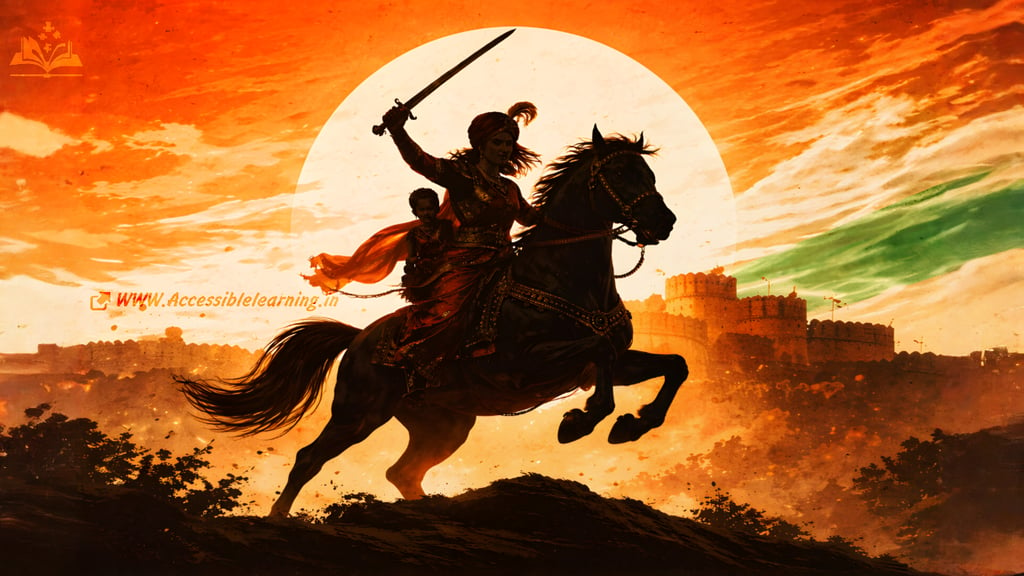
When a young widow refused to surrender her kingdom to the British East India Company in 1853, few could have predicted she would become one of India's most celebrated freedom fighters. Rani Lakshmibai of Jhansi transformed from a royal consort into a military commander, leading cavalry charges and defending fortress walls during India's First War of Independence in 1857-58.
Who Was Rani Lakshmibai?
Rani Lakshmibai (born Manikarnika Tambe, November 19, 1828 – June 18, 1858) was the queen of the princely state of Jhansi in north-central India. She became a symbol of resistance against British colonial rule during the Indian Rebellion of 1857, personally leading her troops in battle and fighting until her death at age 29.
Early Life: From Manikarnika to Maharani
Born in Varanasi to a Maharashtrian Karhade Brahmin family, Manikarnika—affectionately called "Manu"—received an unconventional education for women of her era. Her father, Moropant Tambe, worked at the court of Peshwa Baji Rao II, where young Manu learned horseback riding, archery, and sword fighting alongside traditional studies.
In 1842, at age 14, Manikarnika married Maharaja Gangadhar Rao Newalkar of Jhansi and received the name Lakshmibai. The couple had a son in 1851, but the infant died after just four months. Devastated but determined to secure the kingdom's succession, the Maharaja adopted his cousin's son, Anand Rao, who was renamed Damodar Rao, just one day before the Maharaja's death in November 1853.
The Doctrine of Lapse: Colonial Conquest by Legal Fiction
The British East India Company's Governor-General, Lord Dalhousie, implemented the controversial Doctrine of Lapse—a policy that prohibited Indian rulers from adopting heirs. Under this doctrine, any princely state without a "natural" heir would be automatically annexed by the Company upon the ruler's death.
Despite Maharaja Gangadhar Rao's adoption of Damodar Rao being legally recognized under Hindu law, the British rejected the succession. In March 1854, British authorities annexed Jhansi, offering Lakshmibai an annual pension of 60,000 rupees but stripping her of political authority. The 25-year-old widow refused to accept this injustice, famously declaring, "Meri Jhansi nahi doongi" (I will not give up my Jhansi).
The Rebellion of 1857: From Queen to Commander
The Spark That Ignited Revolution
The Indian Rebellion of 1857 began in May when sepoys (Indian soldiers) in Meerut revolted against the British. The uprising spread rapidly across northern India, reaching Jhansi in June 1857. When rebel forces killed British officers and European civilians in Jhansi's fort, the British later blamed Lakshmibai, though historians debate her actual involvement in these events.
Lakshmibai Takes Command
What remains undisputed is Lakshmibai's extraordinary leadership during the siege of Jhansi. When British forces under General Hugh Rose attacked the city in March 1858, the Rani personally organized the defense:
She assembled a volunteer army of approximately 14,000 rebels
Trained women soldiers to defend the fort's ramparts
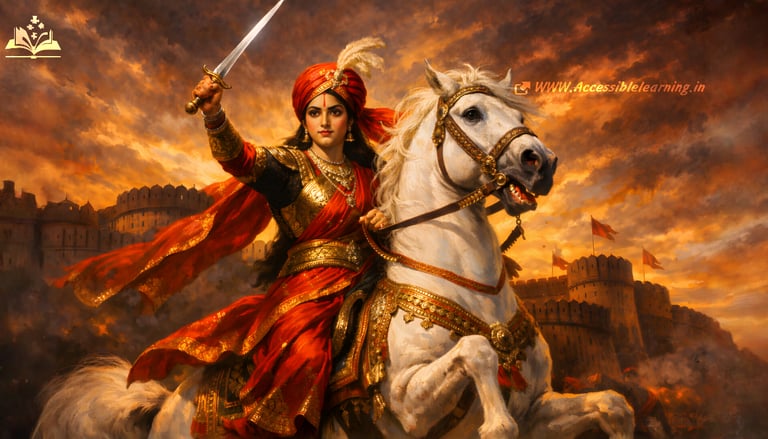
Led cavalry units herself, dressed in military uniform
Managed artillery positions and defense strategies
Her adopted son Damodar Rao was tied to her back during battles
Contemporary British accounts, though written by her enemies, acknowledged her military prowess. General Rose himself called her "the most dangerous of all the rebel leaders."
The Siege and Fall of Jhansi
The British siege lasted from March 23 to April 3, 1858. Despite fierce resistance, the superior British artillery eventually breached Jhansi's walls. Realizing the fort would fall, Lakshmibai escaped on horseback with her son, reportedly jumping from the fort walls at night—a feat that has become legendary in Indian history.
The Battle of Gwalior: A Warrior's Last Stand
After fleeing Jhansi, Lakshmibai joined forces with other rebel leaders, including Tantia Tope and Rao Sahib. Together they captured the strategic fortress of Gwalior in June 1858. However, British forces quickly counterattacked.
On June 18, 1858, during fierce fighting near Gwalior, Rani Lakshmibai was mortally wounded. According to multiple historical accounts, she was struck by a bullet while charging British cavalry, dressed as a male soldier. She died on the battlefield, holding her sword to the last.
To prevent the British from desecrating her body, her attendants cremated her remains immediately on the battlefield—a final act of defiance ensuring she received proper Hindu funeral rites.
Legacy: From Historical Figure to National Icon
British Perspectives: Respect from Adversaries
Remarkably, even British officers who fought against her expressed admiration. General Hugh Rose wrote, "The Rani was remarkable for her bravery, cleverness and perseverance." Another British soldier present at Gwalior noted her "great bravery and resolution" in battle.
Symbol of Indian Nationalism
During India's independence movement in the 20th century, Lakshmibai became an enduring symbol of resistance. Leaders like Subhas Chandra Bose formed the Rani of Jhansi Regiment of the Indian National Army, an all-women combat unit named in her honor.
Contemporary Recognition
Today, Rani Lakshmibai is celebrated throughout India:
Statues and memorials commemorate her in Jhansi, Gwalior, and major Indian cities
Her birthday (November 19) is observed in many Indian states
Numerous schools, universities, and public institutions bear her name
The Indian government issued postage stamps featuring her image in 1957 and 2001
Major films, television series, and literary works tell her story to new generations
Historical Debates and Scholarly Perspectives
Was She a Freedom Fighter or Reluctant Rebel?
Historians continue debating Lakshmibai's motivations. Some scholars argue she initially sought peaceful restoration of her kingdom and only joined the rebellion when attacked by British forces. Others contend she was an active participant from the rebellion's start. What's undeniable is her transformation into a military leader once committed to the cause.
The Question of the 1857 Massacre
The killing of European civilians in Jhansi Fort during June 1857 remains controversial. While British authorities blamed Lakshmibai, several historians suggest she had limited control over rebel forces and may have even tried to protect British residents. Primary sources offer conflicting testimonies, making definitive conclusions difficult.
Separating Legend from History
Like many historical figures, Lakshmibai's story has acquired mythological elements over time. The image of her fighting with her son strapped to her back, while recorded in period accounts, may have been embellished. Similarly, some dramatic escape stories blend verified facts with later additions. Contemporary historians work to distinguish documented events from patriotic legend.
Why Rani Lakshmibai's Story Matters Today
Challenging Gender Norms in the 19th Century
In an era when most Indian women, especially widows, faced severe social restrictions, Lakshmibai's military leadership was revolutionary. She commanded armies, made strategic decisions, and fought in combat—roles exclusively reserved for men in 1850s India. Her example challenged both colonial and traditional patriarchal structures.
Resistance Against Imperialism
Lakshmibai's refusal to surrender Jhansi represents principled resistance against imperial expansion. Her story resonates beyond India, inspiring anticolonial movements worldwide and reminding us that resistance to injustice takes many forms.
Courage Under Impossible Odds
Perhaps most enduringly, her story demonstrates extraordinary courage. Facing the world's most powerful military force with limited resources, she fought not for personal gain but for her people and principles. Whether her cause could have succeeded militarily is less important than the example she set.
Rani Lakshmibai's life spanned just 29 years, yet her impact on Indian history extends far beyond her brief existence. She transformed from a young widow facing dispossession into a warrior queen who challenged the might of the British Empire. Her story embodies courage, leadership, and unwavering commitment to justice.
More than 165 years after her death, Lakshmibai remains relevant—not as a distant historical curiosity, but as a figure whose choices continue inspiring people facing injustice. In classrooms, literature, and popular culture, her example teaches that power isn't measured only in military victory but in the courage to stand for one's principles against overwhelming odds.
The woman who declared, "I will not give up my Jhansi," ultimately lost her kingdom and her life—but won immortality in the hearts of millions who continue drawing strength from her extraordinary story.

Frequently Asked Questions
Q: What was Rani Lakshmibai's real name?
Her birth name was Manikarnika Tambe, affectionately called "Manu" as a child. She received the name Lakshmibai after marrying Maharaja Gangadhar Rao of Jhansi in May 1842, following the custom of royal wives taking new names.
Q: How did Rani Lakshmibai die?
She died on June 18, 1858, from wounds sustained during cavalry combat near Gwalior while fighting British forces. She was struck during a charge by the 8th Hussars and died shortly after being carried from the battlefield. She was approximately 29 years old.
Q: Did Rani Lakshmibai actually fight in battles?
Yes, extensive historical records from both Indian and British sources confirm she personally led troops in combat, participated in cavalry charges, and fought with weapons during the defense of Jhansi (March-April 1858) and subsequent battles at Kalpi and Gwalior.
Q: What happened to Rani Lakshmibai's son?
Her adopted son, Damodar Rao, survived the rebellion. After his mother's death, he eventually surrendered to British authorities in 1860, received a pension of 12,000 rupees annually, but never regained the throne of Jhansi. He died in relative obscurity in May 1906.
Q: Why is Rani Lakshmibai considered a hero in India?
She's celebrated for her courageous resistance against British colonial rule, her military leadership during the 1857 rebellion, her refusal to accept the unjust annexation of her kingdom, and her ultimate sacrifice fighting for independence—making her an enduring symbol of India's freedom struggle.
Q: What was the Doctrine of Lapse?
The Doctrine of Lapse was a British policy (1848-1856) that prevented Indian rulers from adopting heirs. Any princely state without a biological heir would be automatically annexed by the British East India Company upon the ruler's death, enabling territorial expansion without direct military conquest.
Q: Did Rani Lakshmibai kill British civilians in Jhansi?
This remains historically controversial. British authorities blamed her for the massacre of approximately 60 British officers and civilians in June 1857, but the evidence is contradictory. Some accounts suggest she tried to protect them, others that she was powerless to stop rebel sepoys, and still others that she tacitly approved. Definitive historical consensus has not been reached.
Q: Where can I visit places associated with Rani Lakshmibai?
Key historical sites include Jhansi Fort in Uttar Pradesh (site of the famous siege), Rani Mahal in Jhansi (her former palace, now a museum), the memorial at her cremation site in Gwalior, Madhya Pradesh, and commemorative markers in Varanasi, where she was born.
Q: Was Rani Lakshmibai the only woman who fought in the 1857 rebellion?
No, though she was the most prominent. Other women warriors included Begum Hazrat Mahal of Awadh (who led resistance there), Jhalkari Bai (who commanded Lakshmibai's women's regiment), Uda Devi (who fought at Sikandar Bagh), and Avantibai Lodhi (who led forces in Ramgarh). However, Lakshmibai achieved the highest military command role.
Q: What did British officers think of Rani Lakshmibai?
Remarkably, many British officers who fought against her expressed admiration for her courage and military skills. General Hugh Rose called her "the most dangerous of all the rebel leaders," while other British soldiers praised her bravery and leadership despite being enemies.
Q: How accurate are the movies and TV shows about Rani Lakshmibai?
Most dramatizations take significant creative liberties with historical facts, adding romantic subplots, exaggerating certain events, or simplifying complex political situations. While they capture the general spirit of her resistance and major events like the siege of Jhansi, specific dialogue, personal relationships, and day-to-day details are often fictionalized for dramatic effect.
Q: What languages did Rani Lakshmibai speak?
Historical records suggest she spoke Marathi (her native language), Hindi/Bundeli (the local language of Jhansi), Sanskrit (which she studied as part of her education), and possibly some English and Persian (languages of administration in that era).
Q: Are there any descendants of Rani Lakshmibai alive today?
Her adopted son Damodar Rao had children, but the family line became obscure after his death in 1906. Some individuals in modern India claim descent from the family, but these claims are difficult to verify definitively and have not been officially recognized.
Q: Why didn't other Indian rulers support Rani Lakshmibai more effectively?
The rebellion suffered from poor coordination, conflicting interests among Indian rulers, and the overwhelming military superiority of British forces. Some rulers feared British retaliation, others had been co-opted through treaties or pensions, and still others prioritized their own kingdoms over collective resistance. The rebellion lacked unified command and clear strategic objectives.
Q: What would have happened if Rani Lakshmibai had won?
This is speculative, but historians generally believe the rebellion could not have succeeded militarily given British advantages in technology, organization, and global resources. Even if Jhansi had been held, the British would have returned with larger forces. For the rebellion to succeed, it would have required better coordination across India and possibly international support, neither of which materialized.
Subscribe to Frontier Intelligence
All © Copyright reserved by Accessible-Learning Hub
| Terms & Conditions
Accessible Learning Hub — Actionable clarity for high-agency minds.
Weekly breakdowns on AI breakthroughs, capital flow, and human performance systems. Zero fluff.