

Poverty Amidst Prosperity: Understanding India's Economic Growth-Poverty Imbalance
Explore why India's rapid economic growth hasn't eliminated poverty. Analysis of structural challenges, regional disparities, and pathways to inclusive development with the latest data.
INDIA-PAKISTANBANGLADESHAWARE/VIGILANTNEPOTISM/SOCIAL ISSUES
Keshav Jha
11/2/202515 min read
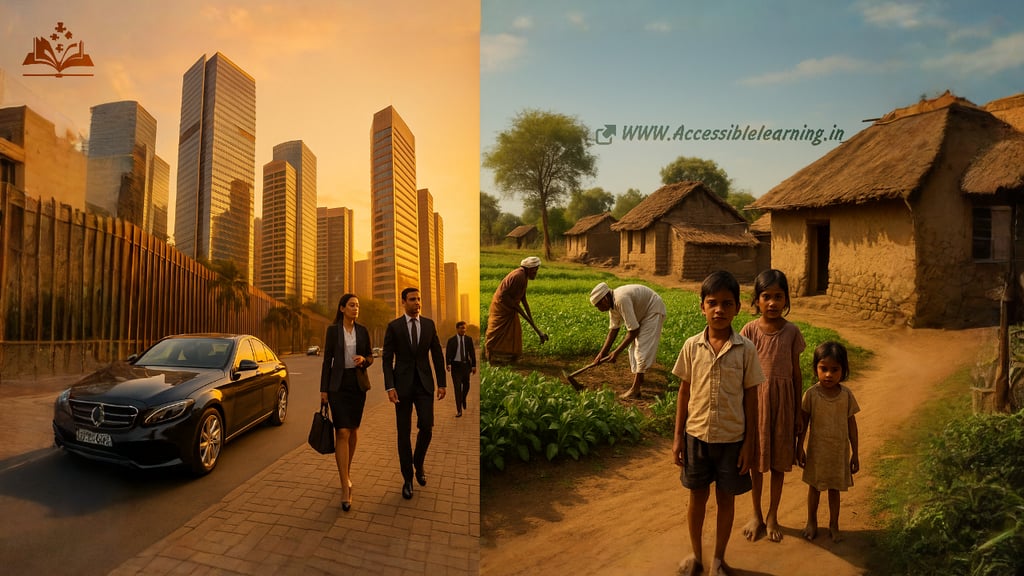

India presents one of the most compelling economic paradoxes of the twenty-first century. The nation has sustained remarkable economic expansion, consistently ranking among the world's fastest-growing major economies, yet hundreds of millions of its citizens continue to experience deprivation. This dissonance between aggregate wealth creation and persistent poverty reveals fundamental structural challenges that demand comprehensive examination.
The Scale of India's Economic Transformation
India's economic trajectory since liberalization in 1991 has been nothing short of extraordinary. The country emerged as the world's fifth-largest economy by nominal GDP, and recent projections suggest it may become the third-largest by 2027. Economic growth has averaged approximately six to seven percent annually over the past three decades, with certain years witnessing even more impressive expansion. The technology sector, pharmaceutical industry, and service economy have positioned India as a global powerhouse in these domains.
The rise of Indian entrepreneurship has created numerous billionaires and a substantial middle class. Urban centers such as Bengaluru, Mumbai, and Hyderabad have transformed into gleaming metropolises with world-class infrastructure in select zones. Foreign direct investment has flowed into the country at unprecedented levels, and India's stock markets have reached record valuations. This economic dynamism has fundamentally altered India's position in the global economic hierarchy.
The Persistence of Poverty Despite Growth
However, beneath these impressive macroeconomic indicators lies a more troubling reality. According to data from various research institutions and government sources, a significant proportion of India's population continues to live in conditions of economic vulnerability. While extreme poverty rates have declined from previous decades, the absolute number of people experiencing deprivation remains substantial given India's massive population exceeding 1.4 billion.
The World Bank's poverty measurement frameworks, combined with India's own multidimensional poverty assessments, reveal that income poverty tells only part of the story. Millions lack access to adequate nutrition, clean drinking water, sanitation facilities, electricity, and healthcare services. Educational attainment remains uneven, with dropout rates particularly high among disadvantaged communities. Rural areas bear a disproportionate burden of poverty, though urban slums also house millions living in precarious conditions.
The COVID-19 pandemic exacerbated these vulnerabilities significantly. Millions of migrant workers lost employment, and the informal sector, which employs approximately eighty to ninety percent of India's workforce, experienced devastating disruptions. While economic recovery has occurred, the pandemic's impact on poverty levels demonstrated how fragile progress can be when growth fails to create resilient, inclusive economic foundations.
Structural Factors Driving the Imbalance
Several interconnected structural factors explain why rapid economic growth has not translated into proportionate poverty reduction. Understanding these mechanisms is essential for developing effective policy responses.
The nature of India's economic growth has been capital-intensive rather than labor-intensive. The technology sector, financial services, and advanced manufacturing require highly skilled workers but create relatively few jobs compared to their economic contribution. Meanwhile, agriculture, which still employs nearly half of India's workforce, contributes less than twenty percent to GDP. This disconnect means that growth occurs in sectors that employ a small fraction of the population, while the majority work in low-productivity sectors with minimal income growth.
Educational inequality perpetuates this divide. Quality education remains concentrated in urban areas and among affluent families who can afford private schooling. Government schools, particularly in rural regions, often lack adequate infrastructure, qualified teachers, and learning resources. This educational stratification ensures that children from poor families rarely acquire the skills necessary to access high-paying jobs in the modern economy. Without educational mobility, intergenerational poverty becomes entrenched.
The informal economy presents another critical challenge. Workers in the informal sector lack job security, social protection, health insurance, and retirement benefits. They experience high income volatility and vulnerability to economic shocks. Despite constituting the vast majority of employment, this sector remains largely outside the formal regulatory framework, making it difficult for workers to accumulate assets or access credit on reasonable terms.
Infrastructure deficits constrain economic opportunities in many regions. While major cities have attracted investment in roads, ports, and digital connectivity, vast rural areas and smaller towns remain inadequately served. Poor transportation networks limit market access for agricultural producers, while inadequate electricity supply hampers small-scale manufacturing and entrepreneurship. These infrastructure gaps prevent rural economies from participating fully in national growth.
Land ownership patterns and agricultural policies further contribute to rural poverty. Land holdings have become increasingly fragmented, with many farmers cultivating plots too small to generate adequate income. Agricultural productivity remains low due to insufficient irrigation, limited access to modern inputs, and inadequate extension services. Price volatility for agricultural commodities creates income uncertainty, and farmers often lack bargaining power in supply chains dominated by intermediaries.
Social stratification based on caste, gender, and religion compounds economic disadvantages. Historically marginalized communities face discrimination in labor markets, limited access to credit, and social barriers to economic mobility. Women's labor force participation in India is notably low compared to other major economies, representing a massive underutilization of human capital. These social factors interact with economic structures to create particularly acute poverty among specific demographic groups.
Regional Disparities in Growth and Development
India's economic growth has been geographically uneven, creating stark regional disparities. Southern and western states such as Karnataka, Maharashtra, Tamil Nadu, and Gujarat have attracted the bulk of investment and experienced robust growth. These states possess better infrastructure, higher literacy rates, and more diversified economies. Their per capita incomes significantly exceed the national average, and poverty rates are comparatively lower.
Conversely, several large northern and eastern states, including Uttar Pradesh, Bihar, Madhya Pradesh, and Odisha, have lagged considerably. These states house the majority of India's poor population. They face challenges including lower educational attainment, poorer governance, inadequate infrastructure, and greater dependence on low-productivity agriculture. Despite having large populations, they attract disproportionately small shares of investment and generate fewer high-quality employment opportunities.
This regional imbalance has profound implications for national poverty reduction. Even if high-growth states continue their trajectories, overall poverty will remain elevated unless lagging states experience substantial acceleration. The constitutional structure of Indian federalism, combined with varying state-level policy effectiveness, means that national economic growth does not automatically translate into uniform development across all regions.
Employment Generation and Quality of Jobs
The relationship between economic growth and employment generation in India has been problematic. Several periods of high GDP growth have coincided with relatively modest employment creation, a phenomenon economists term "jobless growth." When jobs are created, many offer low wages, poor working conditions, and no benefits. The quality of employment matters as much as quantity for poverty reduction.
Manufacturing, traditionally a pathway out of poverty in East Asian economies, has not played the same transformative role in India. The manufacturing sector's share of GDP has stagnated at approximately seventeen percent for decades, failing to absorb the millions of young people entering the workforce annually. Restrictive labor regulations, infrastructure constraints, and competition from other manufacturing hubs have limited India's ability to become a major manufacturing power.
The services sector, particularly information technology, has driven much of India's growth but employs a relatively small, educated workforce. Agriculture releases labor but cannot productively employ those remaining in the sector given land constraints and low productivity. The construction sector absorbs considerable labor but offers mostly informal, temporary work. This structural mismatch between where growth occurs and where employment is needed perpetuates the poverty-growth imbalance.

Policy Responses and Their Limitations
The Indian government has implemented numerous poverty alleviation programs over the decades. These initiatives include food subsidies, rural employment guarantees, housing schemes, direct cash transfers, financial inclusion programs, and social protection measures. The Mahatma Gandhi National Rural Employment Guarantee Act provides up to one hundred days of wage employment annually to rural households, serving as a crucial safety net. Various schemes aim to provide free or subsidized food grains to approximately two-thirds of the population.
More recent initiatives focus on financial inclusion, with efforts to provide bank accounts, insurance, and pension schemes to previously excluded populations. Digital payment infrastructure has expanded rapidly, theoretically increasing access to formal financial services. Infrastructure investment programs aim to improve connectivity and basic services in underserved areas. Skills development and entrepreneurship promotion initiatives seek to enhance employability.
While these programs have achieved certain successes, their overall impact on poverty remains constrained by several factors. Implementation challenges, including corruption, targeting errors, and administrative inefficiencies, reduce effectiveness. Many programs provide temporary relief rather than addressing underlying causes of poverty. Funding limitations prevent programs from reaching adequate scale or providing sufficient benefits. Coordination across multiple government agencies and levels of government often proves difficult.
Furthermore, redistributive programs alone cannot substitute for structural economic transformation. Without sustained employment growth in productive sectors, social protection becomes a permanent subsidy rather than a temporary support enabling upward mobility. The fiscal burden of large-scale welfare programs also constrains resources available for growth-enhancing investments in education, healthcare, and infrastructure.
Healthcare and Nutritional Dimensions
Poverty in India extends beyond inadequate income to encompass serious deficits in health and nutrition. Malnutrition rates among children remain alarmingly high, with long-term consequences for cognitive development and productivity. Maternal and child mortality rates, though improved, still exceed those in many comparable developing countries. Anemia affects a large proportion of women and children, impairing physical and mental development.
Healthcare access remains highly unequal. Public health infrastructure is chronically underfunded and overburdened, particularly in rural areas. Many poor families must seek private healthcare, which can be catastrophically expensive, pushing households deeper into poverty when members fall ill. Out-of-pocket health expenditures constitute a major source of economic vulnerability for Indian families.
The relationship between health, nutrition, and poverty creates a vicious cycle. Poor health reduces earning capacity and educational achievement, perpetuating poverty. Inadequate income prevents access to nutritious food and healthcare, causing health problems. Breaking this cycle requires integrated interventions addressing both economic and health dimensions simultaneously, yet such comprehensive approaches remain limited in scope and scale.
Educational Challenges and Human Capital Development
India's education system faces profound quality challenges that perpetuate economic inequality. While enrollment rates have improved significantly, learning outcomes remain poor. Assessment studies consistently show that large proportions of students lack basic literacy and numeracy skills appropriate for their grade levels. Teacher absenteeism, inadequate training, outdated curricula, and insufficient learning materials all contribute to these deficits.
The proliferation of private schools reflects widespread dissatisfaction with government education but creates a two-tier system. Affluent families access quality education that prepares children for competitive examinations and professional careers, while poor families must rely on underperforming government schools. This educational stratification translates directly into economic stratification in subsequent generations.
Higher education and vocational training systems also exhibit serious shortcomings. Many graduates lack skills demanded by employers, leading to the paradox of high unemployment among educated youth alongside employer complaints about skill shortages. The absence of robust vocational training infrastructure means that most workers in trades and crafts learn through informal apprenticeships without standardized skill certification.
Addressing educational quality requires substantial, sustained investment alongside pedagogical reforms. Teacher training, curriculum modernization, infrastructure upgrading, and accountability mechanisms all need strengthening. Without dramatic improvements in educational quality, India cannot develop the human capital necessary to support broad-based economic advancement and poverty reduction.
The Role of Urbanization and Migration
India's urbanization rate remains relatively low compared to its level of economic development, with approximately thirty-five percent of the population living in urban areas. Urbanization typically accompanies economic development and poverty reduction, as cities offer greater economic opportunities, better services, and higher productivity. However, India's urban growth has not followed this benign pattern entirely.
Many Indian cities exhibit extreme inequality, with luxury high-rises adjacent to sprawling slums. Urban services, including water supply, sanitation, transportation, and healthcare, are often inadequate even in major metropolises. The urban poor frequently live in informal settlements lacking legal status, making them vulnerable to eviction and limiting their access to public services. Urban labor markets, while offering higher wages than rural areas, also impose higher living costs and provide limited employment security for migrants.
Rural-to-urban migration, while offering escape from agricultural poverty, often results in migrants joining the urban informal sector in low-paying, insecure jobs. The lack of affordable housing, social protection, and skills training for migrants limits their ability to improve their circumstances substantially. Managing urbanization to maximize its poverty-reducing potential while minimizing negative externalities remains a critical policy challenge.


Agricultural Transformation and Rural Development
Transforming agriculture and revitalizing rural economies are essential for addressing poverty given the sectoral distribution of poor populations. Agricultural productivity improvements through better irrigation, high-yielding seed varieties, appropriate mechanization, and improved soil health management can significantly increase farmer incomes. Strengthening agricultural value chains and reducing the role of exploitative intermediaries would allow farmers to capture more value from their production.
Diversifying rural economies beyond agriculture offers another pathway. Rural non-farm employment in manufacturing, services, and processing activities can absorb labor released from agriculture while providing higher incomes. This diversification requires infrastructure development, access to credit for rural entrepreneurs, and policies supporting rural industrialization.
Land reforms, though politically challenging, could address the fundamental issue of landlessness and land fragmentation. Strengthening land rights for marginal farmers and agricultural laborers would provide economic security and collateral for accessing credit. Promoting farmer producer organizations and cooperatives can help small farmers achieve economies of scale and bargaining power.
Climate change poses growing threats to agriculture-dependent populations. Increasing weather variability, changing rainfall patterns, and rising temperatures affect crop yields and farmer incomes. Building climate resilience through appropriate technologies, crop insurance, and adaptation strategies is becoming increasingly urgent for rural poverty reduction.
Gender Dimensions of Poverty and Economic Exclusion
Gender inequality significantly contributes to and perpetuates poverty in India. Women's labor force participation rate is notably low, depriving households of potential income and the economy of productive capacity. Cultural norms restricting women's mobility, unequal access to education, discrimination in labor markets, and inadequate support for balancing work and family responsibilities all contribute to women's economic exclusion.
Women face particular disadvantages in accessing and controlling economic resources. Property rights remain skewed toward men despite legal reforms. Access to credit and financial services is more limited for women, constraining entrepreneurship and asset accumulation. Wage discrimination persists, with women earning less than men for comparable work in many sectors.
Female-headed households experience particularly high poverty rates. Widows, divorced women, and single mothers often lack adequate social support and face discrimination. Investing in women's education, economic participation, and asset ownership not only advances gender equality but also contributes substantially to poverty reduction given women's tendency to invest resources in children's health and education.
Technology, Digitalization and Inclusive Growth
India's digital infrastructure has expanded dramatically, with widespread mobile phone adoption and increasing internet penetration. Digital technologies offer potential pathways for inclusive growth through improved access to information, financial services, markets, and government services. Mobile banking and digital payment systems can extend financial services to previously unbanked populations. Online education platforms can theoretically democratize access to quality learning resources.
However, digital divides based on income, education, geography, and language limit technology's inclusive potential. Smartphone ownership, data affordability, digital literacy, and availability of content in local languages all affect who benefits from digitalization. The shift toward platform-based gig economy jobs creates income opportunities for some but also raises concerns about worker protections and income security.
Ensuring that technological change supports rather than undermines inclusive growth requires deliberate policy choices. Digital infrastructure investment must reach underserved areas. Digital literacy programs need scaling. Regulatory frameworks should protect workers in new economic models while preserving flexibility and innovation. Technology policy should be consciously oriented toward creating broadly shared prosperity rather than concentrating gains among narrow segments.
Environmental Sustainability and Poverty Linkages
Environmental degradation and poverty are deeply interconnected in India. Poor communities often depend directly on natural resources for livelihoods and are disproportionately affected by environmental deterioration. Deforestation, water scarcity, air pollution, and soil degradation directly harm the rural and urban poor. Climate change impacts, including extreme weather events, changing agricultural seasons, and resource stress, will disproportionately affect vulnerable populations.
Economic development strategies that neglect environmental sustainability ultimately undermine poverty reduction. Resource depletion, pollution, and ecological damage impose health costs, reduce productivity, and destroy livelihood bases. Conversely, poverty drives environmental degradation as desperate populations overexploit resources for survival. Breaking this poverty-environment vicious cycle requires integrated approaches recognizing their interdependence.
Green growth strategies emphasizing renewable energy, sustainable agriculture, ecosystem restoration, and pollution control can generate employment while protecting environmental assets that poor communities depend upon. Investing in natural capital through watershed management, reforestation, and biodiversity conservation provides livelihood benefits alongside environmental improvements. Climate adaptation measures protecting vulnerable populations from climate impacts are becoming essential components of poverty reduction strategies.
Governance, Institutions and Implementation Capacity
The quality of governance and institutional capacity significantly influences whether economic growth translates into poverty reduction. Effective public institutions that deliver services efficiently, enforce regulations impartially, protect property rights, and maintain the rule of law create enabling environments for broad-based development. Conversely, weak governance, corruption, and implementation failures undermine even well-designed policies and programs.
India's governance challenges include bureaucratic inefficiencies, corruption, weak accountability mechanisms, and capacity constraints, particularly at local government levels. Service delivery failures in education, healthcare, and infrastructure result partly from these institutional weaknesses. Political interference and patronage systems sometimes distort resource allocation away from developmental priorities.
Strengthening institutions requires civil service reforms, enhanced transparency through technology, stronger accountability mechanisms, decentralization of decision-making to appropriate levels, and sustained investment in administrative capacity. Improving governance is neither quick nor easy, but without more effective institutions, policy intentions rarely translate into ground-level impact.


India's experience demonstrates conclusively that rapid aggregate economic growth, while necessary, is insufficient for poverty elimination. The nature and distribution of growth, the sectors in which it is concentrated, the extent to which it generates quality employment, and whether it is accompanied by investments in human capital and social protection all determine poverty outcomes. India's growth has been remarkable but inadequately inclusive, leaving hundreds of millions behind.
Transforming this dynamic requires not merely incremental adjustments but fundamental shifts in development strategy and priorities. The window for action remains open but is not unlimited. Demographic pressures will intensify as millions of young people enter the workforce annually, requiring productive employment opportunities. Climate change will impose growing stresses on vulnerable populations. Rising aspirations among youth, facilitated by digital connectivity and awareness of global lifestyles, create social pressures demanding more equitable distribution of prosperity.
The challenge is simultaneously economic, social, political, and institutional. It demands sustained political will, effective governance, adequate resource mobilization, social consensus around shared objectives, and policy consistency across electoral cycles. International experience shows that such transformation is possible but requires deliberate, comprehensive action. India possesses considerable strengths, including democratic institutions, entrepreneurial dynamism, technological capabilities, and a young population. Converting these assets into broadly shared prosperity represents the defining development challenge of this generation.
Success would not only transform hundreds of millions of individual lives but would also establish India as a model for inclusive development in a democratic context, offering lessons for other nations facing similar challenges. Failure would perpetuate deprivation, waste human potential, generate social instability, and leave unresolved one of the great moral and economic challenges of our time. The path forward is clear even if politically and administratively difficult. The question is whether India's institutions, leadership, and society can muster the collective will to pursue it with the urgency and comprehensiveness that the scale of the challenge demands.
Frequently Asked Questions
Q: Why does poverty persist in India despite rapid economic growth?
Poverty persists in India despite impressive economic growth because the growth has been concentrated in capital-intensive sectors such as technology and financial services that employ relatively few people, while the majority of the workforce remains in low-productivity agriculture and informal employment. Educational inequalities prevent poor populations from accessing high-skill jobs, infrastructure deficits limit economic opportunities in rural areas, and the informal nature of most employment leaves workers vulnerable without social protection or income security.
Q: What percentage of India's population lives in poverty currently?
Poverty measurement in India involves ongoing methodological debates, but multidimensional poverty assessments suggest that substantial proportions of the population experience deprivation across income, health, education, and living standards. While extreme poverty has declined from previous decades, the absolute numbers remain significant given India's large population. Different measurement approaches yield varying estimates, but consensus exists that poverty remains a major challenge affecting hundreds of millions of people.
Q: Which Indian states have the highest poverty rates?
Northern and eastern states, including Bihar, Uttar Pradesh, Madhya Pradesh, Jharkhand, and Odisha, generally experience higher poverty rates compared to southern and western states such as Kerala, Goa, Punjab, and Himachal Pradesh. These disparities reflect differences in literacy rates, infrastructure quality, economic diversification, governance effectiveness, and historical development patterns. Rural areas within these states face particularly acute poverty challenges.
Q: How does India's poverty rate compare to other major developing countries?
India's poverty rates are higher than those in several other major developing countries that have achieved more inclusive growth patterns. China, for example, reduced extreme poverty more rapidly through labor-intensive manufacturing growth and substantial public investment in basic education and health. However, India's poverty reduction performance has been better than some Sub-Saharan African countries and comparable to certain other South Asian nations. The comparison depends significantly on measurement methodologies and definitions used.
Q: What government programs address poverty in India?
India implements numerous poverty alleviation initiatives, including the Mahatma Gandhi National Rural Employment Guarantee Act providing wage employment, the Public Distribution System offering subsidized food grains, housing schemes, direct benefit transfer programs, financial inclusion initiatives, skills development programs, and various social protection measures. While these programs provide important support, implementation challenges, targeting errors, and funding limitations constrain their overall effectiveness in eliminating poverty.
Q: Why has manufacturing not created more jobs in India?
Manufacturing's limited employment generation in India results from several factors, including restrictive labor regulations that discourage large-scale hiring, inadequate infrastructure raising costs and reducing competitiveness, insufficient skills training producing workforce gaps, complex regulatory environments, and strong international competition from established manufacturing hubs. Additionally, increasing automation means that manufacturing globally is becoming less labor-intensive than during earlier industrialization periods in other countries.
Q: How does education quality affect poverty in India?
Education quality profoundly affects poverty transmission across generations. Poor quality in government schools leaves students without skills necessary for modern economy jobs, perpetuating intergenerational poverty. The divide between quality private education accessed by affluent families and inadequate government schooling available to poor families creates educational stratification that translates directly into economic stratification. Without dramatic improvements in educational quality for disadvantaged populations, breaking poverty cycles becomes extremely difficult.
Q: What role does agriculture play in India's poverty challenges?
Agriculture employs nearly half of India's workforce but contributes less than twenty percent to GDP, indicating very low productivity and incomes in this sector. Small and fragmented land holdings, inadequate irrigation, limited access to modern inputs, insufficient extension services, and exposure to price volatility all contribute to agricultural poverty. Since rural areas house the majority of India's poor population, and most depend on agriculture, transforming this sector is essential for substantial poverty reduction.
Q: How has urbanization affected poverty in India?
Urbanization offers pathways out of rural poverty through access to more diverse employment opportunities and better services, but Indian cities struggle to accommodate growing populations adequately. Urban areas exhibit extreme inequality, with slums existing alongside affluence. Inadequate affordable housing, insufficient urban services, and the concentration of migrant workers in informal sector jobs with low pay and no security mean that urbanization does not automatically translate into poverty escape. Better urban planning and governance are needed to maximize urbanization's poverty-reducing potential.
Q: What impact did COVID-19 have on poverty in India?
The COVID-19 pandemic significantly increased poverty in India through massive job losses, particularly affecting the informal sector that employs most workers. Millions of migrant workers returned to villages after losing urban employment. Income reductions pushed vulnerable households below poverty lines, nutritional intake declined, and disruptions to education affected children's learning. While economic recovery has occurred, the pandemic demonstrated how fragile poverty reduction gains can be without robust social protection and resilient economic structures. The full long-term impact on poverty continues to unfold.
Subscribe To Our Newsletter
All © Copyright reserved by Accessible-Learning Hub
| Terms & Conditions
Knowledge is power. Learn with Us. 📚

