

Politics as a “Business Model”: The Monetization of Destruction
An in-depth exploration of how modern geopolitics, defense industries, and advanced military technologies have turned war into a complex economic system. This article examines the destruction-reconstruction cycle, the role of AI and drone warfare as real-world testing grounds, and the growing influence of the global military industry, while also highlighting the human cost behind conflicts.
POLITICAL JOURNEYHARSH REALITYGLOBAL ISSUESNEPOTISM/SOCIAL ISSUES
Jagdish Nishad | Shiv Singh Rajput
3/14/20269 min read
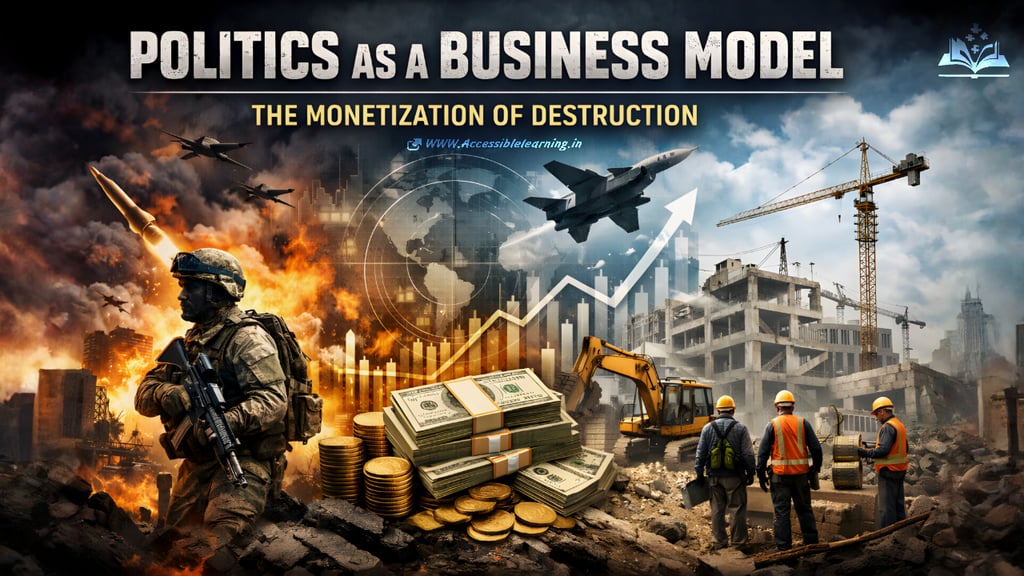
For most of modern history, war was described as the ultimate failure of diplomacy. When negotiations collapsed and tensions escalated beyond control, war was seen as a tragic outcome that leaders tried to avoid. In theory, diplomacy existed to prevent conflict, and war was considered the worst possible alternative.
In the modern geopolitical landscape, however, the relationship between politics, economics, and war has become far more complex. Conflicts today are not only military confrontations. They involve global defense industries, advanced technology companies, intelligence networks, reconstruction firms, and international financial institutions.
Because of this, many political analysts argue that war has gradually become embedded in a broader economic system. In some cases, conflict can generate enormous financial flows through weapons production, technological development, infrastructure rebuilding, and strategic resource control. This has led to a controversial idea: that modern warfare can sometimes function like a business model, where destruction and reconstruction form part of the same economic cycle.
Understanding this idea requires examining how military spending, technological innovation, reconstruction projects, and global power politics intersect during modern conflicts.
War and the Global Defense Economy
One of the clearest indicators of the economic scale of modern warfare is global military spending. Governments around the world collectively spend trillions of dollars each year on defense. These funds support research laboratories, weapons manufacturing plants, software development centers, aerospace engineering programs, and military logistics networks.
Defense industries employ millions of workers across multiple sectors. Engineers design missile systems and fighter aircraft. Software developers create cyber defense platforms and artificial intelligence systems. Manufacturing facilities produce tanks, drones, radar systems, and electronic warfare equipment.
Military research has also produced many technologies that later entered civilian life, including satellite navigation, advanced communications systems, and certain aspects of the internet. Because of this, governments often justify large defense budgets as necessary not only for security but also for technological advancement.
However, large military budgets also create powerful economic ecosystems. Companies that depend on defense contracts have strong incentives to maintain steady demand for military equipment. When conflicts occur, these industries often experience rapid growth in orders, production, and research funding.
War as a Driver of Technological Innovation
Throughout history, war has accelerated technological progress. Major conflicts often push governments to invest heavily in research and development. During these periods, new technologies are created quickly in response to urgent military needs.
In the modern era, military innovation is heavily focused on digital technologies. Artificial intelligence, machine learning, satellite networks, robotics, and cyber defense systems are now central to military strategy.
Modern battlefields involve complex information systems that process massive amounts of data. Satellite imagery, drone surveillance, and electronic signals are analyzed in real time to track movements and identify threats. Artificial intelligence systems help interpret this data and support faster decision-making.
Because these technologies are relatively new, real conflicts provide the most valuable testing environments. Engineers and military planners can observe how systems perform under real combat conditions and improve them based on operational feedback.
For defense companies, a successful battlefield demonstration significantly increases the credibility of their technology in global markets.

The Destruction–Reconstruction Economic Loop
Another major element of modern war economics is the cycle between destruction and rebuilding.
During conflict, infrastructure often suffers extensive damage. Roads, bridges, hospitals, airports, power plants, water systems, and communication networks can all be destroyed or severely damaged. Entire neighborhoods may become uninhabitable.
After the fighting slows down, the rebuilding process begins. Reconstruction requires enormous financial resources. Governments, international organizations, and development banks often invest billions of dollars to restore damaged infrastructure and support economic recovery.
These reconstruction efforts involve large engineering firms, construction companies, logistics providers, and technology contractors. Projects may include rebuilding transportation networks, restoring electrical grids, repairing telecommunications systems, and constructing new housing and public facilities.
The rebuilding phase can last for many years and involve massive international investments.
Critics of the global war economy argue that the same countries that manufacture weapons during conflicts may later see their corporations participate in rebuilding projects. In this sense, destruction and reconstruction can become linked stages in a larger economic process.
While rebuilding is essential for restoring normal life, the financial incentives involved in reconstruction raise important questions about how global economic systems interact with warfare.
War as a Live Testing Ground
Modern battlefields are not only military arenas. They also serve as environments where new technologies are evaluated under real conditions.
Weapons systems that perform successfully during conflict gain a reputation for reliability. Defense companies often highlight the operational success of their equipment when marketing to foreign governments.
This phenomenon is particularly visible with technologies such as drones, missile defense systems, electronic warfare tools, and cyber security platforms.
A military system tested in combat gains a level of credibility that laboratory testing cannot provide. Other nations observing the conflict may decide to purchase similar equipment to strengthen their own defense capabilities.
As a result, active conflict zones sometimes function as real-world testing grounds for emerging military technologies.
Artificial Intelligence and the Future of Warfare
Artificial intelligence is rapidly transforming the nature of military operations. AI systems can process massive datasets, identify patterns, and support rapid decision-making in complex situations.
In modern conflicts, AI may be used to analyze satellite images, track vehicle movements, detect missile launches, and coordinate drone operations. Machine learning systems can identify targets and predict possible threats based on large amounts of collected data.
Drone warfare has become one of the most visible examples of this transformation. Military drones can carry out surveillance missions, monitor enemy movements, and, in some cases, conduct precision strikes.
Compared with traditional fighter jets or missile platforms, drones are often cheaper and easier to deploy. This allows countries to operate large numbers of unmanned systems at relatively lower costs.
Some military planners are now developing swarm drone strategies where groups of drones work together using artificial intelligence to coordinate their actions. These systems can adapt to changing battlefield conditions and perform complex missions.
Cyber warfare is another major frontier. Instead of attacking physical targets, cyber operations focus on disrupting digital infrastructure such as communication networks, financial systems, transportation systems, and energy grids.
As these technologies evolve, their performance in real conflicts significantly influences global demand for advanced military systems.


Resource Control and Strategic Interests
War has always been linked to strategic resources and geopolitical influence. In many cases, conflicts are connected to access to energy resources, trade routes, minerals, and regional influence.
Modern economies rely heavily on resources such as oil, natural gas, rare earth minerals, and advanced semiconductor materials. Control over these resources can shape global power dynamics.
Some conflicts occur in regions that are strategically important for global energy supplies or trade corridors. Maintaining influence over these areas can provide economic and political advantages for powerful nations.
Because of this, geopolitical competition often intersects with economic interests. Governments may view certain regions as strategically important not only for security reasons but also for long-term economic stability.
The Role of Private Contractors
Modern wars increasingly involve private contractors alongside traditional military forces. These contractors provide services such as logistics, security, intelligence analysis, infrastructure support, and equipment maintenance.
Private companies may operate supply chains, maintain military vehicles, build bases, and provide technological expertise during conflicts. Some contractors specialize in cybersecurity or satellite communications.
The involvement of private contractors expands the economic network surrounding modern warfare. War becomes not only a state-driven activity but also a complex system involving multiple corporate actors.
For these companies, conflict zones can represent major operational markets.
The Human Perspective
Despite the large economic and technological systems surrounding war, the reality experienced by civilians is very different.
For people living in conflict zones, war is not an economic system or technological experiment. It is the disruption of daily life and the destruction of communities.
Homes may be destroyed, forcing families to flee. Schools and hospitals may close or become unsafe. Electricity and water supplies may fail. Local businesses collapse, and economic stability disappears.
In such situations, civilians may feel that their cities have become testing grounds for military technologies or arenas for geopolitical competition between powerful nations.
A missile system that analysts describe as effective in military reports may represent fear and devastation for the people living where it was deployed.
This gap between strategic analysis and human experience highlights the profound ethical questions surrounding modern warfare.
The Influence of the Military–Industrial System
The relationship between governments, military institutions, and defense companies has long been discussed under the concept of the military–industrial complex. This term describes how political decisions about military spending can become closely linked with economic interests.
Defense companies depend on government contracts for revenue. Governments rely on these companies for technological innovation and military equipment. This relationship creates a powerful network of influence that shapes defense policies.
In countries where defense industries employ large numbers of workers, political leaders may feel pressure to maintain military budgets to protect jobs and industrial capacity.
While strong defense industries can support national security and technological development, critics argue that they can also create incentives to sustain high levels of military activity.

Rethinking the Economics of Conflict
Modern warfare cannot be understood only through military strategy or political ideology. It must also be examined through economic systems, technological competition, and global markets.
Weapons manufacturing, military research, reconstruction contracts, private contractors, and geopolitical resource competition all form parts of a complex network surrounding modern conflict.
These systems do not necessarily cause wars on their own, but they shape the environment in which wars occur.
Understanding these dynamics is essential for anyone trying to understand modern geopolitics. If the world hopes to reduce conflicts in the future, it must address not only political tensions but also the economic structures that benefit from war.
Stronger diplomatic institutions, transparent reconstruction processes, responsible technology development, and international cooperation may help shift the global system away from cycles of destruction.
Ultimately, recognizing the economic dimensions of warfare is an important step toward building a world where political power is no longer tied to the profitability of conflict but instead focused on long-term stability, development, and peace.
FAQ's
Q: What does “politics as a business model” mean in the context of war?
The phrase refers to the idea that modern conflicts can generate large economic opportunities for certain industries and organizations. Defense contractors, technology firms, logistics companies, and reconstruction businesses may all benefit financially from different stages of a conflict. This does not mean wars are started only for profit, but economic incentives can sometimes influence political and strategic decisions.
Q: How does the destruction–reconstruction cycle work in modern conflicts?
During war, infrastructure such as roads, hospitals, bridges, power plants, and communication networks can be destroyed. After the conflict, governments and international organizations invest large amounts of money to rebuild these systems. Construction firms, engineering companies, and contractors receive major contracts to restore the damaged infrastructure. This creates an economic cycle where destruction is followed by large-scale rebuilding projects.
Q: Why are modern battlefields considered testing grounds for military technology?
Real combat conditions provide valuable data that cannot be fully replicated in laboratories or simulations. When new technologies such as drones, missile systems, or cyber defense tools are used in real conflicts, their performance can be evaluated and improved. If the technology proves effective, it often becomes more attractive to other countries looking to upgrade their military capabilities.
Q: What role does artificial intelligence play in modern warfare?
Artificial intelligence is used to analyze large amounts of battlefield data, identify threats, assist with surveillance, coordinate drone operations, and support military decision-making. AI systems can process satellite images, detect unusual patterns, and help military planners respond more quickly to evolving situations during conflicts.
Q: Why has drone warfare become so common?
Drones are often less expensive than traditional military aircraft and can perform surveillance, reconnaissance, and precision strikes without putting pilots at risk. Their lower cost and flexibility make them attractive tools for many modern militaries. Advances in artificial intelligence have also improved drone coordination and targeting capabilities.
Q: What is the military-industrial complex?
The military-industrial complex describes the close relationship between governments, armed forces, and defense companies. Defense industries rely on government contracts to produce military equipment, while governments depend on these companies for technological innovation and military capabilities. This relationship can influence national defense policies and military spending.
Q: How do private contractors participate in modern wars?
Private contractors provide many services that support military operations. These services may include logistics, equipment maintenance, cybersecurity support, intelligence analysis, infrastructure construction, and transportation. In some conflicts, contractors play a major role in maintaining supply chains and technological systems used by the military.
Q: Are wars really profitable for countries?
For most countries, war is extremely expensive and causes major economic damage. However, certain sectors such as defense manufacturing, military technology development, and reconstruction industries may experience financial growth during or after conflicts.
Q: Why do critics say modern wars are linked to economic interests?
Critics argue that large defense industries, technological competition, and reconstruction contracts create financial incentives connected to conflict. These economic factors can sometimes influence political decisions, especially in countries where defense industries represent an important part of the national economy.
Q: How does war affect ordinary civilians?
Civilians are often the most affected by war. Conflicts can destroy homes, disrupt healthcare and education systems, damage infrastructure, and force people to leave their communities. Economic instability and long-term social trauma often continue long after the fighting ends.
Subscribe to Frontier Intelligence
All © Copyright reserved by Accessible-Learning Hub
| Terms & Conditions
Accessible Learning Hub — Actionable clarity for high-agency minds.
Weekly breakdowns on AI breakthroughs, capital flow, and human performance systems. Zero fluff.