

Physical AI: When LLMs Get Bodies!
Explore Physical AI, where large language models gain real-world abilities through robotics, sensors, and automation. Learn how embodied AI is shaping the future of work, industry, and daily life.
AI ASSISTANTAI/FUTUREA LEARNING
Sachin K Chaurasiya
2/25/20266 min read
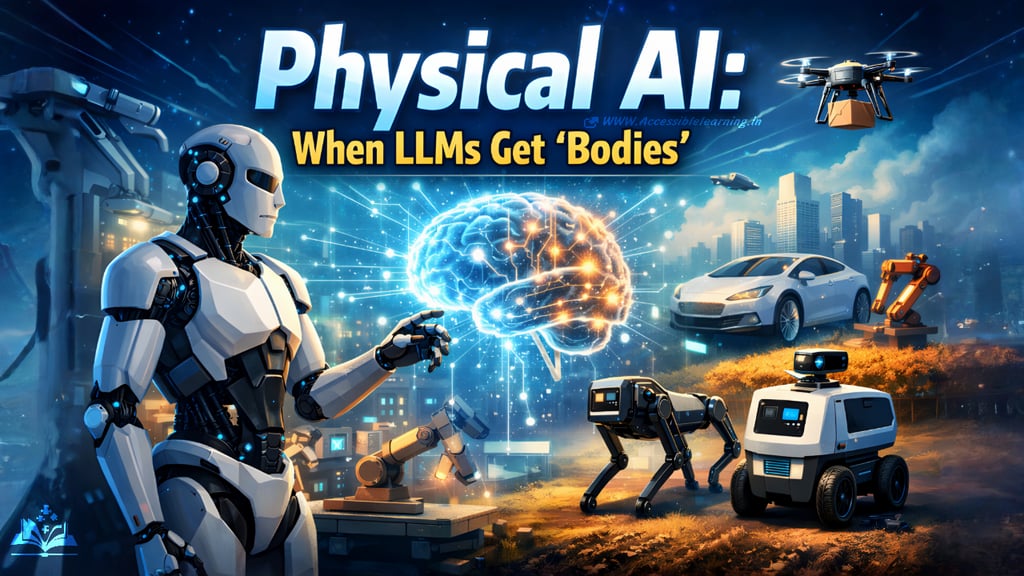
Artificial intelligence has spent years inside screens. It writes emails, answers questions, edits photos, and generates code. Now a major shift is happening. AI is moving into the real world through robots, smart machines, autonomous vehicles, and connected devices. This shift is called Physical AI or Embodied AI when large language models and advanced machine learning systems gain a physical presence.
This is no longer futuristic. Warehouses use AI robots, hospitals use surgical assistants, farms use autonomous tractors, and homes are slowly adopting smart robots. Physical AI is turning software intelligence into real-world action.
What Is Physical AI?
Physical AI refers to AI systems that can see, think, plan, and act in the real world. It combines three layers:
Intelligence Layer – LLMs and multimodal AI models for reasoning.
Perception Layer – Cameras, sensors, microphones, GPS, LiDAR.
Action Layer – Robots, drones, vehicles, and industrial machines.
Traditional AI answered questions. Physical AI can assemble products, cook food, drive vehicles, or assist patients.
Evolution of Physical AI
Understanding the timeline helps explain why this is possible now.
1950–1990: Early robotics and rule-based AI.
2000–2015: Computer vision and deep learning breakthroughs.
2018–2023: Rise of large language models and multimodal AI.
2024 onward: LLMs integrated into robots, vehicles, and IoT devices.
Cheap sensors, faster GPUs, cloud computing, and better algorithms made physical AI practical.
Core Components of Physical AI Systems
Perception
Robots gather real-world data using:
Cameras and depth sensors
Microphones and speech recognition
Temperature and pressure sensors
Motion tracking and mapping systems
This helps machines understand objects, humans, and environments.
Reasoning and Planning
Large language models provide step-by-step reasoning. They can:
Break tasks into smaller actions
Learn from instructions
Understand natural language commands
Explain decisions for transparency
Control and Motion
Control systems convert decisions into movement using:
Robotics kinematics
Reinforcement learning
Motor control algorithms
Real-time feedback loops
Memory and Learning
Physical AI improves with experience using:
Simulation training
Human feedback
Reinforcement learning
Cloud-based learning networks
Real-World Use Cases
Manufacturing
Collaborative robots assemble electronics, cars, and machinery with high precision.
Logistics and Warehousing
Robots sort packages, manage inventory, and optimize delivery routes.
Healthcare
Surgical robots assist doctors, rehabilitation robots help patients walk again, and hospital delivery robots transport medicine.
Smart Homes
Future home robots may cook simple meals, clean rooms, organize items, and monitor safety.
Agriculture
Autonomous tractors, crop-monitoring drones, and smart irrigation systems increase food production.
Construction
AI-powered machines can lay bricks, inspect structures, and reduce construction risks.
Disaster Response
Robots can enter dangerous areas during fires, earthquakes, or chemical leaks.

Physical AI in Everyday Life
In the next 10 years, you may see:
Grocery delivery robots in cities
AI kitchen assistants in homes
Elderly care robots in hospitals
Autonomous taxis in urban areas
Smart factories with minimal human supervision
Physical AI will become as common as smartphones.
Key Technologies Behind Physical AI
Multimodal AI: Understanding text, images, and video together.
Digital Twins: Simulating real environments before deployment.
Edge AI Chips: Faster decisions without cloud delays.
5G and IoT: Real-time communication between machines.
Cloud Robotics: Shared learning across robot networks.
Tactile Sensors: Robots that feel pressure and texture.
SLAM Mapping: Real-time navigation in unknown spaces.
Skills Needed for Physical AI Careers
Students and developers should learn:
Python and robotics frameworks
Machine learning basics
Computer vision
Control systems
Embedded systems
Sensor integration
AI ethics and safety
Physical AI needs both software and hardware knowledge.
Challenges and Risks
Safety
Robots must avoid harming people or property.
Ethics
Privacy, surveillance, and misuse concerns must be addressed.
Job Displacement
Automation may replace repetitive jobs. Reskilling programs are important.
Cost
Advanced robotics hardware is still expensive.
Reliability
Machines must work in unpredictable real-world conditions.
Security
Connected robots can be hacked without strong cybersecurity.
Physical AI and the Economy
Physical AI can create new industries such as:
Robot maintenance services
AI robotics startups
Smart farming companies
Autonomous delivery networks
AI-powered construction firms
Countries investing early may lead the next industrial revolution.
The Future of Physical AI
Experts expect major breakthroughs like:
General-purpose household robots
AI caregivers for aging populations
Autonomous public transport
Space exploration robots
Personalized robotic assistants
Eventually, physical AI may collaborate with humans in almost every field.
How Businesses Can Prepare
Start small with automation pilots.
Build data-driven workflows.
Train teams in AI literacy.
Invest in safety protocols.
Partner with robotics startups.
Monitor regulations and compliance.
Early adopters will gain a strong advantage.
Regulation, Policy, and Governance
As physical AI moves into daily life, governments and industry groups are working on standards for safety, privacy, and accountability. Key areas include:
Robot safety certification similar to vehicle crash tests.
Data protection laws for cameras and sensors collecting personal data.
Liability rules to decide who is responsible when a robot makes a mistake.
Workplace regulations for human–robot collaboration in factories.
Countries that balance innovation with safety will lead this field.


Architecture of a Physical AI System
A modern Physical AI stack usually looks like this:
Sensor Layer – Cameras, LiDAR, microphones, GPS, tactile sensors.
Edge Processing Layer – Local chips running perception models.
Reasoning Layer – Cloud or local LLM planning and decision making.
Control Layer – Motion planning, robotics control algorithms.
Feedback Layer – Monitoring results and improving performance.
This layered architecture allows systems to stay responsive and safe while still learning over time.
Data Needed for Physical AI
Training embodied AI requires more than text datasets. It needs:
Video recordings of human tasks
Motion capture data
Robot sensor logs
Simulation environments
Real-world testing data
Large synthetic datasets created in simulation help reduce cost and risk.
Physical AI in Emerging Markets
Physical AI can solve practical problems in developing economies:
Smart irrigation and crop monitoring
Affordable healthcare robotics in rural clinics
Automated waste sorting in cities
Low-cost delivery robots for crowded urban areas
In countries with fast-growing cities and large logistics networks, Physical AI can improve efficiency and safety at scale.
Research Directions to Watch
Scientists are working on important improvements like:
Better hand manipulation and dexterity
Robots that understand social cues and emotions
Energy-efficient AI chips
Lifelong learning without retraining from scratch
Swarm robotics, where many robots coordinate together
These advances will make physical AI more practical and affordable.
Physical AI is the next big step in artificial intelligence. Giving AI a body connects intelligence with action. It turns software into real-world helpers that can build, repair, care, and collaborate.
The future is not about humans versus machines. It is about humans working with intelligent machines to build safer cities, smarter industries, and better daily life.
FAQs
Q: What is physical AI in simple terms?
Physical AI is artificial intelligence that can interact with the real world using robots, sensors, or machines. It combines AI software with a physical body so systems can perform real tasks like moving objects, driving vehicles, or assisting people.
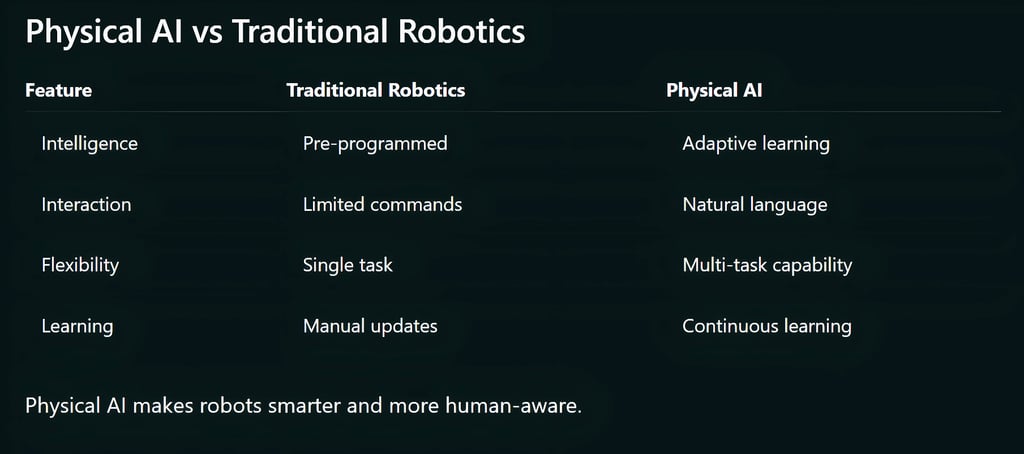
Q: How is physical AI different from traditional robotics?
Traditional robots follow fixed instructions. Physical AI systems can learn, adapt, understand language, and make decisions based on new situations. They are more flexible and intelligent.
Q: Are large language models really used in robots?
Yes. Modern robots use language models to understand spoken commands, plan actions step by step, and explain their decisions. This helps robots work more naturally with humans.
Q: Where is Physical AI already being used?
Physical AI is active in industries such as:
Manufacturing and assembly lines
Warehousing and logistics
Healthcare and surgical robotics
Agriculture and smart farming
Autonomous vehicles
Home cleaning and service robots
These systems are improving efficiency and safety.
Q: Will Physical AI replace human jobs?
Physical AI will automate repetitive and dangerous tasks, but it will also create new jobs in robotics design, maintenance, AI supervision, and safety engineering. Many roles will change rather than disappear.
Q: Is Physical AI safe for everyday use?
Safety depends on design and regulation. Engineers test robots carefully, add sensors to detect humans, and use emergency controls. Governments are also working on safety standards for robotics systems.
Q: When will home robots become common?
Basic home robots already exist, like cleaning robots. More advanced general-purpose home robots are expected to become common between 2028 and 2035 as technology becomes cheaper and safer.
Q: What skills are needed to work in Physical AI?
Important skills include machine learning, robotics programming, computer vision, embedded systems, and control engineering. Creative problem solving and ethics awareness are also important.
Q: What industries will benefit the most from Physical AI?
Industries that depend on physical labor or precision tasks will benefit first. These include logistics, manufacturing, healthcare, agriculture, construction, and transportation.
Q: What is the biggest challenge for Physical AI today?
The biggest challenges are safety, cost, real-world reliability, and energy efficiency. Robots must work in unpredictable environments without causing harm.
Subscribe to Frontier Intelligence
All © Copyright reserved by Accessible-Learning Hub
| Terms & Conditions
Accessible Learning Hub — Actionable clarity for high-agency minds.
Weekly breakdowns on AI breakthroughs, capital flow, and human performance systems. Zero fluff.