

Perplexity Pro vs. NotebookLM vs. Consensus: Which AI Research Tool Is Actually Worth Using?
Compare Perplexity Pro, NotebookLM, and Consensus to find the best AI research tool for your needs. Learn their strengths, weaknesses, use cases, and which platform delivers the most reliable research results.
AI/FUTUREDIGITAL MARKETINGCOMPANY/INDUSTRY
Sachin K Chaurasiya
6/20/20266 min read
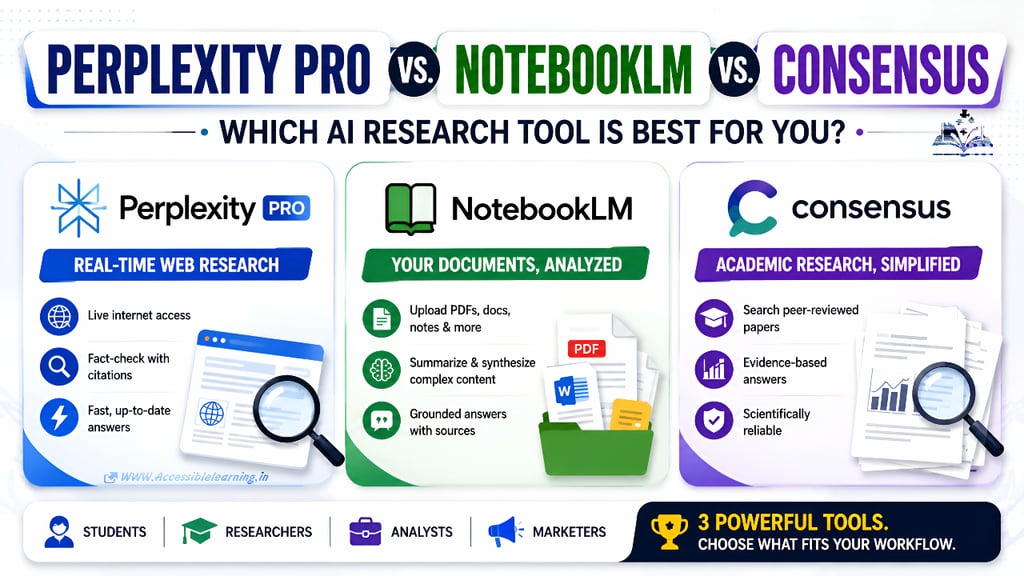
Artificial intelligence has transformed how people search for information, summarize content, and conduct research. Yet one major problem continues to frustrate professionals, students, academics, and analysts: hallucinations.
Traditional AI chatbots can sound convincing even when they are wrong. They often generate information without providing reliable sources, making them risky for serious research, academic work, business analysis, and fact-checking.
As a result, many knowledge workers are shifting away from general-purpose chatbots and adopting specialized AI research tools built around verifiable information.
Three platforms dominate this conversation:
While they may seem similar on the surface, they solve very different research problems. Choosing the wrong one can slow down your workflow. Choosing the right one can save hours every week. This guide explains how each platform works, where it excels, where it fails, and which users should choose each solution.
The Rise of Specialized AI Research Tools
The first generation of AI assistants focused on conversation. The second generation focuses on evidence.
Instead of simply generating answers, modern research tools attempt to:
Cite sources
Verify claims
Retrieve real documents
Summarize large datasets
Reduce hallucinations
Improve transparency
This shift is especially important in fields where accuracy matters:
Academic research
Journalism
Market analysis
Consulting
Healthcare research
Legal research
Technical writing
Content marketing
The three tools discussed here approach this challenge from entirely different angles.
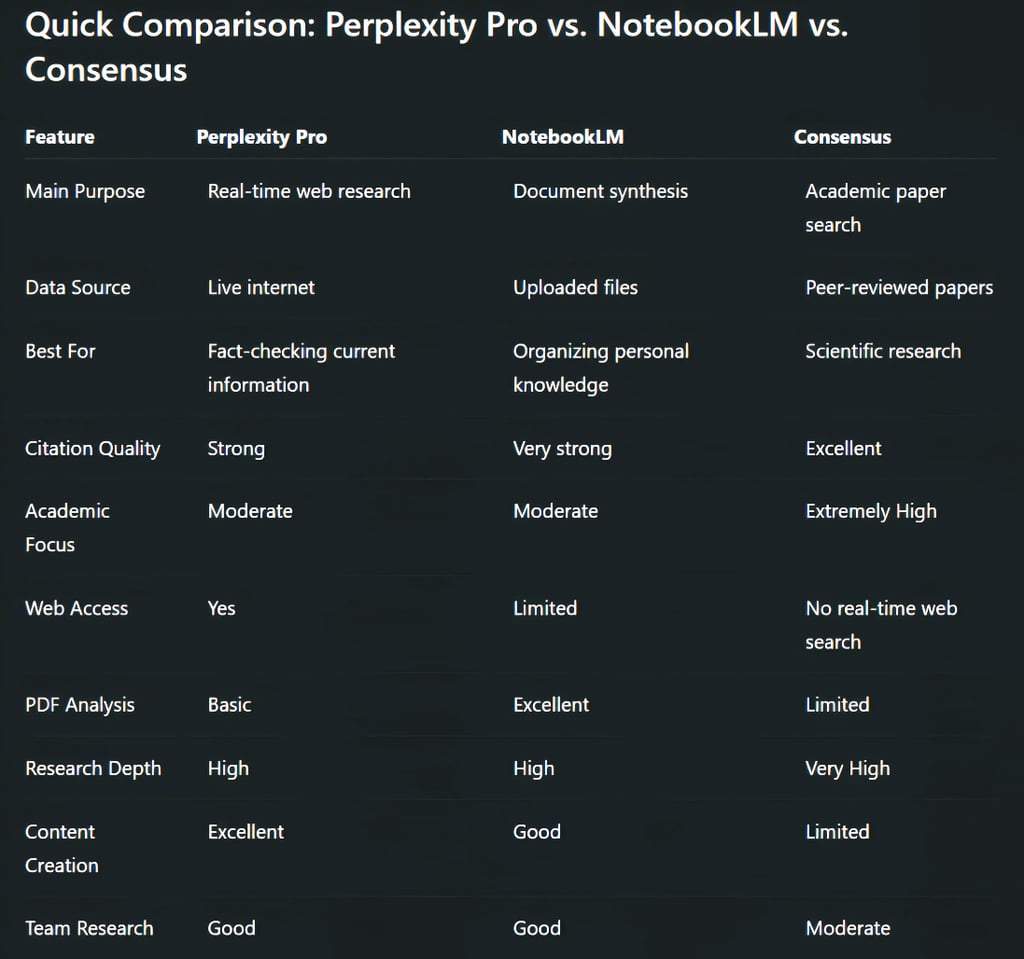

The biggest mistake people make is assuming these tools compete directly. They don't. Each serves a different stage of the research process.
What Is Perplexity Pro?
Perplexity Pro is an AI-powered answer engine designed for real-time internet research. Unlike traditional chatbots, it actively searches the web before generating responses. Every answer includes source citations, allowing users to verify information quickly.
Think of Perplexity as a hybrid between:
Search engine
Research assistant
Fact-checking tool
AI chatbot
Its greatest strength is retrieving up-to-date information from across the internet.
Where Perplexity Pro Excels
1. Real-Time Research
If you need information that changes frequently, Perplexity is often the strongest option.
Examples include:
Industry trends
Product launches
Market updates
Company news
SEO developments
Software releases
Economic data
NotebookLM and Consensus are not designed for rapidly changing information. Perplexity is.
2. Fact-Checking Content
Content marketers, journalists, and analysts frequently use Perplexity to verify statements before publication. Instead of manually opening dozens of tabs, users can:
Ask a question
Review sources
Cross-check information
Explore follow-up queries
This dramatically reduces research time.
3. Competitive Intelligence
Business analysts often use Perplexity to gather information about the following:
Competitors
Industry shifts
Consumer trends
Product positioning
Its ability to synthesize information from multiple websites makes it particularly useful for strategic research.
Perplexity Pro Limitations
Perplexity still relies on information found online. This creates several weaknesses:
Source Quality Can Vary
Not all cited sources are equally trustworthy.
Users must still evaluate source credibility.
Struggles With Proprietary Knowledge
If information exists only in your private documents, Perplexity cannot help much.
Not Designed for Deep Academic Research
While it can find academic papers, it is not optimized specifically for scholarly evidence.
Who Should Use Perplexity Pro?
Perplexity is ideal for:
Content marketers
Journalists
SEO professionals
Consultants
Business analysts
Researchers needing current information
If your research depends on what happened yesterday, last week, or this month, Perplexity is often the best choice.

What Is NotebookLM?
NotebookLM is Google's AI research assistant built around your own documents. Instead of searching the internet, NotebookLM focuses on uploaded content.
Users can upload:
PDFs
Research papers
Reports
Meeting notes
Books
Presentations
Internal documents
The AI then becomes an expert on those materials. This fundamentally changes the research workflow.
Rather than asking, "What does the internet know?"
You ask:
"What do my documents say?"
Where NotebookLM Excels:
1. Large PDF Analysis
NotebookLM shines when dealing with massive amounts of information.
For example:
300-page reports
Research collections
Annual reports
Corporate documentation
Legal materials
Instead of reading every page manually, users can ask questions directly.
2. Knowledge Synthesis
This is where NotebookLM truly separates itself.
Imagine uploading:
20 research papers
10 company reports
15 interview transcripts
NotebookLM can identify the following:
Common themes
Contradictions
Emerging patterns
Supporting evidence
Traditional chatbots struggle with this level of document synthesis.
3. Source Grounding
One of NotebookLM's strongest features is source attribution.
The platform links responses back to uploaded materials.
This significantly reduces hallucinations because answers originate from known documents.
4. Research Project Management
Graduate students and analysts often manage dozens of sources simultaneously.
NotebookLM effectively creates a searchable knowledge base.
Instead of hunting through folders, users can query their entire research library conversationally.
NotebookLM Limitations
Despite its strengths, NotebookLM has constraints.
No Strong Real-Time Web Research
It is not designed to continuously monitor current events.
Depends on Uploaded Content
Its intelligence is only as good as the documents provided.
Not a Discovery Tool
NotebookLM helps analyze information.
It does not help discover new information.
Who Should Use NotebookLM?
NotebookLM is ideal for:
Graduate students
Academic researchers
Consultants
Corporate analysts
Authors
Legal professionals
Knowledge managers
Anyone working primarily with existing documents will likely gain enormous value from NotebookLM.

What Is Consensus?
Consensus takes a completely different approach. Rather than searching the web, it searches scientific literature. The platform is designed specifically for evidence-based research. Its database focuses on peer-reviewed academic studies.
Instead of providing opinions, Consensus attempts to summarize what published research actually says. This makes it unique among AI research tools.
2. Evidence Aggregation
Consensus does something many researchers appreciate. It identifies:
Supporting studies
Contradictory findings
Research trends
Scientific consensus
This helps users understand the broader evidence landscape.
3. Faster Literature Reviews
Traditional literature reviews can require weeks.
Consensus accelerates the process by surfacing relevant studies and summarizing findings.
Researchers still need to read original papers, but the discovery process becomes dramatically faster.
4. Reduced Hallucination Risk
Because responses are grounded in published research, Consensus generally produces fewer unsupported claims than general AI assistants. This is especially important in the following:
Medicine
Psychology
Education
Public policy
Healthcare
Social sciences
Consensus Limitations
Consensus is powerful but specialized.
Limited Beyond Academia
It is not ideal for:
Breaking news
Market trends
Product research
Current events
Research Availability Matters
If a topic lacks sufficient published literature, Consensus has less material to analyze.
Less Useful for Business Intelligence
Corporate and marketing research often requires broader sources than academic papers alone.
Who Should Use Consensus?
Consensus is best for:
Professors
PhD students
Medical researchers
Healthcare professionals
Policy analysts
Evidence-based practitioners
If your decisions must be supported by peer-reviewed science, Consensus is difficult to beat.
Which Tool Has the Lowest Hallucination Risk?
This question appears frequently. The answer depends on context.
Lowest Hallucination Risk for Academic Evidence
Consensus
Because responses come directly from peer-reviewed research.
Lowest Hallucination Risk for Personal Documents
NotebookLM
Because answers are grounded in uploaded sources.
Lowest Hallucination Risk for Current Events
Perplexity Pro
Because it retrieves and cites real-time web information.
No AI system is completely hallucination-free. However, all three significantly outperform generic chatbots for research-intensive tasks.

The Best Tool by Use Case
Choose Perplexity Pro If You Need
Current information
Fact-checking
Industry research
Competitor analysis
SEO research
News monitoring
Choose NotebookLM If You Need
PDF analysis
Research organization
Knowledge management
Multi-document synthesis
Internal document research
Choose Consensus If You Need
Academic literature reviews
Scientific evidence
Peer-reviewed studies
Medical research
Research-backed decision-making
Can You Use All Three Together?
Yes, and many advanced researchers do exactly that. A highly effective workflow looks like this:
Step 1: Discover Information
Use Perplexity Pro to find current developments, reports, and sources.
Step 2: Organize Knowledge
Upload collected documents into NotebookLM.
Use it to synthesize and analyze findings.
Step 3: Validate Claims
Use Consensus to verify whether scientific literature supports key conclusions. This combination creates a powerful research stack that covers:
Current information
Internal knowledge
Scientific evidence
Few standalone tools can match this workflow.
The debate between Perplexity Pro, NotebookLM, and Consensus is often framed incorrectly. There is no universal winner.
Perplexity Pro dominates real-time web research and fact-checking.
NotebookLM excels at understanding and synthesizing your own documents.
Consensus is the strongest option for evidence-based academic research.
For marketers, analysts, and business professionals, Perplexity often delivers the most immediate value.
For students and researchers managing large document collections, NotebookLM is usually the smarter choice.
For academics and anyone requiring peer-reviewed evidence, Consensus remains the gold standard.
The most productive researchers are not choosing one tool over another. They are using each tool for the problem it was designed to solve.
FAQ's
Q: Which is better for research: Perplexity Pro, NotebookLM, or Consensus?
The best tool depends on your research needs. Perplexity Pro is ideal for real-time web research and fact-checking; NotebookLM excels at analyzing uploaded documents and PDFs, while Consensus is best for finding answers based on peer-reviewed academic studies.
Q: Is Perplexity Pro more accurate than ChatGPT for factual research?
Perplexity Pro often provides more reliable research results because it cites sources and retrieves information from the web in real time. However, users should still verify important information from the original sources.
Q: Can NotebookLM analyze multiple PDFs at once?
Yes. NotebookLM can process and synthesize information from multiple uploaded documents, making it useful for literature reviews, research projects, business reports, and large knowledge bases.
Q: What makes Consensus different from other AI research tools?
Consensus focuses exclusively on peer-reviewed academic research. Instead of searching the general web, it analyzes scientific papers and research studies to provide evidence-based answers.
Q: Which AI tool is best for students and academic researchers?
Students and researchers often benefit from using NotebookLM for organizing study materials and Consensus for accessing scientific evidence. Together, they create a powerful academic research workflow.
Q: Can Perplexity Pro, NotebookLM, and Consensus be used together?
Yes. Many professionals use Perplexity Pro to discover information, NotebookLM to organize and analyze documents, and Consensus to verify claims using academic research.
Q: Which tool has the lowest risk of AI hallucinations?
Consensus generally has the lowest hallucination risk for scientific topics because its answers are based on peer-reviewed studies. NotebookLM also reduces hallucinations by grounding responses in uploaded documents.
Q: Is NotebookLM better than Perplexity Pro for PDF research?
Yes. NotebookLM is specifically designed to understand, summarize, and synthesize information from uploaded PDFs and documents, making it more effective for document-based research than Perplexity Pro.
Q: Does Consensus provide access to scientific papers?
Consensus helps users discover and understand findings from scientific studies, making it easier to locate relevant research and identify the overall scientific consensus on a topic.
Q: Which AI research tool is best for marketers and business analysts?
Perplexity Pro is generally the best choice for marketers and analysts because it provides real-time insights, competitor research, industry trends, and fact-checked web information with source citations.
Subscribe To Our Newsletter
All © Copyright reserved by Accessible-Learning Hub
| Terms & Conditions
Knowledge is power. Learn with Us. 📚

