

Palm Sunday: Meaning, History, Traditions, and Everything You Need to Know
Discover the full meaning of Palm Sunday its biblical roots, global traditions, the 2026 date, and rich symbolism. A complete guide for curious minds and faithful hearts.
EVENT/SPECIALCELEBRATION/FESTIVALSEUROPEAN UNIONUSA
Sachin K Chaurasiya
3/12/202612 min read
The Story Behind Palm Sunday: A Biblical Foundation
To understand why Palm Sunday carries such profound weight, you have to step back into first-century Jerusalem, a city alive with tension, hope, and prophecy.
Jesus Arrives from the Mount of Olives
According to all four Gospels Matthew (21:1–11), Mark (11:1–10), Luke (19:28–44), and John (12:12–19) Jesus descended from the Mount of Olives riding on a young donkey. His arrival was no ordinary entrance. News of the miraculous resurrection of Lazarus of Bethany had spread rapidly, and the crowds that gathered were electric with anticipation. They believed the Messiah had come.
As he rode, people did something extraordinary: they spread their outer garments on the road and cut palm branches from nearby trees, laying them in his path. They cried out, "Hosanna!" a Hebrew word meaning "God saves" or "Save us now," followed by "Blessed is he who comes in the name of the Lord! Hosanna in the highest!"
It was a royal reception, offered not to a king on horseback, but to a humble man on a donkey.
Why a Donkey? The Symbolism of Peace
This detail is far from incidental. In the ancient Near East, a ruler riding a horse signaled war and conquest. A ruler riding a donkey signaled peace. The choice was intentional and deeply significant; Jesus was entering Jerusalem not as a military conqueror but as the Prince of Peace.
This moment also fulfilled a prophecy written centuries earlier. In Zechariah 9:9, the prophet wrote, "Rejoice greatly, O daughter of Zion! Shout aloud, O daughter of Jerusalem! Behold, your king is coming to you; righteous and having salvation is he, humble and mounted on a donkey." Matthew (21:4–5) explicitly notes that Jesus' entry fulfilled this prophecy.
The Raising of Lazarus: The Miracle That Set the Stage
The events of Palm Sunday cannot be fully understood without the story that preceded it. Just days before, Jesus had raised his friend Lazarus from the dead after four days in the tomb, a miracle so staggering that it both galvanized his followers and alarmed the religious authorities. It was this event that drove the massive crowd to meet Jesus on the road to Jerusalem. The religious leaders, threatened by his growing influence, began plotting in earnest to have him arrested.
Palm Sunday, then, is both triumphant and shadowed. It is the beginning of a final week that would end in crucifixion and, for Christians, resurrection.
Why Is It Called Palm Sunday?
The name comes directly from the palm branches the people of Jerusalem used to greet Jesus. In the ancient world, palm branches were potent symbols. They represented victory, joy, peace, and triumph and were often used to honor military heroes and kings returning in glory. The Book of Leviticus describes the use of palm fronds in religious festivals, and the Book of Revelation depicts heaven's redeemed holding white robes and palm branches.
When the crowd waved and laid palms before Jesus, they were performing a gesture of the highest honor, one typically reserved for royalty and conquering heroes. The symbolism was unmistakable and deliberate.
When Is Palm Sunday? Dates for 2026 and Beyond
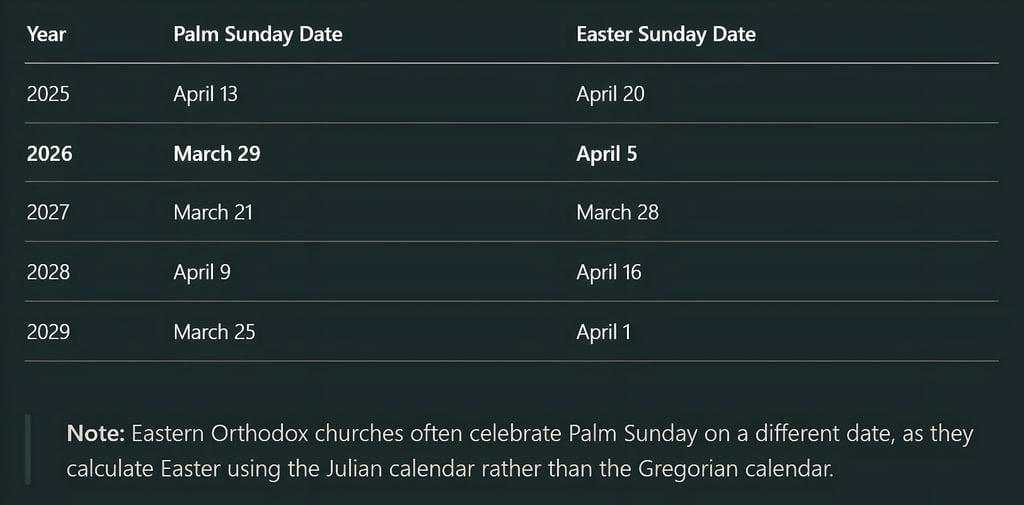
Palm Sunday is what's called a movable feast; its date shifts every year because it is always exactly one week before Easter Sunday. Easter itself is calculated as the first Sunday following the first full moon after the spring equinox (March 21). This means Palm Sunday can fall anywhere between mid-March and mid-April.
Palm Sunday and the Beginning of Holy Week
Palm Sunday doesn't stand alone; it opens the door to Holy Week, the most solemn and sacred sequence of days in Christianity. Each day of the week carries its own name, story, and observance:
Palm Sunday: The triumphal entry into Jerusalem. The week of joy and sorrow begins.
Holy Monday: Jesus cleanses the Temple, overturning the tables of the money changers in an act of righteous anger.
Holy Tuesday: A day of teaching and debate in the Temple courts; Jesus addresses the Pharisees and speaks of end times.
Holy Wednesday (Spy Wednesday): Judas Iscariot, one of the twelve disciples, makes his secret arrangement to betray Jesus to the chief priests for thirty pieces of silver.
Maundy Thursday: The Last Supper. Jesus washes the feet of his disciples, institutes the Eucharist, and is arrested in the Garden of Gethsemane.
Good Friday: The crucifixion of Jesus Christ. A day of mourning, fasting, and solemnity.
Holy Saturday: A day of waiting and silence; Jesus lies in the tomb.
Easter Sunday: The resurrection of Jesus Christ. The culmination of the entire Christian narrative.
Palm Sunday Traditions Around the World
One of the most beautiful aspects of Palm Sunday is how differently and how richly it is celebrated across cultures. The palm branch may be universal, but the way humanity honors it is wonderfully diverse.
The Palm Procession
In most Christian churches worldwide, Palm Sunday services begin with a procession. Worshippers carry palm fronds, olive branches, or locally available greenery as they walk into the church, reenacting the crowd's journey to meet Jesus on the road to Jerusalem. The palms are blessed with holy water, and many worshippers keep them in their homes throughout the year.
The Blessing of the Palms
In Catholic and many Anglican and Episcopal services, the palms are formally blessed before or during the procession. A priest sprinkles them with holy water and prays over them. These blessed palms are considered sacred; they cannot simply be discarded. Instead, they are collected and burned. The ashes become the Ash Wednesday ashes used the following year, completing a beautiful liturgical circle.
Palm Crosses and Woven Crafts
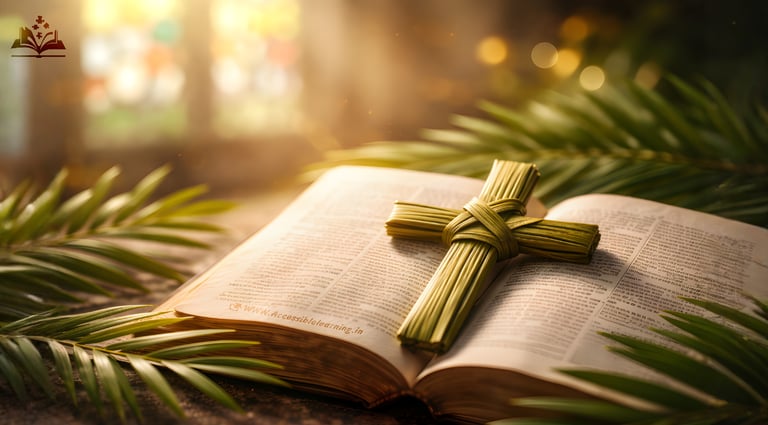
In many congregations, particularly in the United States, the United Kingdom, and across Africa, people weave their palm fronds into small crosses during or after the service. These handmade crosses are taken home and placed behind picture frames, over doorways, or beside religious icons as a symbol of faith and protection.
Palm Sunday in the Philippines
In the Philippines, one of the most Catholic countries on earth, Palm Sunday (known locally as Linggo ng Palaspas) is celebrated with extraordinary devotion. Parishes distribute elaborately decorated palm fronds that have been woven into intricate shapes of stars, flowers, and towering steeples of green. Families bring these to be blessed and keep them in their homes for the entire year.
Palm Sunday in Italy
In Italy, especially in Sicily and Calabria, Palm Sunday (Domenica delle Palme) is celebrated with processions carrying both palms and decorated olive branches, the latter a reference to the olive trees on the Mount of Olives. In some towns, incredibly elaborate woven palm sculptures called palmizi are crafted by artisans and carried through the streets.
Palm Sunday in Mexico and Latin America
Across Latin America, Palm Sunday (Domingo de Ramos) marks the beginning of Semana Santa (Holy Week), one of the most important cultural and religious events of the year. Churches overflow, processions wind through city streets, and elaborate religious art decorates public spaces. In some communities, people reenact the entry into Jerusalem with a live donkey.
Palm Sunday in Eastern Orthodox Christianity
In Eastern Orthodox tradition, Palm Sunday (often called Flowery Sunday or Willow Sunday in Slavic countries) is preceded by Lazarus Saturday, a day dedicated to commemorating the resurrection of Lazarus. In Russia, Ukraine, and other Slavic nations where palm trees don't grow, pussy willow branches are used instead and blessed in overnight candlelit vigils. The willow, budding with new life in early spring, is considered a fitting symbol for the promise of resurrection.
Palm Sunday in Ethiopia (Hosanna)
In Ethiopia, the city of Hosanna was actually named after the cry of the crowds on Palm Sunday. The Ethiopian Orthodox Church celebrates Hosanna with particular fervor, featuring processions, traditional dress, and the carrying of branches. It is considered one of the most important days in the Ethiopian liturgical calendar.
The Dual Nature of Palm Sunday: Triumph and Passion
Palm Sunday carries within it an inherent tension; it is simultaneously joyful and sorrowful. This is why the day is also formally called Passion Sunday in many church traditions. The word "passion" here comes from the Latin passio, meaning suffering.
In many churches, Palm Sunday services include the full reading of the Passion narrative a lengthy Gospel account of Jesus' arrest, trial, and crucifixion, even before those events occur in the calendar week. The congregation experiences the arc from celebration to sorrow within a single service.
Luke's Gospel captures this duality most poignantly. Even as the crowds cheered and the disciples rejoiced, Jesus wept over Jerusalem, not because of his own fate, but out of compassion for a city that did not yet understand the weight of the moment unfolding before it.
This bittersweet quality is what makes Palm Sunday so emotionally resonant. It is a day when the crowd shouts "Hosanna!" and yet, within days, many of those same voices would call for crucifixion. Palm Sunday confronts us with the fickle nature of human praise and the unwavering nature of divine purpose.
What Do Palm Branches Symbolize in Christianity?
The palm branch is one of the oldest and most enduring symbols in religious history. In Christian tradition, palm branches represent several layered meanings:
Victory and Triumph: The act of waving palms was the ancient world's version of a standing ovation, reserved for heroes and kings. Christians see this as an acknowledgment of Jesus as King.
Peace: Because Jesus rode in on a donkey rather than a warhorse, the palm-lined procession is understood as a procession of peace.
Martyrdom: In early Christian art, palm branches became associated with martyrs, those who died for their faith. To hold a palm was to honor a life given in service to God.
Eternal Life and Resurrection: Palm trees, evergreen and enduring even in harsh climates, came to symbolize eternal life in Christian iconography.
Righteousness: Psalm 92:12 states, "The righteous will flourish like a palm tree." The palm's imagery of spiritual flourishing is woven throughout Scripture.


Palm Sunday vs. Passion Sunday: What's the Difference?
Many people wonder whether Palm Sunday and Passion Sunday are the same day. The answer is yes and no.
Historically, "Passion Sunday" referred to the second Sunday before Easter (two Sundays before Palm Sunday), when churches began focusing intensively on the suffering of Christ. After the Second Vatican Council in the 1960s, the Catholic Church merged the observance of Passion Sunday into Palm Sunday, giving the day its full official name: Palm Sunday of the Passion of the Lord.
So in modern Catholic practice, Palm Sunday and Passion Sunday are the same day. In some other Christian traditions, particularly older liturgical churches, the distinction is still maintained. If you hear a church refer to "Passion Sunday," it is honoring the dual nature of this day: the joy of the palm procession and the solemnity of Christ's suffering.
Is Palm Sunday a Public Holiday?
Palm Sunday is not a federal public holiday in the United States or most Western countries. Because it falls on a Sunday, most businesses and schools are already closed for their regular weekend schedules, so its impact on daily life is primarily felt in the religious community.
However, in deeply Catholic countries, including the Philippines, many Latin American nations, and several Eastern European countries, Palm Sunday marks the beginning of a multi-day religious holiday period. Schools may close, businesses adjust hours, and the rhythm of daily life pauses for Holy Week observances.
Palm Sunday and Ash Wednesday: The Beautiful Connection
One of the lesser-known but spiritually rich connections in the Christian liturgical calendar is the relationship between Palm Sunday and Ash Wednesday.
The palms blessed on Palm Sunday are considered sacred; they cannot simply be disposed of carelessly. Churches collect them after the season, dry them out, and burn them. The resulting ashes are then mixed with oil and used the following year on Ash Wednesday, when the priest makes the sign of the cross on each worshipper's forehead and says, "Remember that you are dust, and to dust you shall return."
This cycle is a quiet but profound theological statement: the palms of triumph become the ashes of humility. Joy gives way to repentance, and repentance opens the path back to Easter joy. It is a complete liturgical loop, a year-long conversation between celebration and mortality.
How to Observe Palm Sunday: Meaningful Ways to Mark the Day
Whether you are a lifelong Christian or someone curious about this ancient tradition, there are many ways to meaningfully observe Palm Sunday:
Attend a Palm Sunday church service. Most Christian churches Catholic, Protestant, Orthodox, Anglican, and Episcopal hold special services on this day. Many begin with an outdoor or in-church procession with palms.
Read the Gospel accounts. Take time to read the accounts of Jesus' entry into Jerusalem in all four Gospels: Matthew 21:1–11, Mark 11:1–10, Luke 19:28–44, and John 12:12–19. Notice the small differences between each account and what they emphasize.
Reflect on the week ahead. Use Palm Sunday as an invitation to slow down through Holy Week, following each day's story through to Easter Sunday.
Weave a palm cross. If your church distributes palms, learn to weave a small cross. There are many simple tutorials, and the act of crafting something with your hands can be a meditative spiritual practice.
Pray for peace. Given that the palm branch symbolizes peace, Palm Sunday is a meaningful day to pray for peace in the world, in your community, and in your own heart.
Key Scriptures for Palm Sunday
For those who want to engage with the biblical text directly, here are the primary passages associated with Palm Sunday:
Matthew 21:1–11 — The most detailed account of the entry, explicitly linking it to Zechariah's prophecy.
Mark 11:1–10 — A vivid, eyewitness-style account with precise detail about the colt.
Luke 19:28–44 — The only account that includes Jesus weeping over Jerusalem.
John 12:12–19 — Includes the Pharisees' reaction: "Look, the world has gone after him!"
Zechariah 9:9 — The Old Testament prophecy fulfilled on Palm Sunday.
Psalm 118:25–26 — The source of the "Hosanna... Blessed is he who comes in the name of the Lord" cry.
Palm Sunday in the Context of the Liturgical Year
For Christians who observe a liturgical calendar, Palm Sunday is one of the year's most significant pivot points. It comes at the end of Lent a forty-day season of fasting, prayer, and repentance that began on Ash Wednesday. The palms mark the moment when the slow, quiet work of Lent gives way to the dramatic, urgent drama of Holy Week.
If Lent is the long walk through the desert, Palm Sunday is the moment the city comes into view beautiful, overwhelming, and freighted with everything that is about to happen.
What Palm Sunday Teaches Us
There is something deeply human about Palm Sunday. The crowd that cheered Jesus was not wrong to cheer; they were responding to something real and wondrous. But their cheers were based on incomplete understanding. They wanted a savior, but they imagined salvation looking different from what was coming.
Palm Sunday teaches us that the greatest transformations rarely look the way we expect. The king arrives not on a warhorse but on a donkey. The victory doesn't come through conquest but through surrender. The triumph celebrated with waving palms is completed not in a palace but on a cross.
For Christians, this is the heart of the faith: that weakness can be strength, that loss can become gain, and that a Friday's grief can become a Sunday's joy. Palm Sunday is the opening movement of that story joyful, bittersweet, and filled with the kind of hope that doesn't flinch from what lies ahead.
Frequently Asked Questions
Q: What is Palm Sunday, and why is it celebrated?
Palm Sunday is a Christian holiday observed on the Sunday before Easter. It commemorates Jesus Christ's triumphal entry into Jerusalem, where crowds greeted him by waving palm branches and laying them on the road. It marks the beginning of Holy Week and is celebrated with church services, processions, and the blessing of palm branches.
Q: When is Palm Sunday in 2026?
Palm Sunday in 2026 falls on March 29, 2026. Easter Sunday follows one week later, on April 5, 2026.
Q: Why do Christians use palm branches on Palm Sunday?
Palm branches were used because the crowd that greeted Jesus in Jerusalem waved them as a sign of honor and victory. In the ancient world, palms symbolized triumph, peace, and righteousness, making them the ideal way to welcome a figure seen as a king and savior.
Q: Is Palm Sunday the same as Passion Sunday?
In modern Catholic practice, yes. The day is officially called "Palm Sunday of the Passion of the Lord." Some older liturgical traditions still distinguish between them, with Passion Sunday occurring the week before Palm Sunday. The merger happened following the Second Vatican Council in the 1960s.
Q: What happens in church on Palm Sunday?
On Palm Sunday, most Christian churches conduct a procession in which worshippers carry blessed palm branches (or local alternatives like willow or olive branches). The service typically includes readings from the Passion narrative, the Gospel account of Jesus' arrest, trial, and crucifixion. Worshippers often take their palms home as a sacred symbol.
Q: Can palm branches from Palm Sunday be thrown away?
Traditionally, no. Because they have been blessed, palm branches from Palm Sunday are considered sacred objects. Churches collect them, dry and burn them, and the ashes are used the following year for Ash Wednesday services, the start of Lent.
Q: What does the word "Hosanna" mean on Palm Sunday?
"Hosanna" is a Hebrew word meaning "God saves" or "Save us now." When the crowd shouted "Hosanna" as Jesus entered Jerusalem, they were both praising him and calling out for salvation a cry of worship and desperate hope at the same time.
Q: Why did Jesus ride a donkey on Palm Sunday?
Jesus rode a donkey as a deliberate act of symbolism. In the ancient Near East, kings rode horses when going to war and donkeys when arriving in peace. By choosing a donkey, Jesus fulfilled the prophecy in Zechariah 9:9 and announced himself as the Prince of Peace, not a military conqueror.
Q: What countries celebrate Palm Sunday with special traditions?
Palm Sunday is celebrated globally, with notable traditions in the Philippines (Linggo ng Palaspas with elaborate woven palms), Italy (palm and olive processions), Mexico and Latin America (Domingo de Ramos and Semana Santa), Russia and Slavic nations (pussy willow branches, since palm trees don't grow there), and Ethiopia (celebrated as Hosanna).
Q: Is Palm Sunday a public holiday?
Palm Sunday is not a public holiday in the United States or most Western nations. It falls on a Sunday, so it doesn't affect work or school schedules. In some predominantly Catholic countries, it marks the beginning of Holy Week, which may include official public holidays later in the week (particularly Good Friday).
Subscribe To Our Newsletter
All © Copyright reserved by Accessible-Learning Hub
| Terms & Conditions
Knowledge is power. Learn with Us. 📚

