

Outsourcing Our Minds: The Rise of "Digital Dementia"
Are smartphones and AI making us forget how to remember? Explore the rise of digital dementia, cognitive offloading, the Google Effect, and why memory still matters in the age of AI-powered knowledge.
MODERN DISEASESA LEARNINGAI/FUTURE
Sachin K Chaurasiya | Shiv Singh Rajput | Kim Shin
6/9/20268 min read
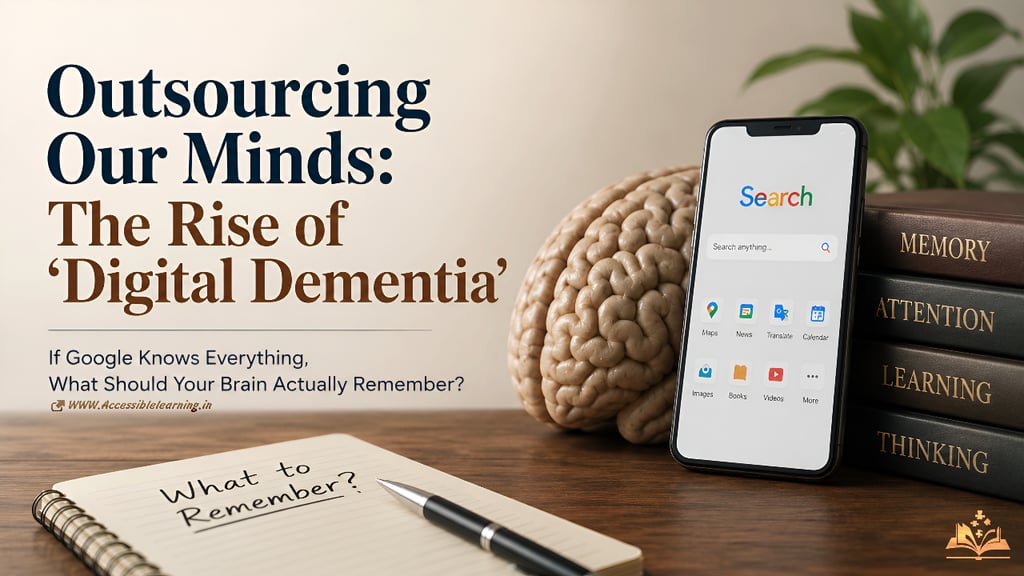
If Google Knows Everything, What Should Your Brain Actually Remember?
A few decades ago, most people could recite dozens of phone numbers from memory. They remembered directions to friends' houses, birthdays, shopping lists, and important facts learned in school. Today, many of us struggle to recall our own spouse's phone number without checking our smartphone.
The reason is simple: we no longer need to remember as much.
Every day, billions of people rely on smartphones, search engines, GPS systems, cloud storage, and AI assistants to store and retrieve information. Our devices have become external hard drives for the human brain. They remember what we forget and answer questions before we even have time to think.
This convenience has transformed modern life. Yet it has also raised a growing concern among neuroscientists, educators, and psychologists: Are we gradually outsourcing our minds?
The phenomenon is often referred to as "digital dementia"—a term used to describe cognitive decline linked to excessive dependence on digital technology for memory, attention, and thinking tasks.
The question is no longer whether technology changes how we think. It clearly does.
The deeper question is this:
If Google knows everything, what is the purpose of human memory in the age of AI?
What Is Digital Dementia?
Digital dementia is not an officially recognized medical diagnosis like Alzheimer's disease or other forms of dementia. Instead, it is an informal term describing the weakening of cognitive abilities due to overreliance on digital devices.
These abilities include:
Memory retention
Concentration
Problem-solving
Critical thinking
Spatial navigation
Information recall
The brain operates according to a fundamental biological principle:
Use it or lose it.
Neural pathways strengthen when they are exercised repeatedly. When certain cognitive functions are outsourced to technology, the brain has fewer opportunities to practice those skills.
Over time, those pathways may become weaker. Just as muscles shrink without physical activity, cognitive abilities can decline without mental exercise.
The Smartphone: Humanity's External Brain
Today's smartphone performs functions that once required significant mental effort. It remembers:
Phone numbers
Addresses
Appointments
Passwords
Shopping lists
Travel routes
Birthdays
Historical facts
Definitions
Calculations
In many ways, modern devices have become extensions of human memory. Psychologists refer to this as cognitive offloading. Cognitive offloading occurs when individuals use external tools to reduce mental workload.
Examples include:
Writing notes
Using calculators
Setting reminders
Saving contacts
Using GPS navigation
While cognitive offloading can improve efficiency, excessive dependence may reduce opportunities for the brain to strengthen memory and recall abilities.
The result is a paradox:
Technology makes us more capable while potentially making certain mental skills less practiced.
The Google Effect: Why We Stop Remembering
Researchers have identified a phenomenon often called the Google Effect or digital amnesia.
When people know information can be easily accessed later, they are less likely to commit it to memory.
Imagine being asked:
"What is the capital of Mongolia?"
If you know you can search for the answer instantly, your brain may not prioritize remembering it.
Instead of storing the fact itself, the brain stores something different:
Where to find the fact.
This shift represents a profound change in human memory. Historically, knowledge meant possessing information internally. Today, knowledge increasingly means knowing how to access information externally. The internet has become a giant memory bank, and humans have adapted accordingly.


Why GPS May Be Reshaping the Brain
Navigation offers one of the clearest examples of cognitive outsourcing. Before GPS, people developed mental maps of their environment.
They remembered:
Street names
Landmarks
Distances
Directions
This process heavily engaged the hippocampus, a brain region critical for memory and spatial awareness. Modern GPS systems eliminate much of that effort.
Instead of building mental maps, users follow turn-by-turn instructions. Many people can drive to a destination dozens of times yet still struggle to describe the route afterward.
The destination is reached successfully, but the brain learns less about the journey. Over years of dependence, this reduced engagement may weaken spatial memory skills.
The Cost of Constant Notifications
Memory is not the only cognitive ability under pressure. Attention has become one of the most valuable and endangered resources in the digital age. Modern devices compete relentlessly for attention through the following:
Notifications
Messages
Social media alerts
News updates
Emails
AI-generated recommendations
Every interruption forces the brain to switch contexts. Research consistently shows that task switching carries cognitive costs. The brain requires time to refocus after interruptions.
As digital distractions increase, sustained concentration becomes more difficult. This has implications beyond productivity. Memory formation depends heavily on attention. If attention is fragmented, memory often becomes fragmented as well.
Are We Becoming Less Intelligent?
This question often sparks alarmist headlines. The answer is more nuanced. Technology is not necessarily making people less intelligent.
Instead, it may be changing the type of intelligence we rely upon. Humans have always created tools that shift cognitive burdens.
Writing reduced the need to memorize long oral histories. Calculators reduced mental arithmetic. Maps reduced navigational guesswork.
Search engines reduced fact memorization. AI may reduce information retrieval altogether. The issue is not whether tools exist.
The issue is whether overdependence prevents the development of essential cognitive skills. A calculator is useful. A person who cannot perform basic arithmetic without one may face limitations.
Similarly, AI can answer questions instantly. But understanding, reasoning, evaluating, and applying information remain fundamentally human responsibilities.
What Happens When AI Becomes Instant Knowledge?
Artificial intelligence is accelerating cognitive outsourcing to unprecedented levels. In the past, people searched for answers. Now AI generates them.
Instead of reading multiple sources, users increasingly ask a chatbot for a summary. Instead of learning a process, they request a solution.
Instead of developing expertise, they seek immediate output. This creates both opportunities and risks. AI can dramatically enhance learning when used as a thinking partner.
However, when used as a replacement for thinking, it can weaken intellectual engagement. The challenge is not AI itself. The challenge is whether people remain active participants in the thinking process.
Does Memorization Still Matter?
Perhaps the most controversial question is whether memorization remains valuable in modern education. If every fact can be accessed within seconds, why memorize anything?
The answer lies in how human cognition actually works. Thinking depends on stored knowledge. Critical thinking is not separate from memory.
It is built upon memory. A person cannot effectively analyze, compare, evaluate, or create without a foundation of information already present in the mind.
Experts in every field possess extensive internal knowledge. They do not constantly stop to look up basic concepts.
Because foundational information is readily available in memory, they can focus on deeper reasoning. Memorization should not be the ultimate goal of education.
But it remains a necessary foundation for understanding. Knowledge stored internally becomes the raw material for creativity and insight.
The New Purpose of Memory in the AI Age
The role of memory is evolving. Instead of memorizing endless isolated facts, people may increasingly focus on remembering:
Core Concepts
Understanding principles rather than individual trivia.
Mental Frameworks
Models that help organize and interpret information.
Critical Thinking Skills
Evaluating whether information is accurate, relevant, or misleading.
Pattern Recognition
Connecting ideas across disciplines.
Context
Understanding why information matters.
Human Experience
Stories, emotions, relationships, ethics, and values.
These forms of knowledge are difficult to outsource completely.
They remain central to human intelligence.

How to Protect Your Brain in a Digital World
Technology is not the enemy. The goal is balance. Practical ways to strengthen cognitive health include:
Memorize Important Information
Learn key phone numbers, addresses, and frequently used facts.
Navigate Without GPS Occasionally
Practice building mental maps of familiar areas.
Read Long-Form Content
Deep reading improves attention and memory.
Reduce Digital Interruptions
Limit unnecessary notifications and multitasking.
Practice Active Recall
Test yourself instead of repeatedly rereading information.
Learn New Skills
Languages, instruments, and complex hobbies stimulate cognitive growth.
Use AI as a Partner
Let AI assist your thinking rather than replace it.
The Future of Human Memory
Every major technological advancement changes how humans think. Writing transformed memory. Printing transformed knowledge. The internet transformed access to information.
Artificial intelligence is transforming cognition itself. The future is unlikely to involve humans memorizing less and less until memory becomes irrelevant. Instead, society may redefine what is worth remembering.
Facts are becoming abundant. Attention is becoming scarce. Information is becoming automated. Wisdom is becoming more valuable.
The people who thrive in the AI era will not necessarily be those who know the most facts. They will be those who can understand, connect, question, and apply information effectively.
The rise of digital technology has given humanity access to more information than any previous generation could imagine. Smartphones, search engines, and AI assistants have become powerful extensions of our minds, helping us store, retrieve, and process knowledge instantly.
Yet the brain remains a living system shaped by use.
When memory, navigation, concentration, and problem-solving are continually outsourced, those abilities may weaken through lack of exercise. This emerging phenomenon, often called digital dementia, serves as a reminder that convenience comes with trade-offs.
The real challenge is not preserving every fact in memory. It is preserving the mental capacities that allow humans to think independently.
In a world where AI can retrieve almost any answer in seconds, the most valuable cognitive skills may no longer be remembering information, but understanding it, questioning it, and transforming it into insight.
Google may know everything. But the human brain still decides what matters.
FAQ's
Q: What is digital dementia?
Digital dementia is an informal term used to describe memory, attention, and cognitive difficulties associated with excessive reliance on digital devices. It refers to the tendency to outsource mental tasks such as remembering phone numbers, directions, and facts to smartphones, search engines, and other technologies, potentially reducing the brain's regular cognitive exercise.
Q: Is digital dementia a real medical condition?
No, digital dementia is not an officially recognized medical diagnosis. However, researchers have studied how excessive screen time, digital dependency, and cognitive offloading can affect memory retention, attention span, and critical thinking skills over time.
Q: How does technology affect memory?
Technology affects memory by making information instantly accessible. When people know they can easily retrieve information from a device, they are less likely to store it in long-term memory. This phenomenon is often called the "Google Effect" or "digital amnesia."
Q: What is cognitive offloading?
Cognitive offloading is the practice of using external tools to reduce mental effort. Examples include using smartphones for reminders, GPS for navigation, calculators for math, and AI assistants for information retrieval. While helpful, excessive cognitive offloading may reduce opportunities to strengthen memory and problem-solving skills.
Q: Does using Google and AI make people less intelligent?
Not necessarily. Google and AI can increase access to information and improve productivity. However, overreliance on these tools may weaken certain cognitive skills if people stop actively engaging in learning, analysis, and critical thinking. Intelligence depends on how technology is used rather than the technology itself.
Q: Why is memorization still important in the AI age?
Memorization provides the foundation for understanding, reasoning, and creativity. While AI can quickly retrieve facts, humans still need internal knowledge to evaluate information, recognize patterns, solve problems, and make informed decisions. Strong memory supports higher-order thinking skills.
Q: Can smartphones reduce attention span?
Research suggests that constant notifications, multitasking, and frequent digital interruptions can make sustained concentration more difficult. Fragmented attention may also affect learning and memory formation because focused attention is essential for storing information effectively.
Q: How does GPS affect the brain?
GPS navigation reduces the need to create mental maps and remember routes. While convenient, heavy reliance on GPS may decrease the brain's engagement with spatial memory and navigation skills, particularly those associated with the hippocampus.
Q: What are the signs of digital dependency?
Common signs include:
Difficulty remembering phone numbers or appointments
Constant reliance on search engines for simple information
Reduced concentration while reading
Anxiety when separated from a smartphone
Frequent multitasking and distraction
Dependence on GPS for familiar routes
Q: How can I improve my memory in a digital world?
You can strengthen memory by:
Practicing active recall
Reading long-form content
Memorizing important information
Limiting distractions and notifications
Learning new skills
Navigating without GPS occasionally
Using AI and technology as learning tools rather than replacements for thinking
Q: What is the Google Effect?
The Google Effect is the tendency to forget information that can be easily found online. Instead of remembering the information itself, people often remember where and how to access it, changing the way memory functions in the digital age.
Q: What skills will be most valuable in the age of AI?
As AI becomes better at storing and retrieving information, valuable human skills will include:
Critical thinking
Problem-solving
Creativity
Emotional intelligence
Communication
Ethical reasoning
Pattern recognition
Decision-making
These abilities help people interpret and apply information in ways that go beyond simple fact retrieval.
Q: Can AI replace human memory?
AI can store and retrieve vast amounts of information, but it cannot fully replace human memory. Human memory provides context, experience, intuition, emotional understanding, and the knowledge needed for critical thinking and decision-making.
Q: Is digital dementia reversible?
In many cases, cognitive skills can improve through regular mental exercise, reduced digital dependence, focused learning, healthy sleep habits, physical activity, and activities that challenge memory and concentration. The brain remains adaptable throughout life due to neuroplasticity.
Q: What is the future of memory in the AI era?
The future of memory is likely to shift from memorizing large amounts of factual information toward retaining concepts, frameworks, context, and critical thinking skills. As AI handles more information retrieval, human value will increasingly come from interpretation, judgment, creativity, and wisdom.
Subscribe To Our Newsletter
All © Copyright reserved by Accessible-Learning Hub
| Terms & Conditions
Knowledge is power. Learn with Us. 📚

