

OSIRIS-REx Asteroid Mission: NASA's Nightmare Descent Into a Cosmic Quicksand
NASA's OSIRIS-REx nearly sank into asteroid Bennu because it wasn't solid. Discover how a rubble-pile asteroid exposed a fundamental flaw in our understanding of space.
SPACE & EXPLORATION
Sachin K Chaurasiya
7/21/20269 min read


Sinking, Not Landing
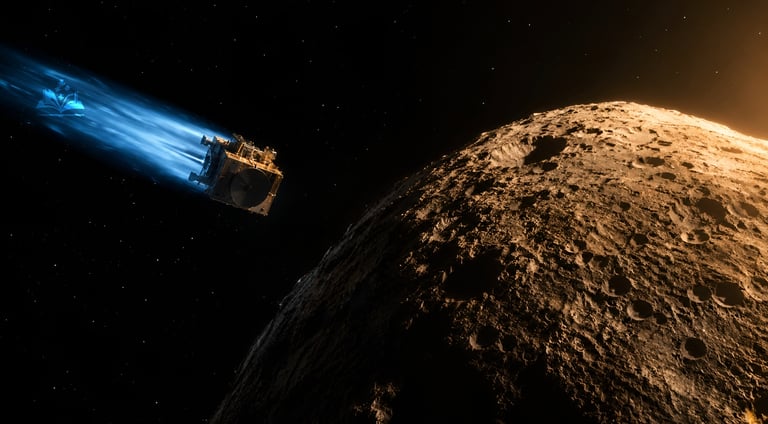
October 20, 2020. A spacecraft the size of a minivan is descending toward asteroid Bennu, 207 million miles from Earth. Mission control is holding its breath.
The spacecraft's arm extends toward the surface. It makes contact.
Then something goes terribly, impossibly wrong.
Instead of a reassuring thud on solid rock, the spacecraft begins to sink. Rocks tumble upward past the camera. Dust rises like an underwater cloud. For a heart-stopping moment, the engineers watching the telemetry wonder if they've just lost a $1 billion mission to a gravity well that behaves less like an asteroid and more like a cosmic ball pit.
This wasn't a disaster. It was a revelation.
The OSIRIS-REx mission was supposed to kiss an asteroid and leave. What it actually did was expose something far more unsettling: Bennu wasn't a solid rock orbiting the sun. It was a collection of rubble held together by gravity alone—a loose, granular aggregate that responded to contact like a liquid, not a stone. And NASA's engineers hadn't fully prepared for that physics.
The Engineering Nightmare: Planning a Landing on Quicksand
The Problem Nobody Wanted to Admit
When engineers designed the OSIRIS-REx asteroid sample return mission in the early 2010s, they were working from assumptions built on incomplete data. Asteroids, they believed, were monolithic chunks of rock—solid, predictable, boring.
Bennu was none of those things.
Radar data from Earth suggested a surface. But when the spacecraft arrived in December 2018, close-up images revealed something closer to a minefield: massive boulders scattered across a terrain pocked with craters and surrounded by fields of loose debris. The spacecraft's own instruments detected methane and water ice signatures, hinting at a complex composition nobody had fully mapped.
The real problem: a rubble-pile asteroid doesn't behave like solid ground. It's held together by the asteroid's own microgravity—a pull so weak that Bennu's gravitational field exerts only 1/200,000th the force of Earth's. When you touch that surface, you're not pressing against rock. You're pressing against billions of loosely bound particles that shift, collapse, and flow like sand under pressure.
Why This Made the Mission Nearly Impossible
The original sample collection plan—OSIRIS-REx's primary objective—relied on a touchdown lasting only 5-10 seconds. Get in, grab material, get out. Simple.
Except Bennu wasn't playing along.
The spacecraft's navigation had to contend with:
Gravitational uncertainty: Bennu's mass distribution was uneven, creating unpredictable gravitational anomalies that could throw off trajectory calculations.
Debris clouds: Larger boulders scattered across the surface created radar shadows, making it impossible to map safe landing zones with precision.
Uneven terrain: The asteroid's regolith (surface material) wasn't uniform. Some areas were loose powder. Others were consolidated rock. The spacecraft had no way to distinguish between them until it was already committed to descent.
Particle dynamics: As soon as the spacecraft's thrusters fired to slow descent, they blasted regolith into the surrounding space. That dust could obscure sensors, lodge in mechanisms, or create unexpected drag forces.
Engineers had to develop an entirely new approach: a gravity-based descent that treated Bennu not as a landing site but as a hazard to be approached with extreme caution.
"We weren't just landing on an asteroid. We were negotiating with one." – NASA engineer reflecting on the mission's approach


The Climax: Bennu Acts Like a Liquid
October 20, 2020—The Touch
After two years of orbital reconnaissance, OSIRIS-REx made its move. The spacecraft descended toward a site called "Nightingale," a relatively flat region chosen as the safest touchdown point.
The arm extended. Its collection head made contact with the surface at less than 1 mile per hour. Here's what happened in the next 16 seconds that changed everything:
The moment the sampler touched down, Bennu's surface responded like a fluid. Rocks lifted off the ground. Fine regolith erupted around the collection head in a cloud. The surface itself began to collapse inward, as if the spacecraft were punching through crust into something less stable beneath.
The spacecraft's thrusters fired to prevent sinking further. The arm retracted immediately.
When telemetry arrived back on Earth—a 14-minute round-trip communication delay—mission control saw something shocking: the spacecraft had collected far more material than expected. The sampler's container was so full that some material couldn't be sealed inside. The collection success vastly exceeded projections.
But there was a cost: the spacecraft had sunk into Bennu like a foot into wet sand.
What the Data Revealed
Analysis of the touchdown data and close-up images led to a stunning realization: Bennu's surface was cohesionless. There was no solid foundation beneath the loose material. The "ground" was just denser regolith—still just rubble, just compacted slightly more.
The asteroid was essentially a gravity-held aggregate, a massive pile of debris in orbit. The microgravity was just barely enough to keep it from scattering into space.
When OSIRIS-REx pressed down, it didn't land on a surface. It compressed particles that immediately rebounded in the near-zero-gravity environment. The "liquid" behavior wasn't poetic license—it was literal physics. Under those specific conditions, loose granular material behaves with surprising fluid-like properties.
"Bennu taught us that asteroids aren't rocks. They're conversations between gravity and chaos." – Planetary scientist analyzing mission results
The Paradigm Shift
What This Means for Asteroid Science
The OSIRIS-REx mission fundamentally rewrote our understanding of how asteroids work. Bennu isn't an anomaly. High-resolution observations from this mission and others like Hayabusa2 (which touched down on asteroid Ryugu around the same time) suggest that many near-Earth asteroids are rubble piles.
This changes everything:
Resource extraction becomes a different problem: Mining a rubble pile requires different techniques than extracting material from solid rock.
Planetary defense becomes more complex: An asteroid's cohesionless nature affects how impact missions (like DART in 2022) actually change its trajectory.
Sample return becomes riskier: Bennu showed that sampling operations on loose-aggregate asteroids carry higher risks of unexpected outcomes.
The Engineering Victory Hidden in the Chaos
Despite the near-loss and the unexpected fluid dynamics, OSIRIS-REx succeeded beyond its mission parameters. It collected 121.6 grams of material—enough to keep scientists busy for decades. The spacecraft returned to Earth in September 2023, and the samples are being analyzed at NASA's Johnson Space Center and distributed to laboratories worldwide.
The fact that the spacecraft collected more material than expected, despite sinking into Bennu's surface, wasn't a lucky accident. It was engineers rapidly adapting to a physics problem they'd never fully anticipated.
We Still Don't Understand Asteroids
The OSIRIS-REx asteroid sample return mission was billed as a routine collection operation. What it delivered was a wake-up call.
For decades, planetary scientists treated asteroids as static objects—ancient rocks frozen in time and space. The OSIRIS-REx mission revealed they're dynamic, unstable, and fundamentally alien to our Earth-bound intuitions about what "solid" means.
Future missions—whether for resource extraction, planetary defense, or scientific curiosity—will need to account for this fluidity. They'll need engineers who think less like geologists and more like fluid dynamicists.
Bennu didn't nearly destroy the OSIRIS-REx mission. It humbled it. And that humility is exactly what space exploration needs.
The asteroid that acted like a ball pit didn't sink NASA's dreams. It reshaped them. And the samples it gave us are still teaching us what we still don't know.
Key Mission Timeline
September 2016: OSIRIS-REx launches from Kennedy Space Center
December 2018: Spacecraft arrives at asteroid Bennu; begins 2-year reconnaissance
October 20, 2020: First sample collection attempt; spacecraft sinks into surface
January 2021: Second successful sample collection; container sealed and secured
May 2021: Spacecraft departs Bennu orbit, begins return journey
September 24, 2023: Sample capsule lands in Utah desert
2024–present: Samples distributed to research institutions worldwide
Why This Mission Matters
The OSIRIS-REx asteroid sample return mission wasn't just about collecting rocks. It was about discovering that the rocks we thought we knew aren't rocks at all. Bennu's behavior—sinking, flowing, shifting—forced a complete recalibration of how we understand the physical properties of near-Earth asteroids.
That knowledge will shape every future mission we send to the outer solar system. And that's worth every moment of tension mission control experienced on October 20, 2020, when their spacecraft began to sink.
Frequently Asked Questions
Q: What Exactly Happened When OSIRIS-REx Touched Bennu?
The spacecraft descended to the surface at roughly 1 mile per hour and extended its robotic arm to make contact. The sampler head pressed against the regolith (loose surface material) and immediately began to sink. Instead of compressing against solid rock, the material behaved like a fluid—rocks floated upward, dust erupted in a cloud, and the spacecraft's sensors detected unexpected motion in all directions. Within 16 seconds, the thrusters fired to prevent further sinking. The entire contact event was captured on camera and transmitted back to Earth, where engineers realized they'd just witnessed something nobody had fully anticipated: a spacecraft collection operation that proved the asteroid's surface had virtually no structural integrity.
Q: Why Did Bennu's Surface Act Like Quicksand?
Bennu is a rubble-pile asteroid—a collection of boulders and regolith held together by the asteroid's own gravity, which is extraordinarily weak (about 1/200,000th of Earth's gravity). Under normal Earth conditions, loose material like sand or gravel would collapse into a pile. But in microgravity, individual particles are barely held together at all. When the spacecraft pressed down on the surface, it compressed particles that had almost no cohesion. In these specific gravitational conditions, granular material behaves with fluid-like properties—it flows, rebounds, and shifts in ways that mimic liquid dynamics. It's not actually liquid, but the physics produces eerily similar results.
Q: Did the Spacecraft Almost Get Lost?
Not quite, but it was close. The engineering team had designed the sample collection for a brief 5-10 second contact with what they assumed would be solid ground. When the spacecraft began sinking, there was a real risk it could get stuck, sink deeper than designed, or become unstable. However, the spacecraft's automated systems detected the anomalous behavior and fired the thrusters immediately to arrest the descent. The quick thinking and robust engineering prevented a potential mission loss. The fact that the spacecraft not only survived but actually collected more material than expected is testament to both the design's resilience and the team's rapid adaptation to unexpected physics.
Q: How Much Material Did OSIRIS-REx Actually Collect?
The spacecraft collected 121.6 grams (about 4.3 ounces) of asteroid material. This vastly exceeded the minimum requirement of 60 grams. The sample is so abundant that some material couldn't fit in the collection chamber, which is precisely why mission engineers knew the touchdown was so successful despite the unnerving sinking sensation. This amount of pristine asteroid material is enough to keep researchers busy for decades and has already yielded insights into Bennu's composition, age, and origins.
Q: What Makes Bennu Different From Other Asteroids?
Bennu is what scientists call a "B-type" asteroid, meaning it's carbonaceous and contains organic compounds and water ice. But more importantly, it's a low-density rubble pile, which means its interior is likely mostly empty space—a collection of boulders with voids between them. Not all asteroids are like this, but observations from OSIRIS-REx and the Hayabusa2 mission (which touched down on asteroid Ryugu at nearly the same time) suggest that many near-Earth asteroids share this rubble-pile structure. This fundamentally changes how we understand asteroid formation, stability, and behavior.
Q: Where Are the OSIRIS-REx Samples Now?
The sample capsule landed in the Utah desert on September 24, 2023. The material was transported to NASA's Johnson Space Center in Houston, where it was carefully catalogued, photographed, and analyzed. Samples have since been distributed to research institutions worldwide, including universities, government agencies, and international partners. Scientists are analyzing the material for organic compounds, mineralogy, dating, and any evidence of the asteroid's thermal and impact history. Some samples are being preserved for future analysis with technologies that don't yet exist.
Q: Could This Happen to Other Missions?
Absolutely. Any future mission to a rubble-pile asteroid will need to account for this behavior. NASA's DART mission (which deliberately crashed into asteroid Didymos in 2022) had to consider similar physics. Future sample-return missions, mining operations, or planetary defense initiatives will all need to treat rubble-pile asteroids as dynamic, unstable systems rather than solid rocks. The OSIRIS-REx mission essentially created a playbook for how to approach these objects safely.
Q: Why Does This Change Our Understanding of the Solar System?
For decades, asteroids were treated as static, unchanging remnants of the early solar system. But if many asteroids are loosely bound rubble piles, it means they're far more dynamic and fragile than we thought. They can be easily disrupted by impacts, gravitational interactions, or even the stress from the Sun's radiation (which can cause thermal expansion and contraction). This affects our models of how asteroids formed, how they've evolved, and how vulnerable they are to impacts or disintegration. It also changes the risk calculations for planetary defense—hitting a rubble pile with a spacecraft might produce very different results than hitting a solid asteroid.
Q: What Was the Point of the OSIRIS-REx Asteroid Sample Return Mission?
The primary goal was to collect pristine asteroid material from a time when the solar system was still forming (Bennu is estimated to be 4.5 billion years old). By analyzing this material, scientists can answer fundamental questions: What were the building blocks of planets? How did organic compounds form in space? What can asteroid samples tell us about the early solar system's chemistry? The secondary goals were to map Bennu's surface, measure its gravitational field, and study how it responds to external forces—all of which contributed to the surprising discovery about its fluid-like behavior.
Q: How Will Future Missions Use These Lessons?
Future asteroid missions will implement:
Enhanced surface penetration models: Better simulations of how spacecraft interact with low-density, granular surfaces
Adaptive landing algorithms: Systems that can detect fluid-like behavior and adjust thrust and contact time in real-time
Alternative sampling techniques: Perhaps using electrostatic collection or magnetic fields instead of mechanical scoops
Redundant descent systems: Multiple abort options in case the spacecraft sinks deeper than expected
Better pre-mission reconnaissance: Longer orbital studies to detect surface material properties before committing to contact
Subscribe to Frontier Intelligence
All © Copyright reserved by Accessible-Learning Hub
| Terms & Conditions
Accessible Learning Hub — Actionable clarity for high-agency minds.
Weekly breakdowns on AI breakthroughs, capital flow, and human performance systems. Zero fluff.