

Orthodox Easter (Paskha) and Cosmonautics Day: Meaning, History, and Global Significance
Explore the significance of Orthodox Easter (Paskha) and Cosmonautics Day. Learn about traditions, history, Yuri Gagarin’s spaceflight, and how faith and science shape human progress.
CULTURE/TRADITIONEVENT/SPECIALRUSSIACELEBRATION/FESTIVALS
Kim Shin
4/2/20265 min read
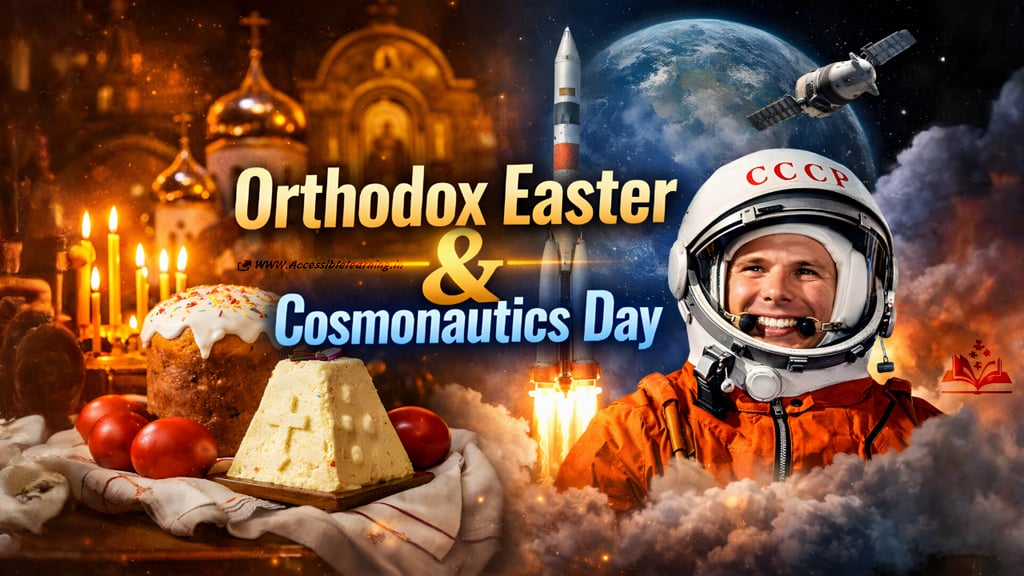
April brings together two powerful observances that reflect very different yet equally meaningful aspects of human life. Orthodox Easter (Paskha) represents spiritual renewal and centuries-old traditions, while Cosmonautics Day celebrates one of humanity’s greatest scientific breakthroughs. When explored together, they offer a broader understanding of culture, belief, and ambition.
Orthodox Easter (Paskha): Beyond Tradition and Ritual
Calendar Differences and Date Calculation
One of the most unique aspects of Orthodox Easter is how its date is determined:
It follows the Julian calendar, not the Gregorian calendar
It must occur after Jewish Passover
It is calculated based on the first full moon after the spring equinox
Because of these rules, Orthodox Easter can fall one to five weeks later than Western Easter.
The Holy Week (Passion Week)
The week leading up to Easter is deeply symbolic and structured:
Holy Monday–Wednesday: Reflection and preparation
Holy Thursday: Commemorates the Last Supper
Good Friday: Marks the crucifixion, observed with mourning
Holy Saturday: A quiet day of anticipation
The emotional progression from sorrow to joy is central to the experience.
The Holy Fire Ceremony
One of the most mystical traditions occurs in Jerusalem:
The Holy Fire is said to miraculously appear in the Church of the Holy Sepulchre
It is then distributed to Orthodox communities worldwide
Many believers see it as a divine sign of resurrection
This event draws thousands of pilgrims each year.
Symbolism in Everyday Traditions
Orthodox Easter traditions are layered with meaning:
Egg tapping game: Symbolizes the breaking of Christ’s tomb
Three kisses greeting: Represents the Holy Trinity
White and gold vestments: Signify purity and victory
Even the foods carry symbolic messages of life, sacrifice, and abundance.
Regional Variations
Different countries celebrate Paskha in unique ways:
Greece: Fireworks and lamb roasting dominate celebrations
Russia: Families exchange decorated eggs and attend long liturgies
Romania: Midnight church services followed by communal meals
Ethiopia: Known as Fasika, includes long fasting and vibrant feasts
These variations show how faith adapts to culture while preserving its core meaning.
Modern Relevance
Today, Orthodox Easter continues to:
Strengthen community bonds
Reinforce identity among diaspora populations
Serve as a time for digital connection through livestreamed services
It remains both traditional and adaptable in a modern world.


Cosmonautics Day: Expanding the Story of Space Exploration
The Global Context: The Space Race
Cosmonautics Day cannot be understood without the Cold War era. Space Race:
A competition between the Soviet Union and the United States
Driven by technological, political, and ideological rivalry
Resulted in rapid advancements in rocket science and space travel
Gagarin’s flight gave the Soviet Union a major symbolic victory.
Yuri Gagarin: The Man Behind the Mission
Beyond the achievement, Gagarin himself became a global icon:
Known for his humility and charisma
Represented hope and unity beyond political divisions
Became an ambassador of science and peace
His legacy continues to inspire astronauts and scientists worldwide.
Evolution of Space Exploration
Since 1961, space exploration has grown dramatically:
Moon landing (1969): Humans reached another celestial body
Space stations: Long-term human presence in orbit
Mars missions: Robotic exploration of other planets
Private space companies: New era of commercial space travel
Cosmonautics Day now celebrates all these achievements, not just the first flight.
Yuri’s Night: A Modern Global Celebration
A contemporary extension of Cosmonautics Day is Yuri’s Night:
Celebrated worldwide on April 12
Combines science, art, and public engagement
Includes parties, lectures, and space-themed events
It makes space exploration accessible and exciting for younger generations.
Educational and Scientific Impact
Cosmonautics Day plays a strong role in:
Promoting STEM education
Inspiring careers in science and engineering
Encouraging curiosity about the universe
Schools, universities, and research institutions often organize special programs.
India’s Connection to Space Exploration
While Cosmonautics Day is rooted in Soviet history, its spirit resonates globally, including in India:
The success of ISRO missions like Chandrayaan and Mangalyaan
Growing interest in space technology and startups
Increasing public engagement with astronomy and science
It reflects a shared global journey toward understanding space.
Shared Themes: Deeper Philosophical Insights
Looking beyond surface differences, both observances explore similar human questions:
The Search for Meaning
Religion asks, "Why do we exist?"
Science asks, "How does the universe work?"
Light as a Symbol
Easter: Light represents resurrection
Space exploration: Light represents discovery and knowledge
Transformation
Spiritual rebirth in Easter
Technological evolution in space exploration

Interesting Facts You Might Not Know
Orthodox Easter greetings continue for 40 days after the celebration
The Vostok 1 capsule landed using a parachute system, not a soft landing
Some Orthodox Christians fast for up to 55 days before Easter
Yuri Gagarin was only 27 years old during his historic flight
The phrase “Christ is Risen” is used instead of “Hello” during Easter season
Orthodox Easter (Paskha) and Cosmonautics Day are more than just dates on a calendar. They represent two powerful dimensions of human existence.
One reminds us to look inward, reflect, and renew.
The other pushes us outward, to explore, innovate, and dream bigger.
Together, they capture the essence of humanity:
A species grounded in belief, yet always reaching for the stars.
FAQ's
Q: What is Orthodox Easter (Paskha)?
Orthodox Easter, also called Paskha or Pascha, is the most important festival in Eastern Orthodox Christianity. It celebrates the resurrection of Jesus Christ and symbolizes victory over death, hope, and spiritual renewal.
Q: Why is Orthodox Easter different from Western Easter?
Orthodox Easter is calculated using the Julian calendar, while Western Easter follows the Gregorian calendar. It must also occur after Jewish Passover, which often causes the date to differ by one to five weeks.
Q: How is Orthodox Easter celebrated?
Orthodox Easter is celebrated with midnight church services, candlelight processions, and festive meals. Traditions include dyeing red eggs, baking kulich (sweet bread), and greeting others with “Christ is Risen.”
Q: What is the significance of red eggs in Orthodox Easter?
Red eggs symbolize the blood of Christ and new life. The act of cracking eggs represents the opening of Christ’s tomb and the resurrection.
Q: What foods are traditionally eaten on Paskha?
Common Orthodox Easter foods include:
Kulich (sweet bread)
Paskha (cheese dessert)
Roasted lamb
Eggs and festive dairy dishes
These foods mark the end of the long fasting period of Lent.
Q: What is Cosmonautics Day?
Cosmonautics Day is celebrated on April 12 to honor the first human spaceflight by Yuri Gagarin in 1961. It marks the beginning of human space exploration.
Q: Who was Yuri Gagarin, and why is he important?
Yuri Gagarin was a Soviet cosmonaut who became the first human to orbit Earth aboard Vostok 1. His achievement proved that humans could survive in space and opened the door for future missions.
Q: Why is April 12 important in space history?
April 12, 1961, is the day Yuri Gagarin completed the first human spaceflight. It is now celebrated globally as Cosmonautics Day and recognized as the International Day of Human Space Flight.
Q: How is Cosmonautics Day celebrated?
Cosmonautics Day is observed with educational events, space exhibitions, public lectures, and tributes to astronauts. Events like Yuri’s Night bring global communities together to celebrate space exploration.
Q: What is Yuri’s Night?
Yuri’s Night is a worldwide celebration held on April 12. It combines science, culture, and entertainment to promote interest in space exploration, especially among younger generations.
Q: What is the connection between Orthodox Easter and Cosmonautics Day?
While they are different in nature, both events represent transformation and hope. Orthodox Easter focuses on spiritual rebirth, while Cosmonautics Day highlights human progress and exploration.
Q: Why are these observances still relevant today?
Orthodox Easter preserves cultural and religious traditions, while Cosmonautics Day inspires innovation and scientific curiosity. Together, they reflect the balance between faith, identity, and technological advancement.
Q: Do Orthodox Christians fast before Easter?
Yes, they observe Great Lent, a period of fasting, prayer, and discipline that lasts about 40 days (often longer with Holy Week). It prepares believers spiritually for Easter.
Q: How did Cosmonautics Day influence modern space missions?
The success of Yuri Gagarin’s mission paved the way for future achievements such as moon landings, space stations, Mars exploration, and private space travel.
Q: Is Cosmonautics Day celebrated worldwide?
Yes, although it originated in Russia, it is now recognized globally. Many countries celebrate it through educational programs, scientific discussions, and space-themed events.
Subscribe to Frontier Intelligence
All © Copyright reserved by Accessible-Learning Hub
| Terms & Conditions
Accessible Learning Hub — Actionable clarity for high-agency minds.
Weekly breakdowns on AI breakthroughs, capital flow, and human performance systems. Zero fluff.