

Nuclear Thermal Propulsion Explained: The Real Technology Powering Mars Missions
Explore how Nuclear Thermal Propulsion (NTP) could transform human space travel to Mars. Learn how this advanced technology works, why it’s more efficient than chemical rockets, and how it enables faster, safer, and more flexible missions beyond Earth.
SPACE/TECHSPACE MISSION
Sachin K Chaurasiya | Vishwajeet Chaurasiya
4/17/20265 min read
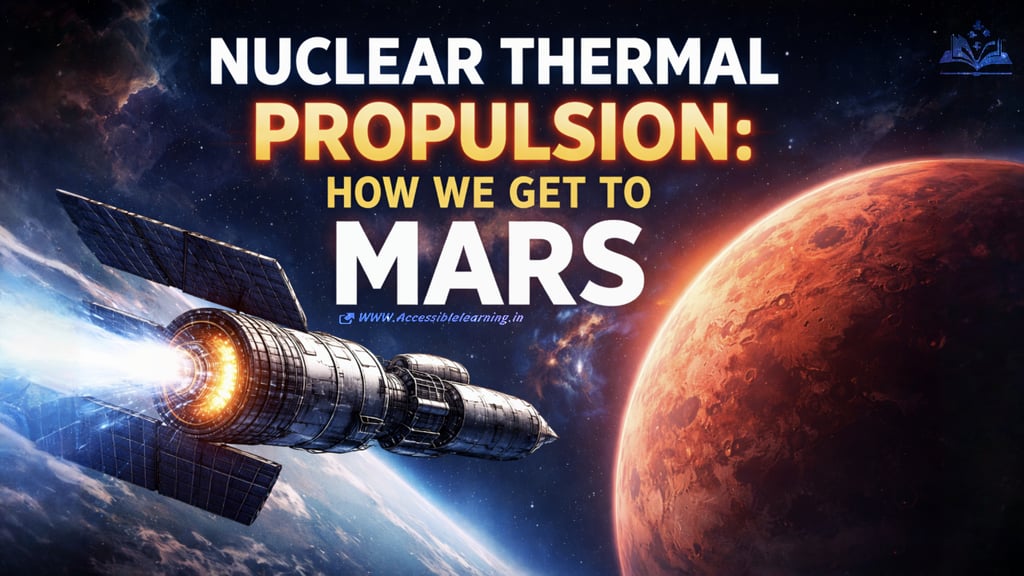
Getting humans to Mars isn’t just about building bigger rockets. The real challenge is time, efficiency, safety, and mission sustainability. Traditional chemical rockets can take 6–9 months to reach Mars, exposing astronauts to radiation, microgravity damage, and long-duration operational risks.
This is where Nuclear Thermal Propulsion (NTP) becomes a serious contender. It offers a practical path to faster interplanetary travel while improving mission flexibility and long-term feasibility.
What Is Nuclear Thermal Propulsion?
At its core, Nuclear Thermal Propulsion replaces chemical combustion with nuclear heat generated through fission.
Here’s how it works in simple terms:
A compact nuclear reactor splits uranium atoms (fission)
This produces extremely high heat (over 2,500 K)
Liquid hydrogen is pumped through the reactor core
The hydrogen heats up and expands rapidly
It is expelled through a nozzle to generate thrust
Unlike chemical rockets, NTP doesn’t rely on burning fuel with oxygen. Instead, it uses pure thermal energy, which is far more efficient.
Key Components of an NTP System
Understanding NTP becomes clearer when you break it into its main parts:
Nuclear Reactor Core: The heart of the system where fission occurs
Fuel Elements: Typically uranium-based materials that sustain the reaction
Hydrogen Propellant Tank: Stores super-cold liquid hydrogen
Nozzle: Converts thermal energy into thrust
Control Drums / Rods: Regulate the nuclear reaction
Radiation Shielding: Protects crew and onboard systems
Each component must operate under extreme conditions, especially high temperature and radiation exposure.
Why NTP Is a Game-Changer
1. High Specific Impulse (Efficiency Boost)
NTP systems can achieve ~850–950 seconds of specific impulse, compared to ~450 seconds for chemical rockets.
This means:
More thrust per unit of fuel
Reduced total launch mass
Better fuel economy for long missions
2. Faster Transit Times
Reducing travel time is critical for human missions.
Chemical rockets: 6–9 months
NTP-powered missions: potentially 3–4 months
Advanced mission profiles: possibly even shorter
Faster transit reduces both biological and operational risks.
3. Abort and Return Capability
One of the less-discussed advantages of NTP is mission safety flexibility.
With higher efficiency and thrust:
Spacecraft can change trajectory mid-mission
Emergency return options become more realistic
Crews are not locked into rigid flight paths
This is a major upgrade over traditional mission constraints.
4. Heavier Payload Delivery
Mars missions require massive payloads:
Habitats
Life-support systems
Surface vehicles
Scientific equipment
NTP allows:
Larger payloads per launch
Fewer launches overall
Reduced mission complexity
5. Reusability Potential
Unlike many chemical stages, NTP systems are being designed with reuse in mind.
Engines could be used across multiple missions
Long operational lifetimes are possible
Lower cost per mission over time
This aligns with the future of sustainable space infrastructure.
Real NASA and Defense Developments
Organizations like NASA and DARPA are actively pushing NTP forward.
DRACO Program
A joint NASA–DARPA initiative
Aims to test a nuclear thermal engine in orbit
Expected demonstration timeline: late 2020s
This mission will validate:
Reactor performance in space
Engine reliability
Safety protocols

Historical Background: This Isn’t New
NTP has been tested before.
Project Rover & NERVA (1950s–1970s)
Developed by NASA and the U.S. Atomic Energy Commission
Successfully tested nuclear rocket engines on Earth
Demonstrated high efficiency and performance
The program was eventually canceled due to:
Budget constraints
Shifting political priorities
Today’s NTP efforts build directly on that legacy, but with modern materials, safety systems, and computing power.
Nuclear Thermal vs Nuclear Electric Propulsion
These two technologies are often confused but serve different roles:
Nuclear Thermal Propulsion (NTP)
High thrust
Short burn times
Ideal for human missions and fast transfers
Nuclear Electric Propulsion (NEP)
Low thrust but extremely efficient
Continuous acceleration over long periods
Better suited for cargo and deep-space probes
Hybrid Approach (Future Concept)
Future missions may combine both:
NTP for fast departure and arrival
NEP for efficient cruising
Engineering Challenges
NTP is powerful, but it pushes engineering limits.
Extreme Temperatures
Reactor materials must survive thousands of degrees Kelvin
Hydrogen can erode reactor components over time
Fuel Stability
Nuclear fuel must remain stable under thermal stress
Preventing fuel degradation is critical
Hydrogen Storage
Liquid hydrogen must be kept at cryogenic temperatures
Boil-off losses must be minimized
Safety and Environmental Concerns
Launch Safety
Reactors are designed to remain inactive during launch
They only start operating once in space
Radiation Protection
Shielding systems protect astronauts
Spacecraft design ensures safe distance from the reactor
Public Perception
Nuclear launches face scrutiny
Transparent safety protocols are essential
Mission Architecture with NTP
A typical Mars mission using NTP could look like this:
Launch components into Earth orbit
Assemble spacecraft in orbit
Activate nuclear engine
Perform high-speed trans-Mars injection
Reduce travel time significantly
Use NTP again for Mars orbit insertion or return
This architecture supports modular and scalable missions.


Beyond Mars: The Bigger Impact
NTP isn’t limited to Mars missions. It could enable:
Faster missions to Jupiter and Saturn
Deep-space human exploration
Asteroid mining operations
Interplanetary cargo transport systems
In essence, NTP becomes a backbone technology for a spacefaring civilization.
Future Outlook
Over the next decade:
Ground and orbital testing will accelerate
Demonstration missions like DRACO will validate designs
Integration with human mission planning will begin
By the 2030s and beyond, NTP could shift from experimental to operational reality.
Nuclear Thermal Propulsion represents one of the most realistic ways to make human Mars missions faster, safer, and more efficient.
It offers:
High efficiency
Reduced travel time
Greater mission flexibility
Scalable deep-space capabilities
Chemical rockets opened the door to space. NTP could be what takes us deeper into it, turning Mars exploration into something practical rather than purely aspirational.
FAQ's
Q: What is Nuclear Thermal Propulsion (NTP) in simple terms?
Nuclear Thermal Propulsion is a rocket technology that uses a nuclear reactor to heat hydrogen fuel, which is then expelled to produce thrust. Instead of burning fuel like traditional rockets, it relies on nuclear energy to generate motion, making it far more efficient.
Q: How is NTP different from chemical rockets?
The key difference is the energy source:
Chemical rockets use fuel combustion (like oxygen + hydrogen)
NTP uses nuclear fission heat
This allows NTP to deliver:
Nearly 2× higher efficiency
Faster travel times
Better payload capacity
Q: How fast can Nuclear Thermal Propulsion get humans to Mars?
With current mission concepts:
Chemical rockets: ~6–9 months
NTP systems: ~3–4 months (or potentially less)
Shorter travel time significantly reduces health risks for astronauts.
Q: Is Nuclear Thermal Propulsion safe for space missions?
Yes, NTP systems are designed with strict safety measures:
Reactors remain inactive during launch
They only activate once safely in space
Shielding protects astronauts from radiation
Safety is a major focus in modern NTP development.
Q: Why is NTP important for Mars missions?
NTP solves several major challenges:
Reduces travel time
Lowers radiation exposure
Allows heavier payloads
Provides more mission flexibility
It makes human Mars missions more practical and sustainable.
Q: What fuel does Nuclear Thermal Propulsion use?
NTP typically uses:
Liquid hydrogen as propellant
Uranium-based fuel inside the reactor
Hydrogen is ideal because it becomes extremely efficient when heated to high temperatures.
Q: What is the current status of NTP development?
Organizations like NASA and DARPA are actively developing NTP systems.
Projects like DRACO aim to test nuclear-powered engines in space within this decade, moving the technology closer to real missions.
Q: What are the biggest challenges of Nuclear Thermal Propulsion?
Some key challenges include:
Handling extremely high temperatures
Developing durable reactor materials
Managing hydrogen storage in space
Addressing regulatory and public concerns
Despite these challenges, progress is steady.
Q: Can NTP be reused for multiple missions?
Yes, many designs aim for engine reusability, which could:
Reduce long-term mission costs
Support frequent Mars missions
Enable sustainable space transport systems
Q: Is Nuclear Thermal Propulsion the future of space travel?
NTP is considered one of the most promising technologies for deep space exploration. While it may not replace all propulsion systems, it is likely to play a central role in human missions to Mars and beyond.
Subscribe To Our Newsletter
All © Copyright reserved by Accessible-Learning Hub
| Terms & Conditions
Knowledge is power. Learn with Us. 📚

