

Neurotech & Brain-Computer Interfaces (BCI): The Quiet Revolution Inside Our Minds
Explore Neurotechnology and Brain-Computer Interfaces in simple language. Learn how BCIs work, real-world uses in healthcare and creativity, hidden research trends, ethical questions, and what this technology means for our future.
HEALTH/DISEASEAI/FUTURE
Shiv Singh Rajput
2/26/20267 min read
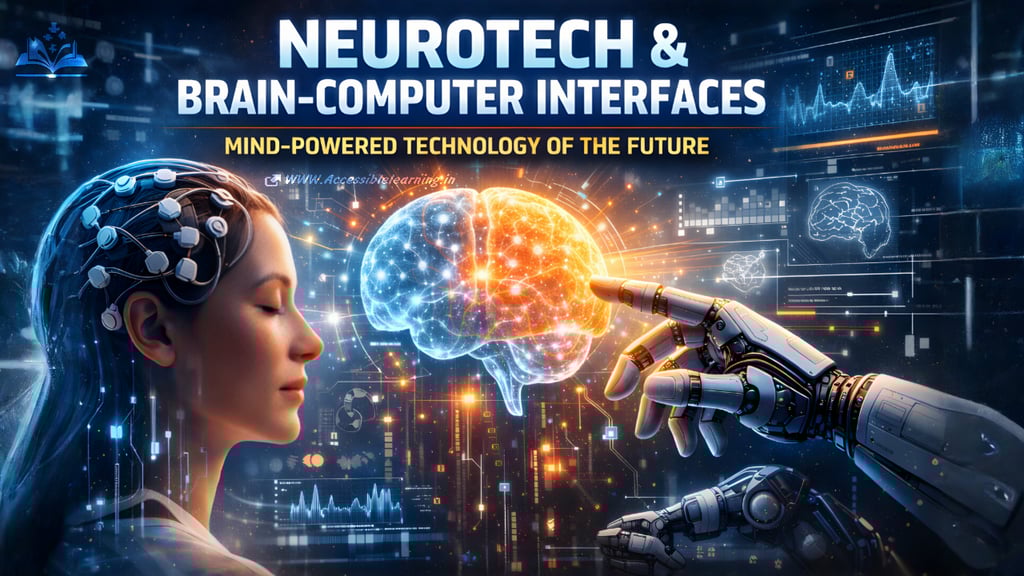
What if your thoughts could type, draw, or control machines?
This is no longer science fiction. Neurotechnology and Brain-Computer Interfaces, often called BCIs, are changing how humans interact with machines. Instead of keyboards, screens, or touch, BCIs read signals directly from the brain and translate them into action.
But this field is not just about controlling a cursor with your mind. It is about restoring movement to paralyzed patients, helping people speak after losing their voice, treating mental illnesses, and even exploring how memory and consciousness work.
Let us go deep into what BCIs really are, how they work, what most people do not know, and where this technology is quietly heading.
What is Neurotechnology?
Neurotechnology is any technology that interacts with the nervous system to measure, repair, or enhance brain function. This includes brain scans, neural implants, stimulation devices, and BCIs.
Some common examples:
EEG headsets that measure brain waves
Deep brain stimulation used for Parkinson’s disease
Neural implants helping paralyzed people move robotic arms
Consumer meditation devices that track focus levels
BCI is one important branch of neurotechnology where brain signals directly communicate with computers.
How Brain-Computer Interfaces Actually Work
A BCI system usually has four parts:
Signal Collection Sensors record brain activity. This can be done using non-invasive tools like EEG caps or invasive implants placed inside the brain.
Signal Processing Raw brain signals are messy. Algorithms clean and interpret them.
Machine Learning Translation AI models learn patterns in brain signals and convert them into commands.
Output Device The command controls a cursor, robotic arm, speech generator, or digital interface.
Think of it like teaching a computer your brain's language.
Types of BCIs (And Why They Matter)
1. Non-Invasive BCIs
These use sensors outside the skull. Example: EEG headsets.
Pros:
Safe
Affordable
Easy to use
Cons:
Lower accuracy
Slower signals
Used in gaming, meditation tracking, and early medical therapy.
2. Semi-Invasive BCIs
Sensors placed inside the skull but outside brain tissue. Example: ECoG implants.
Pros:
Better signal quality
Lower risk than deep implants
Used in research labs.
3. Invasive BCIs
Electrodes implanted directly in brain tissue. Example: Neural implants used for paralysis treatment.
Pros:
High accuracy
Real-time control
Cons:
Surgery required
Ethical concerns
This is where companies like Neuralink are working.


Real-World Applications Today
Healthcare
Paralysis patients controlling robotic arms
Speech restoration for ALS patients
Treating Parkinson’s with stimulation
Managing epilepsy
Gaming and Creativity
Thought-controlled games
Music created from brain signals
Art generated from neural patterns
Workplace Productivity
Focus tracking
Fatigue detection for pilots
Mental workload monitoring
Education
Learning systems adapting to brain engagement levels
Neurofeedback improving concentration
The Ethical Questions No One Talks About Enough
1. Who Owns Your Brain Data?
Brain signals reveal emotions, intentions, and preferences. This is more private than any password.
2. Could Thoughts Be Hacked?
If devices connect to networks, security becomes critical.
3. Will Cognitive Enhancement Create Inequality?
If some people can buy better memory or faster thinking, society may split into augmented and non-augmented groups.
4. What Happens to Free Will?
If machines influence mood or decisions, the definition of choice becomes complex.
The Future of BCIs (Next 10–20 Years)
Here are realistic predictions based on current research:
Thought-to-text typing faster than smartphones
Neural implants treating depression and anxiety
Memory prosthetics helping dementia patients
VR worlds controlled by imagination
Hands-free digital workspaces
Brain-powered prosthetic limbs that feel touch
We may also see personal neuro assistants that understand mood and focus levels in real time.
How BCIs Could Change Digital Design and Business
Since you build digital experiences, here is something interesting. Future interfaces may not have buttons or menus. They will respond to intention, emotion, and attention.
Designers will need to think about
Emotional UX
Cognitive load design
Neural accessibility
Thought-based navigation
Prompt engineering may evolve into neural intent engineering. Your skills in UX strategy and AI workflows will fit naturally into this shift.
Risks That Engineers Are Worried About
Signal misinterpretation causing wrong actions
Device overheating or implant failure
Psychological dependency
Data leaks from neural storage
Long-term brain tissue effects
Regulation is still catching up.
How Someone Can Start Learning Neurotech Today
Study neuroscience basics
Learn signal processing
Explore machine learning
Try open-source EEG tools
Follow academic research papers
Beginner platforms include OpenBCI and EEG-based kits.
Hidden Frontiers in Neurotech That Few Articles Mention
Brain Fingerprinting
Researchers are exploring whether brain responses to known information can be used like a lie detector. This could change criminal investigations but raises privacy risks.
Dream Recording Experiments
Early lab work has reconstructed rough images from brain activity during sleep. Imagine recording dreams for therapy, creativity, or filmmaking inspiration.
Digital Memory Archives
Scientists are studying hippocampus stimulation to help store memories better. In the future, people with dementia might keep digital backups of memories that can be triggered again.
Brain-Based Identity Security
Passwords may be replaced with neural patterns unique to each person. A login could depend on your brain’s reaction to specific images or sounds.
Emotional AI Interfaces
BCIs can detect stress, boredom, or confusion. Future apps may change layout, music, or lighting based on your emotional state.

Neurotech Startups and Research Directions to Watch
Neural dust: tiny wireless implants smaller than a grain of sand
Optical BCIs using light instead of electricity
Non-invasive ultrasound brain stimulation
Hybrid AI + BCI systems for creativity tools
Brain-controlled exoskeletons for rehabilitation
Thought-powered language translation for speech-impaired people
These are not widely known outside research circles, but many are already in the prototype stage.
Neurotech in India: The Quiet Growth
India is slowly entering neurotech through IIT research labs, AI startups, and hospital collaborations. Affordable EEG kits are being used for autism therapy, meditation tech, and mental health research.
There is also huge potential in rural healthcare, where BCI-based diagnostics could detect epilepsy or stroke risks early without expensive scans.
For creators and developers in India, this is an opportunity to build culturally relevant neuro apps for meditation, language learning, and spiritual training tools rooted in Indian traditions.
How BCIs Could Change Creativity and Storytelling
For writers and designers like you, this is exciting. Future creative workflows might include:
Sketching scenes directly from imagination
Generating music from emotional states
Editing video timelines using attention signals
Writing scripts with thought-to-text drafts
Measuring audience emotional reaction in real time
Imagine showing Carolina Pizano Wagner a brand concept where her emotional response shapes the design live. That level of personalization may become normal.
The Real Barriers Slowing Neurotech Down
Battery technology for implants
Long-term biocompatibility of electrodes
Signal noise and calibration time
Cost of clinical trials
Lack of global regulation standards
Public fear from sci-fi misconceptions
Most breakthroughs are limited not by ideas, but by materials science and ethics approval processes.
What Skills Will Matter in the Neurotech Era
Neuroscience basics
Human-centered UX design
Signal processing
Embedded hardware design
Ethical tech policy understanding
AI model training with biological data
Designers who understand emotion and cognition will be in high demand.
BCIs are not about replacing humans with machines. They are about extending human capability and healing limitations. The real story is not the hardware. It is the question this technology forces us to ask:
What does it mean to be human when thoughts can become actions instantly?
The next big interface is not a screen. It is the mind itself.

FAQ's
Q: What is a Brain-Computer Interface in simple words?
A Brain-Computer Interface is a system that reads signals from the brain and turns them into commands for a computer or machine. Instead of using a keyboard or mouse, you use your thoughts.
Q: Are Brain-Computer Interfaces safe?
Most non-invasive BCIs like EEG headsets are safe and already used in research and therapy. Invasive BCIs require surgery, so they are tested carefully and used only in medical situations. Long-term safety is still being studied.
Q: Can BCIs read my thoughts?
No. BCIs cannot read complex thoughts like memories or secrets. They only detect specific patterns, such as moving a cursor left or right, imagining speech, or focusing on a task. This is one of the biggest myths about neurotech.
Q: What diseases can BCIs help treat?
BCIs are being used or tested for:
Paralysis recovery
ALS communication support
Parkinson’s disease
Epilepsy monitoring
Stroke rehabilitation
Depression and anxiety therapy
In the future, they may also help dementia patients restore memory.
Q: Are there BCI devices available for consumers?
Yes, but limited. Consumer EEG headsets exist for meditation tracking, gaming, and focus training. Medical BCIs are still mostly used in hospitals and research labs.
Q: How accurate are Brain-Computer Interfaces?
Non-invasive BCIs have moderate accuracy. Invasive BCIs are more accurate because they read signals directly from brain tissue. AI improvements are increasing accuracy every year.
Q: Can BCIs help people speak again?
Yes. Researchers have built BCIs that translate brain signals into synthetic speech. Some patients who lost speech after stroke or ALS can now communicate again. This is one of the most powerful real-world uses of neurotech.
Q: What companies are working on BCIs?
Major companies and research groups are working on neurotech, including medical labs, startups, and large tech companies exploring neural interfaces.
Most breakthroughs still come from universities and hospitals rather than big tech.
Q: Will Brain-Computer Interfaces replace smartphones?
Not completely. In the future, BCIs may work together with phones, AR glasses, and computers. You might type messages with thoughts but still use screens for visuals.
Q: Is neurotech expensive?
Right now, medical BCIs are costly due to surgery and research costs. Consumer EEG devices are becoming affordable. As technology improves, prices will drop. Just like smartphones became cheaper over time.
Q: What are the biggest ethical concerns in neurotechnology?
Important concerns include:
Brain data privacy
Thought manipulation risks
Security and hacking
Cognitive inequality
Consent in medical use
Neurotech laws are still developing worldwide.
Q: How can someone start learning about neurotechnology?
You can begin with:
Basic neuroscience courses
Signal processing tutorials
Machine learning fundamentals
Open-source EEG projects
Research papers and online lectures
For someone like you working in digital design and AI workflows, neurotech UX design will be a powerful future skill.
Q: Can BCIs improve memory or intelligence?
Research is exploring memory enhancement through brain stimulation, but safe and reliable intelligence boosting is not available yet. Most work focuses on medical recovery.
Q: Will BCIs be common in the next 10 years?
Yes, especially in healthcare and accessibility tools. Thought-to-text typing, prosthetic control, and mental health monitoring are likely to become more common.
Full brain implants for everyday people will take longer.
Q: What is the future of Brain-Computer Interfaces?
The future may include:
Silent communication systems
Brain-controlled prosthetics with touch feedback
Thought-based digital design tools
Emotion-aware apps
Memory support devices
BCIs will slowly become part of normal technology, just like smartphones once did.
Q: Can BCIs connect brains directly to the internet?
Not in the way science fiction shows. BCIs can connect brain signals to computers, but direct internet-brain connection with full data access is far from reality.
Subscribe to Frontier Intelligence
All © Copyright reserved by Accessible-Learning Hub
| Terms & Conditions
Accessible Learning Hub — Actionable clarity for high-agency minds.
Weekly breakdowns on AI breakthroughs, capital flow, and human performance systems. Zero fluff.