

Neuro-Inclusive AI: Designing for ADHD and Dyslexia!
Discover how neuro-inclusive AI is transforming learning for ADHD and dyslexia by adapting content into visual maps, micro-lessons, audio experiences, and personalized learning pathways that reduce cognitive load and improve comprehension.
ACCESSIBLE LEARNINGBIOTECH & HEALTH SCIENCES
Sachin K Chaurasiya | Kim Shin
6/3/20269 min read
For decades, educational systems, workplace training, and professional documentation have followed a simple assumption: everyone learns best from the same format.
A textbook chapter, a PDF manual, a legal document, or a technical guide was typically created once and distributed to everyone equally. While this approach made information scalable, it rarely made it accessible.
For millions of people with ADHD, dyslexia, and other neurodivergent cognitive styles, traditional learning materials often create barriers rather than opportunities. Dense paragraphs, long explanations, overwhelming page layouts, and rigid content structures can increase cognitive load and reduce comprehension.
The emergence of generative AI is changing that reality. Instead of forcing people to adapt to information, AI is beginning to adapt information to people.
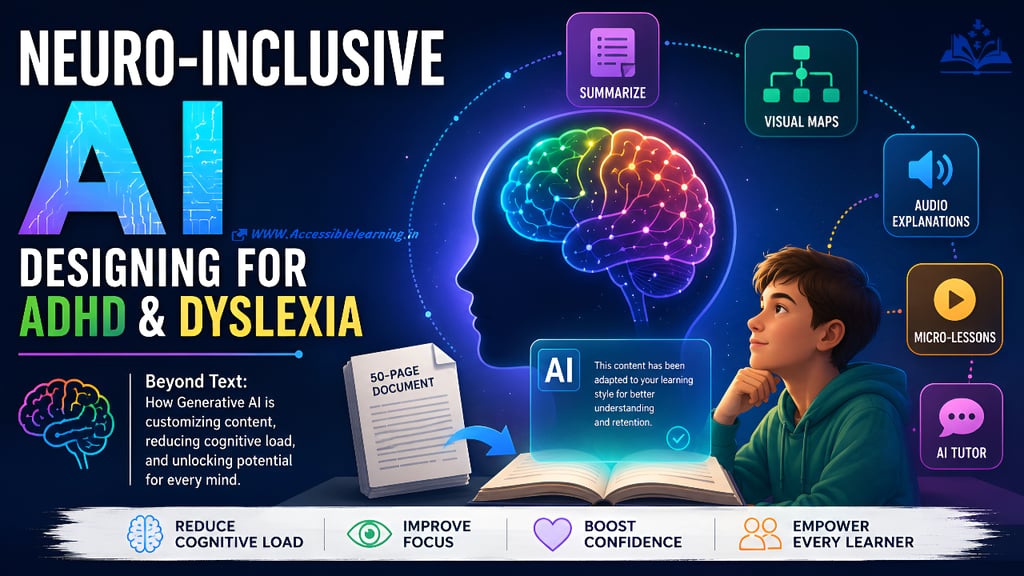
Modern AI systems can instantly transform a 50-page technical report into visual maps, bite-sized lessons, interactive conversations, audio explanations, personalized summaries, and cognitive-friendly learning pathways. This shift represents one of the most important developments in educational technology and accessibility.
The future of learning may not be about creating better content. It may be about creating content that continuously reshapes itself around the learner.
What Is Neuro-Inclusive AI?
Neuro-inclusive AI refers to artificial intelligence systems designed to support different cognitive processing styles rather than assuming a single "standard" way of learning.
These systems recognize that individuals process information differently based on factors such as:
Attention regulation
Reading speed
Working memory capacity
Information retention patterns
Language processing abilities
Executive functioning skills
Visual-spatial learning preferences
Instead of delivering identical content to every user, neuro-inclusive AI dynamically adjusts presentation, complexity, structure, pacing, and interaction style. The goal is not to simplify information. The goal is to make information more accessible without reducing its value.
Why Traditional Content Often Fails Neurodivergent Learners
Most educational and professional content was developed around neurotypical reading behaviors. A typical document may include:
Long paragraphs
Complex sentence structures
Minimal visual support
Large information blocks
Few memory checkpoints
Limited personalization
For many learners with ADHD or dyslexia, these design choices create significant friction.
Challenges for ADHD Learners
Individuals with ADHD often experience difficulties with:
Sustained attention
Task initiation
Information overload
Working memory management
Maintaining focus during long reading sessions
A lengthy document may contain valuable information, but cognitive fatigue can prevent effective engagement. Important concepts become buried inside large text blocks, causing attention to drift before learning occurs.

Challenges for Dyslexic Learners
People with dyslexia may encounter challenges involving:
Decoding written language
Reading fluency
Processing speed
Text-heavy interfaces
Dense typography
The issue is not intelligence. Research consistently shows that dyslexia affects language processing rather than intellectual capability. Unfortunately, traditional educational materials often measure reading speed instead of understanding. This creates unnecessary barriers to learning.
How Generative AI Reduces Cognitive Load
Cognitive load refers to the amount of mental effort required to process information.
When cognitive load becomes excessive, learning efficiency drops dramatically.
Generative AI helps by restructuring information into formats that reduce unnecessary mental strain.
Instead of presenting content in a single fixed form, AI can generate multiple versions tailored to different cognitive needs.
AI-Powered Content Chunking
One of the most powerful applications of neuro-inclusive AI is intelligent content chunking. Imagine a 50-page legal contract. Traditionally, a reader must process the entire document sequentially. An AI system can instantly transform the same material into the following:
Version 1: Executive Summary
A one-page overview highlighting key concepts.
Version 2: Micro-Lessons
Short learning segments lasting two to three minutes each.
Version 3: Question-Based Navigation
Users explore information through natural language questions.
Version 4: Interactive Learning Path
Each section unlocks progressively as understanding improves.
The information remains unchanged.
The delivery becomes personalized.
From Dense Documents to Visual Knowledge Maps
Visual thinking is often a powerful strength among neurodivergent individuals. Generative AI can convert text-heavy material into:
Interactive node maps
Relationship diagrams
Flowcharts
Concept trees
Mind maps
Visual timelines
Decision pathways
Instead of reading 20 pages explaining interconnected concepts, learners can explore a visual representation that highlights relationships instantly.
This approach reduces working memory demands and improves knowledge retention. For ADHD learners especially, visual navigation can provide continuous engagement while reducing attention fatigue.
Personalized Reading Experiences
Modern AI systems can adjust reading environments in real time. Examples include:
Adaptive Text Density
AI can shorten paragraphs without removing meaning.
Dynamic Formatting
Important concepts can be highlighted automatically.
Contextual Summaries
Users receive summaries at natural stopping points.
Vocabulary Assistance
Complex terminology is explained instantly.
Progressive Disclosure
Information appears gradually instead of all at once. This creates a more manageable reading experience for users who struggle with overwhelming information density.
Audio-First Learning and Neurodiversity
One of the most promising developments is the rise of audio-first educational experiences. Many neurodivergent learners process information more effectively through listening than through traditional reading.
Generative AI can transform any document into:
Natural-sounding narration
Conversational podcasts
Interactive audio lessons
Personalized tutoring sessions
Voice-based explanations
Instead of spending an hour decoding dense text, a learner can absorb information while walking, exercising, or engaging in another activity. This flexibility supports different attention styles and learning preferences.
AI-Powered Learning Companions
Traditional educational materials are static. AI learning assistants are interactive.
A learner can ask:
"Explain this in simpler language."
"Turn this into bullet points."
"Give me an example."
"Create a quiz."
"Show me visually."
"Explain it like I'm a beginner."
The content instantly adapts. This creates a personalized educational environment that was previously impossible to scale. Every learner effectively gains access to a customized tutor.


AI and Dyslexia-Friendly Design
Generative AI is also transforming accessibility for dyslexic users. Capabilities include:
Alternative Text Presentation
Content can be rewritten using clearer sentence structures.
Reading-Level Adaptation
Material can be adjusted without losing core meaning.
Speech Integration
Users can switch between reading and listening instantly.
Visual Reinforcement
Concepts can be paired with diagrams and illustrations.
Multimodal Learning
Information can be delivered simultaneously through text, audio, and visual channels.
This creates multiple pathways for understanding.
The Shift From Universal Design to Adaptive Design
Traditional accessibility focused on universal design. The goal was to create one format that works reasonably well for everyone. AI introduces a new model. Adaptive design.
Instead of building one version of content, AI creates personalized versions on demand. Two learners may receive entirely different presentations of the same information while achieving identical learning outcomes.
This represents a fundamental shift in educational philosophy. Accessibility becomes dynamic rather than static.
Workplace Applications of Neuro-Inclusive AI
The benefits extend far beyond education. Organizations are beginning to use neuro-inclusive AI for:
Employee onboarding
Compliance training
Technical documentation
Corporate knowledge management
Professional development
A complex policy document can become
Interactive summaries
Visual workflows
Audio briefings
Step-by-step guidance
Role-specific learning modules
This improves accessibility for all employees, not just neurodivergent individuals.
Ethical Considerations and Challenges
Despite its potential, neuro-inclusive AI must be developed responsibly. Key concerns include:
Over-Personalization
Excessive simplification may reduce opportunities for cognitive growth.
Privacy Risks
Adaptive systems require data about user preferences and behaviors.
Algorithmic Bias
AI models may make inaccurate assumptions about learning needs.
Dependence on Automation
Users should retain opportunities to develop independent learning skills.
Effective neuro-inclusive design balances support with autonomy.
The Future of Personalized Learning
The next generation of AI systems will likely move beyond adapting content. They may adapt entire learning experiences. Future platforms could:
Detect cognitive overload in real time
Adjust lesson complexity automatically
Generate personalized study plans
Recommend optimal learning formats
Create individualized knowledge pathways
Support multiple neurodivergent profiles simultaneously
Learning will become less about consuming information and more about interacting with information in ways that align with individual cognitive strengths.
Neuro-inclusive AI represents a major evolution in how information is created, delivered, and experienced.
For people with ADHD, dyslexia, and other neurodivergent cognitive styles, the challenge has never been a lack of intelligence or curiosity. The challenge has often been the mismatch between how information is presented and how their minds process it.
Generative AI offers a solution that previous educational technologies could not achieve.
By transforming dense documents into visual maps, converting complex subjects into micro-lessons, generating audio-first experiences, and adapting content in real time, AI is reducing unnecessary cognitive barriers and making knowledge more accessible.
The most important breakthrough is not that AI can generate content. It is that AI can reshape content around the learner.
As neuroinclusive design becomes a core principle of educational technology, the future of learning will be defined not by one-size-fits-all materials but by experiences that adapt to the unique ways people think, focus, understand, and remember.

FAQs
Q: What is neuro-inclusive AI?
Neuro-inclusive AI refers to artificial intelligence systems designed to support different cognitive styles and learning needs, including those of people with ADHD, dyslexia, autism, and other forms of neurodiversity. These systems adapt content, pacing, format, and presentation to make information easier to understand and retain.
Q: How does AI help people with ADHD learn more effectively?
AI can help individuals with ADHD by breaking complex information into smaller chunks, creating interactive learning experiences, generating summaries, providing reminders, and reducing cognitive overload. It can also personalize learning pathways based on attention patterns and engagement levels.
Q: Can AI improve learning outcomes for people with dyslexia?
Yes. AI can convert text into audio, simplify complex language, adjust reading difficulty, create visual explanations, and provide multimodal learning experiences. These features help dyslexic learners access information through methods that better match their strengths.
Q: What is cognitive load, and why is it important?
Cognitive load refers to the amount of mental effort required to process information. High cognitive load can reduce comprehension and memory retention. Neuro-inclusive AI helps manage cognitive load by restructuring information into more digestible and accessible formats.
Q: How does generative AI personalize educational content?
Generative AI analyzes content and can automatically transform it into summaries, mind maps, flashcards, quizzes, visual diagrams, audio lessons, or step-by-step explanations. This allows learners to choose the format that best suits their cognitive preferences.
Q: Can AI convert long documents into easier learning formats?
Yes. Modern AI tools can transform lengthy reports, legal documents, technical manuals, and academic papers into concise summaries, visual knowledge maps, micro-learning modules, interactive lessons, and audio explanations.
Q: What are AI-generated micro-lessons?
Micro-lessons are short, focused learning units that cover one concept at a time. AI can automatically break large topics into smaller segments, making learning more manageable and improving knowledge retention for neurodivergent learners.
Q: How do visual knowledge maps support neurodivergent learners?
Visual knowledge maps display relationships between concepts through diagrams, nodes, and connections. They help learners understand complex information faster by reducing the need to process large amounts of text and supporting visual thinking patterns.
Q: Is neuro-inclusive AI only useful for people with ADHD and dyslexia?
No. While it provides significant benefits for neurodivergent individuals, neuro-inclusive AI can improve learning experiences for everyone by offering personalized content formats, flexible pacing, and better accessibility.
Q: What role does audio-first learning play in neuro-inclusive education?
Audio-first learning allows users to consume information through listening instead of reading. AI can convert text into natural speech, podcasts, and conversational explanations, making learning more accessible for individuals who process auditory information more effectively.
Q: Can AI act as a personalized learning assistant?
Yes. AI-powered learning assistants can answer questions, explain concepts in different ways, generate practice exercises, create study plans, and adapt explanations based on a learner's understanding and preferences.
Q: How does neuro-inclusive AI support executive functioning challenges?
AI can assist with planning, prioritization, task management, scheduling, progress tracking, and breaking large projects into smaller actionable steps. These features are especially helpful for individuals who struggle with executive function skills.
Q: What industries are using neuro-inclusive AI?
Neuro-inclusive AI is being adopted across education, corporate training, healthcare, workforce development, legal services, government learning programs, and professional certification platforms.
Q: Are there ethical concerns surrounding neuro-inclusive AI?
Yes. Key concerns include user privacy, data security, algorithmic bias, over-personalization, accessibility standards, and ensuring that AI supports learning rather than creating dependency on automated assistance.
Q: How is neuro-inclusive AI different from traditional accessibility tools?
Traditional accessibility tools typically provide fixed accommodations. Neuro-inclusive AI continuously adapts content in real time based on user needs, preferences, and learning behaviors, creating a more personalized and dynamic experience.
Q: Can AI create learning materials in multiple formats simultaneously?
Yes. A single piece of content can be transformed into text summaries, audio lessons, flashcards, quizzes, visual diagrams, timelines, mind maps, and interactive tutorials, allowing learners to choose their preferred format.
Q: What are the benefits of adaptive learning powered by AI?
Adaptive learning can improve engagement, comprehension, retention, accessibility, learning speed, and learner confidence by delivering information in the most effective format for each individual.
Q: Will neuro-inclusive AI replace teachers and educators?
No. Neuro-inclusive AI is designed to enhance teaching, not replace it. It serves as a support tool that helps educators provide more personalized learning experiences while allowing them to focus on mentorship, guidance, and human interaction.
Q: What is the future of neuro-inclusive AI in education?
Future AI systems may detect cognitive overload, adjust lesson complexity in real time, create individualized learning journeys, and provide highly personalized educational experiences tailored to each learner's strengths and challenges.
Q: Why is neuro-inclusive AI becoming important in modern education?
As awareness of neurodiversity grows, educators and organizations recognize that one-size-fits-all learning models are ineffective for many learners. Neuro-inclusive AI offers scalable personalization, helping create more equitable, accessible, and effective learning environments for everyone.
Q: How can AI help students with ADHD study better?
AI helps students with ADHD by creating structured study plans, shortening lengthy content, generating summaries, providing focus-friendly learning modules, and reducing information overload through personalized content delivery.
Q: What are the best AI tools for dyslexia support?
The most effective AI tools for dyslexia typically include text-to-speech systems, AI reading assistants, visual learning generators, adaptive content platforms, and writing support tools that simplify language while preserving meaning.
Q: Can generative AI reduce cognitive overload?
Yes. Generative AI can reduce cognitive overload by organizing information into smaller, easier-to-process segments, using visuals, audio explanations, and interactive learning formats that match individual cognitive preferences.
Q: How does AI create personalized learning experiences?
AI analyzes learning behaviors, preferences, and performance patterns to generate customized explanations, study materials, quizzes, summaries, and learning paths tailored to each user's needs.
Q: What is the connection between neurodiversity and AI-powered education?
AI-powered education enables personalized learning experiences that accommodate diverse cognitive styles, making educational content more accessible and effective for neurodivergent learners while benefiting all students through adaptive learning technologies.
Subscribe to Frontier Intelligence
All © Copyright reserved by Accessible-Learning Hub
| Terms & Conditions
Accessible Learning Hub — Actionable clarity for high-agency minds.
Weekly breakdowns on AI breakthroughs, capital flow, and human performance systems. Zero fluff.