

Neural Audio Compression: The Technology Powering Scalable AI Voice Streaming
Discover how neural audio compression cuts AI voice storage costs by up to 90%, improves streaming efficiency, and powers the future of scalable speech platforms.
ARTIFICIAL INTELLIGENCE & FUTURE TECH
Sachin K Chaurasiya | Lin Yue
7/16/20266 min read
At 3:17 AM, an AI audiobook platform crashes under peak demand. Millions of listeners lose access. Cloud costs explode overnight. Emergency engineers discover the real problem isn't the text-to-speech model. It isn't the CDN. It isn't the network.
The company still stores and streams AI-generated narration using technology designed decades before generative AI existed.
Executives spent millions training voice models while ignoring the infrastructure responsible for delivering them. Every new audiobook, tutor session, and AI assistant response multiplied storage requirements until the platform reached an economic breaking point.
This isn't a hypothetical future. It is the next operational crisis waiting for organizations that build AI voice products on legacy audio pipelines.
Neural audio compression has become one of the most important technologies in modern AI infrastructure, yet many companies continue treating audio as an afterthought.
Traditional Audio Codecs Are Becoming a Financial Liability
MP3 transformed digital music. Opus revolutionized internet communication. Both remain engineering achievements.
Neither was designed for an ecosystem producing millions of hours of synthetic speech every month. Generative AI changes the economics completely.
An AI tutoring platform might generate personalized lessons for every student. A publishing company can release thousands of AI-narrated audiobooks every week. Customer service platforms now create voice conversations around the clock.
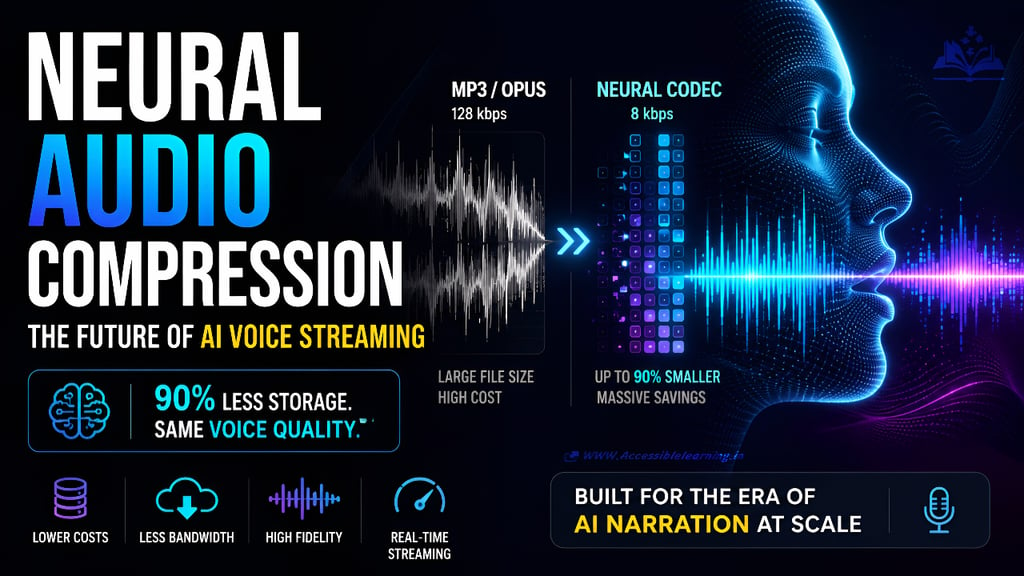
Traditional codecs compress waveforms. Neural codecs compress information. That distinction changes everything.
Instead of preserving every acoustic detail through conventional signal processing, neural audio codecs encode speech into compact mathematical representations known as discrete tokens. AI reconstructs the waveform during playback.
The result delivers dramatic bandwidth reductions without destroying natural speech quality.
A studio-quality 44.1 kHz voice recording that once demanded dozens or even hundreds of kilobits per second can often stream at roughly 8 kbps using modern neural codecs while preserving remarkably natural narration.
That difference compounds across petabytes of storage.
AI Voice Platforms Face an Explosion of Audio Data
Every successful AI voice product eventually collides with infrastructure reality. Storage grows faster than expected. Bandwidth bills increase every quarter. Cache efficiency drops. Backup windows expand. Disaster recovery becomes more expensive.
Most executives obsess over inference costs while ignoring the infrastructure delivering the generated content. That creates an expensive illusion. Generating speech represents only one stage of the pipeline.
Organizations must also:
Store generated narration
Replicate files across regions
Stream content globally
Archive historical recordings
Deliver low-latency playback
Maintain redundancy for disaster recovery
Each duplicated audio file multiplies operational costs. Neural compression attacks the largest recurring expense instead of chasing tiny optimization gains elsewhere.
Neural Audio Codecs Rewrite the Economics of Streaming
Modern neural codecs replace decades-old assumptions about compression.
Instead of relying exclusively on psychoacoustic models like MP3 or Opus, neural codecs learn efficient representations directly from massive speech datasets.
Models such as Descript Audio Codec (DAC) and Google's Lyra v2 demonstrate what modern AI-driven compression can achieve for speech-heavy applications.
These systems transform audio into compact latent representations before reconstructing high-quality output during decoding. The advantages extend far beyond smaller file sizes.
Organizations gain:
Dramatically lower storage requirements
Lower CDN bandwidth consumption
Faster global streaming
Reduced cloud infrastructure spending
Better scalability for AI narration
Lower latency on constrained mobile networks
For platforms distributing thousands of hours of AI narration every day, infrastructure savings quickly reach millions of dollars annually. Ignoring those savings becomes a leadership failure, not merely a technical oversight.

Cloud Bills Reveal the Truth Nobody Wants to Discuss
Many executives proudly announce new AI voice features while finance teams quietly panic over storage invoices.
Cloud providers charge for nearly everything:
Object storage
Replication
Egress bandwidth
Backup retention
Regional redundancy
CDN delivery
Audio files remain online for years.
Every audiobook chapter.
Every tutoring session.
Every personalized lesson.
Every generated podcast.
Every archived conversation.
Traditional codecs force organizations to carry unnecessary operational weight forever. Neural compression reduces that burden before it reaches production scale.
Some deployments report storage reductions approaching 90% for speech-centric workloads while maintaining voice quality that listeners perceive as virtually unchanged. Those numbers reshape infrastructure budgets.
Legacy Audio Pipelines Create Tomorrow's Outages
Most engineering disasters never begin with catastrophic software bugs. They begin with reasonable decisions that nobody revisits. An organization launches using MP3 because every device supports it.
Traffic doubles.
Then doubles again.
AI narration replaces human recording.
Storage grows exponentially.
Bandwidth consumption overwhelms projections.
Caching strategies collapse under scale.
Emergency migrations begin after costs spiral out of control.
Every rushed migration introduces operational risk.
Every compatibility layer increases complexity.
Every temporary workaround becomes permanent technical debt.
Eventually the infrastructure becomes too fragile to evolve.
The crisis appears sudden.
The negligence happened years earlier.
The 3 Biggest Warning Signs of Lethal Technical Debt
Organizations heading toward infrastructure failure usually display the same warning signs:
Storage grows faster than customer growth. If audio storage expands exponentially while user growth remains linear, the architecture wastes resources instead of scaling efficiently.
Engineers optimize servers instead of file formats. Teams spend months tuning databases, CDNs, and caching while ignoring outdated compression methods that create the majority of infrastructure costs.
Leadership measures AI quality but ignores delivery efficiency. Executives celebrate better voice models while infrastructure spending quietly consumes margins until profitability disappears.
None of these warning signs solve themselves. Ignoring them guarantees larger failures later.
Voice Fidelity Still Determines Customer Trust
Compression alone means nothing if customers hear robotic artifacts. Early low-bitrate codecs often sacrificed clarity for efficiency. Neural codecs changed that equation.
Modern systems reconstruct speech with remarkable naturalness because neural decoders learn how human voices behave instead of preserving every waveform sample literally.
Listeners judge emotion, pronunciation, pacing, and realism. They rarely evaluate raw bitrate.
If an audiobook sounds natural at a fraction of previous bandwidth requirements, the infrastructure wins without degrading the experience. That combination transforms neural compression from an engineering curiosity into a business advantage.
The Next AI Arms Race Will Focus on Infrastructure
The AI industry loves discussing larger language models. Investors celebrate parameter counts. Marketing departments advertise smarter assistants. Meanwhile, infrastructure determines whether those products remain profitable.
Every improvement in voice generation increases demand for storage and streaming. Without efficient compression, success becomes financially dangerous.
Organizations that modernize early will deliver more content for lower cost while competitors burn cash maintaining obsolete pipelines.
This pattern repeats throughout technology history.
Superior infrastructure rarely receives headlines.
It usually wins markets anyway.


Companies That Ignore Neural Compression Will Pay the Price
AI voice generation no longer represents the hard part. Delivering billions of minutes of narration efficiently has become the real engineering challenge. Organizations still relying exclusively on legacy codecs risk turning operational success into financial disaster.
Neural audio compression offers a direct response to exploding storage costs, bandwidth demands, and cloud spending. Executives who dismiss it as an optimization project misunderstand the economics of AI.
Infrastructure always determines scale.
Architecture always determines profitability.
And technical debt always collects interest.
Companies that modernize their audio pipelines today will stream more content, spend less money, and expand faster. Companies that refuse will eventually discover the same lesson every failed infrastructure strategy teaches.
Technology does not reward nostalgia.
It rewards architecture built for the future.
FAQ's
Q: What is neural audio compression?
Neural audio compression uses AI models to encode audio into compact mathematical tokens instead of traditional waveform compression. This approach dramatically reduces file sizes while preserving natural voice quality, making it ideal for AI-generated speech, audiobooks, and voice assistants.
Q: How is a neural audio codec different from MP3 or Opus?
Traditional codecs like MP3 and Opus rely on signal processing and psychoacoustic models. Neural audio codecs use deep learning to reconstruct speech from compressed representations, enabling much lower bitrates with higher voice fidelity for AI narration.
Q: Why is neural audio compression important for AI voice applications?
AI platforms generate massive amounts of voice content every day. Neural compression lowers storage requirements, reduces bandwidth usage, speeds up streaming, and cuts cloud infrastructure costs, making large-scale AI voice services more profitable and scalable.
Q: Which neural audio codecs are leading the industry?
Some of the most recognized neural audio codecs include Descript Audio Codec (DAC), Google Lyra v2, SoundStream, and EnCodec by Meta. Each targets efficient, high-quality speech and audio compression for modern AI applications.
Q: How much can neural audio compression reduce cloud storage costs?
For speech-heavy workloads such as AI audiobooks, virtual tutors, and voice assistants, neural audio compression can reduce storage and streaming bandwidth requirements by up to 90%, depending on the codec, bitrate, and deployment architecture.
Q: Does neural audio compression reduce voice quality?
Modern neural codecs are designed to preserve natural speech, emotion, and clarity even at extremely low bitrates. In many AI narration use cases, listeners notice little to no difference compared to much larger traditional audio files.
Q: What industries benefit most from neural audio compression?
Industries that generate or stream large volumes of speech benefit the most, including AI audiobook platforms, e-learning providers, customer support automation, podcast hosting, media streaming services, virtual assistants, accessibility tools, and conversational AI platforms.
Subscribe to Frontier Intelligence
All © Copyright reserved by Accessible-Learning Hub
| Terms & Conditions
Accessible Learning Hub — Actionable clarity for high-agency minds.
Weekly breakdowns on AI breakthroughs, capital flow, and human performance systems. Zero fluff.