

Neural Audio Compression: The New Standard for Automated Audiobook Channels
Discover how neural audio codecs and AI audio compression enable studio-quality audiobooks, lower bandwidth costs, and scalable audiobook automation.
A LEARNINGAI/FUTUREARTIST/CREATIVITYDIGITAL MARKETING
Sachin K Chaurasiya
6/20/20267 min read
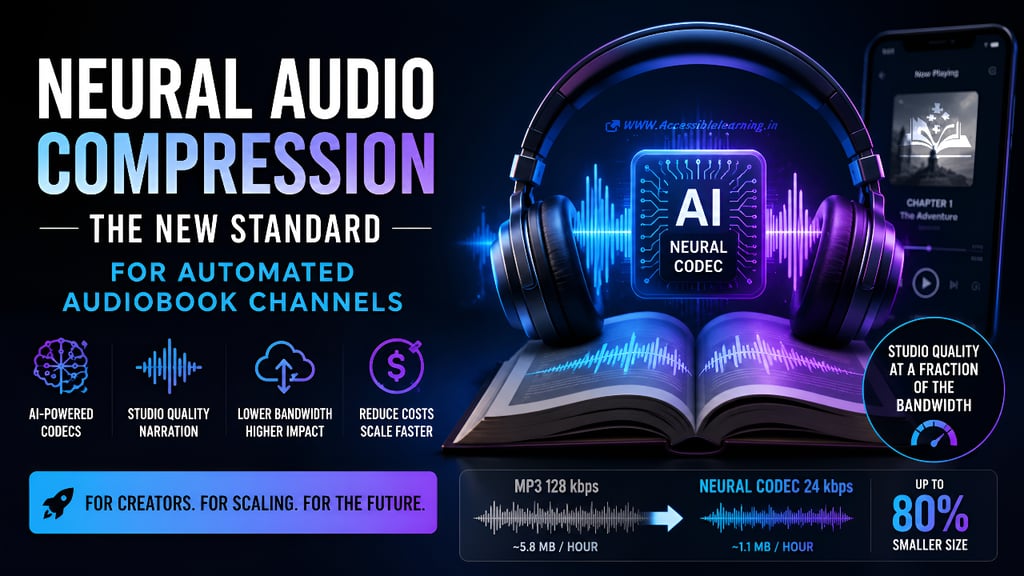
Forget MP3: How Neural Codecs Deliver Studio-Quality Narration at a Fraction of the Bandwidth
The audiobook industry is experiencing a fundamental shift. For decades, audio distribution relied on formats such as MP3, AAC, and other traditional compression methods that balanced sound quality against file size. While these formats helped digital audio scale globally, they are increasingly becoming a bottleneck for creators managing large libraries of AI-generated narration.
Today, neural audio codecs are redefining what is possible. Powered by machine learning, these advanced compression systems can preserve speech quality while dramatically reducing bandwidth requirements. For creators running automated audiobook channels, AI-narrated podcast networks, and multi-voice content libraries, neural audio compression is quickly becoming the new standard.
The result is simple but transformative: higher-quality narration, faster streaming, lower storage costs, and a better listening experience for audiences regardless of their internet connection.
What Is Neural Audio Compression?
Neural audio compression uses deep learning models to encode and reconstruct audio signals more efficiently than conventional codecs.
Traditional codecs work by removing audio information that human ears are less likely to notice. This process has limitations because it relies on predefined acoustic rules.
Neural audio codecs take a completely different approach.
Instead of following fixed compression algorithms, they learn the structure of speech, music, and sound patterns from massive datasets. During compression, the system stores compact representations of audio rather than raw waveform information. During playback, a neural decoder reconstructs the sound with remarkable accuracy.
This approach allows neural codecs to achieve significantly lower bitrates while maintaining clarity that often rivals much larger audio files.
In practical terms:
Smaller files
Faster downloads
Lower hosting costs
Better streaming performance
More efficient audiobook automation
For creators handling thousands of hours of AI-generated content, these benefits are impossible to ignore.
Why MP3 Is No Longer Enough
MP3 changed digital audio forever, but it was designed in a very different technological era. Modern audiobook channels face challenges that MP3 was never built to solve:
Massive AI-generated content libraries
Multi-language narration
Multiple voice variants
Personalized audio experiences
Global mobile-first audiences
Continuous content generation pipelines
An automated audiobook channel may generate hundreds of hours of narration every week. Storing every file as a high-quality MP3 quickly becomes expensive.
Even worse, listeners increasingly expect instant playback on mobile devices with varying network conditions. Traditional compression creates a difficult tradeoff:
Lower bitrate means lower quality.
Higher quality means larger files.
Neural codecs dramatically reduce this compromise by preserving intelligibility and naturalness at much lower bitrates.
How Neural Audio Codecs Work
Understanding the technology helps explain why the performance gains are so significant. A neural audio codec typically consists of three core stages:
1. Audio Analysis
The model examines speech patterns, phonemes, intonation, rhythm, and acoustic characteristics.
Rather than storing every waveform detail, it identifies the most important information needed for reconstruction.
2. Latent Representation Encoding
The audio is transformed into compact latent representations.
These compressed representations contain far less data than the original recording.
Think of it as storing the essence of the audio instead of every individual sound wave.
3. Neural Reconstruction
A decoder model recreates the audio from the compressed representation.
Because the model understands human speech patterns, it can generate highly realistic audio while using dramatically fewer bits.
The result is a listening experience that often exceeds what listeners expect from such small file sizes.

Why Automated Audiobook Channels Need AI Audio Compression
Audiobook automation is scaling rapidly. Modern creators use AI narration systems to generate the following:
Fiction audiobooks
Non-fiction summaries
Educational content
Language-learning materials
Podcast episodes
Serialized audio stories
Without efficient compression, storage and delivery costs can grow faster than audience growth. AI audio compression solves several major operational challenges.
Lower Storage Requirements
A library containing 10,000 hours of narration can consume enormous amounts of storage.
Neural codecs can reduce storage requirements significantly while maintaining professional-quality playback.
For large-scale publishers, this translates directly into lower infrastructure costs.
Faster Content Distribution
Automated audiobook channels often publish content continuously. Smaller files mean:
Faster uploads
Faster synchronization
Quicker publishing workflows
Improved content delivery
This becomes especially valuable when multiple languages and voice variants are involved.
Improved Mobile Accessibility
Many listeners consume audiobooks while they are:
Cellular networks
Public Wi-Fi
Rural internet connections
Emerging-market mobile networks
Neural compression enables smoother playback under constrained bandwidth conditions. This expands audience reach without sacrificing listening quality.
The Connection Between AI Voice Synthesis and Compression
The rise of neural audio codecs is closely tied to advances in AI voice synthesis optimization. Modern synthetic voices have become remarkably realistic.
Many AI narration systems now generate the following:
Natural pacing
Emotional variation
Human-like intonation
Character-specific voices
Multi-speaker dialogue
However, realistic voices create larger and more complex audio outputs. Without advanced compression, storage demands rise rapidly. Neural codecs are particularly effective because they understand speech characteristics generated by modern AI narration systems.
This synergy allows creators to produce more realistic audio while maintaining efficient file sizes. As AI voice quality improves, compression technology becomes increasingly important.
Multi-Voice Audiobooks at Scale
One of the most exciting developments in audiobook automation is multi-voice production. Instead of a single narrator, AI systems can assign different voices to:
Main characters
Supporting characters
Narrators
Dialogue segments
Language versions
This dramatically improves engagement but also increases production volume.
A single audiobook may generate dozens of voice variations.
Neural audio compression makes this approach economically viable.
Creators can store and stream multiple voice versions without overwhelming infrastructure costs.
This opens the door to highly personalized listening experiences that would have been impractical using traditional codecs.
Benefits for Podcast Automation
The same advantages extend beyond audiobooks. Podcast networks increasingly use AI-generated workflows for the following:
Episode creation
News summaries
Educational programming
Audio newsletters
Content repurposing
Neural audio codecs help podcast operators:
Reduce hosting expenses
Improve streaming reliability
Accelerate distribution
Support larger archives
For channels publishing daily or hourly content, these efficiencies compound quickly.
The Role of Neural Codecs in Global Content Expansion
Global audio consumption is growing rapidly.
Creators are no longer serving a single language or region.
AI narration platforms can generate content in dozens of languages, creating unprecedented scale.
However, international growth introduces challenges:
Variable network quality
Mobile-first users
Storage constraints
Bandwidth limitations
Neural audio compression helps remove these barriers. Listeners can access high-quality narration even when internet speeds are limited. For creators targeting global audiences, this is becoming a competitive advantage rather than a technical upgrade.

Choosing the Right Audiobook Automation Tools
Not all audiobook automation tools are equally prepared for the future. When evaluating platforms, creators should look for systems that support:
Native Neural Codec Integration
Compression should be built directly into the workflow rather than added as an afterthought.
Multi-Voice Production
Support for multiple speakers enables richer audiobook experiences.
Scalable Storage Management
Large content libraries require efficient asset organization.
Adaptive Streaming
The ability to deliver audio efficiently across different connection speeds improves audience retention.
AI Voice Synthesis Optimization
High-quality voice generation and efficient compression should work together seamlessly.
The strongest platforms increasingly treat narration generation and audio compression as a unified pipeline.
Common Misconceptions About Neural Audio Compression
"Lower Bitrate Means Lower Quality"
This assumption comes from the MP3 era.
Neural codecs frequently outperform traditional codecs at equivalent bitrates.
"Only Large Publishers Need It"
Even small creators benefit from reduced storage and hosting costs.
As content libraries grow, efficiency becomes increasingly valuable.
"Listeners Won't Notice the Difference"
Listeners may not recognize the codec being used, but they notice smoother streaming, faster playback, and fewer interruptions.
User experience improvements often translate into higher engagement and retention.
The Future of AI Audio Compression
The next generation of neural audio codecs will likely become even more intelligent. Future systems may dynamically adapt compression based on:
Listener preferences
Device capabilities
Network conditions
Voice characteristics
Content type
Real-time optimization could allow audiobooks to stream at the best possible quality while consuming minimal bandwidth.
Combined with advances in AI voice synthesis, these technologies will make large-scale automated audio publishing more accessible than ever.
The distinction between human-produced and AI-generated audio will continue to narrow, while delivery systems become faster and more efficient.
Neural audio compression is not simply an improvement over MP3. It represents a fundamental shift in how audio is stored, transmitted, and experienced.
For creators managing automated audiobook channels, podcast networks, and AI-generated narration libraries, traditional compression methods increasingly struggle to keep pace with modern production demands.
Neural audio codecs provide a practical solution by delivering high-quality speech at dramatically lower bandwidth requirements. The benefits extend across storage, streaming, scalability, audience reach, and operational efficiency.
As audiobook automation tools continue to evolve and AI voice synthesis optimization becomes more sophisticated, neural audio compression is emerging as the foundation that makes large-scale audio publishing economically viable.
The creators who adopt these technologies early will be positioned to build larger libraries, reach more listeners, and operate more efficiently in an increasingly audio-first digital landscape.
FAQ's
Q: What is AI audio compression?
AI audio compression is a technology that uses machine learning models to reduce audio file sizes while preserving sound quality. Unlike traditional codecs, AI systems learn speech and audio patterns, enabling more efficient compression at lower bitrates.
Q: How do neural audio codecs differ from MP3?
Neural audio codecs use deep learning to encode and reconstruct audio, whereas MP3 relies on fixed compression rules. This allows neural codecs to deliver clearer speech and better listening quality at significantly smaller file sizes.
Q: Why are neural audio codecs important for audiobook automation?
Neural audio codecs help automated audiobook channels reduce storage costs, improve streaming performance, and manage large libraries of AI-generated narration more efficiently without sacrificing audio quality.
Q: Can AI audio compression improve audiobook streaming on slow internet connections?
Yes. AI audio compression reduces bandwidth requirements, allowing audiobooks to stream smoothly even on mobile networks, limited-data plans, and slower internet connections.
Q: How does AI voice synthesis optimization work with neural audio compression?
AI voice synthesis optimization creates realistic synthetic narration, while neural audio compression ensures those voice files remain compact and efficient for storage and streaming. Together, they enable scalable audiobook production.
Q: Are neural audio codecs suitable for multi-voice audiobooks?
Absolutely. Neural audio codecs are particularly valuable for multi-voice productions because they help manage the larger volume of audio generated by multiple AI narrators while keeping storage and delivery costs low.
Q: What are the benefits of AI audio compression for podcast creators?
Podcast creators can reduce hosting expenses, accelerate content delivery, improve listener experience, and maintain large episode archives without excessive bandwidth consumption.
Q: Do neural audio codecs affect audio quality?
When properly implemented, neural audio codecs can maintain or even improve perceived speech quality compared to traditional codecs at similar or lower bitrates.
Q: Which industries benefit most from neural audio compression?
Industries that rely heavily on voice content, including audiobook publishing, podcasting, e-learning, digital media, language-learning platforms, and AI content generation, benefit significantly from neural audio compression.
Q: Is neural audio compression the future of digital audio delivery?
Many experts consider neural audio compression the next evolution of audio technology because it enables high-quality audio experiences while dramatically reducing storage and bandwidth requirements.
Subscribe To Our Newsletter
All © Copyright reserved by Accessible-Learning Hub
| Terms & Conditions
Knowledge is power. Learn with Us. 📚

