

Navigating the AI-Saturated Web as a Student
Learn how to navigate an AI-saturated web as a student. Discover practical strategies for spotting deepfakes, verifying facts, identifying AI hallucinations, evaluating sources, and using artificial intelligence responsibly for research and learning.
PSYCHOLOGY & COGNITIVE SCIENCEACCESSIBLE LEARNING
Sachin K Chaurasiya | Shiv Singh Rajput
6/4/20267 min read
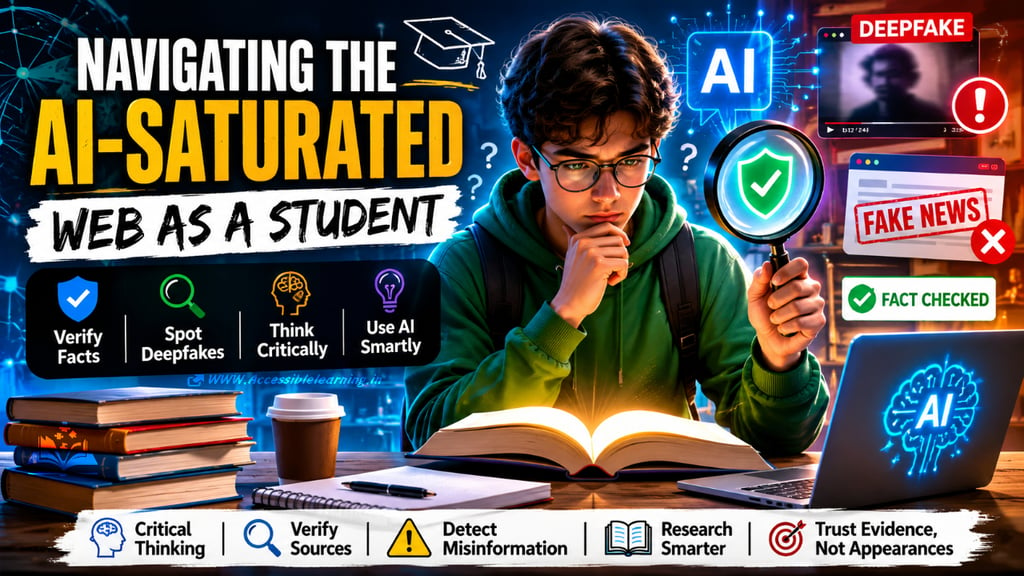
Deepfakes, Dead Data, and Truth: Critical Thinking in the Age of Synthetic Information
The internet has always been a place where information competes for attention. Today, however, students face a new challenge: much of that information may not have been written, researched, or even verified by humans.
AI-generated articles, synthetic search summaries, automated study guides, deepfake videos, and machine-written explanations are rapidly transforming how knowledge is created and distributed online. While these tools can make learning more accessible, they also introduce new risks. Incorrect facts can spread at scale. Outdated information can appear current. Convincing-looking content can be completely fabricated.
For modern learners, finding information is no longer the hardest part. Determining whether information is trustworthy has become the real challenge.
This guide explores how students can navigate an AI-saturated web, verify facts effectively, identify hallucinated information, and use artificial intelligence as a research assistant rather than an unquestioned authority.
The Rise of Synthetic Information
Just a few years ago, most educational content online was created by teachers, researchers, journalists, bloggers, and subject matter experts. Today, AI systems can generate thousands of articles in minutes.
Many websites use AI to:
Produce educational content
Generate news summaries
Rewrite existing articles
Create study notes
Answer search queries
Build FAQ pages
Produce historical explainers
Some AI-generated content is useful and accurate. Some is partially correct. Some is entirely fabricated. The problem is that all three often look equally convincing. Students can no longer assume that professional formatting, polished language, or high search rankings automatically indicate accuracy.
Why AI Hallucinations Matter in Education
One of the most discussed challenges in artificial intelligence is hallucination. An AI hallucination occurs when a system presents false information as if it were true.
Examples include:
Invented statistics
Fake historical events
Nonexistent scientific studies
Incorrect quotations
Fabricated references
Wrong mathematical explanations
Imaginary experts
The danger is not that AI always gets things wrong. The danger is that AI often sounds confident when it is wrong. For students conducting research, confidence should never be confused with credibility.
Understanding "Dead Data"
Many students worry about fake information, but outdated information can be equally harmful. Dead data refers to information that was once accurate but is no longer relevant.
Examples include:
Old economic statistics
Expired regulations
Obsolete scientific theories
Outdated software instructions
Historical interpretations replaced by new evidence
AI systems frequently train on large datasets that may not include the most recent developments. As a result, students may unknowingly rely on information that has already been superseded.
Always ask:
When was this information published?
When was it last updated?
Has newer research changed the conclusion?
Timeliness is a critical part of credibility.
The Deepfake Challenge
Deepfakes have added a visual layer to misinformation. Using AI, creators can generate videos, audio recordings, and images that appear authentic even when they are entirely fabricated.
Students increasingly encounter the following:
Fake historical speeches
Synthetic interviews
AI-generated documentaries
Altered photographs
Artificial voice recordings
A realistic video is no longer proof of authenticity.
When encountering surprising visual content:
Search for multiple independent reports.
Check whether reputable institutions mention it.
Verify original publication dates.
Examine whether the content appears on official sources.
Visual evidence should support facts, not replace verification.

The New Research Mindset: Verify First, Trust Later
Traditional internet use often followed this pattern:
Search
Find answer
Use answer
Modern research requires a different approach:
Search
Find answer
Verify answer
Compare sources
Use answer
This extra verification step is becoming an essential academic skill. The most successful students are not those who find information fastest. They are those who evaluate information most effectively.
The Three-Source Rule
One of the simplest ways to improve research quality is the Three-Source Rule.
Before accepting a fact:
Find at least three independent sources.
Compare their explanations.
Look for agreement.
If multiple trustworthy sources reach the same conclusion independently, confidence increases significantly.
This method is especially useful for:
Historical events
Scientific claims
Health information
Political topics
Statistical data
Single-source research is increasingly risky in an AI-generated information ecosystem.
How to Spot AI-Generated Content
AI-generated content is not automatically bad. However, students should recognize common indicators. Potential signs include:
Excessive Generic Language
Articles that repeat broad statements without providing evidence may be generated primarily for search visibility rather than education.
Missing Sources
Credible educational content typically references studies, institutions, books, or experts.
Lack of Original Insight
Many AI-generated articles summarize existing information without adding analysis or expertise.
Repetitive Structure
Sections may feel formulaic, repetitive, or unusually uniform.
Unsupported Statistics
Any number presented without attribution deserves scrutiny.
When in doubt, follow the evidence trail.
Good information leaves breadcrumbs.
Poor information often leaves none.
Reverse Research: A Powerful Student Skill
Instead of asking:
"Is this answer correct?"
Ask:
"Where did this answer come from?"
This small shift changes everything. Reverse research involves tracing information back to its original source.
For example:
A blog cites a statistic.
Locate the study.
Read the study summary.
Verify whether the statistic was interpreted correctly.
Many misleading claims originate from distorted summaries rather than outright fabrication. Following the source chain often reveals the full story.
Using AI as a Research Partner
The best way to use AI is not as a replacement for critical thinking but as a tool that strengthens it. Students can use AI to:
Generate Questions
Ask AI:
What perspectives am I missing?
What counterarguments exist?
What assumptions should I challenge?
Compare Viewpoints
AI can summarize competing interpretations of complex topics.
Explain Difficult Concepts
When used carefully, AI can simplify complicated ideas and improve comprehension.
Create Research Checklists
Students can use AI to generate verification steps before finalizing assignments.
The key is remembering that AI should assist investigation, not replace it.
Cross-Examining Information with AI
A particularly effective strategy is using AI to challenge itself. Instead of asking:
"Explain climate change."
Try:
What evidence supports this explanation?
What criticisms exist?
Which claims are debated?
What sources should I verify?
This transforms AI from an answer machine into a critical thinking tool. The quality of research often depends on the quality of questions.
Evaluating Sources in the AI Era
Students should prioritize information from:
Academic Sources
Peer-reviewed journals
University publications
Research institutions
Government Sources
Official statistics and public data repositories often provide reliable information.
Established News Organizations
Professional editorial oversight helps reduce inaccuracies.
Subject Matter Experts
Experts with demonstrated qualifications generally provide stronger evidence than anonymous content creators.
Source authority matters more than ever in a world where anyone can generate professional-looking information instantly.


Practical Fact-Checking Workflow for Students
Whenever encountering an unfamiliar claim:
Step 1: Pause
Avoid accepting information immediately.
Step 2: Check the Source
Who published it?
Step 3: Verify the Date
Is the information current?
Step 4: Find Supporting Evidence
Can other trusted sources confirm it?
Step 5: Look for Original Data
Can you trace claims to primary sources?
Step 6: Evaluate Bias
What incentives might influence the publisher?
Step 7: Reach a Conclusion
Only after verification should information become part of your research.
This process may take a few extra minutes, but it dramatically improves academic reliability.
Future-Proofing Your Learning Skills
As AI systems become more sophisticated, synthetic information will become increasingly difficult to distinguish from human-created content. The students who thrive in this environment will develop skills that machines cannot easily replace:
Critical thinking
Source evaluation
Logical reasoning
Evidence assessment
Contextual understanding
Intellectual skepticism
These abilities transform information consumers into informed investigators.
The modern web is no longer just a collection of human knowledge. It is becoming a blend of human expertise, machine-generated content, automated summaries, synthetic media, and algorithmically amplified information.
For students, this shift presents both opportunities and challenges.
Artificial intelligence can accelerate learning, explain complex topics, and expand access to knowledge. At the same time, it can generate convincing inaccuracies, amplify outdated information, and blur the line between fact and fabrication.
Success in this new environment depends on a simple principle: trust evidence, not appearances.
The future of education will not belong to those who consume the most information. It will belong to those who can evaluate information most effectively.
In an AI-saturated web, critical thinking is no longer an academic advantage. It is a survival skill.

FAQ's
Q: What does an AI-saturated web mean?
An AI-saturated web refers to an online environment where a significant amount of content is created, summarized, or influenced by artificial intelligence. This includes AI-generated articles, search summaries, study guides, images, videos, and chat-based answers. While AI can improve access to information, it also increases the risk of misinformation, hallucinated facts, and synthetic content.
Q: How can students verify information generated by AI?
Students can verify AI-generated information by checking multiple trusted sources, consulting academic databases, reviewing primary sources, and confirming facts through reputable institutions. Following the "three-source rule" is one of the most effective ways to confirm accuracy.
Q: What are AI hallucinations?
AI hallucinations are false or fabricated statements presented as factual information by artificial intelligence systems. These may include invented statistics, nonexistent studies, incorrect quotations, or inaccurate historical details. Hallucinations occur because AI predicts likely text patterns rather than verifying facts.
Q: Why shouldn't students rely entirely on AI for research?
AI can provide quick summaries and explanations, but it may also produce outdated, incomplete, or inaccurate information. Research requires source evaluation, fact-checking, and critical thinking, which remain essential human skills that AI cannot fully replace.
Q: How do I know if an article is AI-generated?
Signs of AI-generated content may include repetitive language, generic explanations, unsupported claims, lack of credible sources, and minimal original analysis. However, not all AI-generated content is unreliable, so the focus should be on verifying evidence rather than identifying authorship alone.
Q: What is the best way to fact-check information online?
The best fact-checking process includes:
Identifying the original source
Checking publication dates
Comparing multiple independent sources
Reviewing expert opinions
Verifying statistics through official reports or academic research
Q: How can students spot deepfake videos and images?
Students can identify potential deepfakes by checking the original source, looking for inconsistencies in visuals or audio, verifying whether reputable organizations report the same event, and using reverse image or video searches when necessary.
Q: What are primary and secondary sources?
A primary source is original evidence, such as research papers, government reports, interviews, historical documents, or official datasets. A secondary source interprets or summarizes primary information. For academic research, primary sources generally provide stronger evidence.
Q: Can AI-generated search results contain incorrect information?
Yes. AI-generated search summaries may occasionally contain errors, outdated information, or misleading interpretations. Students should treat these summaries as starting points for research rather than final answers.
Q: How can AI help students become better researchers?
AI can assist students by:
Explaining difficult concepts
Generating study questions
Suggesting alternative viewpoints
Identifying research gaps
Summarizing large amounts of information
Students should use AI as a research assistant while independently verifying important claims.
Q: What are the most reliable sources for academic research?
Reliable academic sources include:
Peer-reviewed journals
University publications
Government websites
Research institutions
Professional organizations
Academic databases and libraries
These sources typically undergo review processes that improve credibility and accuracy.
Q: Why is critical thinking more important in the age of AI?
As AI-generated content becomes more common, students must evaluate information rather than simply consume it. Critical thinking helps learners assess evidence, recognize bias, identify misinformation, and make informed decisions based on trustworthy sources.
Q: What is "dead data," and why should students avoid it?
Dead data refers to information that was once accurate but has become outdated due to new discoveries, policy changes, technological advancements, or updated statistics. Using outdated information can weaken research quality and lead to incorrect conclusions.
Q: How can students use AI responsibly for assignments?
Students can use AI responsibly by:
Brainstorming ideas
Organizing research
Clarifying difficult topics
Creating study materials
Reviewing drafts
However, all facts, citations, and academic claims should be independently verified before submission.
Q: What skills will help students succeed in an AI-driven information environment?
The most valuable skills include:
Critical thinking
Source evaluation
Fact-checking
Media literacy
Digital research
Logical reasoning
Evidence analysis
These skills help students distinguish credible information from misinformation, regardless of how convincing AI-generated content may appear.
Subscribe to Frontier Intelligence
All © Copyright reserved by Accessible-Learning Hub
| Terms & Conditions
Accessible Learning Hub — Actionable clarity for high-agency minds.
Weekly breakdowns on AI breakthroughs, capital flow, and human performance systems. Zero fluff.