

Nanobots in Medicine: How Tiny Robots Could Become the Body’s Internal Maintenance Crew
Nanobots, the future internal maintenance crew of the human body, are transforming medicine through targeted drug delivery, cancer treatment, nano-sensors, and real-world nanotechnology breakthroughs already in use today.
COMPANY/INDUSTRYHEALTH/DISEASEAI/FUTURE
Sachin K Chaurasiya | Shiv Singh Rajput
2/28/20265 min read
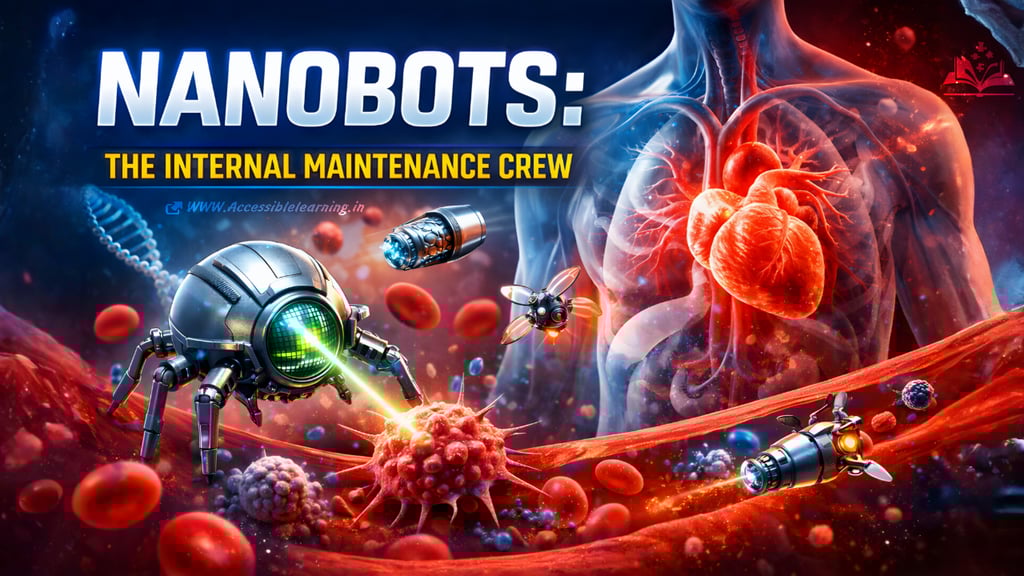
Nanobots are often described as science fiction, but parts of this technology already exist in hospitals, research labs, and clinical trials. From targeted cancer drugs to magnetic micro-robots moving through blood vessels, scientists are steadily building what could become the human body’s internal maintenance crew.
This article explains nanobots in depth, grounded in real-world science, current medical breakthroughs, and what is realistically coming next.
What Are Nanobots in Real Terms?
Nanobots are extremely small engineered systems designed to operate inside the body. Some are mechanical devices, but many real-world “nanobots” today are:
Smart drug-delivery nanoparticles
DNA-based molecular robots
Magnetic micro-robots
Biohybrid bacteria-driven systems
These systems may not look like tiny metal robots. Instead, they behave like programmable microscopic tools.
Real Nanotechnology Already Used in Medicine
Before true nanobots arrive, nanomedicine is already saving lives.
Targeted Cancer Drug Nanoparticles
Some chemotherapy drugs are packaged in nanoparticles so they accumulate more in tumors than healthy tissue.
Examples include:
Liposomal drug delivery systems
Nanoparticle-based chemotherapy carriers
Antibody-linked nano-drug systems
These technologies reduce side effects and improve drug efficiency.
Real-world use:
Nanoparticle cancer drugs are approved in multiple countries.
Hospitals use them today for breast cancer, ovarian cancer, and Kaposi’s sarcoma.
This is one of the clearest examples of nanobot-like medical systems already in use.
COVID-19 mRNA Vaccines Used Nanotechnology
The Pfizer-BioNTech and Moderna vaccines used lipid nanoparticles to protect fragile mRNA and deliver it into cells.
Without nanotechnology, mRNA vaccines would not work effectively.
This showed the world how powerful nanoscale delivery systems can be.
Magnetic Micro-Robots in Blood Vessels
Researchers have successfully moved tiny magnetic robots through animal blood vessels using external magnetic fields.
Real experiments have shown:
Navigation through tiny arteries
Controlled movement to specific locations
Delivery of micro-particles
These robots could one day clean artery plaque or deliver drugs to hard-to-reach areas.
DNA Nanorobots That Target Cancer Cells
Scientists have created DNA structures that open only when they detect specific cancer markers.
In laboratory tests, these DNA nanobots:
Found tumor cells
Released clotting agents
Cut off tumor blood supply
This is a real milestone in programmable molecular robotics.
Nano-Sensors for Continuous Health Monitoring
Researchers are developing nanosensors that can monitor body chemistry in real time.
Examples include sensors for:
Blood sugar monitoring
Cancer biomarkers
Infection markers
Inflammation signals
Some experimental glucose nanosensors could one day eliminate finger-prick testing for diabetics.


Real-World Applications Under Development
1. Artery Plaque Removal
Magnetic nanorobots are being tested to:
Break down cholesterol plaque
Deliver clot-dissolving drugs
Reduce stroke risk
This could replace invasive heart procedures.
2. Targeted Antibiotic Delivery
Scientists are developing nano-carriers that deliver antibiotics directly to infected tissue.
This helps fight antibiotic-resistant bacteria because a higher drug concentration reaches the infection.
3. Brain Drug Delivery
One of medicine’s biggest problems is crossing the blood-brain barrier. Nanoparticles are being tested to deliver drugs for:
Alzheimer’s disease
Parkinson’s disease
Brain tumors
Some early trials have shown improved drug delivery to brain tissue.
4. Smart Wound Healing Nanotech
Researchers are developing nano-fibers and nanobots that:
Release antibiotics into wounds
Promote tissue growth
Detect infection early
These could help treat burns, diabetic ulcers, and surgical wounds.
Real Research Institutions Working on Nanobots
Major universities and labs are actively developing nanobot systems, including research at:
MIT
Harvard Medical School
Caltech
ETH Zurich
Stanford University
Hospitals and biotech companies are also investing heavily in nanomedicine. Global funding for nanomedicine research runs into billions of dollars each year.
Timeline: When Will Real Nanobots Be Common?
Today
Nanoparticle drug delivery
Nano-based vaccines
Magnetic micro-robot experiments
Next 5–10 Years
More targeted nano cancer treatments
Nano-sensors for real-time health monitoring
Smart drug-release implants
Next 10–30 Years
Semi-autonomous nanobots
Internal repair systems
Preventive nanomedicine
Fully autonomous nanobots moving freely in the bloodstream are still under development, but progress is steady.
Why Real Nanobot Technology Matters
1. Precision Medicine
Nanobots allow treatment at the exact disease location.
2. Reduced Side Effects
Healthy tissue is not damaged.
3. Early Diagnosis
Disease can be detected before symptoms.
4. Less Invasive Surgery
Some operations may become unnecessary.
5. Lower Long-Term Healthcare Costs
Prevention is cheaper than emergency care.
Challenges Scientists Still Face
Even with real progress, major problems remain.
Safety Testing
Nanobots must not trigger immune reactions.
Long-Term Effects
We must know how nanobots behave over decades.
Mass Production
Building devices at the nanoscale is expensive.
Regulation
Governments must create new medical approval systems.
Ethical Concerns
Privacy and control over internal monitoring are big questions.
These challenges are why careful testing is essential.
The Future of Internal Maintenance
The long-term goal is a body where nanobots constantly
Repair damaged cells
Destroy cancer before it spreads
Remove toxins
Monitor organ health
Maintain ideal body chemistry
Instead of treating illness after it appears, medicine becomes preventive and continuous.
Nanobots are not just an idea anymore. Real-world nanotechnology is already in vaccines, cancer treatments, and experimental robotic systems inside blood vessels.
We are still years away from fully autonomous medical nanobots, but each breakthrough brings us closer to a world where microscopic machines protect our health from inside.
The internal maintenance crew is coming. It is being built today, step by step, in laboratories around the world.


FAQ's
Q: What are nanobots in simple terms?
Nanobots are extremely tiny machines designed to work inside the human body. They can detect problems, deliver medicine, repair cells, or monitor health. Many real-world versions today are smart nanoparticles rather than mechanical robots.
Q: Are nanobots real or just science fiction?
Nanobot-like technologies already exist. Doctors use nanoparticle drug delivery systems in cancer treatment and lipid nanoparticles in mRNA vaccines. Fully autonomous nanobots that move freely in the body are still under development.
Q: How small are nanobots?
Nanobots are measured in nanometers. One nanometer is one billionth of a meter. Thousands of nanobots could fit across the width of a human hair.
Q: What diseases could nanobots treat?
Nanobots may help treat many conditions, including:
Cancer
Heart disease
Infections
Genetic disorders
Brain diseases like Alzheimer’s
Diabetes
They are especially useful for diseases that require precise drug delivery.
Q: Are nanobots safe for humans?
Safety is the biggest focus in nanobot research. Scientists design nanobots using biocompatible materials that dissolve after use. Before approval, they must pass strict testing for immune reactions, toxicity, and long-term effects.
Q: When will nanobots be available to the public?
Some nanotechnology treatments are already available. More advanced nanobot systems may appear within 10 to 30 years, depending on research breakthroughs and clinical trials.
Q: How do nanobots move inside the body?
Different designs use different methods:
Magnetic fields
Chemical signals
Ultrasound guidance
Blood flow movement
Future nanobots may use AI-assisted navigation.
Q: Can nanobots replace surgery?
In some cases, yes. Nanobots could remove plaque, repair tissue, or deliver drugs without invasive surgery. However, major operations will still be needed for certain conditions.
Q: Could nanobots be hacked or misused?
This is a real ethical concern. Researchers are working on secure communication systems and strict medical regulations to prevent misuse. Data privacy and control will be important issues in the future.
Q: Will nanobots be affordable?
Costs are high today because the technology is new. As production improves, prices are expected to fall, just like with smartphones and other medical technologies.
Q: Can nanobots help with aging?
Scientists believe nanobots may one day repair damaged cells, remove harmful proteins, and improve tissue health. This could slow aging and extend healthy lifespan, though this is still experimental.
Q: Do nanobots stay in the body forever?
Most designs are biodegradable. They break down safely or are removed by the body after completing their task.
Q: How are nanobots different from normal medicine?
Traditional medicine spreads through the whole body. Nanobots target specific cells or tissues, making treatment more precise and reducing side effects.
Q: Are nanobots controlled by artificial intelligence?
Some future systems may use AI to analyze health data and guide treatment. Current nanobot-like systems mostly follow programmed chemical or physical triggers.
Q: Why are nanobots important for future healthcare?
Nanobots could shift medicine from treating disease after symptoms appear to preventing disease early. This could improve quality of life, reduce hospital visits, and lower long-term healthcare costs.
Subscribe to Frontier Intelligence
All © Copyright reserved by Accessible-Learning Hub
| Terms & Conditions
Accessible Learning Hub — Actionable clarity for high-agency minds.
Weekly breakdowns on AI breakthroughs, capital flow, and human performance systems. Zero fluff.