

Mother's Day 2025: History, Meaning, Gift Ideas & Everything You Need to Know
Mother's Day is more than a holiday—it's a globally celebrated tribute to the women who shape us. From its surprising origins with Anna Jarvis to its $34.1 billion modern footprint, this complete guide covers the history, traditions, gift ideas, world celebrations, and everything you need to honor the mothers in your life in 2025.
EVENT/SPECIALCELEBRATION/FESTIVALS
Kim Shin
3/3/202610 min read
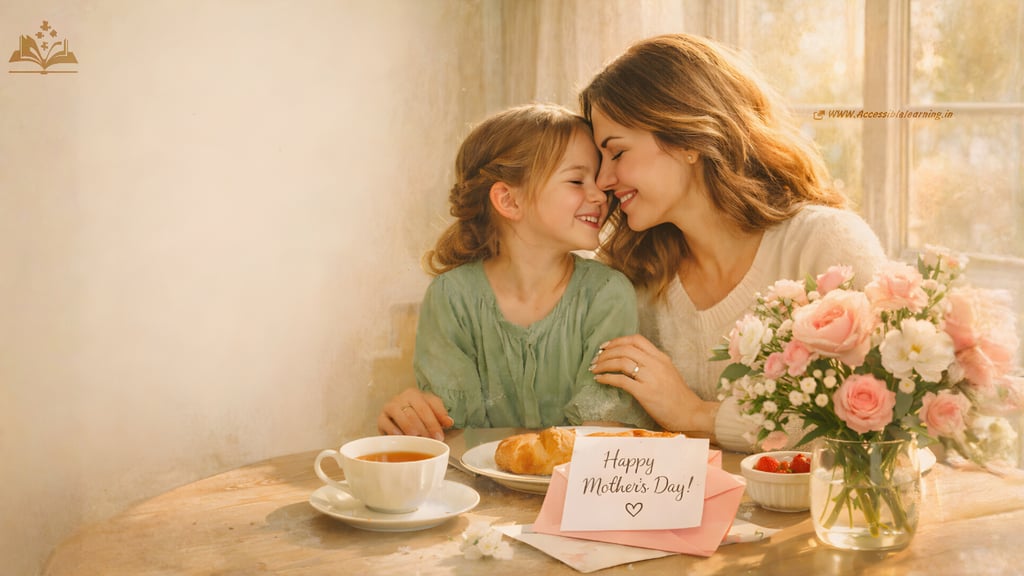
What Is Mother's Day?
At its heart, Mother's Day is a day of gratitude, a moment carved into the calendar where the world collectively pauses to acknowledge the women who shaped us. More than a commercial holiday, it is a cultural rite of recognition for unconditional love, quiet sacrifice, and the invisible labor that holds families together.
In the United States, Mother's Day is formally defined as a federal observance (not a federal holiday, but a nationally recognized day) held on the second Sunday of May each year. It celebrates mothers, stepmothers, grandmothers, foster mothers, and every maternal figure who has played a nurturing role in someone's life.
Today, Mother's Day is one of the most widely observed days in the world, celebrated across cultures with flowers, shared meals, heartfelt cards, and the gift of quality time. The average American now spends $259.04 on Mother's Day, a number that reflects not just commerce but genuine emotional investment in honoring the women who matter most.
When Is Mother's Day in 2025?
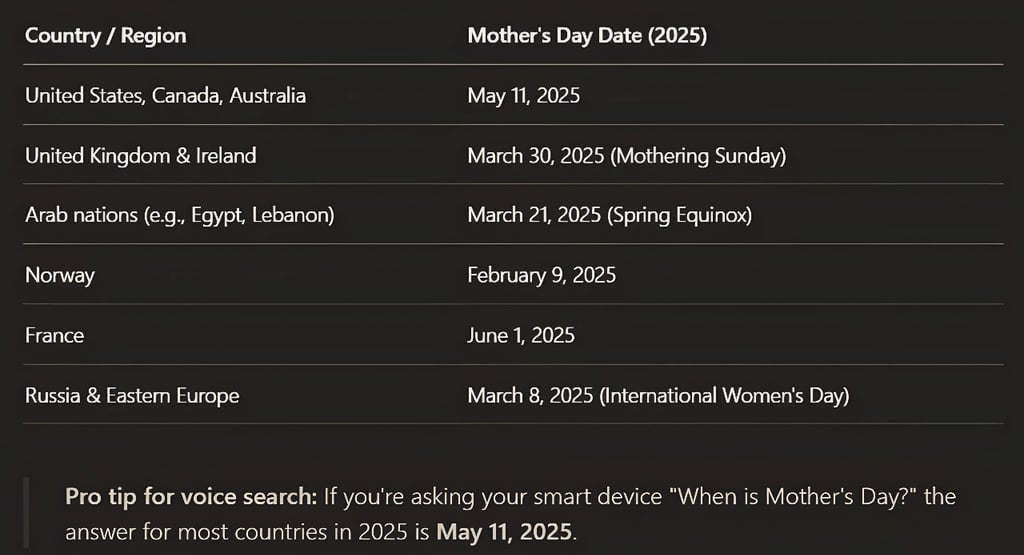
Mother's Day 2025 is on Sunday, May 11, 2025.
The date changes every year because it always falls on the second Sunday of May in the U.S., Canada, Australia, and dozens of other countries. Here's a quick reference for other regions:

The History of Mother's Day
Ancient Roots: Celebrating the Mother Figure
Long before greeting cards and flower deliveries, humanity was celebrating motherhood. Ancient Greeks honored Rhea, the mother of the gods, with spring festivals. Ancient Romans celebrated Hilaria, a three-day festival dedicated to Cybele, the great mother goddess, complete with offerings at temples. These early observances were less about individual mothers and more about the sacred archetype of the nurturer.
Mothering Sunday: The British Precursor
In 16th-century Britain, a Christian observance called Mothering Sunday emerged on the fourth Sunday of Lent. Originally a day when people returned to their "mother church" (the main church in their region), it gradually evolved into a time for families to reunite. Servants and apprentices were given the day off to visit their mothers, often bringing small gifts or "simnel cake," a rich fruitcake still associated with the tradition today. This practice laid the emotional and cultural groundwork for the modern holiday.
Anna Jarvis and the Birth of the Modern Holiday
The Mother's Day most of us celebrate today was the vision and later, the great regret of a single woman: Anna Jarvis of Webster, West Virginia.
After her mother, Ann Reeves Jarvis, died on May 9, 1905, Anna dedicated herself to creating a formal holiday to honor mothers everywhere. Her mother had been a community activist who organized "Mother's Day Work Clubs" during the Civil War to treat wounded soldiers on both sides. Anna felt that mothers deserved a day of recognition.
After years of campaigning, the first official Mother's Day celebration was held on May 10, 1908, at St. Andrew's Methodist Church in Grafton, West Virginia. By 1911, every U.S. state observed the holiday. On May 9, 1914, President Woodrow Wilson signed a proclamation officially establishing Mother's Day as a national observance on the second Sunday of May.
The Irony: Anna Jarvis Grew to Hate What She Created
One of the most poignant twists in Mother's Day history is that its own founder grew to despise the commercialized version of the holiday she had worked so hard to create. Anna Jarvis had originally envisioned a day of personal, handwritten letters expressing love and gratitude that were intimate and sincere. When she saw that florists, greeting card companies, and candy manufacturers were capitalizing on it, she was outraged.
She spent the latter part of her life campaigning against Mother's Day, writing letters to candy companies, suing those who used the phrase commercially, and calling publicly for the holiday to be abolished. She died in 1948, without children, largely penniless, in a sanitarium. The very industry she railed against reportedly paid for her care at the end.
It is a story that reveals something important: the holiday's commercial success and its heartfelt emotional core have always existed in tension with each other.
How Mother's Day Is Celebrated Around the World
Mother's Day is one of the rare occasions where a single sentiment thank you, Mom echoes across languages, cultures, and continents simultaneously. Yet how that sentiment is expressed varies beautifully from place to place.
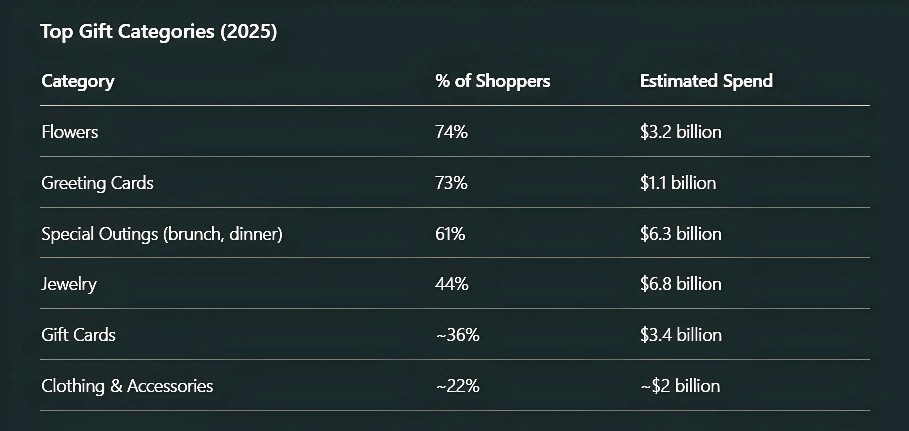
United States & Canada: Families gather for brunch or dinner and give flowers (74% of celebrants), greeting cards (73%), and special gifts. It's the second-highest consumer spending holiday of the year in the U.S., surpassed only by winter holidays.
United Kingdom: Celebrated as Mothering Sunday in late March during Lent. Children give their mothers flowers (traditionally daffodils) and simnel cake. The occasion is more closely tied to its religious origins than the American version.
Mexico: Celebrated on May 10 every year (a fixed date, not the second Sunday). It is among the most festive Mother's Day celebrations in Latin America. Mariachi bands play outside mothers' homes at dawn. Schools hold elaborate performances called "festejo" days before the holiday.
India: Increasingly observed on the second Sunday of May, reflecting Western influence. Urban families give gifts and organize outings, while traditional expressions of care continue through everyday service and cooking.
Ethiopia: Celebrates Antrosht, a multi-day harvest festival where families reunite and daughters bring vegetables while sons contribute meat. Mothers and daughters sing songs and anoint each other with butter as a mark of love and respect.
Japan: Known as Haha no Hi ("Mother's Day"), it's celebrated on the second Sunday of May. Red carnations are the traditional gift symbolizing purity, sweetness, and endurance. White carnations are given in memory of mothers who have passed.
France: Observed on the last Sunday of May (or first Sunday of June if it falls on Pentecost). The holiday was promoted by Napoleon as a way to encourage large families. Today it's celebrated with flowers, family meals, and handmade gifts from children.
Mother's Day 2025: Key Facts & Statistics
Based on the most recent data from the National Retail Federation (NRF) and Prosper Insights & Analytics (April 2025 survey, n=7,948):
Consumer Spending
Total U.S. spending: $34.1 billion, the second-highest Mother's Day spending figure ever recorded (the record was $35.7 billion in 2023)
Average spending per celebrant: $259.04 — up from $254.04 in 2024
Year-over-year increase: 1.8%
Participation
83% of U.S. adults celebrate Mother's Day in some form
Mother's Day ranks as the third most popular holiday in America, after Christmas (93.4%) and July 4th (87.2%)
The average celebrant honors 1.4 mothers (mother/stepmother, wife, daughter, grandmother, etc.)

Shopping Behavior
36% of consumers shop online (up 1.4% from 2024)
32% shop at department stores
29% shop at specialty stores
25% shop at local/small businesses
48% of shoppers look for a "unique or different" gift
42% prioritize gifts that "create a special memory."
36% of men plan to give experiential gifts (vs. 29% in 2019)
Communication on Mother's Day
An estimated 122 million phone calls are made on Mother's Day more than any other day of the year
Americans purchase approximately 113 million cards for Mother's Day annually
During the 2020 pandemic, 1.75 billion minutes of calls and 6 billion texts were exchanged on Mother's Day
Best Mother's Day Gift Ideas for 2025
Experiential Gifts (The Fastest-Growing Category)
The trend is unmistakable: people increasingly want to give memories, not things. Experiential gifts allow mothers to feel celebrated beyond a single morning. Popular options include:
A cooking class or wine tasting experience
Spa day or wellness retreat voucher
Concert, theater, or sporting event tickets
A weekend getaway or curated day trip
Scenic hike followed by a gourmet picnic
Personalized & Meaningful Gifts
With 47–48% of shoppers seeking unique or different gifts, personalization has become a core strategy. Think:
Custom jewelry with birthstones or engraved initials
A professionally designed photo book capturing shared memories
A commissioned portrait or illustration
A handwritten letter paired with a meaningful object
A "memory jar" filled with notes from every family member
Traditional Gifts That Always Resonate
There's a reason flowers (74%) and greeting cards (73%) remain the most popular choices: they work. The key is thoughtful execution:
A curated bouquet of her favorite flowers (not just roses)
A subscription to a monthly flower delivery service
A heartfelt, handwritten card (Anna Jarvis would approve)
Fresh herbs or a potted plant she can tend to year-round
Tech-Forward & Lifestyle Gifts
A growing number of celebrants are embracing functional, modern gifts:
Smart home devices (ambient displays, digital photo frames)
AI-powered wellness apps or subscriptions
Noise-canceling headphones for moments of quiet
Personalized playlist or curated audiobook membership
Budget-Friendly Gift Ideas (Under $50)
Herb garden kit with seeds she loves
Aromatherapy candle set
A beautiful journal with her favorite quote on the cover
Specialty tea or coffee sampler
Homemade coupon book for chores, dinners, and time together
The Meaning Behind Mother's Day Traditions
Why Flowers? The Language of Blooms
Anna Jarvis originally chose the white carnation as Mother's Day's official flower a symbol of pure love, faithfulness, and endurance. Over time, any flower came to represent the holiday. Flowers communicate what words sometimes cannot: beauty, care, life, and presence. Red carnations are given to living mothers; white ones honor those who have passed. In Japan, red carnations remain the primary gift.
Mother's Day accounts for more flower purchases than almost any other single day in an industry that sees its third-biggest annual spike of the year (after Valentine's Day and Christmas).
Why Brunch?
The Mother's Day brunch tradition is layered with intent. It gives the mother of the household a meal she didn't have to cook, prepared either at a restaurant or by family members taking over the kitchen. It is, in its simplest form, a gesture of role reversal, taking over the care so she can simply receive it. Restaurants nationwide see a massive surge in reservations on Mother's Day, making it one of the busiest dining days of the calendar year.
Why Cards?
Greeting card sales for Mother's Day exceed 113 million cards annually, second only to Christmas in total volume. The tradition of written words traces back to the holiday's origin: Anna Jarvis wanted handwritten letters, not commercial cards. The irony is that the greeting card industry became one of the first beneficiaries of Mother's Day's commercialization. Today, a thoughtful, personally written card even inside a store-bought one remains one of the most emotionally resonant gifts a person can give.
Anna Jarvis wanted something simple: a day when every person who had a mother would sit down, pick up a pen, and write her a letter. Not a purchase. Not a reservation. A letter.
The holiday she created eventually grew far beyond that vision into a $34 billion industry spanning flowers, fine dining, jewelry, and experiential travel. And yet, at its quietest and truest core, Mother's Day is still about that original impulse: the desire to look at someone who poured themselves into you and say, clearly and deliberately, thank you. I see you. I love you.
Whatever form that takes a bouquet of her favorite flowers, a brunch table filled with laughter, or a handwritten note slipped under a door the sentiment is the same. It always has been.

FAQ's
Q: When is Mother's Day 2025?
Mother's Day 2025 is on Sunday, May 11, 2025. It falls on the second Sunday of May every year in the United States, Canada, Australia, and many other countries.
Q: Why is Mother's Day celebrated?
Mother's Day is celebrated to honor mothers and maternal figures for their unconditional love, sacrifices, and contributions to family and society. The modern holiday was founded by Anna Jarvis in 1908 and officially recognized by President Woodrow Wilson in 1914.
Q: Who invented Mother's Day?
The modern Mother's Day was created by Anna Jarvis, a woman from Webster, West Virginia, who began campaigning for the holiday after her mother's death in 1905. The first official celebration was held on May 10, 1908. Ironically, Anna Jarvis later opposed the commercialization of the holiday she created.
Q: What day does Mother's Day fall on?
In most countries, including the U.S., Mother's Day falls on the second Sunday of May each year. In the UK, it's celebrated on the fourth Sunday of Lent (Mothering Sunday), which fell on March 30 in 2025. Some countries, like Mexico, celebrate on a fixed date (May 10).
Q: How much do people spend on Mother's Day?
According to the National Retail Federation's 2025 data, Americans are expected to spend a total of $34.1 billion on Mother's Day, with the average person spending $259.04 on gifts, outings, and celebrations. This is the second-highest spending figure on record for the holiday.
Q: What are the most popular Mother's Day gifts?
The most popular Mother's Day gifts in 2025 are flowers (74%), greeting cards (73%), special outings like brunch or dinner (61%), jewelry (44%), and gift cards (~36%). Experiential gifts like concerts, spa days, and cooking classes are growing rapidly in popularity.
Q: Is Mother's Day a federal holiday?
Mother's Day is not a federal holiday in the United States, meaning banks, schools, and government offices remain open. However, it is a nationally recognized observance. It was officially designated by President Woodrow Wilson in 1914.
Q: What flower is associated with Mother's Day?
The carnation is the traditional Mother's Day flower, originally chosen by founder Anna Jarvis. A red or pink carnation honors a living mother; a white carnation is worn in memory of a mother who has passed. Today, many flowers have become associated with the holiday; roses, lilies, sunflowers, and tulips are all common choices.
Q: How is Mother's Day celebrated in different countries?
Celebrations vary widely. In the U.S., it typically involves flowers, cards, dining out, and gifts. In Mexico, it's a fixed date (May 10) marked by mariachi serenades and school performances. In the UK, it's "Mothering Sunday" in Lent. In Ethiopia, the multi-day festival Antrosht involves family reunions and ritual celebrations of the harvest. In Japan, red carnations are the primary gift, with white carnations given in memory of deceased mothers.
Q: What do mothers actually want for Mother's Day?
Surveys consistently show that mothers place a high value on quality time over material gifts. A 2025 NRF survey found that 42% of shoppers specifically look for gifts that "create a special memory." Experiences (spa days, dining, trips) and personal acts of service (taking care of chores, cooking a meal, spending uninterrupted time together) rank among the most appreciated expressions of love.
Q: What is the history of Mothering Sunday in the UK?
Mothering Sunday dates back to 16th-century Britain as a Christian observance on the fourth Sunday of Lent, when people returned to their "mother church." Over time, it became a day for families to reunite. Children brought their mothers small gifts often simnel cake or fresh flowers. Today, the UK observes it similarly to Mother's Day in the U.S., though it retains its earlier Lenten timing.
Q: How many phone calls are made on Mother's Day?
An estimated 122 million phone calls are made worldwide on Mother's Day, making it the busiest phone call day of the year, surpassing even New Year's Eve. During the 2020 pandemic, this translated to approximately 1.75 billion minutes of calls and 6 billion texts exchanged on Mother's Day.
Q: What is the origin of Mother's Day cards?
While Anna Jarvis originally envisioned handwritten letters, not printed cards, the greeting card industry rapidly commercialized the sentiment starting in the early 1920s. Today, Americans purchase approximately 113 million cards for Mother's Day annually, making it the third-highest card sales day of the year, after Christmas and Valentine's Day. Jarvis spent years fighting this commercialization.
Subscribe To Our Newsletter
All © Copyright reserved by Accessible-Learning Hub
| Terms & Conditions
Knowledge is power. Learn with Us. 📚

