

Modern Dating Problems: 25 Toxic Relationship Trends You Shouldn’t Ignore
Modern dating has more options, more access, and more exposure than ever before. Yet, many people feel more confused, disconnected, and emotionally drained in relationships today. This article explores the real toxic trends shaping modern relationships, why they are becoming normalized, and how they quietly damage trust, communication, and emotional stability.
NEW YOUTH ISSUESNEPOTISM/SOCIAL ISSUESAWARE/VIGILANTGLOBAL ISSUES
Kim Shin
3/29/20265 min read
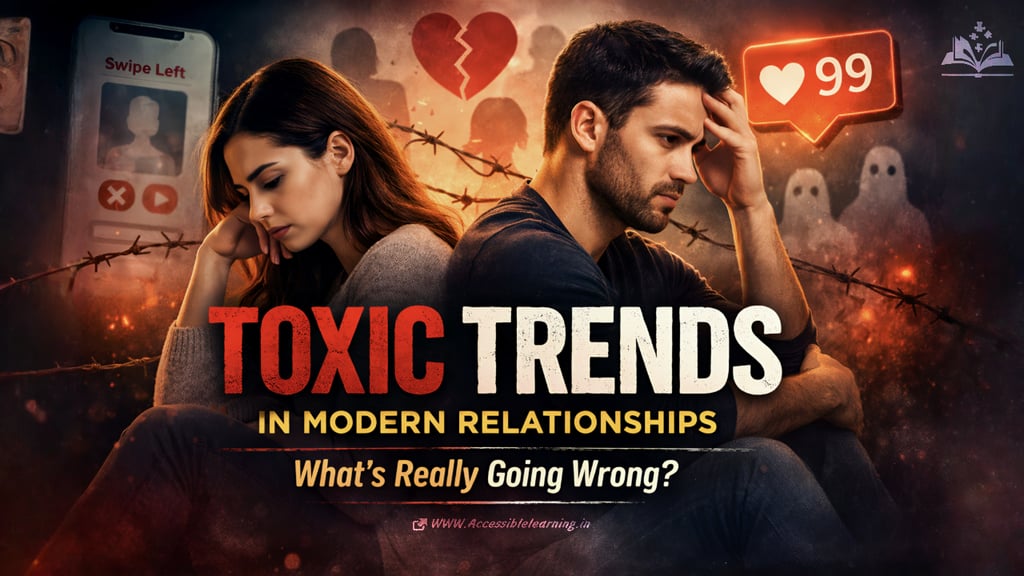
Modern relationships aren’t just changing; they’re becoming harder to navigate. People have more freedom, more access, and more exposure than ever before. But instead of making love easier, it has made it more complicated, confusing, and often emotionally exhausting.
This isn’t a surface-level issue. It’s a shift in mindset, behavior, and expectations. And many toxic patterns are now so common that people don’t even recognize them as unhealthy anymore. Let’s go deeper into what’s actually happening.
The Illusion of Infinite Options
Dating apps have trained people to believe there’s always someone better out there.
What happens because of this:
People stop valuing what they have
Minor flaws become reasons to leave
Commitment feels like losing opportunities
Deeper issue:
Choice overload creates dissatisfaction. When people think they can always upgrade, they struggle to appreciate real connection.
Emotional Unavailability Becoming Normal
People want connection, but avoid emotional exposure.
Modern patterns:
Saying “I’m not ready” while still engaging
Avoiding serious discussions
Keeping feelings vague to stay safe
Root cause:
Fear of rejection
Past trauma
Ego protection
Outcome:
Surface-level relationships that never evolve into something meaningful.
Situationship Culture
Undefined relationships are now one of the biggest emotional traps.
Why people stay in them:
Hope that it will turn into something real
Fear of losing the person
Comfort without responsibility
What it causes:
Anxiety
Lack of clarity
Emotional imbalance (one cares more)
Reality:
Clarity is respect. Confusion is often intentional.
Social Media Shaping Unrealistic Expectations
Social media has redefined what people think love should look like.
Common distortions:
Love must be exciting all the time
Partners must constantly prove love publicly
Relationships must look perfect
Hidden truth:
Most online relationships are curated, not real
Real relationships involve routine, conflict, and effort
Validation Addiction
Many people depend on external validation instead of internal confidence.
Signs:
Needing constant attention
Overthinking messages and replies
Feeling insecure without reassurance
Deeper problem:
Self-worth becomes dependent on someone else’s behavior.

Communication Without Depth
We talk more but communicate less effectively.
Modern issues:
Over-reliance on texting
Avoiding difficult conversations
Passive-aggressive replies
Ghosting instead of closure
Impact:
Misunderstandings
Emotional distance
Unresolved issues
“Self-Love” Misused as Avoidance
Self-love has become a shield to avoid responsibility.
What it looks like:
Leaving at the first sign of discomfort
Refusing to compromise
Avoiding accountability
Reality:
Growth requires discomfort. Not everything challenging is toxic.
Fear of Being Alone
Many people stay in unhealthy dynamics because they fear loneliness.
This leads to:
Accepting poor treatment
Ignoring red flags
Settling for less than they deserve
Truth:
Being alone is healthier than being in something that drains you.
Transactional Relationships
Relationships are increasingly treated like exchanges.
Examples:
Keeping score of effort
Conditional love
Expecting returns for everything given
Problem:
Genuine connection cannot grow in a calculated environment.
Instant Gratification Mindset
People expect fast results in relationships.
Expectations:
Immediate chemistry
Quick emotional bonding
Fast resolution of problems
Reality:
Trust takes time
Emotional intimacy develops slowly
Strong relationships are built, not rushed
Ghosting Becoming Acceptable
Ending communication without explanation has become common.
Why people ghost:
Avoid confrontation
Lack emotional maturity
Don’t want accountability
Impact on the other person:
Confusion
Self-doubt
Lack of closure
Truth:
Ghosting is not harmless. It reflects poor communication skills.
Love Bombing and Fast Intensity
Some relationships start extremely intense and fade just as quickly.
Signs:
Over-the-top affection early on
Constant communication
Big promises too soon
What follows:
Sudden withdrawal
Emotional confusion
Reality:
Real connection builds gradually, not instantly.
Lack of Boundaries
Many people either
Have no boundaries
orUse boundaries as walls
Common problems:
Saying yes when they mean no
Allowing disrespect
Not communicating limits clearly
Healthy truth:
Boundaries are not about control. They are about self-respect.

Hyper-Independence
Independence is healthy. But extreme independence can block intimacy.
What it looks like:
Refusing help
Avoiding emotional reliance
Keeping distance to stay in control
Root cause:
Trust issues
Fear of vulnerability
Comparison Culture
People constantly compare their relationships to others.
This leads to:
Dissatisfaction
Unrealistic expectations
Pressure to perform instead of connect
Avoiding Accountability
Blame shifting has become common.
Examples:
“That’s just how I am."
Refusing to admit mistakes
Turning every issue into an argument
Reality:
Without accountability, relationships cannot grow.
Overexposure Early On
People share too much too quickly.
What happens:
Emotional burnout
Fast attachment without real understanding
Loss of mystery and depth
Lack of Patience
People want perfect relationships instantly.
Result:
Giving up too early
Not working through challenges
Constant restarting with new people
Misunderstanding Compatibility
People confuse attraction with compatibility.
Truth:
Chemistry is instant
Compatibility is built over time
Ignoring this leads to repeated relationship failures.
Normalizing Disrespect
Subtle disrespect is often ignored.
Examples:
Inconsistent behavior
Lack of effort
Emotional neglect
Over time, this becomes accepted instead of addressed.
Emotional Dependency
Some people rely completely on their partner for emotional stability.
Impact:
Pressure on the relationship
Loss of individuality
Increased insecurity
Confusing Attention with Love
Attention is often mistaken for genuine care.
Difference:
Attention is temporary
Love is consistent and stable
Fear of Honest Conversations
People avoid difficult discussions to keep things “peaceful.”
Result:
Problems stay unresolved
Resentment builds silently
Prioritizing Ego Over Connection
Winning arguments becomes more important than understanding each other.
Reality:
Ego destroys what empathy could fix.

Lack of Emotional Education
Most people were never taught how to:
Communicate properly
Handle conflict
Understand emotions
So they learn through mistakes, often hurting themselves and others.
Modern relationships are not broken by chance. They reflect how people think, behave, and handle emotions today. There is more access, more choice, and more exposure. But without emotional awareness, discipline, and honesty, all of that turns into chaos instead of connection.
What actually works:
Clear communication
Emotional responsibility
Patience
Consistency
Mutual respect
At the end of the day, real relationships are not about perfection. They are about effort, clarity, and showing up even when it’s not convenient.
FAQ's
Q: What are toxic trends in modern relationships?
Toxic trends in modern relationships refer to unhealthy patterns that have become common and normalized in today’s dating culture. These include ghosting, situationships, emotional unavailability, validation dependency, and lack of clear communication. These behaviors often create confusion, emotional stress, and unstable connections instead of meaningful relationships.
Q: Why are modern relationships becoming more complicated?
Modern relationships are more complicated due to:
Dating apps creating endless choices
Social media setting unrealistic expectations
Fear of commitment and vulnerability
Fast-paced lifestyle reducing emotional depth
People now have more access but less clarity, which leads to confusion and inconsistency.
Q: What is a situationship, and why is it toxic?
A situationship is a relationship without clear labels or commitment. It becomes toxic when:
One person expects more than the other
There is no emotional security
Boundaries are unclear
This lack of clarity often leads to anxiety, emotional imbalance, and wasted time.
Q: How does social media affect modern relationships?
Social media negatively impacts relationships by:
Creating unrealistic expectations of “perfect” love
Encouraging comparison with other couples
Promoting validation through likes and attention
This can lead to dissatisfaction even in healthy relationships.
Q: Why do people ghost instead of communicating?
People ghost because they:
Want to avoid uncomfortable conversations
Lack emotional maturity
Don’t want accountability
While it may feel easier, ghosting often leaves the other person confused and emotionally affected.
Q: What are the signs of emotional unavailability?
Common signs include:
Avoiding deep conversations
Not expressing feelings clearly
Fear of commitment
Inconsistent behavior
Emotionally unavailable people struggle to build meaningful, long-term connections.
Q: Is self-love being misunderstood in modern dating?
Yes, in many cases self-love is misunderstood. While it is important, it is often used as an excuse to:
Avoid compromise
Escape accountability
Leave relationships too quickly
True self-love includes growth, responsibility, and emotional awareness.
Q: Why do people fear commitment today?
Fear of commitment comes from:
Too many options (fear of missing out)
Past relationship trauma
Desire to maintain independence
Fear of emotional vulnerability
This leads many people to avoid serious relationships or delay commitment.
Q: How can you identify a toxic relationship early?
Early signs include:
Lack of communication or clarity
Inconsistent effort
Emotional manipulation
Disrespect or neglect
Feeling anxious more than secure
Recognizing these signs early can help avoid long-term emotional damage.
Q: What is the difference between attention and real love?
Attention is temporary, inconsistent, and often self-serving
Real love is consistent, stable, and based on mutual care and respect
Confusing the two often leads to disappointment.
Q: Are dating apps ruining relationships?
Dating apps are not inherently bad, but they can contribute to toxic patterns such as:
Treating people as replaceable
Lack of effort
Short-term mindset
The impact depends on how individuals use them.
Q: Why do modern relationships lack depth?
Lack of depth is often caused by:
Fear of vulnerability
Superficial communication
Fast-paced interactions
Emotional unavailability
Deep relationships require time, effort, and openness.
Q: How can someone avoid toxic relationship patterns?
To avoid toxic patterns:
Set clear boundaries
Communicate honestly
Take responsibility for your actions
Avoid rushing emotional connections
Focus on consistency over intensity
Healthy relationships are built through awareness and effort.
Q: What role does communication play in healthy relationships?
Communication is the foundation of any healthy relationship. It helps in:
Resolving conflicts
Building trust
Understanding expectations
Strengthening emotional connection
Without clear communication, even strong relationships can fail.
Q: Can modern relationships still be healthy and successful?
Yes, but it requires the following:
Emotional maturity
Clear intentions
Patience
Mutual respect
Despite current trends, healthy relationships are still possible when both people are willing to grow and invest.
Subscribe to Frontier Intelligence
All © Copyright reserved by Accessible-Learning Hub
| Terms & Conditions
Accessible Learning Hub — Actionable clarity for high-agency minds.
Weekly breakdowns on AI breakthroughs, capital flow, and human performance systems. Zero fluff.