

Minjar Festival Himachal Pradesh: The Week When Chamba Stops Everything and Celebrates Its Identity
Discover the history, cultural significance, rituals, and economic impact of the Minjar Festival in Himachal Pradesh. Explore how Chamba's iconic harvest celebration preserves tradition, boosts tourism, and shapes regional identity.
CULTURE/TRADITIONINDIA/BHARATCELEBRATION/FESTIVALS
Jagdish Nishad
7/15/20264 min read
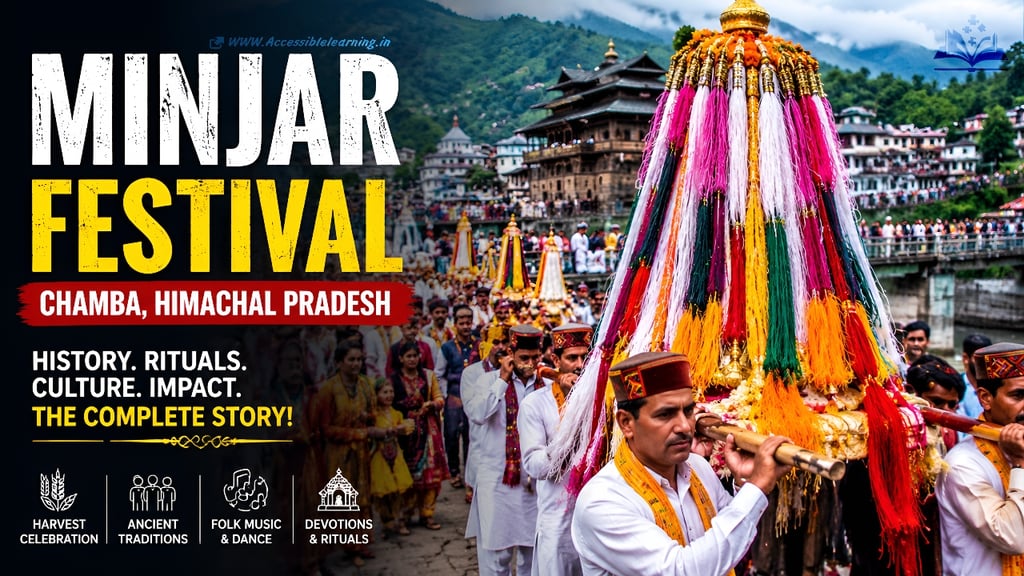
The Minjar Festival is not just a religious event. It is Himachal Pradesh's annual declaration that local culture still matters in an era obsessed with modernization.
Held in the historic town of Chamba, this week-long festival usually takes place during the monsoon season and attracts thousands of pilgrims, traders, performers, officials, and tourists. What looks like a colorful celebration on the surface actually carries centuries of political history, agricultural symbolism, and regional pride.
The Festival Began as a Celebration of Survival and Prosperity
The word "Minjar" refers to the silk tassels that symbolize maize flowers and ripening paddy crops. Farmers traditionally exchanged these tassels as a prayer for a successful harvest.
The roots of the festival stretch back more than a thousand years. Historical accounts connect the celebration to the victory of Chamba's rulers over neighboring territories and the expansion of their kingdom. Agriculture and political power became intertwined, and Minjar evolved into a public display of both prosperity and authority.
Unlike many modern festivals that exist mainly for tourism, Minjar emerged from practical realities. People depended on successful crops, stable governance, and favorable weather. The festival became a collective expression of gratitude and hope.
Chamba Becomes the Cultural Capital of Himachal for One Week
During Minjar, the quiet mountain town of Chamba transforms completely.
Traditional processions move through the streets. Folk musicians fill public spaces. Dancers perform regional traditions that many younger generations rarely encounter in daily life.
The event attracts participants from across Himachal Pradesh and neighboring regions. Local artisans, handloom workers, and craftsmen use the festival to showcase products that struggle to compete with mass-produced goods.
This transformation creates a powerful economic surge. Hotels fill up. Restaurants experience record demand. Local vendors generate significant seasonal income.
The reality, however, remains more complicated than tourism brochures suggest. Chamba's infrastructure faces enormous pressure during the festival. Traffic congestion, waste management challenges, and crowd control become serious logistical concerns.
The festival generates revenue, but it also exposes the limits of local infrastructure.
The Grand Procession Is the Heart of the Festival
Every major festival has a defining moment. For Minjar, it is the ceremonial procession.
Devotees carry offerings, local deities receive public honors, and traditional leaders participate alongside government representatives. The event creates a rare space where religion, politics, and community identity intersect openly.
The procession eventually moves toward the Ravi River.
Participants carry coconuts, fruits, flowers, and Minjar tassels as symbolic offerings. The ritual reflects gratitude for water, fertility, and agricultural abundance.
Many observers see only colorful costumes and music. They miss the deeper message: mountain communities have always depended on rivers, rainfall, and land. The ceremony publicly acknowledges that dependence.
Agriculture Still Drives the Festival's Core Message
Modern visitors often focus on cultural performances and photography opportunities. That misses the point.
Minjar remains fundamentally tied to agriculture. The festival celebrates the crops that historically sustained the region. Even as urbanization grows and younger generations leave villages for cities, the agricultural symbolism remains central.
This connection explains why the festival continues to resonate across generations.
The message remains simple: without successful harvests, cultural traditions cannot survive.
In an age dominated by technology and service-sector jobs, Minjar serves as a reminder that food security still depends on farmers and rural communities.
Folk Culture Gets a Rare Moment in the Spotlight
Himachal Pradesh possesses an extraordinary cultural heritage, but much of it struggles for visibility outside the state. Minjar changes that.
Traditional dance forms, local music, regional costumes, and indigenous customs receive widespread attention during the festival. Performers who spend most of the year outside the public spotlight suddenly become cultural ambassadors.
This visibility matters.
Across India, countless local traditions face pressure from homogenized entertainment, social media trends, and commercial culture. Festivals like Minjar function as cultural preservation mechanisms.
Without such platforms, many traditions could disappear within a generation.

Tourism Loves Minjar, But Commercialization Brings Risks
Every successful cultural festival faces the same challenge.
Popularity attracts money.
Money attracts commercialization.
Commercialization often weakens authenticity.
Minjar stands at this crossroads today.
Tourism generates employment and boosts local businesses. At the same time, excessive commercialization risks reducing a deeply rooted cultural celebration into a staged attraction designed primarily for visitors.
Organizers constantly balance preservation and promotion. The challenge remains significant: how do you expand economic benefits without turning heritage into a product?
There is no easy answer.
Why Minjar Festival Matters Beyond Himachal Pradesh
Minjar represents something larger than a regional celebration. It demonstrates how local identity survives despite globalization, urban migration, and cultural standardization.
Many communities across India struggle to preserve traditions while adapting to modern realities. Chamba's annual festival shows that cultural continuity remains possible when communities actively participate rather than passively observe.
The festival also highlights an uncomfortable truth.
People often celebrate culture after it becomes endangered. Communities rarely invest in preservation when traditions remain strong.
Minjar succeeds because residents continue treating it as a living tradition rather than a museum exhibit.
The Real Legacy of Minjar Festival
The Minjar Festival survives because it serves multiple purposes simultaneously.
It honors agricultural heritage.
It strengthens community identity.
It supports local economies.
It preserves regional traditions.
It reminds younger generations where they come from.
Most importantly, it proves that cultural festivals do not need to choose between history and relevance.
While countless traditional events fade into obscurity, Minjar continues to evolve without abandoning its roots. That balance explains why this centuries-old celebration remains one of Himachal Pradesh's most significant cultural observances.
For one week every year, Chamba does more than celebrate a festival. It reminds an entire region that identity, heritage, and community still carry value in a rapidly changing world.
Subscribe To Our Newsletter
All © Copyright reserved by Accessible-Learning Hub
| Terms & Conditions
Knowledge is power. Learn with Us. 📚

