

Mao Zedong: Revolutionary Leader Who Shaped Modern China | Complete Biography
Discover Mao Zedong's complex legacy: a revolutionary leader who unified China, implemented radical policies, and shaped modern Chinese history. Full biography inside.
CHINATHE GREAT LEADERCHINESE HISTORYBIOGRAPHY/HISTORY
Jian Yu
12/20/20258 min read
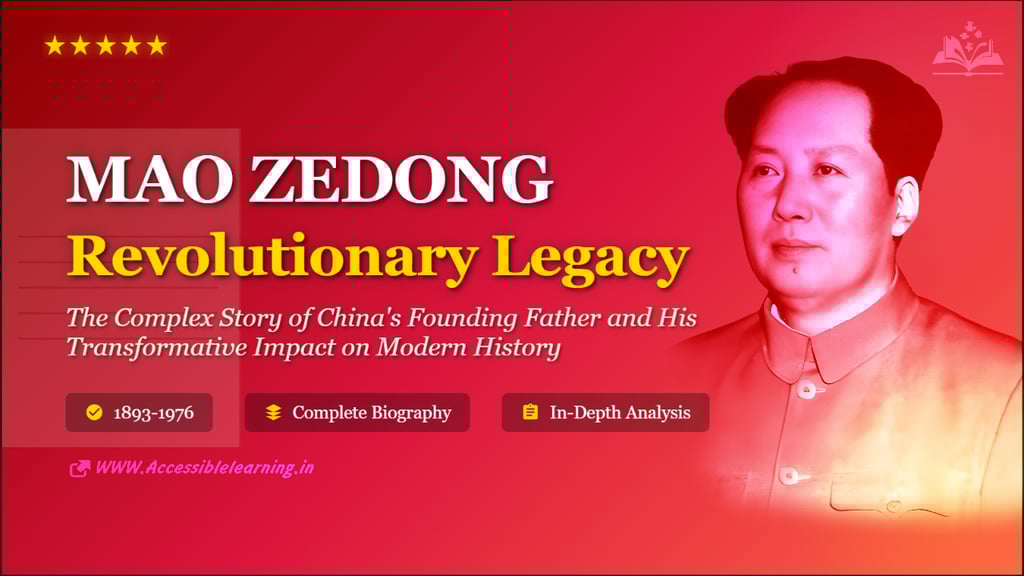
Mao Zedong remains one of the most influential and controversial figures of the 20th century. As the founding father of the People's Republic of China, his leadership transformed a feudal society into a communist state, while his policies resulted in both industrial progress and catastrophic human suffering. Understanding Mao's life and legacy is essential to comprehending modern China's political landscape and its relationship with the world.
Early Life and Revolutionary Beginnings
Born on December 26, 1893, in Shaoshan village, Hunan Province, Mao Zedong grew up in a peasant family that had achieved modest prosperity. His father was a strict disciplinarian and grain dealer, while his mother practiced Buddhism and showed greater compassion toward the poor—a contrast that would shape Mao's worldview.
During his formative years, Mao witnessed the decline of the Qing Dynasty and the struggles of rural Chinese peasants. These experiences planted the seeds of his revolutionary ideology. After completing his education at the First Normal School of Changsha, Mao became increasingly involved in political activism and Marxist study groups.
The Birth of a Communist Revolutionary
In 1921, Mao attended the first meeting of the Chinese Communist Party (CCP) in Shanghai, becoming one of its founding members. Unlike many urban intellectuals who dominated the early party leadership, Mao recognized the revolutionary potential of China's vast peasant population—a perspective that would define his approach to communist revolution.
Rise to Power: The Long March and Beyond
Mao's ascent within the Communist Party was neither swift nor straightforward. Throughout the 1920s and early 1930s, he struggled against rival factions and competing ideologies within the CCP. His fortunes changed during the legendary Long March of 1934-1935.
The Long March: A Defining Moment
Facing annihilation by Nationalist forces led by Chiang Kai-shek, approximately 100,000 Communist troops embarked on a strategic retreat covering over 6,000 miles. Only about 8,000 survived the treacherous journey through mountains, rivers, and enemy territory. During this ordeal, Mao emerged as the party's paramount leader, solidifying his position at the Zunyi Conference in 1935.
The Long March became a foundational myth in Communist Chinese history, demonstrating the party's resilience and Mao's strategic genius. This epic journey allowed the Communists to regroup in Yan'an, where Mao developed his theoretical framework combining Marxism-Leninism with Chinese characteristics.
The Chinese Civil War and Victory
Following World War II and the defeat of Japanese forces in China, the civil war between Communists and Nationalists resumed with renewed intensity. Despite being outnumbered and outgunned, Mao's forces employed guerrilla warfare tactics and won widespread peasant support through land reform promises.
By 1949, the Nationalist government collapsed, and Chiang Kai-shek fled to Taiwan. On October 1, 1949, Mao stood atop Tiananmen Gate and proclaimed the establishment of the People's Republic of China, declaring that "the Chinese people have stood up."


Mao's China: Transformation and Tragedy
Land Reform and Early Policies (1949-1957)
Mao's initial years in power focused on consolidating Communist control and restructuring Chinese society. Land reform campaigns redistributed property from landlords to peasants, while political campaigns targeted perceived enemies of the state. These early years saw genuine improvements in literacy, healthcare, and women's rights, but also brutal purges that claimed hundreds of thousands of lives.
The Great Leap Forward (1958-1962)
Perhaps Mao's most catastrophic policy failure, the Great Leap Forward aimed to rapidly transform China from an agrarian economy into an industrialized socialist society. Mao believed China could surpass Western industrial powers through sheer willpower and mass mobilization.
The campaign's hallmarks included
Collectivization of agriculture into massive communes
Backyard steel furnaces producing low-quality metal
Unrealistic production quotas and false reporting
Diversion of agricultural labor to industrial projects
The results were devastating. Poor planning, environmental disasters, and ideological rigidity led to the Great Chinese Famine, which claimed an estimated 15 to 45 million lives between 1959 and 1961—one of the deadliest famines in human history. Despite mounting evidence of catastrophe, Mao refused to abandon his policies, and local officials fabricated success reports to avoid punishment.
The Cultural Revolution (1966-1976)
After being sidelined following the Great Leap Forward's failure, Mao launched the Cultural Revolution to reassert his authority and purge the party of "capitalist roaders" and "counter-revolutionaries." He mobilized young people into Red Guard units who attacked traditional culture, intellectuals, and anyone deemed insufficiently revolutionary.
The Cultural Revolution's impact included:
Destruction of cultural heritage sites, artifacts, and historical texts
Persecution of millions, including teachers, artists, and party officials
Disruption of education, with universities closed for years
Economic stagnation and social chaos
An estimated 1.5 to 2 million deaths
The period didn't end until Mao's death in 1976, leaving China traumatized and economically weakened.
Mao Zedong Thought: Ideology & Philosophy
Mao developed a distinctive interpretation of Marxism-Leninism adapted to Chinese conditions. Key elements of Mao Zedong Thought include:
Continuous Revolution
Mao believed that class struggle must continue even after the socialist revolution succeeded. This concept justified repeated political campaigns and purges to prevent the restoration of capitalism.
Mass Line
Mao emphasized connecting with the masses, learning from ordinary people, and mobilizing them for revolutionary action. This principle stressed the importance of maintaining ties between party leadership and the population.
Guerrilla Warfare Theory
His military writings emphasized flexibility, mobility, and winning popular support. Mao famously wrote that guerrillas must move among the people "as fish swim in the sea," highlighting the importance of popular backing.
Self-Reliance
Mao promoted self-sufficiency and independence from foreign powers, particularly the Soviet Union after the Sino-Soviet split in the 1960s. This philosophy shaped China's isolationist policies during much of his rule.
Foreign Policy and International Relations
Mao's foreign policy evolved significantly throughout his leadership. Initially aligned closely with the Soviet Union, China received substantial aid and advisors in the 1950s. However, ideological differences and geopolitical tensions led to the Sino-Soviet split, leaving China diplomatically isolated.
A watershed moment came in 1972 when President Richard Nixon visited China, opening diplomatic relations between the two countries. This strategic realignment, facilitated by National Security Advisor Henry Kissinger, fundamentally altered Cold War dynamics and positioned China for future engagement with the West.
Personal Life and Character
Mao's personal life reflected the contradictions of his public persona. He married four times, with his relationships often intertwined with political developments. His final wife, Jiang Qing, became a powerful political figure during the Cultural Revolution as a member of the notorious Gang of Four.
Those who knew Mao described him as charismatic, intellectually curious, and capable of great charm. He was also an accomplished poet who appreciated classical Chinese literature even while his campaigns destroyed cultural treasures. Yet he could be ruthlessly pragmatic, willing to sacrifice millions for his ideological goals, and intolerant of dissent.
Legacy and Historical Assessment
Mao Zedong's legacy remains deeply contested both within China and internationally. The Chinese Communist Party officially acknowledges that Mao made "gross mistakes" during the Cultural Revolution but maintains that his contributions outweigh his errors, typically framing his legacy as "70 percent good, 30 percent bad."
Positive Aspects of Mao's Legacy
Supporters point to several achievements:
Unifying China after decades of civil war and foreign invasion
Improving literacy rates and basic healthcare access
Advancing women's rights and social equality
Establishing China as an independent world power
Creating infrastructure for future economic development
Negative Aspects and Criticisms
Critics emphasize the immense human cost:
Tens of millions of deaths from famine, persecution, and political campaigns
Destruction of cultural heritage and traditional values
Economic stagnation and missed development opportunities
Cult of personality and authoritarian governance
Suppression of intellectual freedom and dissent
Mao's Influence on Modern China
Despite the catastrophic failures of his later years, Mao's influence on contemporary China remains profound. His image adorns Tiananmen Square and Chinese currency. The Communist Party continues to invoke his name and ideology while implementing economic policies he would have considered capitalist betrayals.
Current Chinese leadership walks a delicate balance—maintaining Mao's symbolic authority while quietly repudiating many of his actual policies. Deng Xiaoping's market reforms beginning in 1978 represented a fundamental departure from Maoist economics, yet were justified as adapting Mao Zedong Thought to new circumstances.
Comparative Historical Perspective
Mao stands among the 20th century's most transformative and destructive leaders. His death toll rivals or exceeds that of Joseph Stalin, though this comparison remains politically sensitive. Unlike Hitler, whose legacy is universally condemned, or Stalin, whose reputation has declined in Russia, Mao remains an officially revered figure in China.
This official veneration reflects practical political considerations: completely repudiating Mao would undermine the Communist Party's legitimacy, since he founded the current regime. Therefore, Chinese authorities carefully manage historical discussions about Mao, censoring the most critical assessments while acknowledging certain mistakes.
Frequently Asked Questions
Q: What was Mao Zedong known for?
Mao Zedong was the founding father of the People's Republic of China and the paramount leader of the Chinese Communist Party from 1935 until his death in 1976. He is known for leading the Communist revolution that unified China, implementing radical social and economic policies including the Great Leap Forward and Cultural Revolution, and developing Mao Zedong Thought as an adaptation of Marxism-Leninism to Chinese conditions.
Q: How many people died under Mao Zedong's rule?
Scholarly estimates suggest that between 40 and 80 million people died as a result of Mao's policies, with the majority perishing during the Great Chinese Famine (1959-1962) caused by the Great Leap Forward. The Cultural Revolution claimed an additional 1.5 to 2 million lives. These figures remain contested and politically sensitive, with exact numbers difficult to determine due to incomplete records and government secrecy.
Q: What was the Great Leap Forward?
The Great Leap Forward (1958-1962) was Mao's campaign to rapidly industrialize China and collectivize agriculture through massive communes and backyard steel furnaces. The policy proved catastrophic, disrupting agricultural production and causing the Great Chinese Famine, which killed tens of millions. Unrealistic quotas, poor planning, and false reporting by terrified officials exacerbated the disaster.
Q: What was Mao's Cultural Revolution?
The Cultural Revolution (1966-1976) was a sociopolitical movement launched by Mao to reassert his authority and purge "capitalist" elements from Chinese society. Mao mobilized young Red Guards who attacked traditional culture, persecuted intellectuals, and destroyed historical artifacts. The period brought economic disruption, educational collapse, and widespread violence before ending with Mao's death.
Q: How is Mao Zedong viewed in China today?
Mao remains an officially revered figure in contemporary China, with his portrait displayed in Tiananmen Square and on currency. The Communist Party maintains that his contributions outweigh his mistakes, typically using the formulation "70 percent good, 30 percent bad." However, his economic policies have been thoroughly abandoned in favor of market reforms, and open criticism of Mao remains politically sensitive and often censored.
Q: What was Mao Zedong's relationship with the Soviet Union?
Initially, Mao's China was closely allied with the Soviet Union, receiving substantial aid and advisors in the 1950s. However, ideological disagreements and geopolitical tensions led to the Sino-Soviet split in the early 1960s, leaving China diplomatically isolated until rapprochement with the United States in the 1970s.
Q: Did Mao Zedong write any books?
Yes, Mao was a prolific writer. His most famous works include the "Little Red Book" (Quotations from Chairman Mao Zedong), which became mandatory reading during the Cultural Revolution, and numerous essays on guerrilla warfare, political philosophy, and revolutionary strategy. He was also an accomplished poet who wrote in classical Chinese styles.
Q: What was the Long March?
The Long March (1934-1935) was a military retreat by Communist forces covering over 6,000 miles to escape Nationalist encirclement. Of approximately 100,000 who began the journey, only about 8,000 survived. The ordeal established Mao as the Communist Party's paramount leader and became a foundational legend in Chinese revolutionary history.
Mao Zedong transformed China from a fragmented, semi-colonial society into a unified nation-state capable of challenging global powers. He improved literacy, advanced women's rights, and ended centuries of foreign domination. Yet these achievements came at an almost incomprehensible human cost—tens of millions dead from famine, persecution, and ideological excess.
Understanding Mao requires acknowledging both aspects of this legacy without minimizing either his transformative impact or his catastrophic failures. For China, Mao represents both national pride and collective trauma—a contradiction the country continues to navigate decades after his death.
Today, as China emerges as a global superpower with an economy built on market principles Mao would have considered heretical, his shadow still looms large. The Communist Party derives its legitimacy from the revolution he led, even as it pursues policies he would have condemned. This paradox defines modern China: a nation simultaneously shaped by and moving beyond the legacy of its founding revolutionary leader.
For historians, students of political science, and anyone seeking to understand contemporary China, engaging seriously with Mao Zedong's life and legacy remains essential. His story offers profound lessons about revolutionary transformation, the dangers of unchecked power, and the complex relationship between noble intentions and catastrophic outcomes—themes that continue to resonate in our world today.
Subscribe To Our Newsletter
All © Copyright reserved by Accessible-Learning Hub
| Terms & Conditions
Knowledge is power. Learn with Us. 📚

