

Machine Learning Explained in the Easiest Way Possible
A simple and clear breakdown of how machine learning works, explained in a human-centered way. This guide covers how machines learn from data, the step-by-step ML process, different learning types, real-world applications, and why machine learning is shaping the future.
EDUCATION/KNOWLEDGEPROGRAMMINGAI/FUTURE
Sachin K Chaurasiya
11/28/20254 min read
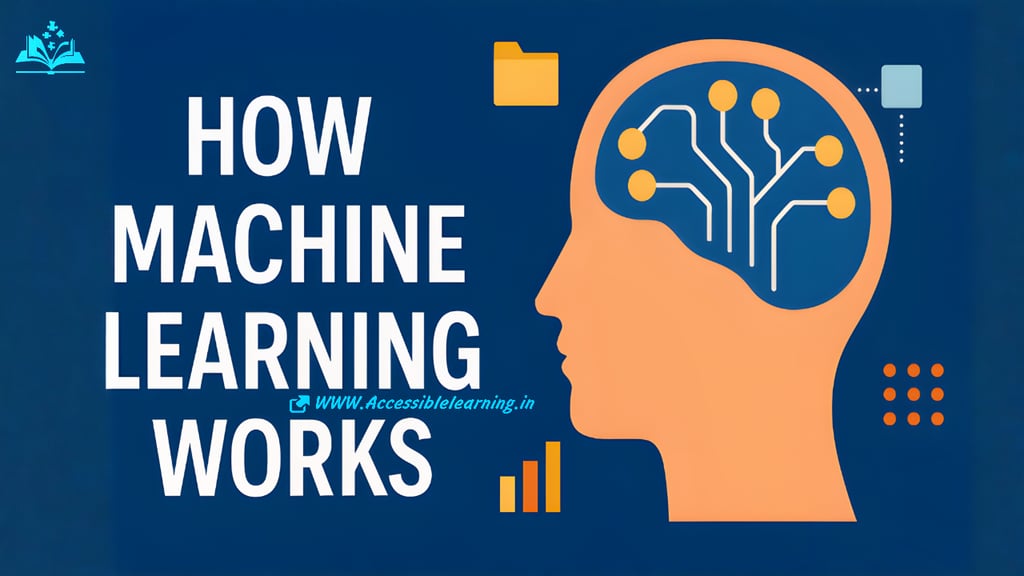
Machine learning often looks complicated from the outside, but the core idea is simple. It’s a method where computers learn from data instead of following fixed instructions. This helps machines make predictions, recognize patterns, and improve as they receive more information.
Below is an expanded, in-depth look at how machine learning actually works, why it matters, and where you see it in daily life.
What Machine Learning Actually Does
Machine learning replaces “manual rules” with “learning by example.” Instead of telling a system what to do, you show it enough examples so it can figure things out on its own.
For instance: A programmer doesn’t write a rule that says, “If the image has whiskers and pointy ears, it’s a cat.” The machine simply looks at thousands of images and identifies the pattern of what a cat typically looks like.
This gives the system flexibility, which is why machine learning performs well even when the task is complex or the data is unpredictable.
A More Detailed View of the Machine Learning Process
Collecting Data
This is the foundation. The quality and quantity of data determine how well the model performs. Data sources include:
Photos
Videos
Text documents
Audio recordings
Website logs
Financial transactions
IoT sensor readings
Medical scans
The more diverse and rich the data, the smarter the system becomes.
Cleaning and Preparing Data
This step is often the most time-consuming. Real-world data contains:
Missing values
Duplicate entries
Incorrect formats
Outliers
Noise
Data scientists fix these issues so the model receives clean, meaningful information.
Feature Selection and Engineering
A feature is a specific piece of information used for learning.
Example: For predicting house prices, features include size, location, rooms, age, and material.
Feature engineering makes learning easier by:
Extracting useful patterns
Removing irrelevant factors
Transforming raw data into usable insights
Good features = better accuracy.
Choosing the Right Algorithm
Algorithms are learning tools. Each works best for specific tasks.
Common examples include:
Linear Regression – predictions
Logistic Regression – classification
Decision Trees – rule-based decisions
Random Forest – combining many trees
Support Vector Machines – strong classification
Neural Networks – deep and complex pattern learning
K-Means – grouping items
Naive Bayes – text-based tasks
Choosing the wrong algorithm can weaken accuracy, even with good data.
Training the Model
This is where learning happens. The model repeatedly studies the training data, makes predictions, compares results, and adjusts itself using mathematical formulas. This cycle continues until it reaches the best accuracy possible.
Validating the Model
To ensure the model isn't memorizing the data, it is tested on new information it has never seen before.
This helps check:
Real-world performance
Accuracy
Reliability
Error rates
Bias or imbalance
Overfitting or underfitting
Deployment
Once approved, the model goes live in apps, websites, devices, or backend systems.
It now interacts with real users and real data.
Continuous Learning
Modern systems keep learning automatically. Whenever new data enters, the model updates and improves. This is why recommendation systems, search engines, and spam filters get better with time.

Types of Machine Learning
Semi-Supervised Learning
A mix of labeled and unlabeled data. Useful when labeling everything is expensive or slow.
Self-Supervised Learning
The model generates its own labels from raw data.
This is widely used in large language models and vision systems.
Deep Learning
A subfield of machine learning using neural networks with many layers.
Deep learning powers:
Facial recognition
Voice assistants
Autonomous vehicles
Image generation
Large AI models like GPT, Gemini, and Claude
Where Machine Learning Is Used Today
Business
Demand forecasting
Customer segmentation
Sales prediction
Fraud detection
HR hiring filters
Technology
Social media feed ranking
Search algorithms
Virtual assistants
Content moderation
Healthcare
Early disease detection
Personalized treatment
Radiology image analysis
Finance
Credit scoring
Stock market prediction
Risk management
Manufacturing
Quality inspection
Predictive maintenance
Automation robots
Education
Adaptive learning systems
AI tutors
Test scoring
Transportation
Traffic management
Route optimization
Self-driving systems
Machine learning is now a part of almost every digital service.
Insights That Make Machine Learning Powerful
Machines Don’t Just Learn Patterns; They Learn Probability
Instead of giving an absolute answer, models estimate probabilities:
Example: “There is an 89% chance this email is spam.”
Models Improve With More Data
The more examples they observe, the smarter and more accurate they become.
Machines Learn Faster Than Humans
Tasks that take years for humans to master can be learned by a model in hours with enough data.
ML Can Find Hidden Patterns
Some relationships are too complex for humans to notice.
Machine learning reveals those hidden insights automatically.
ML Reduces Human Error
Since it works on data and math, it avoids emotional or biased decisions—unless the data itself is biased.
Real-Life Examples That You Don’t Notice
Google Photos can group your memories by face and location
Ride-hailing apps set prices using ML
Banks approve or decline loans automatically
Smart fridges suggest recipes
Weather apps predict rainfall using ML models
Email apps auto-suggest full sentences
Cars detect lanes using computer vision
Currency exchanges detect fake notes with ML
Machine learning is running behind the scenes in almost everything.
The Future of Machine Learning
Machine learning is moving towards:
Better explainability
Safer AI systems
Self-improving models
Human-like reasoning
Real-time learning
More personalized digital experiences
As ML evolves, it blends more naturally into everyday life.
Machine learning isn’t just a technology. It’s a learning process inspired by how humans understand the world. With more data, more experience, and more training, machines become better at making decisions and predicting outcomes.
It already powers daily tools like maps, online shopping, photos, entertainment apps, banking systems, and healthcare machines. And as the technology advances, it will continue to transform how we work, learn, and live.

FAQs
Q: What is machine learning in simple words?
Machine learning is a way for computers to learn from examples instead of being programmed with fixed rules. The more data it studies, the better it becomes at making predictions and decisions.
Q: How is machine learning different from traditional programming?
Traditional programming requires step-by-step instructions. Machine learning studies data, finds patterns automatically, and adjusts itself without needing constant manual rules.
Q: Do you need a lot of data for machine learning?
Most machine learning models improve with more data. Some simple models work with small datasets, but complex systems like image recognition and AI assistants need large amounts of high-quality data.
Q: Is machine learning the same as AI?
Machine learning is a branch of AI. AI focuses on making systems intelligent, while machine learning teaches systems to learn from data.
Q: What are the main types of machine learning?
The three core types are supervised learning, unsupervised learning, and reinforcement learning. There are also advanced forms like deep learning and self-supervised learning.
Q: Where is machine learning used in daily life?
You see machine learning in Google Maps, YouTube recommendations, online shopping, spam filters, banking fraud detection, smart home devices, and face unlock features.
Q: Do machine learning models make mistakes?
Yes. Models can be wrong if the data is biased, incomplete, or poorly prepared. This is why testing, validation, and updating are important.
Q: Is machine learning difficult to learn?
The concepts are simple, but advanced ML requires math, coding, and experience with data. Beginners usually start with basic algorithms and small projects.
Q: Can machine learning replace humans?
Machine learning automates repetitive and data-heavy tasks, but it doesn’t replace human creativity, judgment, or emotional understanding. It works best when combined with human decision-making.
Q: What is deep learning?
Deep learning is a more advanced form of machine learning that uses neural networks with many layers. It powers vision systems, speech recognition, and large AI models.
Subscribe To Our Newsletter
All © Copyright reserved by Accessible-Learning Hub
| Terms & Conditions
Knowledge is power. Learn with Us. 📚

