

Lohri: The Fire Festival That Celebrates Harvest, Hope, and Community
Lohri is a vibrant harvest festival rooted in Punjab’s agrarian culture, marking the end of winter and the return of longer days. This article explores the history, rituals, folklore, food traditions, social meaning, and modern relevance of Lohri, revealing why it remains a powerful symbol of community, gratitude, and seasonal renewal.
CULTURE/TRADITIONINDIA/BHARATCELEBRATION/FESTIVALS
Keshav Jha
1/4/20264 min read
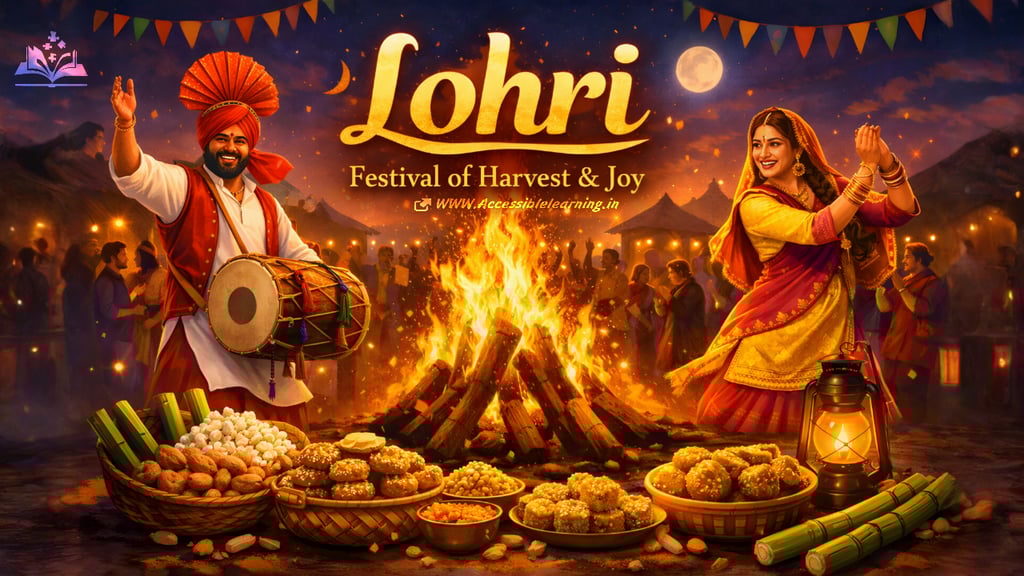
Lohri is one of those festivals that cannot be understood by date alone. It lives in fields, courtyards, folk songs, and family rituals. Celebrated mainly in Punjab, Haryana, Himachal Pradesh, and parts of North India, Lohri marks a seasonal turning point where winter begins to loosen its grip and daylight slowly grows longer.
Observed every year on 13 January, Lohri stands at the intersection of agriculture, astronomy, folklore, and social life. It is both a celebration and a pause, a reminder that human life has always moved in rhythm with nature.
Seasonal and Astronomical Context
Lohri is closely connected to the solar cycle. It falls just before Makar Sankranti, when the sun begins its northward journey, known as Uttarayan.
This shift has deep meaning in traditional societies:
Longer days symbolized renewed energy and productivity
The weakening of winter was associated with hope and survival
Sunlight was seen as a life-giving force for crops and people alike
Lohri celebrates this transition not through temples or formal worship, but through open-air gatherings and shared rituals.
Deep Roots in Agrarian Life
Punjab has historically been an agricultural land, and Lohri reflects the emotions of farming communities waiting for the wheat harvest.
Wheat is sown in October and matures after Lohri
Farmers celebrate having crossed the hardest winter phase
The festival expresses gratitude for soil fertility and seasonal balance
Unlike harvest festivals that celebrate abundance after reaping, Lohri celebrates anticipation. It honors effort, patience, and faith before results are visible.
The Bonfire as a Social and Symbolic Center
The Lohri bonfire is not decorative. It is functional, symbolic, and emotional.
Symbolically, the fire represents:
The sun’s warmth returning to earth
Protection against cold and darkness
Letting go of negativity and hardship
Socially, it acts as:
A gathering point where hierarchy dissolves
A shared space for elders, children, and guests
A reminder of communal living in village culture
Offerings thrown into the fire are gestures of respect toward natural forces rather than religious obligations.
Folklore and the Power of Oral History
Lohri keeps alive a strong oral tradition. Folk songs sung during the festival preserve stories that never entered textbooks.
The legend of Dulla Bhatti is central:
Remembered as a rebel who helped poor girls get married
Seen as a symbol of resistance and social justice
Celebrated not as royalty, but as a protector of the common people
Through Lohri songs, history survives in emotion rather than dates.
Lohri and Gender Traditions
Traditionally, Lohri celebrations were more publicly visible for male children, reflecting older social structures. However, this has been changing.
Modern celebrations increasingly:
Celebrate the birth of daughters equally
Highlight inclusivity and social balance
Reinterpret rituals in progressive ways
This evolution shows that Lohri is not frozen in the past. It adapts while keeping its emotional core intact.
Food as Seasonal Wisdom
Lohri food is deeply aligned with climate and nutrition.
Common ingredients like jaggery, sesame seeds, peanuts, and maize:
Generate body heat during winter
Provide energy for physical labor
Use locally available produce
These foods reflect traditional knowledge of seasonal eating long before nutrition science formalized it.
Community Bonding and Collective Joy
Lohri is a festival without isolation. It is meant to be experienced together.
Neighbors exchange greetings and food
Children learn cultural values through participation
Elders pass down stories, songs, and customs
In rural settings, Lohri strengthens village identity. In cities, it recreates that sense of belonging within modern spaces.


Urban Celebrations and Cultural Continuity
As lifestyles change, Lohri has found new forms of expression:
Housing societies organize shared events
Cultural groups perform folk music on stage
Digital platforms help spread awareness among younger generations
Even when celebrated in smaller ways, the spirit of Lohri remains rooted in warmth and connection.
Emotional and Psychological Meaning
Lohri offers something rare in modern life: pause and presence.
It reminds people to:
Celebrate effort, not just outcomes
Find warmth in human connection
Respect cycles instead of rushing through them
The fire becomes a space for reflection, laughter, and release.
Why Lohri Remains Relevant Today
Lohri continues to matter because it answers a human need that never disappears:
The need to gather
The need to hope
The need to mark time meaningfully
In an age of fast change, Lohri quietly reminds people that seasons still turn, and community still heals.
Lohri is not just a festival of Punjab. It is a living reminder of how humans once understood time, nature, and togetherness. Through fire, food, music, and shared presence, Lohri celebrates survival, patience, and renewal.
As long as people gather around a flame on a cold January night, sharing warmth and stories, Lohri will continue to burn bright.
FAQ's
Q: What is Lohri, and why is it celebrated?
Lohri is a traditional winter festival celebrated mainly in Punjab and North India. It marks the end of the coldest winter phase, the return of longer days, and expresses gratitude for crops, sunlight, and seasonal balance.
Q: On which date is Lohri celebrated every year?
Lohri is celebrated on 13 January each year, a day before Makar Sankranti, and is linked to the sun’s northward movement.
Q: What is the significance of the Lohri bonfire?
The bonfire symbolizes warmth, the sun’s energy, and the release of negativity. People gather around it to offer food items and celebrate unity, renewal, and hope.
Q: Why is Lohri important for farmers?
For farmers, Lohri represents a key stage in the wheat-growing season. It is a time to celebrate crossing the harsh winter period and to express gratitude before the harvest begins.
Q: What foods are traditionally eaten during Lohri?
Traditional Lohri foods include makki di roti, sarson da saag, rewri, gajak, peanuts, popcorn, and jaggery-based sweets, all suited to winter nutrition.
Q: Who is Dulla Bhatti, and why is he remembered on Lohri?
Dulla Bhatti was a folk hero of Punjab remembered for helping the poor and standing against injustice. His story is kept alive through Lohri folk songs.
Q: Is Lohri only celebrated in Punjab?
While Lohri is most strongly associated with Punjab, it is also celebrated in Haryana, Himachal Pradesh, Delhi, and by Punjabi communities worldwide.
Q: How is Lohri celebrated in modern urban settings?
In cities, Lohri is celebrated through community gatherings, cultural programs, music, dance, and shared meals, adapting traditional rituals to modern lifestyles.
Subscribe To Our Newsletter
All © Copyright reserved by Accessible-Learning Hub
| Terms & Conditions
Knowledge is power. Learn with Us. 📚

