

Living in USA as a Foreigner: 12 Years of Challenges and Experiences
Discover the hidden realities of living in the USA as a foreigner after 12 years. Explore long-term expat life, USA residency challenges, immigration laws, cost of living vs quality of life, and what it truly takes to build a permanent home in America.
ACCESSIBLE LEARNING
Jagdish Nishad | Kim Shin
7/15/20268 min read
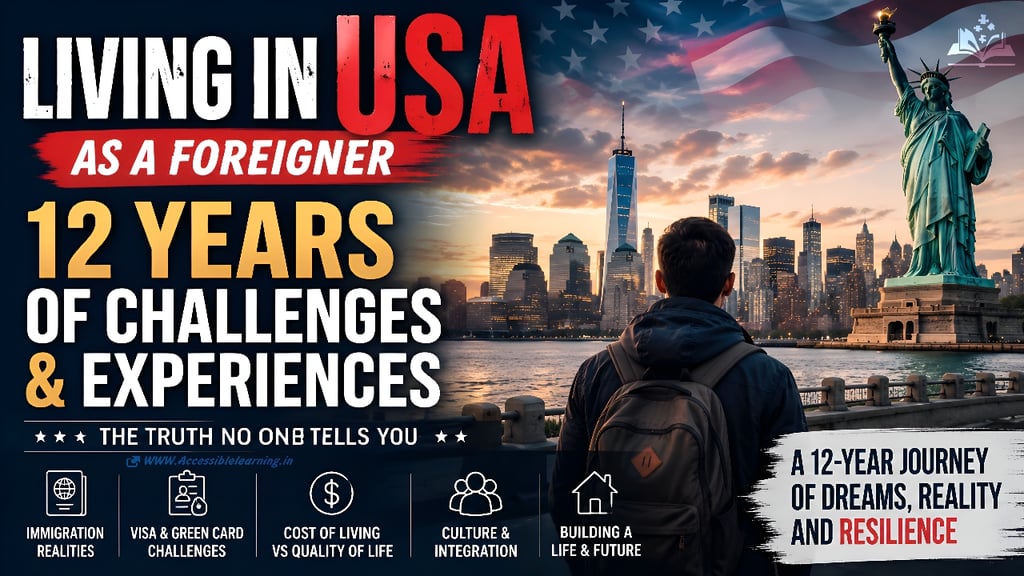

The hidden realities of building a life in America after the honeymoon phase ends.
The Illusion of Arrival
The first year in the United States feels like standing inside a film you've watched your entire life.
The highways are wider than expected. The supermarkets seem endless. Every state feels like its own country. From the glass towers of Manhattan to the quiet suburbs outside Dallas, from the tech campuses of Silicon Valley to the neighborhoods surrounding Chicago's Loop, everything carries an energy that convinces you opportunity is everywhere.
At first, America rewards momentum.
You secure a job, rent your first apartment, open a bank account, receive your Social Security Number, and slowly begin understanding the systems that make daily life function. You learn which grocery stores fit your budget, which neighborhoods feel safe after dark, and why everyone seems to spend so much time in their cars. Small victories begin to replace the uncertainty of arrival.
For a while, it feels as though you've made it.
But twelve years have a way of stripping away illusions.
The excitement of exploring famous landmarks eventually gives way to something far less glamorous. You stop taking photographs of every skyline because they become part of your daily commute. The subway platforms in New York, the Metro stations in Washington, D.C., the CTA trains in Chicago, or the endless traffic crawling along Interstate 405 in Los Angeles become ordinary inconveniences rather than exciting experiences.
You are no longer a visitor.
You pay taxes. You understand credit scores. You know when property taxes are due, how health insurance deductibles work, and why Americans discuss mortgage interest rates over dinner. Friends back home imagine your life through social media photos, but those snapshots never show the paperwork, the waiting, or the invisible calculations happening behind every major decision.
That is when the real story begins.
Long-term expat life in the USA is not defined by arrival. It is defined by what happens after the novelty disappears.
The Cold Shower
Here is the unvarnished truth.
The greatest challenge of living in the United States after more than a decade is rarely cultural. Most long-term residents speak fluent English, understand workplace expectations, celebrate local holidays, and have built successful careers.
The real challenge is learning to live with uncertainty.
There is a quiet psychological burden that many Americans never experience because they were born inside the system. Foreign residents carry it every single day.
Every promotion raises a legal question.
Can I accept this job without affecting my immigration status?
Every career change becomes an immigration decision.
Can my employer sponsor me?
Every overseas family emergency creates anxiety.
Will I be allowed back into the country without complications?
Even buying a house, starting a business, or planning retirement often begins with the same uncomfortable question.
How secure is my legal future here?
That uncertainty changes the way you live.
Many immigrants hesitate before making long-term investments because they know immigration policy can change. Some delay having children. Others remain in jobs they no longer enjoy because leaving would jeopardize their immigration status. Families postpone major life decisions while waiting for paperwork that moves through government systems at a pace no individual can control.
This is the hidden emotional tax of immigration.
You may look completely settled from the outside, yet internally you are constantly calculating risk.
What no one tells you before you pack your bags is that building a life in America often means learning to live inside uncertainty while pretending everything feels stable.
The Bureaucratic Reality: Where Life Meets the Law
Dreams may bring people to America.
Government policy determines how long they stay.
The United States immigration system is one of the most detailed and legally complex in the world. For long-term foreign residents, daily life is closely connected to several federal agencies whose decisions influence careers, finances, and family planning.
The U.S. Citizenship and Immigration Services (USCIS) processes applications for employment authorization, Green Cards, adjustment of status, naturalization, and many other immigration benefits. The U.S. Department of State controls visa issuance through American embassies and publishes the monthly Visa Bulletin that determines when immigrant visas become available. The U.S. Department of Labor oversees labor certification requirements for many employment-based Green Card applications, while U.S. Customs and Border Protection (CBP) controls entry into the country at airports and land borders.
Most immigrants quickly learn that every immigration category creates a different life.
Professionals often arrive through H-1B visas, which remain subject to annual numerical caps and lottery selection. Executives and multinational employees frequently use L-1 visas, while individuals with internationally recognized achievements may qualify under the O-1 visa category. Students begin with F-1 visas, transition through Optional Practical Training (OPT), and then hope to secure employer sponsorship before their work authorization expires.
For many, the ultimate goal is permanent residency.
Reaching that goal is rarely simple.
Employment-based Green Card categories such as EB-1, EB-2, and EB-3 operate under annual numerical limits and country-specific quotas established by Congress. Applicants born in countries with exceptionally high demand, particularly India and China, often spend years waiting for priority dates to become current.
Life begins revolving around dates on government documents.
Priority dates.
Receipt notices.
Biometric appointments.
Requests for Evidence.
Employment Authorization Documents.
Advance Parole approvals.
These are not abstract bureaucratic terms.
They determine where you can work, whether you can travel, and sometimes whether your family can remain together.
Recent years have introduced changes in premium processing, online filing systems, employment authorization rules, humanitarian programs, and processing priorities. While modernization has improved certain procedures, long processing times continue affecting thousands of skilled workers and their families.
For many immigrants, success is measured not only by salary or career growth but also by finally receiving a Green Card after years of waiting. Only then does life begin to feel predictable.

The Cost of Stability
America is often described as the land of opportunity. That description is accurate. It is also incomplete.
The financial reality of long-term life depends heavily on where you live.
A software engineer earning a six-figure salary in San Francisco may spend well over a third of their income on housing alone. Families in New York City face similar pressures, while professionals in Boston, Seattle, Los Angeles, and Washington, D.C., often encounter comparable housing markets.
Meanwhile, cities such as Columbus, Raleigh, Kansas City, or Indianapolis offer significantly lower housing costs without sacrificing employment opportunities in many industries.
This is where the conversation around the cost of living vs quality of life in USA becomes deeply personal.
Healthcare introduces another layer of complexity.
Unlike many countries where medical care is largely funded through public systems, healthcare in the United States is closely linked to private insurance. Employer-sponsored health plans often determine which doctors you can visit, how much you pay for treatment, and whether changing jobs temporarily affects your family's medical coverage.
Retirement planning also arrives earlier than many immigrants expect.
401(k) accounts, IRAs, Social Security contributions, college savings plans, mortgage interest, and investment portfolios become ordinary dinner-table conversations. Eventually, financial security matters more than impressive salaries. Stability becomes the new definition of success.
The Cultural 'Why'
Many foreigners initially believe Americans are distant.
After enough years, that perception changes.
American society was built through continuous migration, economic mobility, entrepreneurship, and regional diversity. People regularly move across states for education, employment, or family opportunities. Lifelong friendships based solely on geography are therefore less common than in many parts of Europe, Asia, or Latin America.
Relationships often grow through shared activities rather than shared history.
Parents become friends through schools.
Professionals connect through work.
Communities develop around religious institutions, volunteer organizations, sports clubs, and local neighborhoods.
This mobility explains why Americans often appear friendly during first conversations while requiring more time before deeper friendships develop.
The government reflects similar principles.
American institutions prioritize documentation, eligibility, and legal procedure because they manage one of the world's largest immigration systems. Decisions are generally based on statutory requirements rather than personal circumstances.
From the perspective of an immigrant, this can feel impersonal.
From the perspective of the system, it is administrative consistency.
Understanding that difference helps explain many frustrations that long-term residents experience.
Learning What "Home" Really Means
Somewhere around the tenth year, something unexpected happens.
You stop comparing everything to your country of birth.
You begin comparing one American city with another.
You know which local bakery makes the best bread. You recognize neighbors by name. You cheer for a local sports team. Election years affect your conversations. Community events fill your weekends.
Without realizing it, you have built routines that no visitor could understand.
Your children may speak English more naturally than your native language. Your closest friends may come from five different countries. Family traditions begin blending cultures instead of replacing them.
This is integration.
Not assimilation.
Your original identity does not disappear.
It expands.
The Reality of Permanent Integration
At the end of the day, America does not become home because you have lived here for twelve years.
It becomes home because your daily responsibilities outweigh the excitement that first brought you here.
You have experienced promotions and layoffs. You have renewed visas, filed taxes, navigated healthcare systems, survived economic uncertainty, and built relationships that extend beyond your immigrant community.
The USA residency challenges never disappear completely. Immigration policies evolve. Processing times change. Legal requirements continue shaping important decisions.
Yet something more important changes.
You stop measuring your life by how foreign America feels.
Instead, you measure it by how deeply your own story has become woven into the country's fabric.
That is the hidden reality of living in the USA.
The government may continue recognizing you through immigration categories, application numbers, and legal status.
But real belonging is built elsewhere.
It is built through years of ordinary mornings, difficult decisions, quiet persistence, and the simple realization that home is no longer defined by where you were born. It is defined by where your life has taken root.


FAQ's
Q: Is living in the USA as a foreigner worth it in the long term?
It depends on your career goals, immigration status, and personal priorities. While the United States offers excellent professional opportunities and high earning potential, long-term expats often face challenges such as visa uncertainty, rising living costs, healthcare expenses, and complex immigration processes. For many, the rewards come with significant personal and financial trade-offs.
Q: What are the biggest USA residency challenges for long-term immigrants?
The most common USA residency challenges include lengthy Green Card processing times, employment-based visa restrictions, maintaining legal status, changing immigration policies, healthcare costs, and balancing career growth with immigration requirements.
Q: What is the cost of living vs quality of life in the USA for expats?
The cost of living varies dramatically by location. Cities like New York City, San Francisco, Seattle, and Boston are among the most expensive, while places like Raleigh, Columbus, Indianapolis, and Kansas City offer a lower cost of living. Quality of life depends on factors such as income, housing, healthcare access, commute times, and local community support.
Q: How difficult is it to get permanent residency (a Green Card) in the USA?
The difficulty depends on your immigration category and country of birth. Employment-based Green Cards (EB-1, EB-2, and EB-3), family-sponsored immigration, and other pathways each have different eligibility requirements. Applicants from high-demand countries may experience significantly longer waiting periods due to annual visa limits.
Q: What are the hidden realities of living in the USA as a foreigner?
Beyond career opportunities, many long-term expats face legal uncertainty, expensive healthcare, complex tax obligations, social integration challenges, work-life balance issues, and the emotional stress of maintaining immigration status while building a stable future.
Q: Can foreigners buy property or own a home in the USA?
Yes. Foreign nationals can generally purchase residential and commercial property in the United States regardless of their immigration status. However, mortgage approval, financing options, tax obligations, and lending requirements may differ from those available to U.S. citizens and permanent residents.
Q: How can foreigners successfully integrate into American society?
Successful integration goes beyond legal residency. Building local friendships, participating in community activities, understanding workplace culture, improving financial literacy, respecting cultural diversity, and staying informed about immigration laws all contribute to a successful long-term expat life in the USA.
Subscribe to Frontier Intelligence
All © Copyright reserved by Accessible-Learning Hub
| Terms & Conditions
Accessible Learning Hub — Actionable clarity for high-agency minds.
Weekly breakdowns on AI breakthroughs, capital flow, and human performance systems. Zero fluff.