

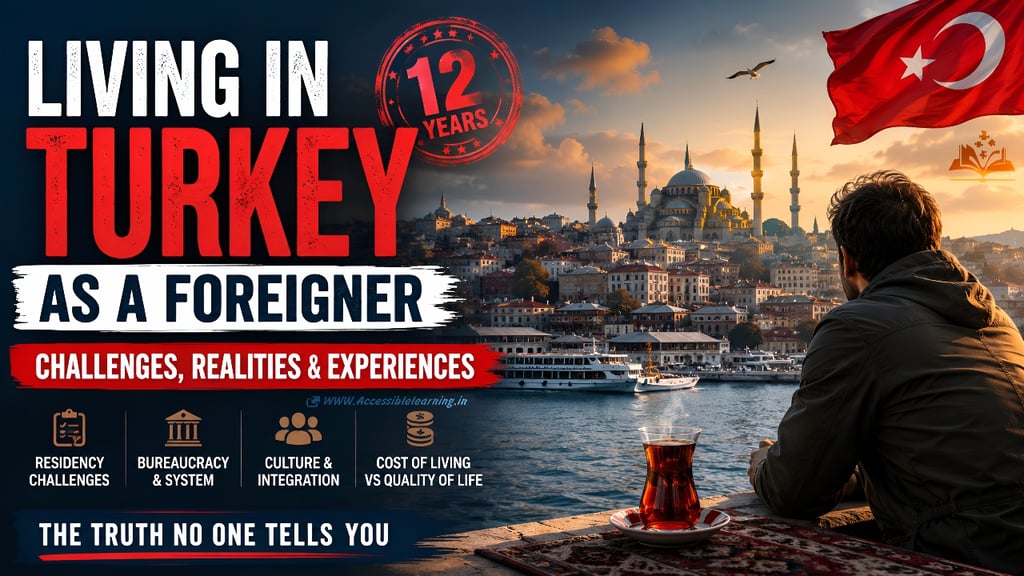
Living in Turkey as a Foreigner: 12 Years of Challenges and Experiences!
Discover the hidden realities of living in Turkey after 12 years, from residency challenges and bureaucracy to culture, costs, and long-term expat life.
ACCESSIBLE LEARNING
Jagdish Nishad | Kim Shin
7/19/20267 min read
The Illusion of Arrival
The first year in Turkey feels intoxicating.
You convince yourself that you have discovered a version of life everyone else overlooked. Morning walks along the Bosphorus. Fresh simit was bought from the neighborhood baker before work. Endless tea served without asking. The call to prayer echoes across hills while ferries cross between Europe and Asia. It all feels cinematic.
After a decade, the romance changes.
Not because Turkey loses its beauty. It doesn't.
Because beauty and belonging are not the same thing.
Twelve years teaches you that Turkey is a country you can love deeply while still never fully understanding every invisible rule that governs daily life. The Instagram version disappears long before the tenth anniversary. What remains is something more complicated and, arguably, far more rewarding.
Long-term expat life in Turkey is not measured by how many historical sites you've visited or how well you negotiate at the Grand Bazaar. It is measured by how many renewal appointments you've survived, how many times your residence status changed without warning, and how many conversations you've had in government offices where one missing document reset months of planning.
Eventually, you stop introducing yourself as someone "living abroad." You simply have a life.
You know which ferry from Kadıköy reaches Beşiktaş fastest during rush hour. You know traffic on the D-100 Highway can destroy an afternoon meeting. You instinctively avoid moving apartments just before residence permit renewal season. You know that bureaucracy follows its own calendar, regardless of yours.
Tourists see monuments.
Residents learn systems.
That difference changes everything.
The Cold Shower
Here is the unvarnished truth. The hardest part about living in Turkey for twelve years is rarely the language. It is uncertainty.
You can build friendships, establish a career, learn Turkish well enough to debate politics over endless glasses of tea, and still wake up knowing that one administrative decision can dramatically alter your future.
That uncertainty creates a quiet psychological tax. It never completely disappears. Many foreigners discover that life functions on two parallel tracks. One belongs to Turkish citizens.
The other belongs to everyone else. Neither track is necessarily unfair. They are simply different.
You notice it while renting apartments.
While opening certain financial products.
While dealing with employment regulations.
While planning children's education.
While considering retirement.
Every major life decision eventually circles back to one question.
"What is your legal status?"
Ironically, after twelve years, this question feels heavier than it did during your first twelve months. Because now you actually have something to lose.
You have neighbors who became family.
Your favorite café owner already knows your order.
Your children may think Turkish before they think in your native language.
Yet the administrative system still evaluates you primarily through documents rather than memories.
That emotional contradiction defines much of long-term foreign residency.


The Bureaucratic Reality (Legal Anchoring)
This is where fantasy meets paperwork. Turkey operates one of the region's more structured immigration systems, but it has become significantly stricter in recent years.
Most foreigners interact with the Directorate General of Migration Management, commonly known as Göç İdaresi. Since administrative restructuring, many immigration functions are coordinated under the Presidency of Migration Management, the authority responsible for residence permits, international protection, and migration policy.
For long-term residents, the residence permit (İkamet İzni) becomes the center of life.
Common permit categories include:
Short-Term Residence Permit
Family Residence Permit
Student Residence Permit
Long-Term Residence Permit
Humanitarian Residence Permit
Residence Permit for Victims of Human Trafficking
Each category carries different eligibility rules, renewal conditions, and rights.
The long-term residence permit appears attractive because it removes regular renewal requirements. However, qualifying generally requires at least eight years of continuous legal residence while meeting strict conditions related to public assistance, security checks, and uninterrupted legal status.
That sounds straightforward. Reality rarely is.
Small administrative gaps can affect eligibility.
Changing permit categories may reset expectations.
Documentation requirements evolve.
Policy interpretations sometimes differ between provincial migration offices.
Then comes address registration.
Every move requires proper notification through the civil registration system. Your officially registered address matters for residence validity, government correspondence, banking, taxation, healthcare administration, and countless other procedures.
Foreigners also become familiar with appointments at provincial migration offices in cities like Istanbul, Ankara, Izmir, and Antalya, where appointment availability and processing times can fluctuate depending on migration volumes.
Healthcare introduces another layer.
Some residents qualify through the public health insurance system under specific circumstances, while many rely on private insurance, particularly during residence permit applications where valid health coverage remains a legal requirement.
Employment has its own framework.
Foreign nationals generally require work authorization administered through Turkish labor regulations. Holding a residence permit alone usually does not authorize employment.
Recent years have also brought tighter enforcement regarding residence approvals in neighborhoods experiencing exceptionally high foreign population concentrations.
What no one tells you before you pack your bags is this:
You do not simply "renew paperwork."
You continually demonstrate that your life still fits within evolving legal frameworks.
For many long-term residents, that becomes the most exhausting part of remaining.
The Cultural 'Why'
Understanding Turkey requires looking beyond today's headlines. Modern Turkey sits at the intersection of empire, republic, migration, geopolitics, and economic volatility.
The country has spent generations balancing modernization with tradition. Centralized government with local community values.
European economic aspirations with Middle Eastern geography. National identity remains extraordinarily important.
That historical context explains much about administrative caution. Immigration policy is not developed in isolation.
It exists alongside regional conflicts, refugee movements, labor market concerns, housing pressures, national security priorities, and changing economic realities.
When locals appear cautious toward newcomers, it is often less personal than foreigners assume. Community trust in Turkey has traditionally been built through long relationships.
Families often remain connected across generations.
Business networks rely heavily on personal reputation.
Neighborhood identity still matters.
This explains why acceptance takes time.
Turkish hospitality is genuine.
So is social observation.
People may welcome you warmly into their homes while still quietly asking where you came from, why you stayed, whether you intend to leave, and whether you truly understand local customs.
Those questions are rarely hostile.
They reflect a society where belonging has historically been earned through consistency rather than declared through intention.
Cost of Living vs Quality of Life in Turkey
One of the biggest misconceptions concerns affordability. Many foreigners arrive believing Turkey offers permanently low living costs. The reality is more dynamic.
Inflation has repeatedly reshaped household budgets.
Rental markets in neighborhoods such as Cihangir, Nişantaşı, Moda, and coastal districts have changed dramatically over the past decade.
Currency fluctuations affect everyone differently.
Foreign income may temporarily create purchasing advantages.
Local salaries often tell another story entirely.
The cost of living vs quality of life in Turkey becomes an intensely personal calculation.
Some residents gladly accept economic uncertainty because daily life still offers something increasingly rare elsewhere.
Walkable neighborhoods.
Strong café culture.
Fresh produce markets.
Intergenerational communities.
A slower social rhythm built around conversation rather than schedules. Others eventually conclude that financial predictability matters more. Neither decision is wrong.

The Hidden Realities of Living in Turkey
The hidden realities of living in Turkey are rarely dramatic. They accumulate quietly.
Learning which official translation offices are accepted.
Keeping physical copies of every important document.
Understanding that regulations may change faster than online advice.
Accepting that speaking Turkish opens doors, but not every door.
Recognizing that cultural integration and legal integration are separate achievements.
You can master one without fully achieving the other.
That realization surprises many people.
The Reality of Permanent Integration
At the end of the day, home is not created by residency cards.
It is created by repetition.
The same grocery store.
The same barber.
The same neighbors.
The same ferry crossing on rainy mornings.
The same tea glass is placed in front of you before you even ask. Yet permanent integration asks a harder question.
Can you accept loving a country that may always categorize you differently?
After twelve years, many foreigners discover the answer is yes.
Not because the system suddenly treats them exactly like citizens.
It usually doesn't. Instead, they stop measuring belonging through paperwork.
They measure it through ordinary moments. Helping a neighbor carry groceries. Watching children switch effortlessly between languages. Knowing exactly which street to take when Istanbul traffic freezes.
Feeling disappointed when they spend too long outside Turkey because something feels missing.
That is the paradox.
Legally, you may always remain a foreign national.
Emotionally, part of you quietly becomes local.
Perhaps that is the most honest definition of long-term expat life in Turkey.
Not becoming Turkish.
But becoming someone whose life is permanently intertwined with Turkey's future, even while the administrative system continues to remind you where you began.
FAQ's
Q: Is Turkey a good country for long-term expats?
Turkey can offer an excellent quality of life, rich culture, and relatively affordable daily living compared to many Western countries. However, long-term expat life in Turkey also comes with challenges, including evolving residency regulations, economic fluctuations, and navigating local bureaucracy. Success often depends on learning Turkish, adapting to local customs, and maintaining legal residency.
Q: What are the biggest Turkey residency challenges for foreigners?
The most common Turkey residency challenges include renewing residence permits, meeting changing immigration requirements, maintaining valid health insurance, registering your address correctly, and keeping up with updates from the migration authorities. Long-term residents should also be aware that immigration policies can change over time.
Q: Can foreigners get permanent residency in Turkey?
Yes. Foreigners may become eligible for a Long-Term Residence Permit after legally residing in Turkey for at least eight continuous years, provided they meet the government's eligibility requirements. Approval is not automatic and depends on factors such as continuous legal residence, financial stability, and compliance with Turkish immigration laws.
Q: What is the cost of living vs quality of life in Turkey?
The cost of living vs quality of life in Turkey varies by city and lifestyle. While housing, transportation, and groceries may still be more affordable than in many European countries, inflation and currency fluctuations have significantly affected living expenses in recent years. Many long-term residents value Turkey's community culture, food, healthcare access, and lifestyle despite rising costs.
Q: Is learning Turkish necessary for long-term expat life in Turkey?
While it is possible to live in major cities using English, learning Turkish greatly improves everyday life. It helps when dealing with government offices, healthcare providers, landlords, local businesses, and building genuine relationships with Turkish communities. Language skills also make cultural integration much easier.
Q: Can foreigners buy property and live permanently in Turkey?
Yes. Foreign nationals can purchase property in Turkey under certain legal conditions. However, owning property does not automatically grant permanent residency or Turkish citizenship. Buyers should understand the current residence permit rules and consult legal professionals before making long-term investment decisions.
Q: What are the hidden realities of living in Turkey that most newcomers overlook?
The hidden realities of living in Turkey include adapting to changing immigration policies, dealing with administrative paperwork, understanding cultural expectations, managing inflation, and realizing that legal residency and true social integration are two different experiences. Building a stable life in Turkey takes patience, flexibility, and a long-term perspective.
Subscribe to Frontier Intelligence
All © Copyright reserved by Accessible-Learning Hub
| Terms & Conditions
Accessible Learning Hub — Actionable clarity for high-agency minds.
Weekly breakdowns on AI breakthroughs, capital flow, and human performance systems. Zero fluff.