

Living in South Korea as a Foreigner: 12 Years of Challenges and Experiences
Discover the hidden realities of living in South Korea as a foreigner after 12 years. Explore residency challenges, visa rules, cost of living, cultural integration, and the truth about long-term expat life in South Korea.
ACCESSIBLE LEARNING
Jagdish Nishad | Kim Shin
7/23/20267 min read
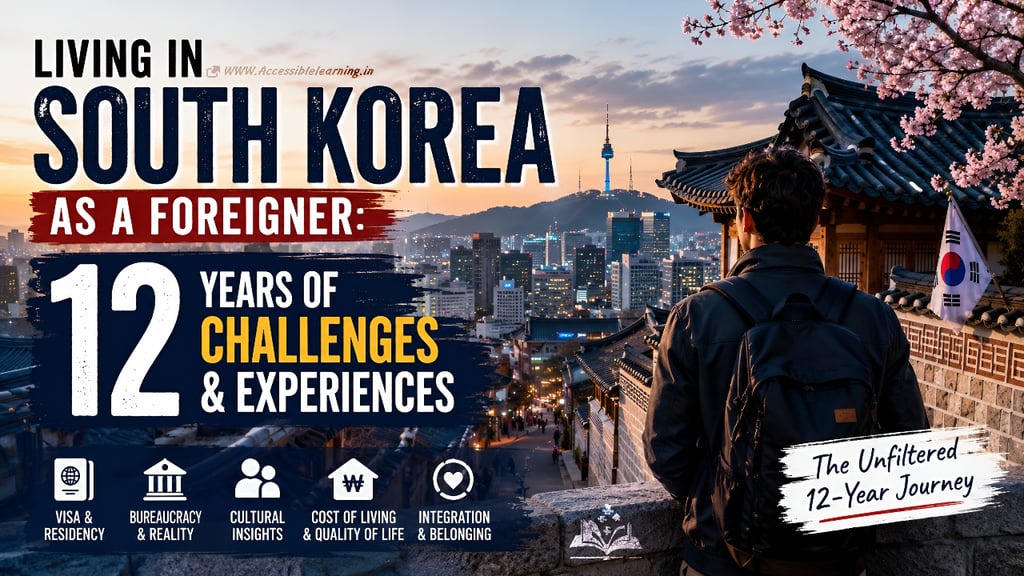
South Korea has become one of the most talked-about destinations for expatriates. K-pop, cutting-edge technology, safe cities, efficient transportation, and one of the world's fastest internet networks create an image of a country where modern life simply works.
That image is not false.
It is simply incomplete.
After twelve years, the novelty disappears. The subway announcements become background noise. Cherry blossom season feels normal. Ordering food in Korean no longer feels like an achievement. The real story begins when South Korea stops feeling like a destination and starts feeling like ordinary life.
Here is the unvarnished truth.
Long-term expat life in South Korea is not defined by culture shock. It is defined by endurance, bureaucracy, relationships, and understanding a society that was never originally designed around immigration.
The Illusion of Arrival
The first two years are exciting.
You marvel at the punctuality of Seoul's subway system. You discover neighborhoods like Hongdae, Seongsu-dong, Itaewon, Yeonnam-dong, and Seochon. Weekend trips to Busan, Jeju Island, Gyeongju, and Sokcho become routine adventures.
Everything feels efficient.
The convenience stores never seem to close.
The delivery arrives before you're hungry.
The public transport system connects nearly everything.
Healthcare is surprisingly affordable once enrolled correctly.
Life appears almost frictionless. Then something changes. Around year five, your tourist identity disappears. Around year ten, your foreign identity does not.
That realization surprises almost everyone.
You know every transfer between Line 2 and Line 9.
You understand Korean workplace etiquette.
You know exactly when to bow and when not to.
You pay taxes.
You contribute to the National Pension.
Your children may even speak Korean better than your native language.
Yet certain conversations still begin with exactly the same question.
"Where are you from?"
Not because people dislike foreigners. Because society quietly categorizes them differently.
South Korea remains one of the world's most ethnically homogeneous countries, and that shapes almost every long-term experience in ways newcomers rarely anticipate.
The Cold Shower
What no one tells you before you pack your bags is that loneliness changes shape. During your first year, loneliness comes from not understanding the language. After twelve years, it often comes from understanding everything.
You recognize office politics.
You notice conversations suddenly becoming more formal when you enter.
You understand jokes that weren't translated.
You realize certain promotions quietly stop at invisible ceilings.
No one announces those ceilings.
Nobody needs to.
The system often speaks through silence. Ironically, South Korea is remarkably welcoming in everyday interactions.
Neighbors may help carry furniture. Restaurant owners remember your order.
Taxi drivers become conversational once they realize you speak Korean. But professional and institutional acceptance often moves much more slowly than personal kindness.
Many foreigners describe existing in two different Koreas.
One is warm, generous, and deeply hospitable.
The other remains cautious about fully integrating outsiders into long-established social networks built through schools, military service, universities, and lifelong regional connections.
Neither version is fake.
Both exist simultaneously.
That duality defines much of the hidden realities of living in South Korea.

The Bureaucratic Reality (Legal Anchoring)
Emotion alone never explains expatriate life. Government policy does. Every long-term resident eventually becomes familiar with the offices that quietly determine daily life.
The first is the Korea Immigration Service, operating under the Ministry of Justice, where visa renewals, residence status, and immigration permissions are managed.
Depending on your circumstances, your life may revolve around visa categories such as
E-2 Foreign Language Instructor Visa
E-7 Specially Designated Activities Visa
D-8 Corporate Investment Visa
F-2 Long-Term Residency Visa
F-5 Permanent Residency Visa
F-6 Marriage Migrant Visa
Each comes with different freedoms. Each also comes with different limitations.
The difference between an E-series employment visa and an F-series residency visa is enormous.
One ties your legal status largely to your employer.
The other provides significantly greater independence.
Many long-term residents spend years accumulating enough points under South Korea's F-2 Points-Based Residency System, where factors such as income, education, Korean language ability, age, and community integration determine eligibility.
Permanent residency through the F-5 visa is possible. It is not automatic. Financial thresholds, years of legal residence, integration requirements, and documentation matter. Employment creates another layer of complexity.
Changing jobs often involves immigration notifications, employer cooperation, and strict compliance with visa conditions.
Opening certain businesses can require changing visa status entirely. Housing presents another bureaucratic challenge.
Most apartments require either Jeonse, the country's unique large refundable deposit system, or monthly rental contracts with substantial upfront deposits. Foreign residents without permanent status may face additional scrutiny from landlords despite having stable incomes.
Healthcare functions efficiently through the National Health Insurance Service (NHIS) once enrolled, but eligibility and contributions depend on residency status and employment. Tax obligations are administered through the National Tax Service (NTS).
Pension contributions often involve the National Pension Service (NPS), with refund eligibility depending on bilateral agreements between South Korea and a resident's home country.
Recent immigration policy has gradually expanded pathways aimed at attracting skilled professionals, researchers, technology specialists, entrepreneurs, and graduates from Korean universities. At the same time, authorities have continued tightening compliance through digital immigration systems, stronger employment verification, and closer coordination between immigration, taxation, and labor agencies.
None of this feels dramatic.
Until one missing document delays everything.
That is when bureaucracy stops being paperwork and becomes personal.
The Cultural 'Why'
Many outsiders misunderstand South Korea because they compare it with traditional immigrant societies.
South Korea is not one.
Modern South Korea transformed within a remarkably short historical period.
The devastation following the Korean War was followed by one of history's fastest economic transformations, often called the "Miracle on the Han River." Economic growth depended heavily on rapid industrialization, strong state planning, export-driven industries, and social cohesion.
Collective stability became a national priority.
Education became intensely competitive.
Companies rewarded long-term loyalty.
Relationships were built through schools, universities, military service, workplaces, and extended family networks.
Those structures still influence modern society.
Trust is frequently established through shared history rather than shared geography.
That is why integration can feel slower than expected.
It is not always about language. It is often about time.
Even perfect Korean cannot recreate decades of shared educational experiences or family connections.
Understanding this removes some of the frustration.
The system is not necessarily rejecting foreigners.
It simply evolved around a population that remained relatively homogeneous for generations.
As immigration increases and demographic pressures grow due to an aging population and low birth rate, South Korea continues to adapt. But institutional change typically moves more slowly than economic necessity.
Cost of Living vs Quality of Life in South Korea
One of the biggest surprises after twelve years is that financial success does not automatically produce social belonging. The cost of living vs quality of life in South Korea is more complicated than many online rankings suggest.
Outside central Seoul, daily expenses can remain manageable.
Public transportation is among the world's best values.
Healthcare remains comparatively affordable.
Public safety is exceptional.
Digital infrastructure is outstanding.
Yet housing costs continue to place pressure on residents, especially in Seoul's competitive property market.
Private education expenses influence many family budgets.
Long working hours remain common in parts of the corporate sector, although gradual labor reforms and changing workplace expectations are beginning to reshape some industries.
Quality of life ultimately depends less on salary than on whether you successfully build community. Without meaningful relationships, even the most efficient city eventually feels mechanical.


The Reality of Permanent Integration
At the end of the day, twelve years changes your perspective more than your passport. South Korea begins to feel like home in unexpected ways.
You instinctively remove your shoes.
You stop questioning convenience store culture.
You know exactly which subway exit saves five minutes.
You celebrate Chuseok with friends.
You complain about humidity every summer.
Yet complete assimilation remains elusive for many long-term residents.
And perhaps that is the wrong goal.
Home is not always where you become identical to everyone around you. Sometimes home is where you understand the rules well enough to live honestly within them.
The deepest lesson after twelve years is accepting that belonging is not always granted through legal status alone.
It is earned through consistency.
Through respect.
Through language.
Through patience.
Through contributing to a society without expecting it to become a copy of the place you left behind. That may never erase the label of "foreigner." But it does create something far more meaningful. A life that is genuinely rooted. One that exists not despite South Korea's complexities but because you learned how to live alongside them.
FAQ's
Q: Is South Korea a good country for long-term expats?
Yes, South Korea offers excellent public transportation, healthcare, safety, and digital infrastructure. However, long-term expat life in South Korea also comes with challenges such as language barriers, social integration, competitive housing, and visa-related requirements.
Q: What are the biggest residency challenges for foreigners in South Korea?
The most common South Korea residency challenges include maintaining the correct visa status, qualifying for long-term residency or permanent residence, navigating immigration rules, securing housing, and building lasting social and professional networks.
Q: Can foreigners get permanent residency in South Korea?
Yes. Foreigners can apply for permanent residency through eligible pathways such as the F-5 Permanent Resident Visa, provided they meet requirements related to legal residence, income, financial stability, Korean language proficiency, and other government criteria.
Q: What is the cost of living vs quality of life in South Korea?
While housing in Seoul can be expensive, South Korea offers excellent value through affordable public transportation, high-quality healthcare, reliable public services, and exceptional safety. Quality of life often depends more on employment, housing location, and community than on salary alone.
Q: Is it difficult to integrate into South Korean society?
Integration takes time. Learning Korean, understanding workplace culture, respecting local customs, and building genuine relationships are essential. Many long-term residents find that cultural acceptance grows gradually rather than happening overnight.
Q: Do I need to speak Korean to live in South Korea long-term?
Although it is possible to live in larger cities with limited Korean, fluency significantly improves daily life. It makes dealing with government offices, healthcare providers, landlords, banks, and employers much easier while helping build stronger social connections.
Q: Which visa is best for long-term residence in South Korea?
The ideal visa depends on your situation. Many long-term residents eventually move from employer-sponsored visas, such as E-series visas, to more flexible options like the F-2 Long-Term Residency Visa or the F-5 Permanent Resident Visa, which offer greater stability and independence.
Q: What is the hidden reality of living in South Korea as a foreigner?
The hidden reality is that efficient infrastructure and modern conveniences do not automatically lead to a sense of belonging. Many long-term expats discover that the greatest challenges are social integration, career progression, and navigating a system primarily designed for Korean citizens rather than temporary residents.
Subscribe to Frontier Intelligence
All © Copyright reserved by Accessible-Learning Hub
| Terms & Conditions
Accessible Learning Hub — Actionable clarity for high-agency minds.
Weekly breakdowns on AI breakthroughs, capital flow, and human performance systems. Zero fluff.