

Living in New Zealand as a Foreigner: 12 Years of Challenges and Experiences
Discover the hidden realities of living in New Zealand as a foreigner after 12 years, including residency challenges, costs, culture, and long-term expat life.
ACCESSIBLE LEARNING
Jagdish Nishad | Kim Shin
7/18/20267 min read
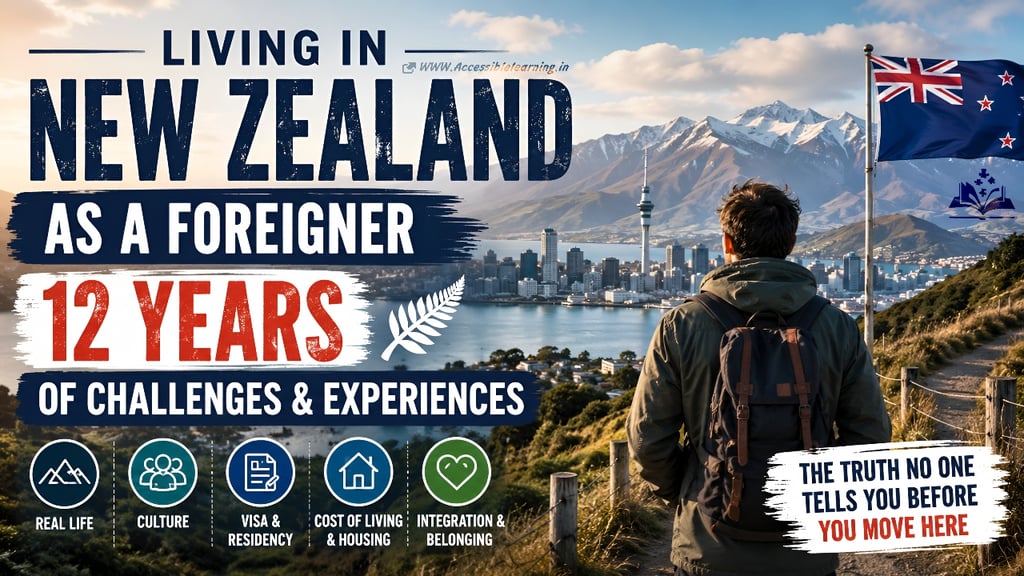
The Illusion of Arrival
The first year in New Zealand feels almost unreal.
The mountains appear untouched. The air feels cleaner than anywhere you've lived before. Even daily routines seem calmer. A weekend drive from Auckland to the Coromandel Peninsula, coffee in Wellington's Cuba Street, hiking around Queenstown, or watching the sunset over Piha Beach can convince you that you've finally found the perfect country.
Many newcomers mistake peace for permanence.
After twelve years, you stop seeing New Zealand through the eyes of a visitor. The country becomes less of a postcard and more of a functioning system. You understand why supermarkets in Auckland seem expensive compared to salaries. You know that finding a specialist doctor may require patience. You understand why housing conversations dominate dinner tables and why everyone watches the property market with unusual intensity.
Long-term expat life in New Zealand has very little to do with scenery.
It becomes about whether you can build genuine relationships. Whether your career has room to grow in a relatively small economy. Whether your children begin speaking with Kiwi accents while you still quietly calculate exchange rates every month.
Eventually you stop comparing New Zealand to home.
Instead, you compare today's New Zealand with the version that existed when you first arrived.
That is where the real story begins.
The Cold Shower
Here is the unvarnished truth. Living in New Zealand for more than a decade rarely feels difficult because of dramatic events. It is difficult because of accumulated small realities.
New Zealand is one of the most socially polite countries in the world. People are generally respectful, friendly, and helpful. But friendliness should never be confused with deep friendship.
Many foreigners discover that Kiwi social circles often begin in childhood, continue through university, and remain remarkably stable throughout adulthood. Breaking into those circles can take years.
Ironically, loneliness in New Zealand often looks nothing like loneliness elsewhere.
Nobody is rude.
Nobody excludes you intentionally.
Yet weekends quietly pass without invitations.
You know dozens of people.
Very few become family.
Professionally, the market is equally unique.
New Zealand's economy is innovative in agriculture, construction, tourism, healthcare, renewable energy, education, logistics, and technology, but it remains relatively small. Entire industries that support thousands of specialists overseas may only employ a few hundred people nationally.
Career ceilings arrive sooner. Promotion opportunities can be limited.
Changing employers often means relocating between Auckland, Wellington, Christchurch, Hamilton, or Tauranga because opportunities outside major urban centres become increasingly specialised.
Many experienced migrants eventually realise that career growth sometimes requires leaving the country they spent years trying to settle in. That psychological contradiction is rarely discussed.

The Bureaucratic Reality (Legal Anchoring)
What no one tells you before you pack your bags is that New Zealand's immigration system never truly disappears from your life until permanent status is secured.
Every major life decision passes through government policy.
Employment.
Housing.
Healthcare eligibility.
Family sponsorship.
Retirement planning.
Travel flexibility.
The system is administered by Immigration New Zealand, operating within the broader framework of the Ministry of Business, Innovation and Employment.
Over the past several years, immigration policy has evolved considerably.
The introduction of the Accredited Employer Work Visa (AEWV) fundamentally changed how many skilled migrants enter and remain in New Zealand. Instead of simply receiving a job offer, migrants often depend upon employers maintaining accredited status while satisfying wage thresholds, labour market requirements, and visa conditions.
Residence pathways have also shifted.
Many migrants pursue residence through the Skilled Migrant Category Resident Visa, while others qualify through occupation-specific pathways or family sponsorship. Periodic reforms have adjusted points systems, eligibility requirements, salary thresholds, and processing priorities.
After becoming a resident, many people eventually seek a Permanent Resident Visa, which removes travel conditions and offers greater long-term security.
Citizenship is another entirely separate legal milestone administered by the Department of Internal Affairs after meeting residence and presence requirements.
Healthcare access also surprises newcomers.
While residents and eligible visa holders benefit from New Zealand's publicly funded health system, temporary migrants frequently rely on private health insurance depending on visa conditions and eligibility.
Then there are taxes.
Income tax is managed through the Inland Revenue, commonly known as IRD. Obtaining an IRD number is among the first administrative steps every working migrant completes, and understanding tax residency rules becomes increasingly important once overseas investments or retirement savings enter the picture.
Housing introduces another layer.
Foreign ownership rules have tightened significantly in recent years. For many migrants, buying property depends heavily upon residency status rather than simply financial capacity.
The emotional weight of these systems is easy to underestimate.
You may spend years feeling settled while still recognising that one policy adjustment can change your future plans overnight. That awareness quietly follows many long-term migrants.
The Cultural 'Why'
To understand New Zealand, you first have to understand its scale. This is a nation with a relatively small population spread across two large islands separated by significant geography.
Communities are naturally close-knit because many people genuinely know each other.
Trust is not built quickly because social networks have existed for generations.
The country's cautious immigration policies are not primarily expressions of hostility.
They reflect practical concerns.
New Zealand manages limited housing supply, constrained healthcare capacity, infrastructure pressures, environmental sustainability, and labour market balance while attempting to preserve social cohesion.
Its economy also relies heavily on exports, including dairy, agriculture, forestry, wine, tourism, and increasingly specialised services.
Population growth must therefore remain carefully managed. The influence of both Māori and European traditions also shapes daily life.
There is strong emphasis on fairness, modesty, community participation, and avoiding unnecessary displays of status. Many newcomers mistake this understated culture for emotional distance.
It is usually something different.
People prefer consistency over intensity.
Trust is earned quietly.
Not announced loudly.
Understanding this cultural rhythm changes everything.
Cost of Living vs Quality of Life in New Zealand
One of the hidden realities of living in New Zealand is accepting that financial mathematics rarely follows international expectations.
Groceries remain expensive. Imported consumer goods often cost substantially more than equivalent products overseas. Construction costs influence housing prices. Geographic isolation increases transportation expenses throughout the economy.
At first glance, these numbers seem discouraging. Yet quality of life is measured differently here. Commutes are generally shorter than in many global megacities.
Outdoor recreation is part of ordinary life rather than luxury.
Public spaces remain remarkably accessible.
Crime rates are comparatively moderate in many areas.
Families often prioritise time together over constant professional competition.
The calculation therefore becomes deeply personal.
Some people accept slower wealth accumulation in exchange for greater daily balance.
Others eventually conclude that economic opportunity elsewhere better matches their ambitions. Neither decision is objectively correct. That is why discussions about the cost of living vs quality of life in New Zealand rarely have universal answers.


The Hidden Realities of Living in New Zealand
After twelve years, you no longer measure success by residency milestones alone.
You measure it differently.
Can you call someone during an emergency without hesitation?
Do your neighbours know your name?
Have you stopped mentally converting every price into your home currency?
Can you imagine growing old here?
These questions matter more than immigration paperwork.
New Zealand residency challenges eventually become less about visas and more about belonging.
Because paperwork ends.
Identity never quite does.
The Reality of Permanent Integration
At the end of the day, New Zealand does not promise transformation.
It offers something quieter.
Stability.
Predictability.
A society that generally functions because most people trust the institutions around them. For foreigners, however, permanent integration requires accepting a difficult truth.
You may become a citizen.
You may own a home overlooking Wellington Harbour or raise children who consider themselves completely Kiwi.
You may know every back road through Canterbury, every shortcut across Auckland, and every weather joke about Wellington.
Yet part of your identity will always exist between two worlds.
That is not failure. It is simply the nature of migration.
Home eventually becomes less about where you were born and less about the passport you carry. It becomes the place where your ordinary life unfolds.
After twelve years, New Zealand stops being an adventure. It becomes where your routines live. And perhaps that is the most honest definition of belonging any migrant can hope for.
FAQ's
Q: Is New Zealand a good country for long-term expats?
Yes, New Zealand offers a high quality of life, excellent work-life balance, and a safe environment. However, long-term expats often face challenges such as a high cost of living, limited career opportunities in certain industries, housing affordability, and the time it takes to build meaningful social connections.
Q: What are the biggest New Zealand residency challenges for foreigners?
The biggest challenges include meeting the requirements for the Skilled Migrant Category Resident Visa or other residence pathways, adapting to changing immigration policies, securing long-term employment with accredited employers, and eventually qualifying for permanent residency or citizenship.
Q: What is the real cost of living vs quality of life in New Zealand?
While New Zealand provides excellent healthcare, clean environments, and a relaxed lifestyle, everyday expenses such as rent, groceries, utilities, and imported goods are relatively high. Whether the quality of life outweighs the costs depends on your income, location, and personal priorities.
Q: Can foreigners buy property in New Zealand?
Property ownership rules for foreigners are restricted. In many cases, only New Zealand citizens and residents can purchase existing residential property, although some exceptions apply. Understanding your residency status and current regulations is essential before planning to buy a home.
Q: Is it difficult to make friends in New Zealand as a foreigner?
Many long-term expats say that while Kiwis are friendly and welcoming, building deep, lasting friendships can take time. Joining local clubs, volunteering, participating in community events, and maintaining consistent social interactions often help create stronger connections.
Q: Which cities are best for long-term expat life in New Zealand?
The most popular choices include Auckland for career opportunities, Wellington for government and technology sectors, Christchurch for affordability and rebuilding growth, Hamilton for education and healthcare, and Tauranga for a relaxed coastal lifestyle. Each city offers different advantages depending on your profession and lifestyle goals.
Q: How does the Accredited Employer Work Visa (AEWV) affect foreign workers?
The Accredited Employer Work Visa (AEWV) requires most overseas workers to be employed by an accredited New Zealand employer. Your ability to work, change jobs, and progress toward residency often depends on meeting visa conditions, employer accreditation, and current immigration policies.
Q: What should I know before moving to New Zealand permanently?
Before relocating, research visa pathways, employment opportunities, healthcare eligibility, taxation, housing costs, and regional job markets. The hidden realities of living in New Zealand include adapting to a smaller job market, geographic isolation, and balancing the cost of living with the country's exceptional quality of life.
Subscribe to Frontier Intelligence
All © Copyright reserved by Accessible-Learning Hub
| Terms & Conditions
Accessible Learning Hub — Actionable clarity for high-agency minds.
Weekly breakdowns on AI breakthroughs, capital flow, and human performance systems. Zero fluff.