

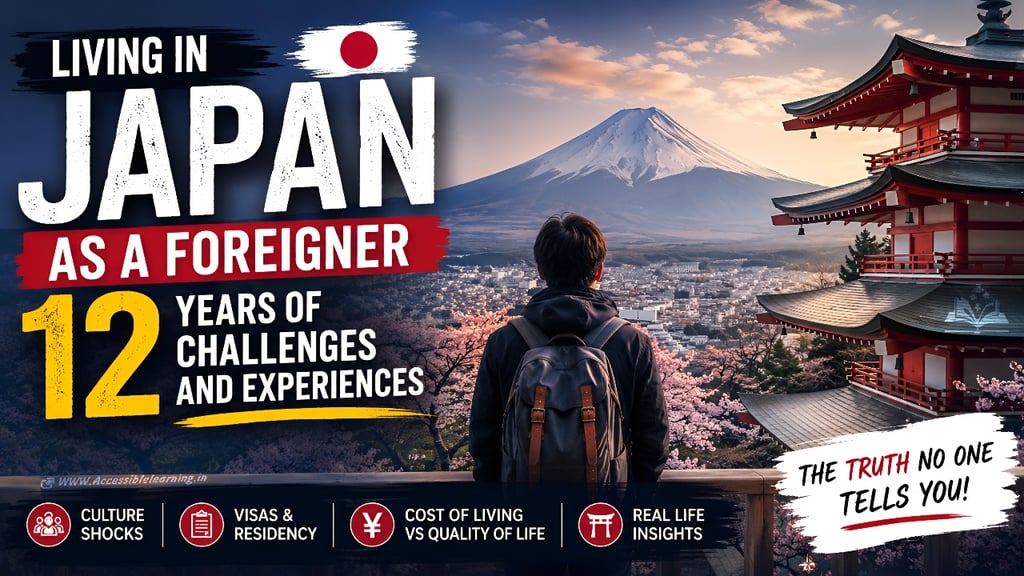
Living in Japan as a Foreigner: 12 Years of Challenges and Experiences
Discover the hidden realities of living in Japan as a foreigner after 12 years. Explore residency challenges, culture, visas, costs, and long-term expat life.
ACCESSIBLE LEARNING
Kim Shin | Jagdish Nishad
7/14/20268 min read
Japan rewards patience more than ambition.
That is the first lesson you learn after twelve years here.
The second is far more difficult. You can master the language, pay taxes without missing a deadline, know every shortcut through Shinjuku Station, cheer for your neighborhood baseball team, and still discover that true belonging operates on rules that no official handbook ever explains.
The internet is full of stories about cherry blossoms, spotless streets, convenience stores, and bullet trains. Most are written after a week-long vacation or a two-year teaching contract. They capture the excitement but rarely the permanence.
This is different.
This is about long-term expat life in Japan after the novelty has disappeared, when everyday life becomes ordinary, predictable, and surprisingly complicated.
If you're searching for the hidden realities of living in Japan, this is the conversation that usually happens behind closed apartment doors, late-night izakaya tables, and among foreigners who have quietly built lives here over more than a decade.
The Illusion of Arrival
The first few years feel almost magical. Everything works.
The trains arrive on time. Streets remain remarkably clean. Crime stays low. Bureaucracy, while intimidating, follows rules instead of improvisation. There is comfort in knowing exactly what society expects from you.
By year twelve, however, your relationship with Japan changes completely. You no longer navigate Tokyo by landmarks.
You instinctively know which exit of Shinjuku Station leads directly toward your office. You understand why locals avoid transferring during rush hour on the Chuo Line. You know that living in Setagaya feels entirely different from living in Minato or Koto, despite being within the same metropolitan area.
You stop photographing temples.
Instead, you worry about pension contributions, annual tax adjustments, childcare waiting lists, apartment contract renewals, and whether your neighborhood garbage collection calendar changed again.
Life becomes wonderfully ordinary. Ironically, that ordinary routine is exactly when Japan begins revealing its deeper layers.
The country rewards consistency more than charisma.
Relationships are built slowly.
Trust accumulates through years of showing up, not impressive first impressions.
The longer you stay, the more you realize that Japan is not difficult because people dislike foreigners.
It is difficult because nearly every institution was built around assumptions that everyone participating already understands the cultural operating system.
The Cold Shower
Here is the unvarnished truth.
The hardest part of living in Japan for twelve years is rarely the language.
It is the invisible boundary that remains even after you've become fluent.
You can discuss politics in Japanese, negotiate contracts, understand regional dialects, and still occasionally hear someone compliment your Japanese as though you've just learned your first sentence.
That moment isn't always intended as an insult. Yet over years, it quietly reminds you that your identity is often evaluated before your experience.
The psychological tax is subtle.
You're included.
But not always fully.
You're welcomed.
Yet rarely assumed to belong.
This affects almost every aspect of long-term life.
Professional advancement sometimes slows because senior leadership remains culturally homogeneous.
Neighborhood associations may treat you warmly while still assuming someone Japanese should explain important matters.
Social circles often remain compartmentalized between work, family, and lifelong school friendships that outsiders naturally never experienced.
Many foreigners eventually discover they have excellent acquaintances but relatively few deeply rooted relationships.
Not because Japanese people lack warmth.
Because intimacy develops differently here.
Years pass before someone casually invites you into family traditions.
Even then, certain conversations remain carefully reserved.
The emotional exhaustion doesn't come from dramatic discrimination.
It comes from constantly existing just outside complete familiarity.
Small moments accumulate.
Apartment applications requiring additional guarantors.
Real estate agencies quietly steering foreigners elsewhere.
Unexpected hesitation during job interviews despite impressive qualifications.
Bank staff requesting extra verification simply because your residence card differs from everyone else's.
None of these moments define life. Together, however, they create an emotional weight that outsiders rarely discuss honestly.

The Bureaucratic Reality (Legal Anchoring)
This is where everyday life becomes anchored in government systems rather than personal aspirations. Japan's immigration framework has become more flexible in recent years, but it remains highly structured.
Most long-term residents begin under one of several Status of Residence categories administered by the regional offices of the Immigration Services Agency of Japan.
Common categories include:
Engineer/Specialist in Humanities/International Services
Highly Skilled Professional (HSP)
Business Manager
Student
Spouse or Child of Japanese National
Long-Term Resident
Permanent Resident
Each category carries different rights, renewal requirements, and career flexibility.
For many professionals, obtaining the Highly Skilled Professional visa represents a major milestone.
Japan's points-based immigration system evaluates applicants using education, income, work experience, publications, and research achievements.
Those reaching sufficient point thresholds may qualify for accelerated permanent residency, sometimes after only one to three years depending on eligibility.
That policy significantly changed long-term migration planning for skilled workers. But eligibility on paper does not eliminate complexity. Permanent Residency applications remain heavily document-driven.
Applicants often prepare years of tax records, pension contribution histories, residence documentation, employment certificates, and evidence of stable financial standing.
The government is effectively asking one question:
Have you demonstrated long-term reliability?
Taxes matter. A lot.
Your annual income taxes pass through the National Tax Agency, while municipal obligations involve your city office.
Residence tax (Jūminzei), National Health Insurance or Employees' Health Insurance, and pension contributions under either the National Pension (Kokumin Nenkin) or Employees' Pension Insurance (Kōsei Nenkin) become essential parts of your immigration record.
Late payments are no longer viewed as minor administrative oversights.
They can directly affect permanent residency evaluations.
Municipal governments handle many of the realities that define daily life.
Your local City Hall (Shiyakusho) or Ward Office (Kuyakusho) processes resident registration, address changes, family registration matters relevant to foreign residents, health insurance enrollment, childcare services, and tax-related administration.
After twelve years, these offices become surprisingly familiar.
They're where adulthood happens.
Recent years have also seen broader immigration modernization efforts, including expanded categories under the Specified Skilled Worker (SSW) program to address labor shortages in sectors such as nursing care, construction, manufacturing, hospitality, and agriculture.
Digitalization has improved some administrative processes, yet many procedures still require in-person appointments, official seals in certain contexts, paper documentation, and meticulous recordkeeping.
The emotional reality is simple.
Your legal stability depends less on dramatic immigration interviews and more on consistently managing thousands of tiny administrative responsibilities over many years.
The Cultural 'Why'
To understand Japan, you must first understand that stability has historically been valued above disruption. That principle influences almost everything.
The education system.
Corporate structures.
Government administration.
Neighborhood organizations.
Even interpersonal communication.
Japan developed through centuries where social harmony often carried greater importance than individual expression.
Modern economic success reinforced those values.
Large companies traditionally rewarded lifetime employment.
Communities expected long-term participation.
Institutions optimized for predictability rather than rapid adaptation.
Foreign residents entered systems originally designed around remarkable cultural uniformity.
That explains much of what newcomers mistake for personal rejection.
Many procedures aren't intentionally exclusionary.
They're standardized to an extraordinary degree.
When someone arrives operating outside those expectations, institutions often struggle to accommodate flexibility because flexibility itself has historically been uncommon.
Ironically, younger generations are gradually changing this landscape.
International hiring has expanded.
English appears more frequently in government communication.
Global companies encourage more diverse workplaces.
Tokyo, Osaka, Fukuoka, and Yokohama continue becoming more internationally connected.
Yet deep cultural rhythms evolve slowly.
And Japan has never been a society that embraces rapid transformation simply because globalization expects it.
Understanding that historical context removes much of the frustration.
Not all of it. But enough to replace resentment with perspective.
Cost of Living vs Quality of Life in Japan
The conversation about cost of living vs quality of life in Japan deserves far more nuance than internet rankings usually provide.
Tokyo is expensive.
That part is obvious.
Housing, especially near central districts and major stations, demands careful budgeting. Imported goods remain costly.
Moving apartments often involves deposits, agency fees, guarantor arrangements, and other upfront expenses that surprise many newcomers.
Yet daily life frequently feels financially stable.
Public transportation reduces dependence on cars.
Healthcare remains comparatively affordable through the national insurance framework.
Public infrastructure functions exceptionally well.
Cities remain clean, organized, and safe enough that many residents comfortably walk home late at night.
Quality of life isn't measured solely by salary.
It comes from reliability.
When trains arrive as scheduled.
When streets remain orderly.
When government systems, although bureaucratic, generally function as intended.
Those quiet advantages become increasingly valuable over twelve years.


The Reality of Permanent Integration
What no one tells you before you pack your bags is that permanent integration is not a destination. It is an ongoing negotiation.
You may eventually receive Permanent Residency. You may buy a home. Raise children.
Speak Japanese naturally. Celebrate New Year traditions.
Vote in local neighborhood associations where permitted. Build a successful business.
And still experience occasional reminders that your story began somewhere else.
At the end of the day, calling Japan home is less about achieving perfect acceptance and more about choosing commitment despite ambiguity.
Home is where your routines exist.
Where your doctor knows your medical history.
Where your favorite ramen shop remembers your order.
Where your taxes are filed.
Where your children grow up.
Where your friendships survive difficult years.
Japan may never completely erase the distinction between native and foreign.
That is part of its social architecture.
But after twelve years, you realize something equally important. Belonging is not always granted. Sometimes it is quietly earned through consistency, responsibility, respect, and time.
That process is slower than most people expect. It is also far more meaningful.
For those willing to embrace both the privileges and the compromises, long-term expat life in Japan becomes something far deeper than relocation.
It becomes a life.
Not a temporary chapter.
A permanent one.
FAQ's
Q: Is Japan a good country for long-term expats?
Yes, Japan offers excellent public safety, reliable healthcare, world-class transportation, and a high quality of life. However, long-term expats should also be prepared for language barriers, cultural differences, and a slower path toward social integration than many other developed countries.
Q: What are the biggest challenges of living in Japan as a foreigner?
The biggest challenges include adapting to Japanese workplace culture, navigating complex administrative procedures, overcoming language barriers in everyday situations, finding long-term housing, and building meaningful social connections. Many long-term residents also mention the feeling of remaining an outsider despite years of living in the country.
Q: How can a foreigner get permanent residency in Japan?
Permanent Residency (PR) in Japan is generally available after meeting specific residency requirements, maintaining stable employment, paying taxes and pension contributions on time, and demonstrating good conduct. Some highly skilled professionals may qualify for an accelerated PR pathway under Japan's points-based immigration system.
Q: Is the cost of living in Japan worth the quality of life?
For many long-term residents, the answer is yes. While cities like Tokyo can be expensive, the overall quality of life is often considered excellent due to efficient public transportation, low crime rates, high-quality healthcare, clean public spaces, and dependable public services.
Q: Can foreigners buy property in Japan?
Yes. Foreign nationals can legally purchase property in Japan without needing Japanese citizenship or permanent residency. However, obtaining a home loan may require additional documentation, a stable income, and in many cases, long-term residency or a reliable financial history in Japan.
Q: Is learning Japanese necessary for long-term life in Japan?
While it is possible to live in Japan using English in some major cities, learning Japanese significantly improves career opportunities, simplifies government procedures, strengthens relationships with locals, and makes everyday life considerably easier over the long term.
Q: What visa options are available for foreigners who want to live in Japan?
Japan offers several long-term residence categories, including work visas, the Highly Skilled Professional (HSP) visa, Business Manager visa, Student visa, Spouse visa, Long-Term Resident status, and Permanent Residency. The best option depends on your employment, family situation, and long-term goals.
Q: Can foreigners fully integrate into Japanese society?
Many long-term residents build rewarding careers, friendships, and families in Japan. However, complete cultural integration can take many years, and some foreigners feel they are viewed as outsiders despite speaking fluent Japanese and living in the country for decades.
Q: What should I know before moving to Japan permanently?
Before relocating, research visa requirements, healthcare, pension obligations, taxation, housing costs, workplace culture, and regional differences in the cost of living. Understanding these practical realities will make the transition smoother and help set realistic expectations for long-term life in Japan.
Subscribe to Frontier Intelligence
All © Copyright reserved by Accessible-Learning Hub
| Terms & Conditions
Accessible Learning Hub — Actionable clarity for high-agency minds.
Weekly breakdowns on AI breakthroughs, capital flow, and human performance systems. Zero fluff.