

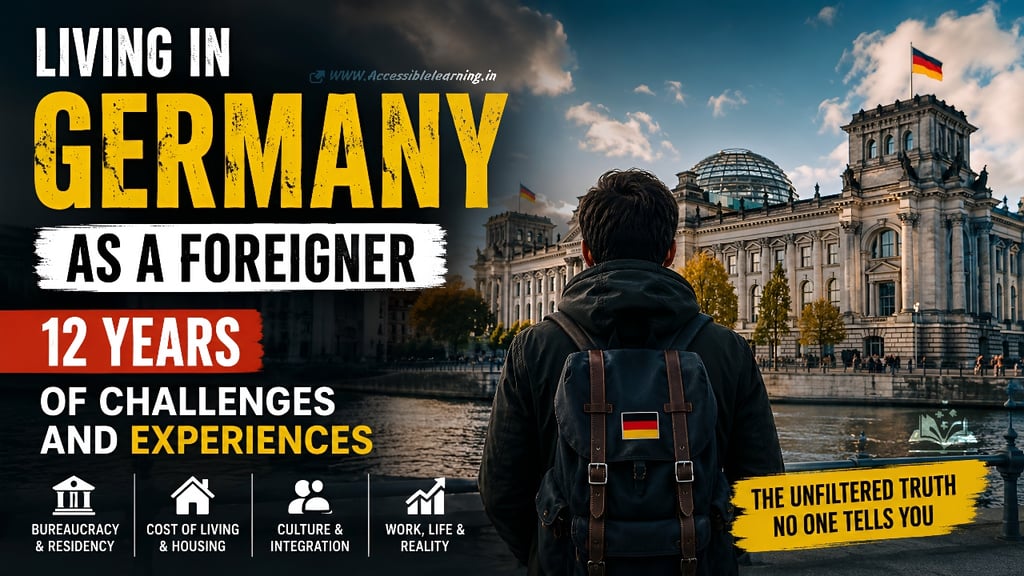
Living in Germany as a Foreigner: 12 Years of Challenges and Experiences
Discover the hidden realities of living in Germany as a foreigner after 12 years. Explore bureaucracy, residency challenges, cost of living vs. quality of life, cultural integration, and what long-term expat life in Germany is really like.
ACCESSIBLE LEARNING
Jagdish Nishad | Kim Shin
7/28/20267 min read
Germany is often presented as the blueprint for stability. Reliable trains, world-class engineering, universal healthcare, clean streets, strong worker protections, and a social system that appears almost mathematically organized. From abroad, it can seem like a country where life eventually settles into predictable comfort.
After twelve years, that image changes.
Not because Germany disappoints, but because you finally understand what the brochures never mention. Long-term expat life in Germany is less about surviving culture shock and more about learning to function inside a society whose rules were never designed around newcomers. The challenges become quieter, deeper, and far more difficult to explain to friends back home.
Here is the unvarnished truth.
The Illusion of Arrival
The first two or three years feel like progress.
You learn enough German to order food without hesitation. You stop relying on translation apps. You know which platform your regional train usually departs from. You discover that supermarkets close on Sundays and eventually stop complaining about it.
You begin recognizing neighborhoods.
You know why people prefer Prenzlauer Berg over Neukölln. You understand the difference between Schwabing and Maxvorstadt in Munich. You no longer confuse Frankfurt's financial district with Sachsenhausen's relaxed evenings along the river.
Daily routines become ordinary.
Your bank account works. Your health insurance card sits permanently inside your wallet. Recycling becomes muscle memory. You instinctively separate paper, plastic, glass, and biowaste without thinking.
Friends back home assume you've "made it."
Ironically, this is often when the real journey begins.
Because adapting to Germany is relatively straightforward.
Belonging to Germany is something else entirely.
After more than a decade, you realize you understand almost every rule. Yet the invisible boundary between understanding a country and becoming part of it remains surprisingly firm.
The Cold Shower
What no one tells you before you pack your bags is that Germany rarely rejects foreigners openly. Instead, it asks whether you fit. Every interaction carries an expectation that systems already exist for a reason.
Appointments are scheduled weeks ahead. Procedures are documented. Responsibilities belong to someone specific. Flexibility is rarely celebrated. For long-term residents, this creates an unexpected psychological tax.
You can speak fluent German.
You can pay taxes.
You can own property.
You can raise children born in Germany.
Yet there are moments where you're reminded that your life still began somewhere else.
Conversations with colleagues occasionally reference childhood television shows, school traditions, or historical experiences everyone else immediately understands.
You're smiling.
Everyone else is remembering.
The difference matters.
Many expats describe loneliness not as isolation but as permanent translation.
Not translating languages.
Translating identity.
Even friendships often develop differently than they might in more socially spontaneous cultures.
German relationships tend to form slowly and intentionally.
Once established, they are remarkably loyal.
Getting there requires patience many newcomers underestimate.
This hidden reality of living in Germany surprises even highly educated professionals who arrived expecting technical challenges rather than emotional ones.

The Bureaucratic Reality (Legal Anchoring)
The greatest influence on an expat's quality of life often isn't their employer. It's paperwork.
Germany's immigration system operates under the Residence Act (Aufenthaltsgesetz), while skilled migration has expanded significantly following reforms under the Skilled Immigration Act (Fachkräfteeinwanderungsgesetz).
Those names eventually become part of everyday vocabulary. Your legal future frequently depends on appointments with the Ausländerbehörde.
For many residents in Berlin, obtaining an appointment at the immigration office has historically become almost legendary due to demand, although digital booking systems and staffing have gradually improved in several states.
Every extension matters.
Every missing document matters.
Every deadline matters.
Depending on your circumstances, you may hold the following:
EU Blue Card
Skilled Worker Residence Permit
Opportunity Card (Chancenkarte)
Family Reunification Residence Permit
Student Residence Permit
Self-employed or Freelance Residence Permit
Permanent Settlement Permit (Niederlassungserlaubnis)
Each category carries different rules regarding employment, residency continuity, family rights, and future eligibility.
Changing jobs is not always as simple as signing a new contract.
Periods of unemployment can affect residence status.
Absences from Germany may influence permanent residency eligibility.
Citizenship reforms have recently made long-term integration more accessible by reducing standard residency requirements for many applicants while permitting broader acceptance of dual citizenship. For many foreign residents, this represents one of the most significant immigration policy shifts in decades.
Yet citizenship itself remains only one milestone.
Permanent residence generally requires demonstrating stable income, sufficient pension contributions, German language proficiency, and familiarity with German legal and social structures.
The bureaucracy is rarely emotional.
It simply expects compliance.
Many foreigners eventually discover that living in Germany means planning your calendar around immigration appointments almost as carefully as your professional career.
Germany Runs on Documentation
There is another adjustment few anticipate. Germany trusts paper. Digital services continue improving, but physical documentation still carries remarkable importance.
Registration through the Einwohnermeldeamt or Bürgeramt remains one of the first legal obligations after moving. Without your Anmeldung, everyday life quickly becomes complicated.
Opening bank accounts.
Receiving tax identification numbers.
Internet contracts.
Employer registration.
Health insurance.
Everything begins there.
Then comes the tax system.
The annual interaction with the Finanzamt becomes another recurring chapter in every long-term resident's life.
Many expats eventually hire tax advisors not because they dislike paperwork, but because Germany's tax regulations reward precision. Precision is a national language.
Cost of Living vs Quality of Life in Germany
One of the biggest misconceptions is that Germany automatically guarantees financial comfort. Reality depends entirely on where you live.
Munich remains one of Europe's most expensive rental markets. Berlin, once considered remarkably affordable, has experienced dramatic housing pressure.
Hamburg and Frankfurt continue seeing steady housing costs rise. Finding an apartment can become more competitive than finding employment.
Viewings regularly attract dozens of applicants. Landlords request employment contracts, income statements, SCHUFA credit reports, and extensive documentation before making decisions.
Ironically, securing housing often becomes the greatest Germany residency challenge after securing employment.
Yet quality of life remains consistently high.
Healthcare functions reliably.
Public transport reaches nearly every region.
Paid vacation allowances remain generous.
Worker protections exceed those found in many developed economies.
Parents benefit from extensive family support policies.
This creates an interesting contradiction.
Germany may not maximize disposable income.
It often maximizes stability.
For many long-term residents, that trade-off eventually becomes worthwhile.
The Cultural "Why"
None of this exists by accident.
Modern Germany was shaped by reconstruction after the devastation of the Second World War, decades of institutional rebuilding, federal governance, industrial competitiveness, and a national commitment to predictability over improvisation.
Rules became safeguards.
Documentation became accountability.
Planning became trust.
Economic success relied on manufacturing excellence, vocational education, engineering precision, and social partnership between employers, employees, and government.
The result is a society where reliability often matters more than charisma.
Promises matter.
Schedules matter.
Procedures matter.
To someone arriving from a more relationship-driven culture, this can initially feel cold. Eventually, many discover it represents something else entirely.
Consistency.
Once you understand that principle, many frustrations begin making sense.
The system isn't asking whether you are foreign.
It's asking whether everyone is following the same rules.

The Reality of Permanent Integration
After twelve years, Germany no longer feels foreign. It also may never feel entirely yours. Both ideas can exist simultaneously.
Your favorite bakery recognizes your order before you speak.
Your neighbors trust you enough to collect their packages.
Your children may speak German more naturally than your mother tongue.
Yet every official document still asks where you were born.
At the end of the day, permanent integration isn't measured by passports alone. It's measured by whether your life continues functioning naturally inside the rhythms of the country.
You stop comparing Germany to where you came from.
You stop waiting for complete acceptance.
Instead, you build a life based on contribution rather than validation.
That is perhaps the greatest lesson of long-term expat life in Germany.
Home isn't the place where nobody notices you're different.
Home is the place where you understand the rules, contribute to the community, accept the imperfections, and realize that belonging is built through years of ordinary moments rather than dramatic milestones.
Germany rarely embraces you quickly. But if you remain patient, respectful, and resilient, it often rewards you with something deeper than excitement. It offers stability. And for many people who stay long enough, that quiet stability eventually becomes its own definition of home.
FAQ's
Q: Is Germany a good country for long-term expats?
Yes, Germany offers excellent healthcare, strong labor protections, high-quality infrastructure, and economic stability. However, long-term expats often face challenges with bureaucracy, housing, language integration, and building deep social connections.
Q: What are the biggest challenges of living in Germany as a foreigner?
The most common challenges include navigating immigration procedures, securing affordable housing, learning German, adapting to strict administrative systems, understanding local culture, and establishing lasting friendships.
Q: Can foreigners get permanent residency in Germany?
Yes. Many foreign nationals can apply for a Permanent Settlement Permit (Niederlassungserlaubnis) after meeting residency requirements, demonstrating financial stability, making pension contributions, and proving sufficient German language proficiency. Eligibility depends on the type of residence permit and individual circumstances.
Q: Is it difficult to find housing in Germany?
In many major cities such as Berlin, Munich, Frankfurt, and Hamburg, finding rental accommodation can be highly competitive. Landlords often require proof of income, employment, credit history (SCHUFA), and other supporting documents before approving an application.
Q: Do I need to speak German to live in Germany?
While English is widely used in international companies and larger cities, learning German significantly improves daily life, employment opportunities, interactions with government offices, and long-term social integration.
Q: What is the cost of living vs. quality of life in Germany?
Germany generally offers a high quality of life through reliable healthcare, public transportation, worker protections, and social benefits. Although housing costs have risen in many cities, many residents find the overall balance between expenses and public services worthwhile.
Q: How difficult is German bureaucracy for expats?
German bureaucracy is detailed and documentation-driven. Foreign residents frequently interact with offices such as the Ausländerbehörde, Bürgeramt, and Finanzamt, making careful record-keeping and meeting deadlines essential for visas, taxes, and residency matters.
Q: Can foreigners become German citizens?
Yes. Germany has modernized its citizenship laws, making naturalization more accessible for many long-term residents who meet residency, language, financial, and legal requirements. Recent reforms have also expanded opportunities for dual citizenship in many cases.
Subscribe to Frontier Intelligence
All © Copyright reserved by Accessible-Learning Hub
Accessible Learning Hub — Actionable clarity for high-agency minds.
Weekly breakdowns on AI breakthroughs, capital flow, and human performance systems. Zero fluff.